
PASSPORT
-
Altitude-technical class
-
Tian-Shan
-
Peak Khan-Tengri (6995 m), via the South face
-
Proposed - 5B category of complexity, first ascent
-
Height difference – 2700 m, length – 4750 m
Length of sections with 5–6 category of complexity – 2680 m. Average steepness of the most difficult sections is 50° (4700 m–6700 m).
-
Pitons hammered:
ice – 138, rock – 57, bolted – 2.
-
Team's travel time: 88 hours and days – 10
-
Overnights: 1st – on snow; 2nd – sitting, carved in ice; 3rd – sitting, carved in ice, uncomfortable; 4–5th – convenient snow platform; 6th – snow platform; 7th – sitting, carved in ice, uncomfortable; 8th – three-person sitting, carved in ice, four in a small cave; 9th – five-person sitting on a rock ledge, two in a cave.
-
Leader: Isachenko Gennadiy Ivanovich, MS
Participants:
- Razumov Yuriy Mikhailovich, MS
- Silin Boris Mikhailovich, MS
- Laletin Andrey Vladimirovich, CMS
- Stroganov Yuriy Vladimirovich, CMS
- Shustrov Nikolay Borisovich, CMS
- Kozlovskiy Viktor Iosifovich, CMS
-
Sr. coach: Kolchin Alexander Alexandrovich, ICMS
Coaches:
- Novgorodtseva Galina Petrovna, MS
- Biryukov Vladimir Nikolaevich, CMS
-
Start of the route: August 9, 1982; summit on August 18, 1982; return on August 21, 1982.
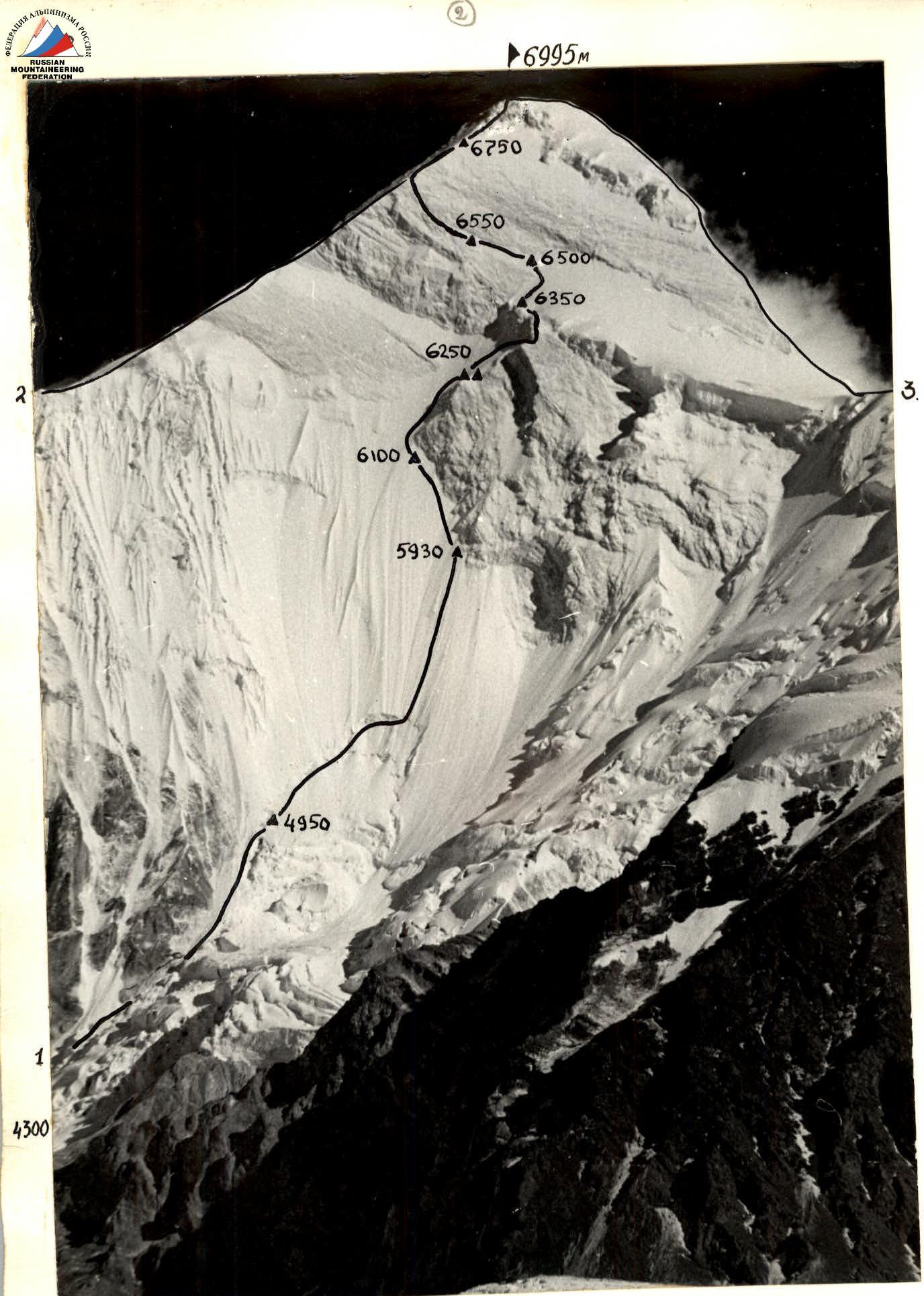
-
The team's route via the South face. Taken on August 13, 1982, 9:00, G-44,58, from 6 km, No. 1, 4200 m.
-
10.10.3 rib, B. Romanov's route, 1964.
-
According to the film of the Eastern wall, V. Voronin route, 1973.
To obtain a photo of the wall profile from the right, a first ascent was made by a group consisting of:
- Zhukov S.
- Kolchin A. A.
- Shustrov A.
to the summit of Zhalyktau, 5100 m via the 10.3 ridge, approximately 4B category of complexity, on August 10, but at the moment of reaching the summit, the weather deteriorated and did not allow for a quality snapshot.
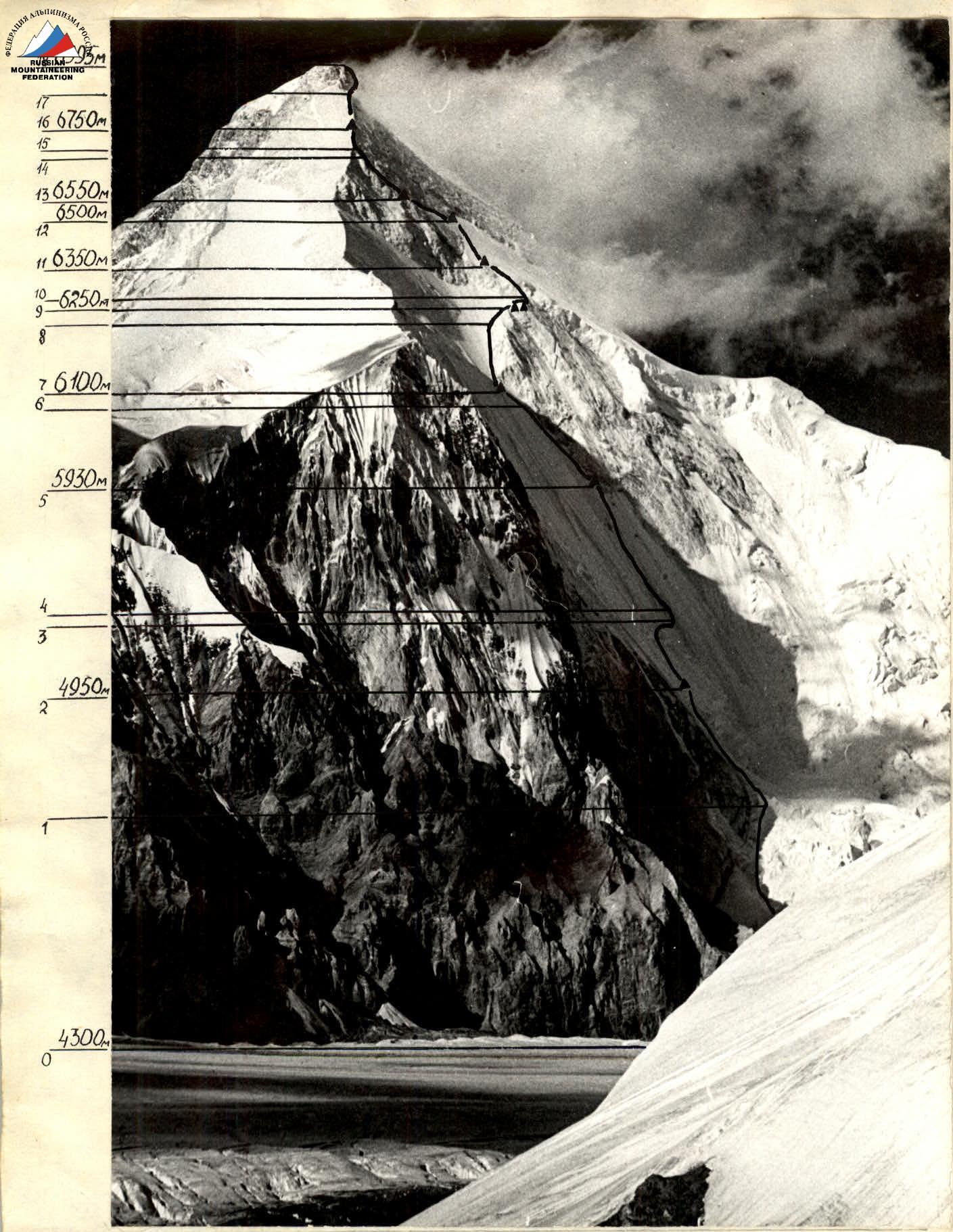
The wall profile on the left. Taken on August 5, 1982, at 18:00; I-24; 3.5–10.5; distance 15 km; No. 2; 4000 m.
Preliminary acquaintance with the area and the object of ascent was conducted:
- according to the materials of reports;
- according to the existing literature;
- according to consultations with climbers who have been in this area of Tian-Shan.
This information and the study of photographic materials obtained from a knowledgeable person in the area, the expedition leader V. Biryukov, allowed for a preliminary choice of the route.
The team has been seriously preparing for participation in the USSR Climbing Championships for several years. Continuous joint training is conducted, and technical techniques are practiced using new equipment. Particular attention during preparation for the season was paid to overall physical fitness and technical training on ice and snow terrain.
A preliminary gathering was held in the Tian-Shan area, Karakol, where:
- combined routes were selected for passage;
- all team members made training ascents up to 5B category of complexity.
Before ascending Khan-Tengri, the group made two acclimatization exits:
- The first – to a height of 5400 m along the Semenovsky glacier;
- The second – to a height of about 6300 m along the classic path and to the "Marble Rib" (in two groups).
The final team composition was determined based on the results of training ascents and acclimatization exits, taking into account the results of passing physical standards.
Based on observations of the South face from the South Inylchek glacier and reconnaissance results from the "Marble Rib" during the acclimatization exit, the route was finally chosen and the tactics for its passage were determined. The problematic aspects were the extensive ice board in the lower part of the wall, the marble wall of the summit tower, and the possibility of organizing safe and convenient bivouacs.
Considering the observation results and taking into account the unstable weather in the area, it was decided to pass the lower part of the route at night and two options were planned for passing the upper rock part of the South face.
To ensure the safety of the entire event, a rescue team of 10 people was organized. The rescue team's action plan provided for the possibility of assisting the first ascent group both from the "Marble Rib" and along the classic path through the summit.
From the bivouac under the wall, observation was organized to clarify the patterns of avalanche descent, radio and video communication with the first ascent group and the rescue team.
Ascent Schedule
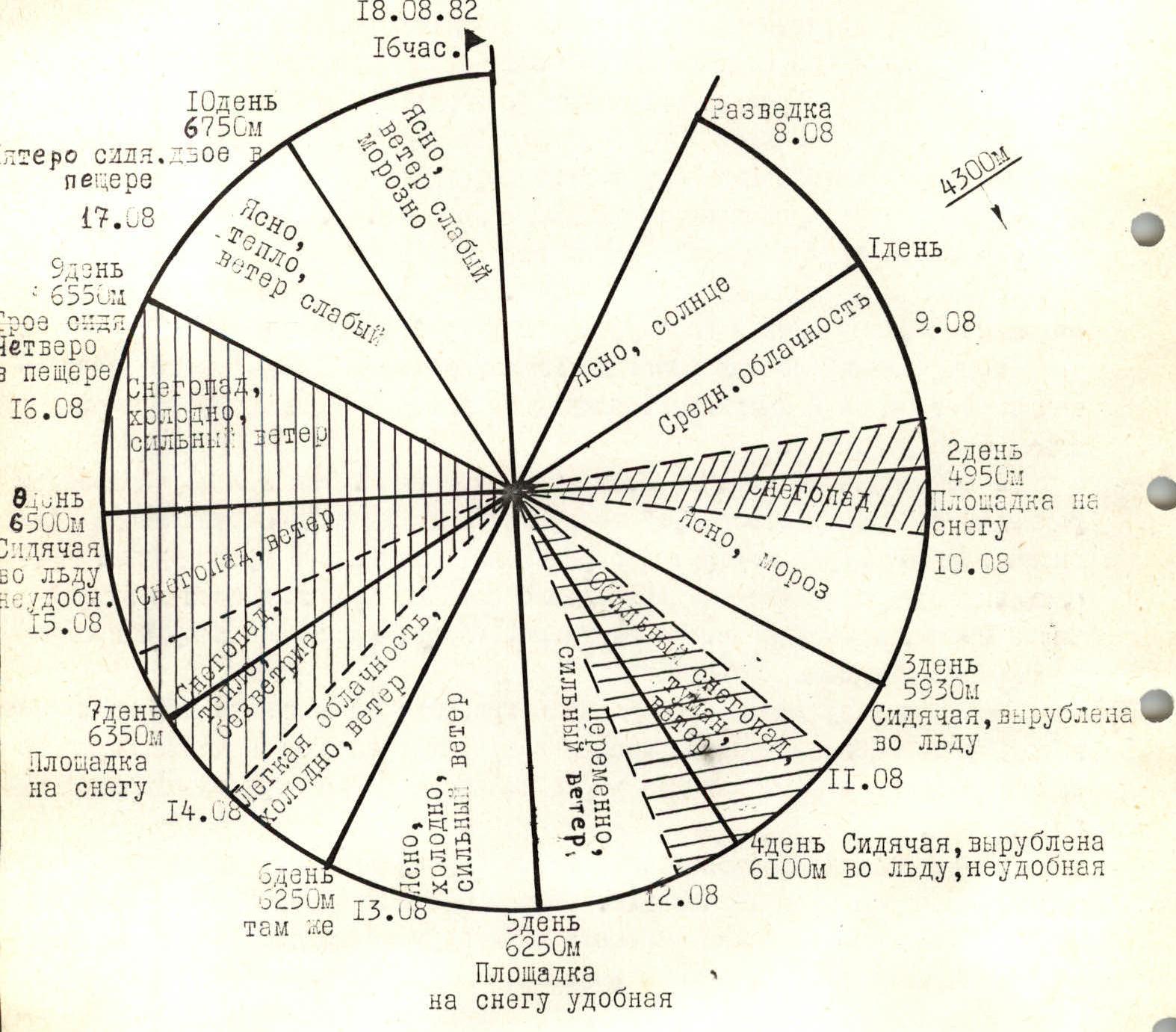
Team Movement Tactics
The ascent via the South face of Khan-Tengri required solving the following tasks:
- overcoming an extensive ice board in one transition (in the lower part of the wall)
- ensuring the team's ability to function at an altitude above 6000 m in extreme weather conditions with a limited number of convenient bivouacs.
- overcoming the marble wall, devoid of a developed profile with few places for organizing protection (in the upper part of the massif).
The solution to these tasks involved a tactical ascent plan. The icefall and the lower part of the ice board were planned to be passed at night. Possible bivouac locations were determined based on preliminary reconnaissance. The selection of bivouac equipment allowed the group to organize a bivouac both in tents and in a cave. The passage of the marble wall was planned to be done with preliminary processing.
Overall, the tactical plan for the ascent was generally followed. Adverse weather conditions forced the group to use a backup option for passing the marble wall, slightly to the left of the main one, and somewhat slowed down the ascent pace (instead of the planned 8 days, 10 days were required to pass the wall).
The weather conditions during the ascent were unstable. The worst weather conditions caught the group in the upper part of the wall, where there were practically no convenient bivouacs. Under these conditions, the group deemed it possible to continue moving, paying particular attention to identifying safe bivouac locations and choosing a path free from avalanche falls.
Safety issues during the ascent were paramount for the group. They included ensuring reliable protection during movement; the number of ice and rock pitons allowed for protection to be organized on any terrain profile. As mentioned earlier, reconnaissance and selection of safe bivouac locations were conducted. As the wall was passed, the group constantly refined the safest path and switched to backup options when weather conditions worsened (sections R2–R4 and R11–R13). During the team's ascent, a rescue team of ten people was in close proximity.
The group had a "Lastochka" radio station for communication with observers and the rescue team and two "Vitalka" stations for communication between rope teams.
Radio communication with observers and the rescue team was stable throughout the ascent.
Considering the specifics of the lower part of the route, the group planned a shifted movement schedule relative to the time of day and increased the working day duration. Organizing a double overnight stay on the R8–R9 section allowed for a more rhythmic alternation of movement and rest.
The rope teams were formed based on partners who had worked together for several years:
- Razumov — Silin
- Laletin — Shustrov
- Isachenko — Stroganov
However, if necessary, the rope teams worked in different compositions. The lead climber, who moved with a lighter backpack, was changed approximately twice during the working day (sections R4–R5, R10–R11, R15).
Preliminary processing was carried out on the sections:
- R9–R10
- R11–R12
- R13–R14
Ropes were used during the movement on the sections:
- R3–R5
- R6–R11
- R12–R15
For greater group compactness on the ice board, a double rope tactic was employed, where two, and at times four, people moved simultaneously (more details on sheet 9, photo No. 7).
Finding places for a good bivouac was a labor-intensive task (photo No. 115). Bivouac locations were chosen:
- under the cover of rocks (points 5, 7, 12);
- or on protruding snow ridges (points 9, 11).
To ensure the safety of participants at bivouacs, ropes were organized.
Thanks to careful protection during movement and high individual technique of the participants, there were no falls or injuries on the route. However, prolonged work on the front teeth of crampons for almost the entire ascent led to partial numbness of the toes in most participants.
Despite the fact that the selection and manufacture of high-altitude insulated footwear and preparation for the ascent were given serious attention, three participants (Shustrov, Silin, Stroganov) experienced minor frostbite in extreme cold, not requiring hospitalization.
Considering the snow-ice nature of the route, the team paid special attention to the preparation of appropriate equipment. At their disposal were several samples of new non-standard equipment:
- experimental crampons with a rigid platform (manufactured by LES);
- ice anchor (developed and manufactured by VISTI);
- a good set of titanium ice screws (manufactured by team participants);
- ice axes and ice picks of new design (manufactured by LES).
This equipment helped to reliably and quickly pass the ice and snow sections.
























































































 
Comments
Sign in to leave a comment