
Passport
- Altitude class
- Tian-Shan, North Inylchek Glacier
- Peak Khan-Tengri, via North Ridge
- 55 km
- Elevation gain — 2995 m, distance — 5560 m. Length of sections 5 km – 660 m. Average steepness of the route — 33°. Excluding the snow plateau (5900–6000 m) and the summit dome (6920–6995 m) — 50°.
- Pitons hammered:
| rock | nuts | ice screws |
|---|---|---|
| 16 / 0 | 57 / 0 | 96 / 0 |
-
Team's working hours: 33 hours and days — 4 (including the day of sitting out).
-
Overnights: 1st-2nd on snow platforms, 3rd-4th on platforms cut out on a snow-ice ridge.
-
Leader: Yarvikov Yuri Mikhailovich (MS)
Participants:
- Zakharov Nikolai Nikolaevich (MSMK)
- Antipin Sergei Mikhailovich (MS)
- Sereda Vladimir Alexandrovich (MS)
- Bogdanov Vitaly Viktorovich (CMS)
- Gamayunov Ivan Petrovich (CMS)
- Karlov Alexander Petrovich (CMS)
- Miller Irina Petrovna (CMS)
-
Coach: Zakharov Nikolai Nikolaevich
-
Departure to the route: July 29, 1988.
Summit — August 2, 1988. Return — August 4, 1988.
-
S/c "Yenisei", Krasnoyarsk.
 www.alpfulederation.ru ↗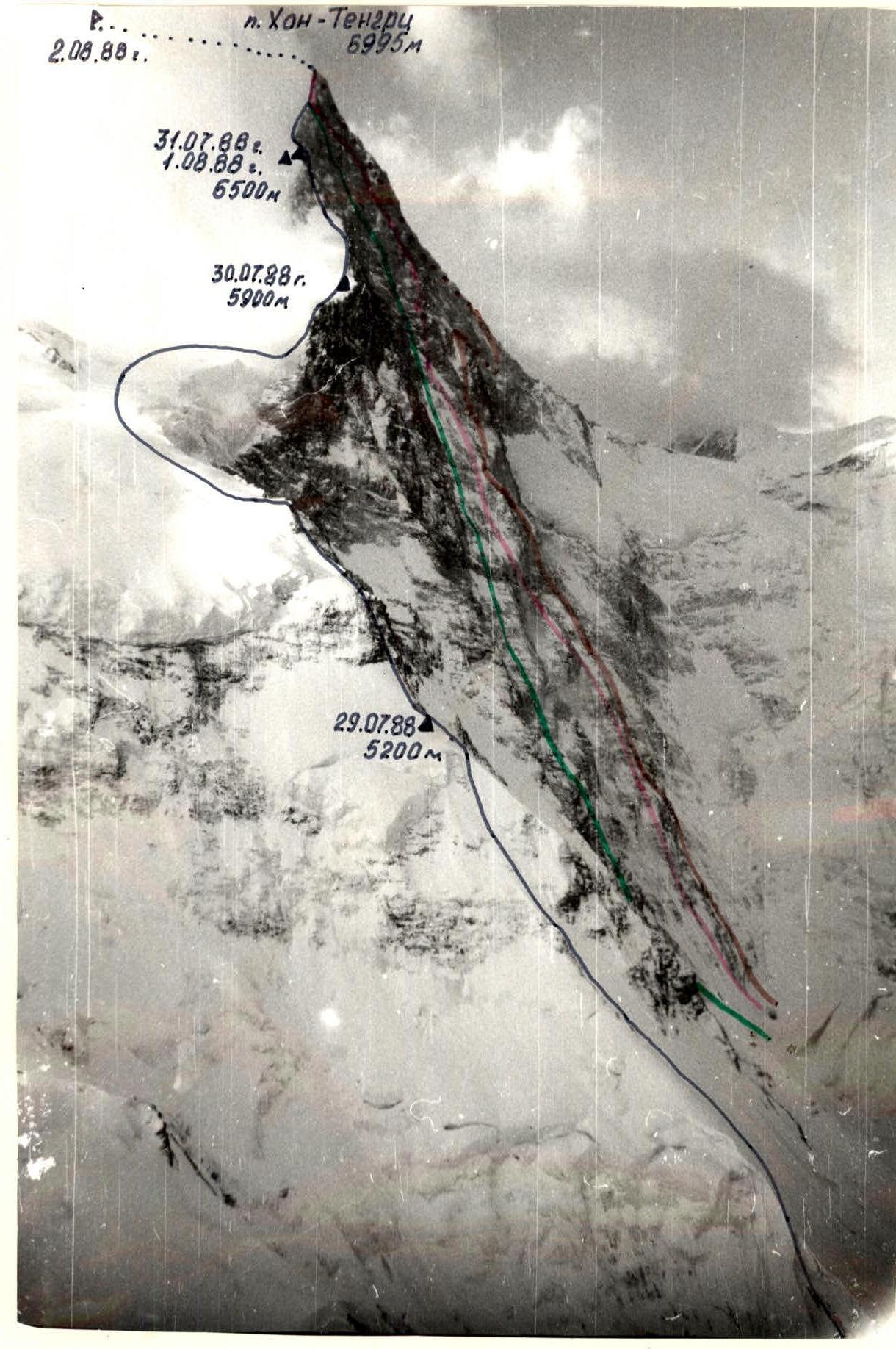
General photo of the summit. Taken on August 24, 1988, at 9:00. "Minitar I" lens, F = 32 mm. Shot from a helicopter, height about 5000 m, distance 1.5 km.

Tactical Actions of the Team
During the ascent, the team deviated from the tactical plan due to bad weather, which started on the second day of the ascent and by 15:00 had intensified to the point where the group had to stop for the night at 16:00, having worked 2 hours less than planned and 300 m less in height. The next bad weather, which caught up with the team after the third night, forced them to have a day of sitting out, i.e., to use the backup plan.
The organization of the group's movement on each section is described in the "Route Description by Sections". To ensure safety:
- The first person went on a UIAA rope
- The last one — with top rope on the fixed ropes
- The rest of the team members — on fixed ropes with a jumar, backed up by a prusik knot.
For organizing belay stations were used:
- On ice — double ice screws
- On rocks — triple, quadruple points (nuts, pitons, bolts).
The movement regime is reflected in the "Ascent Schedule". Meals were two times a day:
- In the morning before departure
- In the evening after setting up the camp
Pocket food was provided during the day. All overnight stays were set up in safe places. List of food products.
| 1. Crackers | 2 kg |
|---|---|
| 2. Fried meat | 2 kg |
| 3. Buckwheat groats | 0.5 kg |
| 4. Oatmeal | 6.5 kg |
| 5. Soups, 8 packs | 0.8 kg |
| 6. Sugar | 1.5 kg |
| 7. Sweets | 1 kg |
| 8. Tea | 0.2 kg |
| 9. Lard | 1 kg |
| 10. Sausage | 1.5 kg |
| 11. Salmon caviar, 8 cans | 1.2 kg |
| 12. Dry milk | 1.0 kg |
| 13. Raisins, dried apricots, prunes | 1.5 kg |
| 14. Honey | 0.9 kg |
The weight of the products was: 15.6 kg. Gasoline 7 l — 6.2 kg with packaging. Total: 21.8 kg.
The weight of the backpacks when the team left for the route was about 9 kg each, not counting the equipment in use.
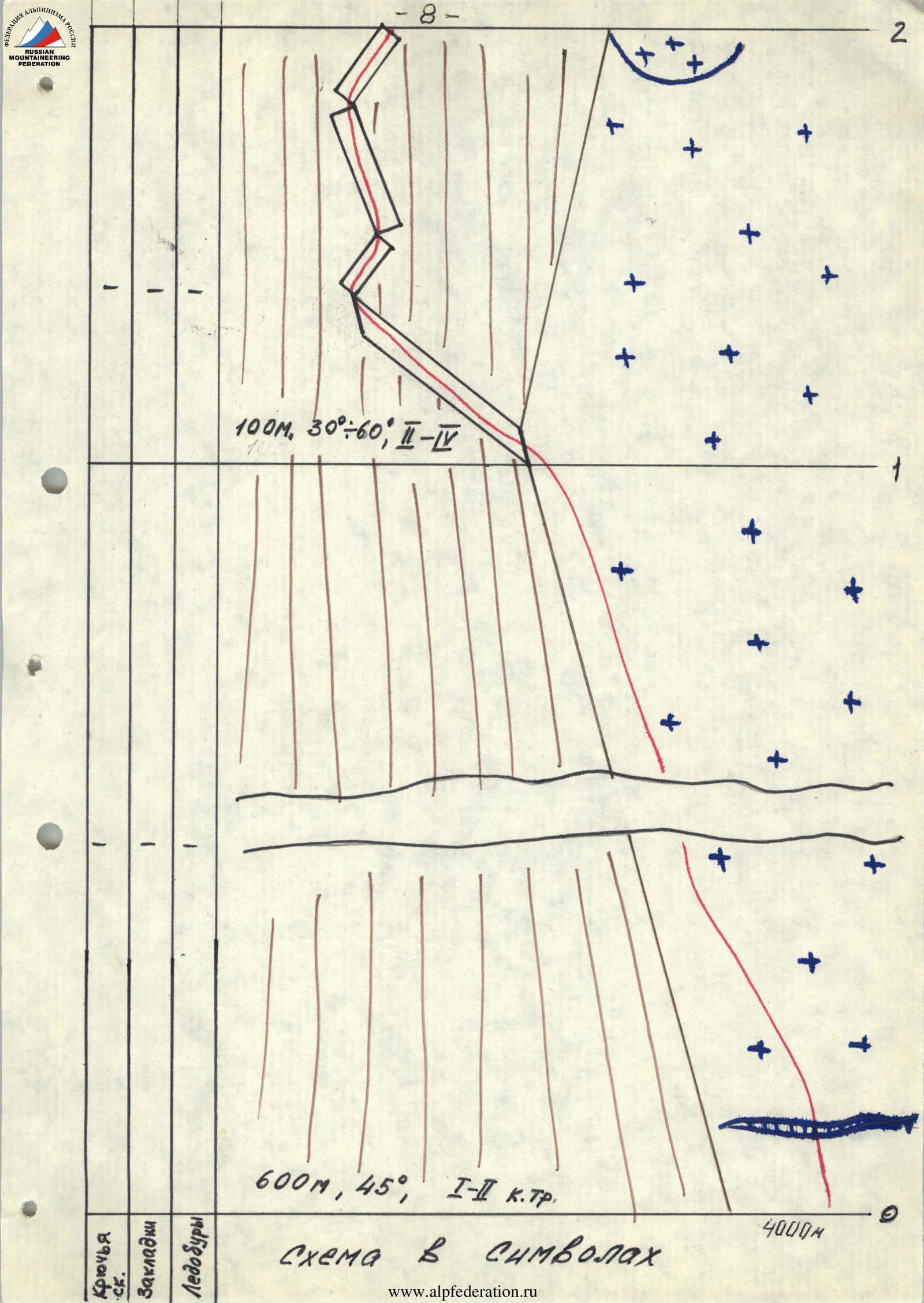
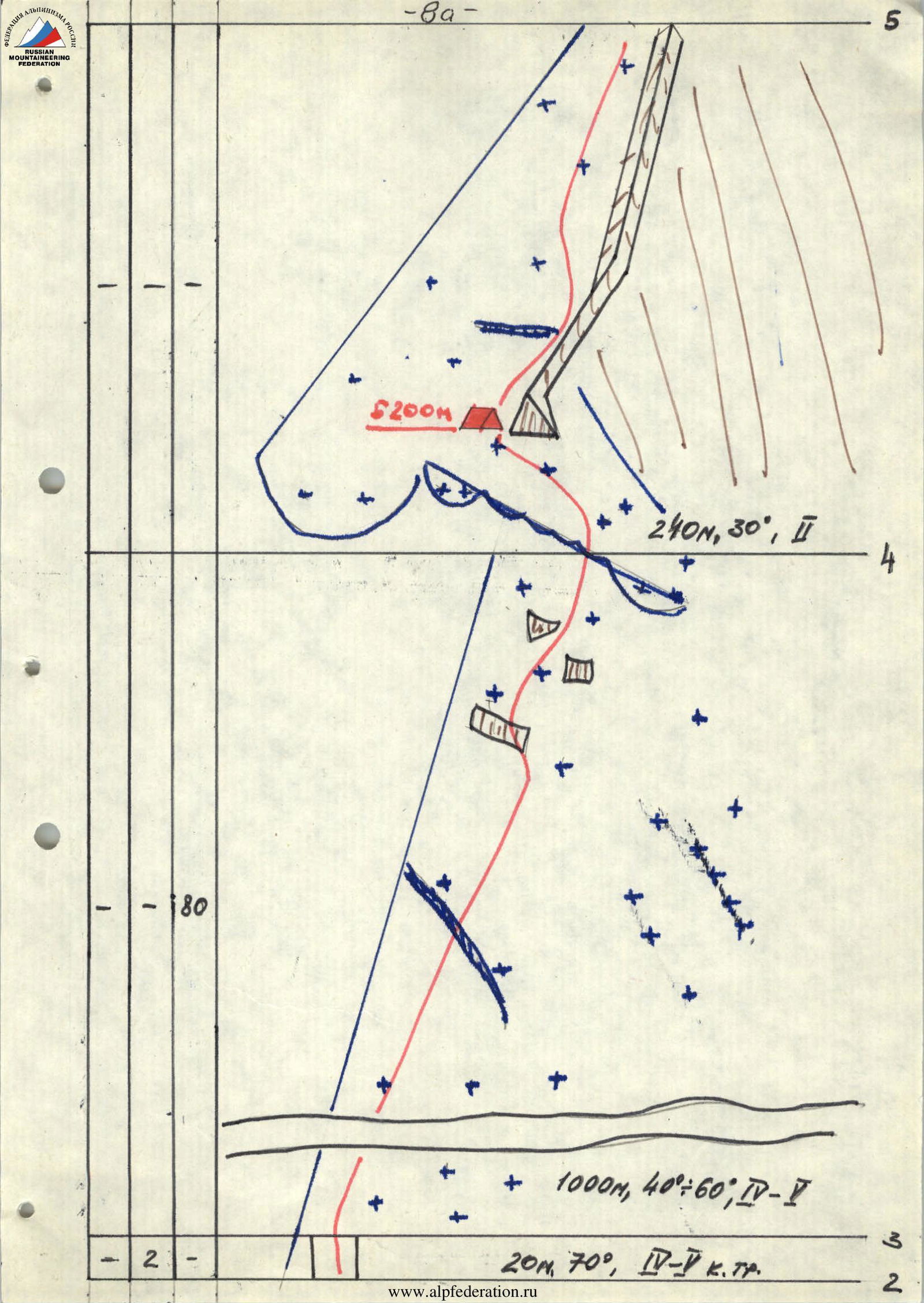
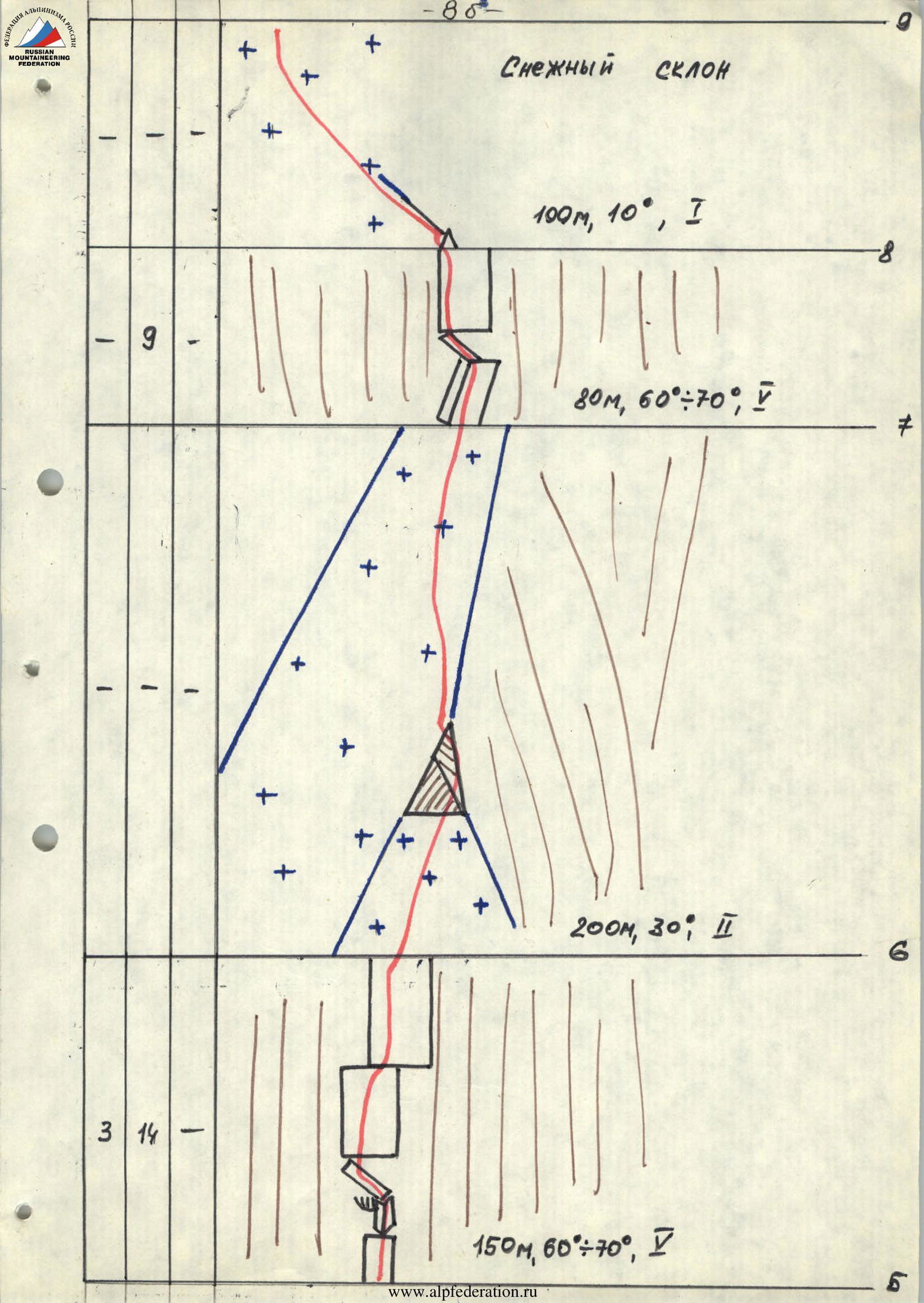 80 m, 50°, III–IV

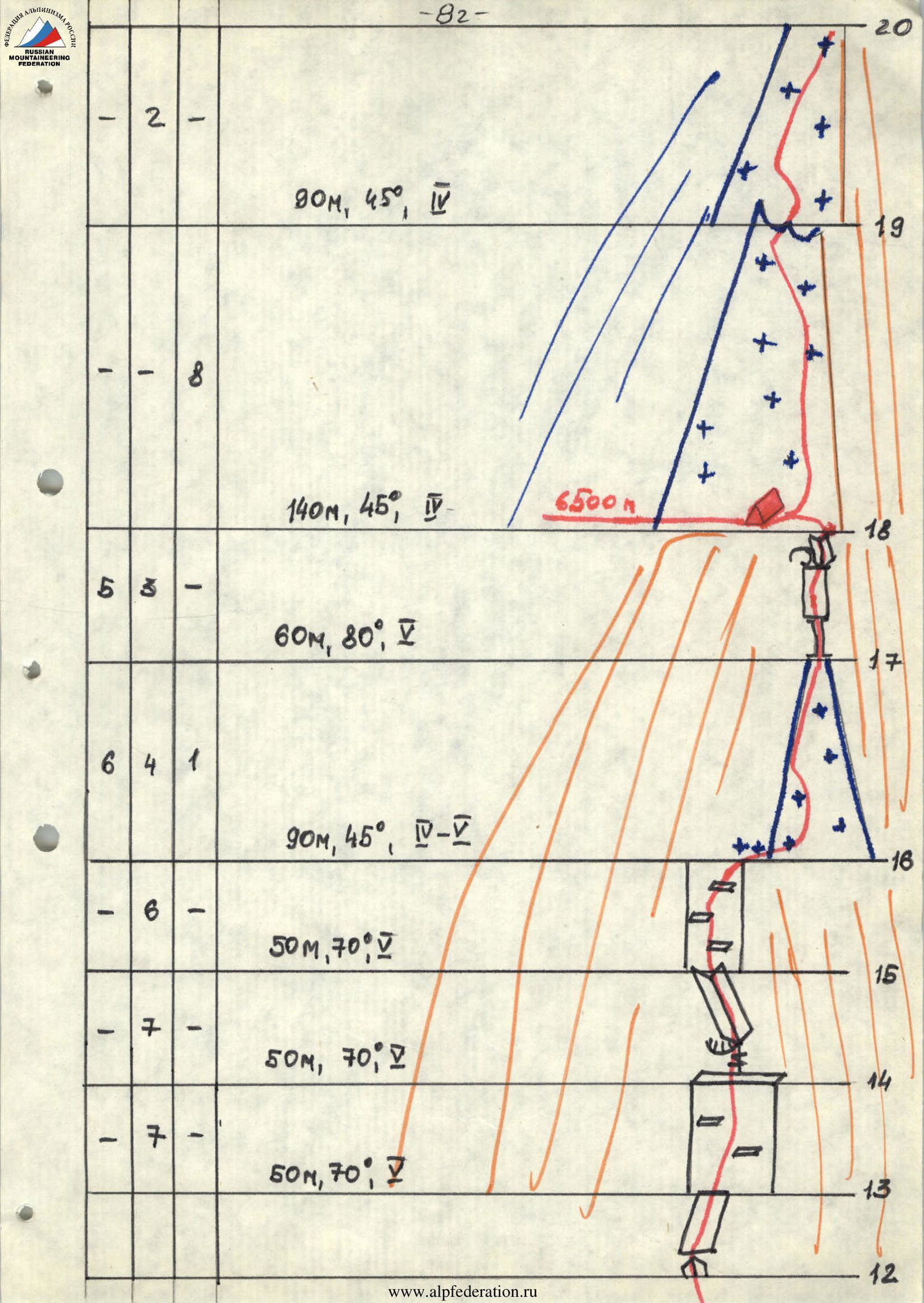
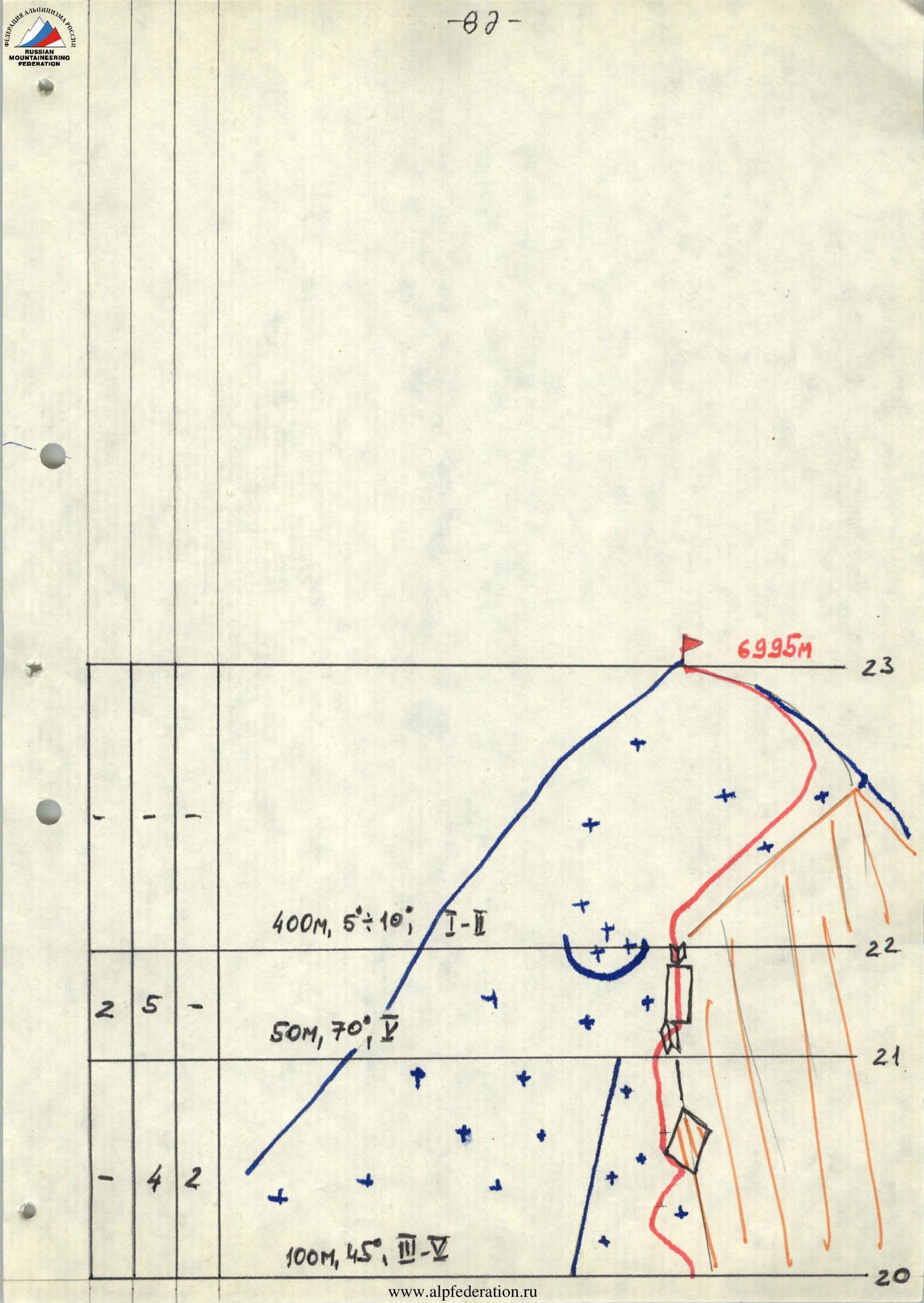
Route Description by Sections
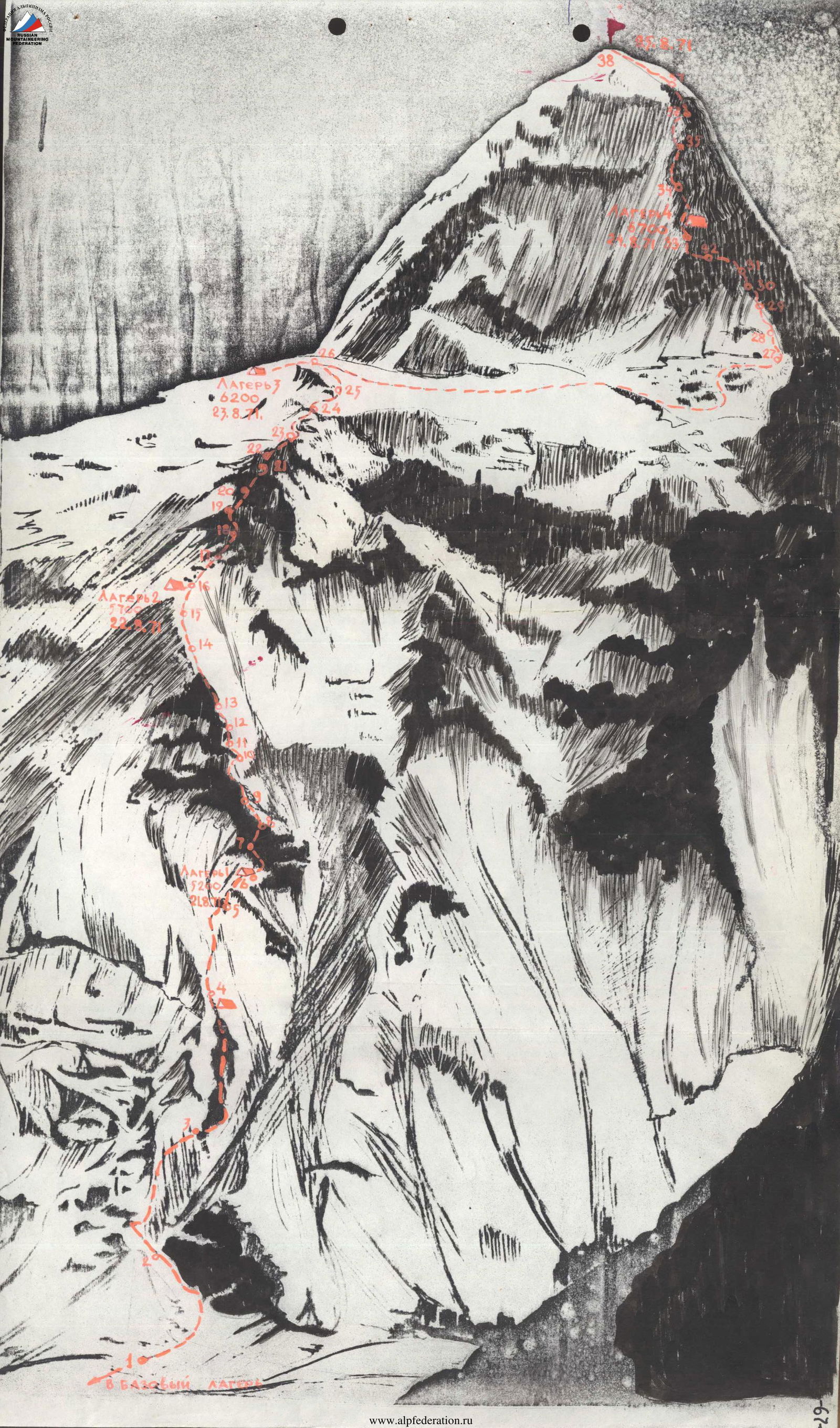
R0–R1. Snow-ice slope is overcome along the left rock triangle. Movement is simultaneous. In the second half of the day, falling rocks were observed. R1–R2. Simple rocks. Highly destroyed. Movement is simultaneous in a tight group. R2–R3. Highly destroyed rock wall. Passed with fixed ropes. Simultaneous movement on these ropes is excluded. R3–R4. Ice-snow slope. Passed with fixed ropes. In the lower part, many frozen rocks. Gentle areas alternate with steep sections, and in places of transition from steep ice to gentle — crevasses. R4–R5. Snow slope with rock outcrops. To the left behind a rock in the middle of the section — excellent platforms. Closed crevasses. R5–R6. Rock bastion. In the middle and upper parts, the rocks are highly destroyed and snow-covered. Movement with fixed ropes. Long U-shaped pitons work well as belay points. R6–R7. Snow slope with rock outcrops. A gendarme in the middle of the section is bypassed to the right along easy rocks. R7–R8. Second rock bastion. Mainly nuts — eccentrics — were used as belay points. Fixed ropes were hung for the group's passage. R8–R9. Snow slope with deep loose snow. Simultaneous movement with changing lead. R9–R10. Ice wall. R10–R11. Snow plateau. Passed in the direction of the summit along the slopes of Peak Saladin.
R11–R12. Snow-ice slope. Ascent along the edge of the North wall of the peak towards the rusty rocks.
R12–R13. Destroyed gentle rocks. Simultaneous movement on the right side of the ridge.
R13–R14. Rock walls alternating with shelves. Rich terrain, both pitons and various nuts can be used for belaying. Fixed ropes.
R14–R15. Crevice turning into an internal corner. Terrain identical to section R13–R14. Fixed ropes.
R15–R16. Walls, small shelves.
R16–R17. Traverse to the right into a couloir and up the couloir along the left edge. Belaying in the couloir:
- through an ice axe;
- rock pitons on the walls of the couloir. Piton belay. Fixed ropes.
R17–R18. Chimney turning into a rock wall covered in ice. Belaying is difficult due to the layer of ice in the cracks and on the surface of the rocks. Thin rigid pitons. Fixed ropes.
R18–R19. Snow-ice ascent with rock outcrops. Belaying:
- through ice screws;
- hanging fixed ropes.
R19–R20. Second snow-ice ascent. Ice screws. Fixed ropes.
R20–R21. Third snow-ice ascent. Ice screws. Fixed ropes.
R21–R22. Traverse to the right onto a rock wall turning into an overhanging internal corner. Belaying through eccentrics.
R22–R23. Summit dome. Along the edge of the North wall, located to the right of the route, to the summit of Peak Khan-Tengri.
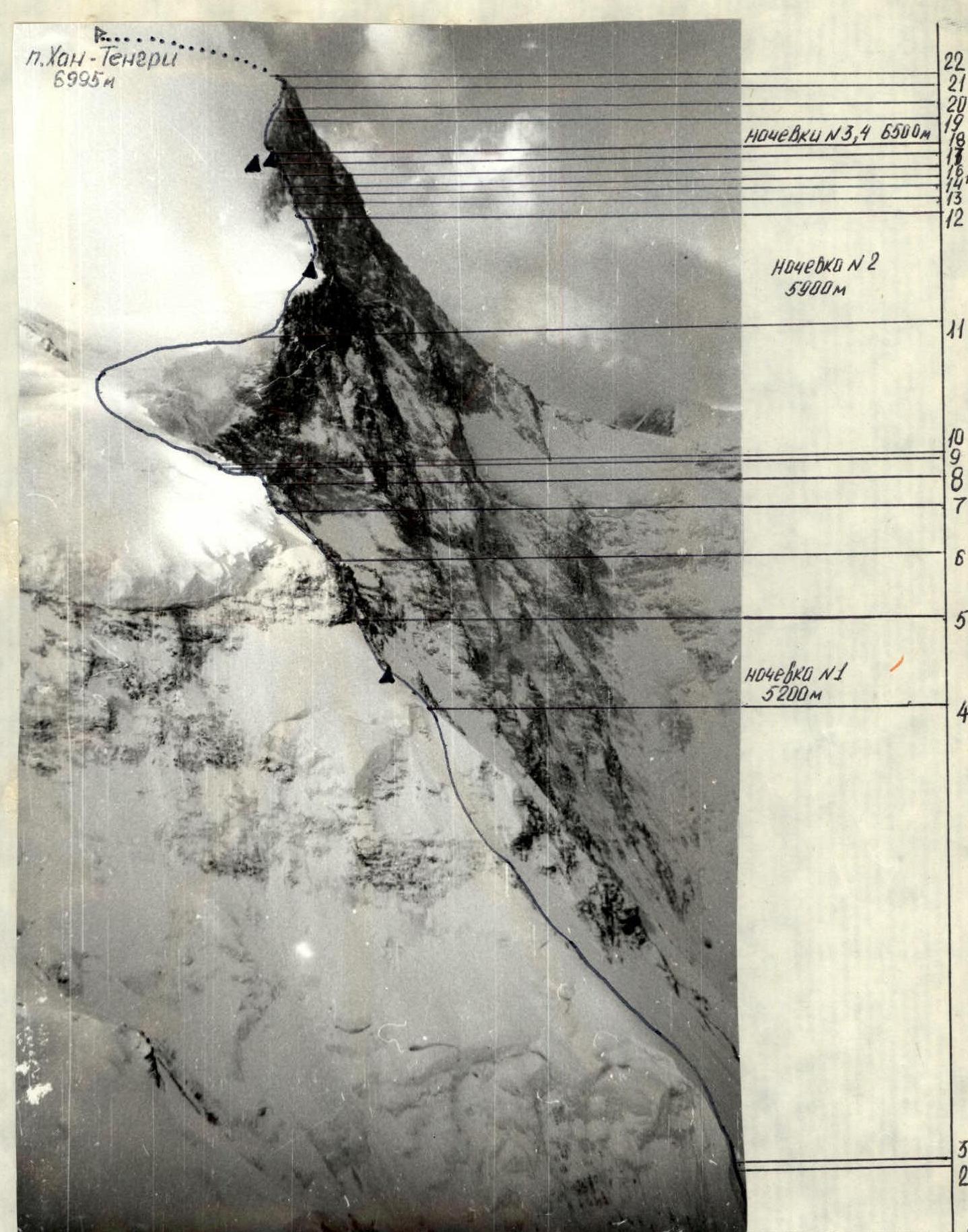
Technical photo of the route. Taken on August 24, 1988. "Minitar I" lens, F = 32 mm, from a helicopter, height 5000 m, distance 1.5 km.
Debriefing Protocol
Ascent to Peak Khan-Tengri via the North Ridge, 5B category of complexity, team of SC "Yenisei" within the framework of the RSFSR Championship in the altitude class.
Present: Team:
- Yarvikov Yu.M. — captain
- Miller I.P.
- Antipin S.M.
- Sereda V.A.
- Karlov A.P.
- Gamayunov I.P.
- Bogdanov V.V.
- Zakharov N.N. — coach
- Judge — Naydovich B.V. Releasing: Pankov A.F. Head of SO: Podolny V.F.
Yarvikov Yu.M.: "We set out on the route according to plan on July 29 at 7:00. We passed the rock triangle and about 20 ropes of ice to the first overnight stay (5200 m). On the next day, July 30, we overcame the rock bastion (3 ropes), then the snow-ice plateau above the icefall. After lunch, the weather deteriorated sharply, and we stopped for the night at an altitude of 6100 m. On July 31, we passed the snow-ice ascent, reached the rusty rock bastion. To the right of the route, we climbed up the rocks and snow couloir to the edge of the bastion (6500 m). A heavy snowfall began, and we set up camp. On August 1, in conditions of continuous snowfall and poor visibility, we made an attempt to ascend but, having passed 3 ropes, were forced to descend to the overnight stay due to the danger of avalanches. On August 2, the weather improved. We continued the ascent, belaying in avalanche-prone areas on the rocks. Having overcome the last rock ascent and passed the summit dome, we reached the summit at 17:00. By 19:00, we descended to the overnight stay (6500 m) in conditions of strong wind and renewed snowfall. The descent was normal, following the ascent route. We were back in the base camp on August 4".
Naydovich B.V.: "Who passed the key sections first? Evaluate the activity of the participants".
Yarvikov Yu.M.: "All team members worked actively, in accordance with the tactical plan. Karlov worked first on key rock sections, Antipin S.M. on ice. We want to note the clear execution of the tactical plan, which was designed to match the strength and qualification of the participants. The team correctly oriented itself in bad weather conditions, deciding to wait it out, thereby preserving strength and not risking on an avalanche-prone slope. Food and fuel were sufficient until the end of the ascent, as they were taken with a calculation for bad weather".
Zakharov N.N.: "On the route, we consulted in detail with E. Ilyinsky, who gave valuable recommendations on the safe passage of avalanche-prone couloirs in the upper part of the route, where the snow-ice slopes are inclined towards the North wall. In these areas, it is necessary to belay on rock outcrops, as well as through ice screws, as almost anywhere under a layer of snow, you can dig out ice".
Naydovich B.V.: "Was there a possibility of an avalanche in the last couloir before the ascent to the pre-summit ascent?"
Zakharov N.N.: "The couloir is small: in the lower part, it is 20 m wide, in the upper part — about 40 m. There is enough snow in it for small avalanches to occur. In this couloir, we provided reliable belaying — fixed ropes through 2 ice screws and nuts on rock outcrops".
Karlov A.P.: "On the organization of overnight stays:
- The first (at 5200 m) — reliable, convenient, protected by a rock.
- The second (at 6100 m) — organized on the safest snow field before the ascent to the rusty rocks.
- On the edge (at 6500 m), it was difficult to set up a camp. The captain correctly chose a protruding rock for this, which is not subject to the danger of an avalanche. This camp is the most convenient place for further summit assault".
"On the equipment prepared specifically for ascents to Peak Khan-Tengri within the framework of the RSFSR and USSR Championships:
- 2 double 4-person tents were tested (weight of each — 2.2 kg).
- Down jackets complete with vests.
- Down sleeping bags (can be used both individually and collectively).
- Windproof, comfortable climbing suits.
- Double high-altitude boots (made to order, pre-tested in February on routes of 5A, 5B category of complexity) showed good thermal insulation properties".
Naydovich B.V.: "The route is not very icy, did you take too many ice screws on the route?"
Sereda V.A.: "On most sections, belaying is organized through ice screws. In addition, to increase the speed of passage of fixed ropes, the rope is blocked on an additional ice screw. In total, we took 15 ice screws".
Zakharov N.N.: "In addition, ice screws came in handy during the descent, when we had to hang about 20 fixed ropes on the ridge, as the snow was unreliable, and crampons got clogged".
Miller I.P.: "This route requires great physical preparation. The technical complexity of rocks and ice — from 3 to 5 category. Everything is complicated by the fact that the rocks are covered with snow and ice. Almost the entire route, except for the snow plateau above the icefall, was climbed with alternate belaying".
Zakharov N.N.: "This ascent gave a lot of practical experience in terms of preparing the team for the passage are one of the main tasks of the team's participation in the RSFSR Championship".
Podolny V.F.: "We maintained communication with the group 3 times a day, there was not a single break in communication. The route was well visible when there was good visibility, and we were able to observe the team on most of the route".
Pankov A.F.: "The team passed the route in difficult meteorological conditions and fulfilled the tactical plan. No violations of mountaineering rules were committed, safety was observed. The ascent should be credited to the participants and the captain".
Naydovich B.V.: "The ascent was prepared and carried out in accordance with the rules, competently, at a high sports level. The report on the ascent is submitted for consideration by the main judging panel of the RSFSR Championship".
Secretary: A. Gazi A. T. Galyautdinova
Judge: B.V. Naydovich

Comments
Sign in to leave a comment