
-
Class of high-altitude technical ascents.
-
Central Tian-Shan, Kokshaal-Too ridge
-
Peak Pobeda Gl. summit (7439 m) via West summit from Dikiy pass from Zvezdochka glacier
-
Category of complexity — 5B
-
Height difference — 3039 m Average steepness of the ridge part of the route — 40°.
-
Pitons driven:
- rock pitons — 5*
- bolt pitons — 8
- chocks — 6 * — reusing previously driven pitons
-
Climbing hours: ascent – 30, descent – 13, days – 7
-
Overnights: 1, 2, 3, 6 – lying in a cave, 4, 5 – in a tent, protected from wind by a snow wall.
-
Leader: Nikolay A. Totmyanin — Master of Sports Participants: Alexey M. Nikiforov — Candidate for Master of Sports
-
Coach: Nikolay A. Totmyanin — Master of Sports
-
Departure to the route — August 14, 1999, summit — August 19, 1999, return — August 20, 1999.
-
Organization: Central Expeditionary and Tourist Center "NEVA", St. Petersburg
Team leader and coach Nikolay A. Totmyanin 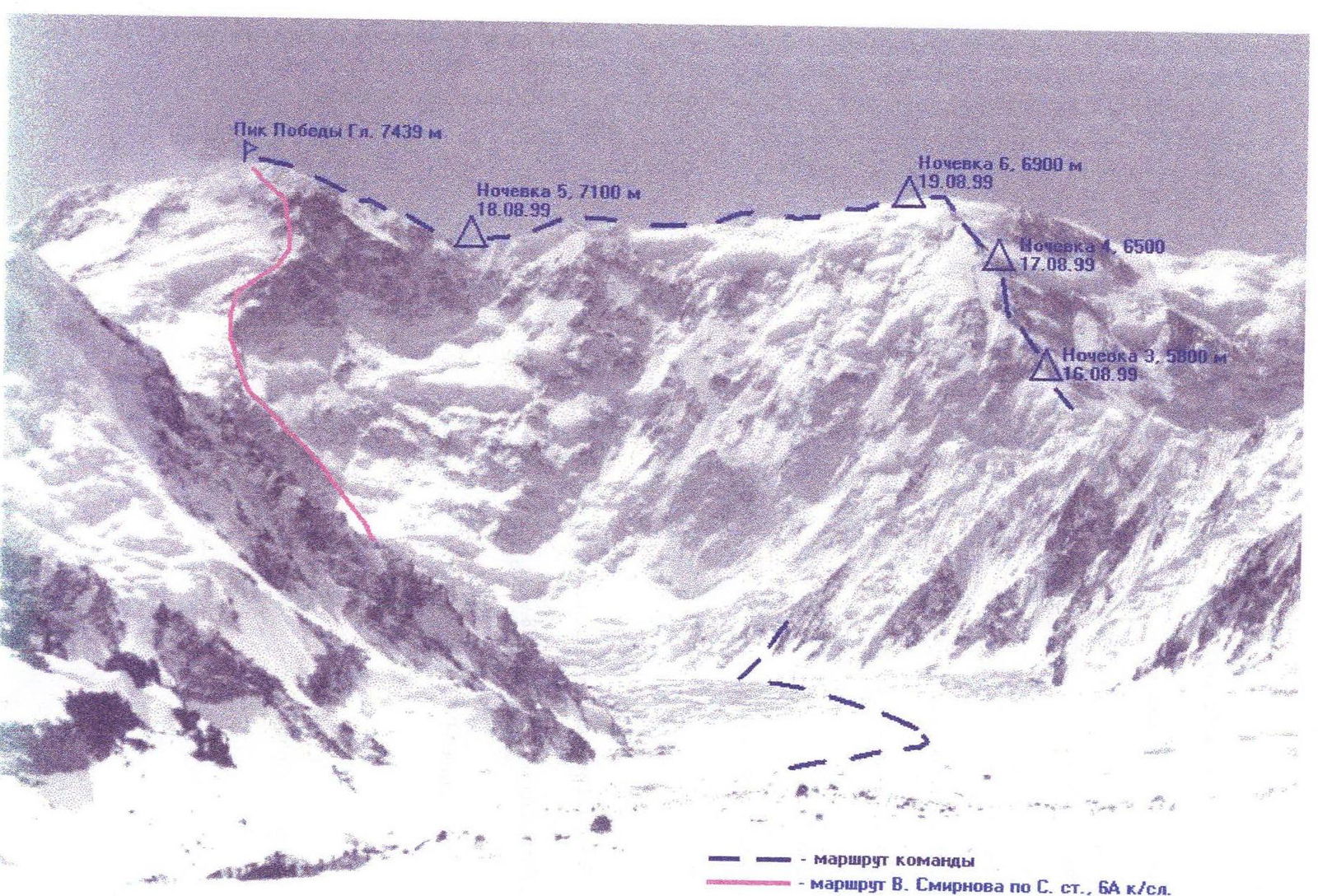 www.alpfederation.ru ↗
Team's Tactical Actions
The team arrived at South Inylchek glacier on July 20, 1999. Between July 22 and August 9, 1999, team members made two acclimatization trips to the slope of Khan-Tengri peak and ascended Khan-Tengri peak via the classical route with overnight stays at altitudes of 5300 m and 5800 m and descents to rest in the base camp. Following the reconnaissance results, the route to Pobeda Gl. main summit via the West summit from Dikiy pass (5B category of complexity) was chosen for the ascent within the framework of the Russian Championship, as the safest and most feasible under the conditions of summer 1999. The tactical plan for the ascent was made considering the following aspects:
- the level of physical and technical preparedness of the participants;
- the results of the acclimatization carried out;
- the complexity of the route after the snowfalls;
- frequent and abrupt changes in weather conditions and short periods of good weather;
- the objective danger of the icefall when ascending to Dikiy pass;
- the long extent of the high-altitude section (above 6500 m) of the route;
- the impossibility of quickly receiving help from a rescue team or other climbers in an emergency.
After resting in the base camp, the team approached the route on August 11. On August 12 and 13, the ascent did not take place due to continuous snowfall and frequent snow avalanches from fresh snow on the slope under the icefall. On August 14, they started the route early in the morning and by 9:00 overcame the icefall on the ascent to Dikiy pass. Above the icefall, they met a trio of climbers from Irkutsk who were descending after an unsuccessful attempt to ascend. When ascending to the pass, they had to "tread snow", despite following the descent tracks of the Irkutsk climbers. On August 15, the pair planned to ascend to the end of the snowy section of the ridge to an altitude of 5800 m, but a group of foreigners who ascended afterwards and overnighted in a neighboring cave asked them to escort a sick Frenchman down. Nikiforov stayed at camp 1. Totmyanin went down with the Frenchman and by 19:00 descended to the base camp on the moraine under Gorky peak. On August 16, Nikiforov, together with the foreigners, ascended to the base of the first rock band to the planned overnight stay site at an altitude of 5800 m by 13:00 and started preparing the bivouac (digging a cave). An hour later, Totmyanin ascended to 5800 m, having left the base camp at 4:00. From the start of the route (from an altitude of 4400 m) to 5300 m, he climbed together with a pair of climbers from Omsk. In the following days, the ascent was carried out according to the plan. The team's actions on the route were determined by the tactical plan, which was largely implemented. This was facilitated by a realistic assessment by the participants of their capabilities, good knowledge of the route, and a successful choice of the time to start the route under conditions of highly unstable weather.
Movement on complex and dangerous sections of the route was carried out in a rope team. When moving on snow and ice terrain, the change of the lead climber in the rope team was made depending on the condition of the snow cover, with a frequency necessary to maintain a uniform pace of movement and preserve good working capacity throughout the day.
- maintaining a uniform pace of movement;
- preserving good working capacity throughout the day.
Movement on rocky terrain was carried out simultaneously or alternately, depending on the complexity of the section and the possibility of using belay points left by previous expeditions. Throughout the entire route, the pair worked in crampons with anti-sticking plates.
Belaying on snow and ice was carried out using:
- ice axes
- ice screws.
For belaying on rocks, the following were used:
- pitons
- rope loops and remnants of ropes from previous expeditions
- a set of chocks taken by the team on the route.
Overnights on the route were held in caves or in a "North Face" tent, which was set up in safe places and protected from the wind by a snow wall. For quick preparation of the site under the tent and digging caves, there was a high-strength and lightweight titanium shovel.
Safety on the route was ensured by:
- choosing an objectively safe path and time of movement,
- organizing reliable belaying,
- passing the dangerous section under Dikiy pass early in the morning,
- timely stopping for overnight stay,
- using reliable, high-quality, and tested equipment.
They took with them:
- a sufficient amount of high-calorie quick-preparation food,
- a reserve of fuel (gasoline and gas),
- a gasoline primus stove,
- a gas burner.
The group regularly contacted the base camp using a portable radio station at the set hours.
The team completed the route with a sufficient "safety margin"; there were no failures or injuries.

Comments
Sign in to leave a comment