
Passport
- Class of high-altitude technical ascents.
- Central Tien Shan, Kokshaal-Too ridge
- Peak Pobeda G. (7439 m) via West peak from per. Dikiy from l. Zvezdochka
- Complexity category — 5B
- Height difference — 3039 m, Average steepness of the ridge part of the route — 40 degrees.
- Pitons driven:
Rock anchor pitons
12* 8 ice screws
- — use of previously driven pitons
- Travel hours: ascent — 28, descent — 15, days — 6
- Overnights: 1 — lying in a cave, 2–5 — in a tent protected from the wind by a snow wall.
- Leader: Totmyanin Nikolai Anatolyevich — Master of Sports
Participants:
- Aseev Mikhail Vladimirovich 1st category
- Meloni Pierre (France)
- Meloni Brigitte (France)
- Coach: Moshnikov Anatoly Ivanovich — Honored Master of Sports
- Route entry — August 17, 1997, summit — August 20, 1997, return — August 22, 1997
- Organization: CET "NEVA", St. Petersburg
Team leader Totmyanin N.A.
Team coach Moshnikov A.I.
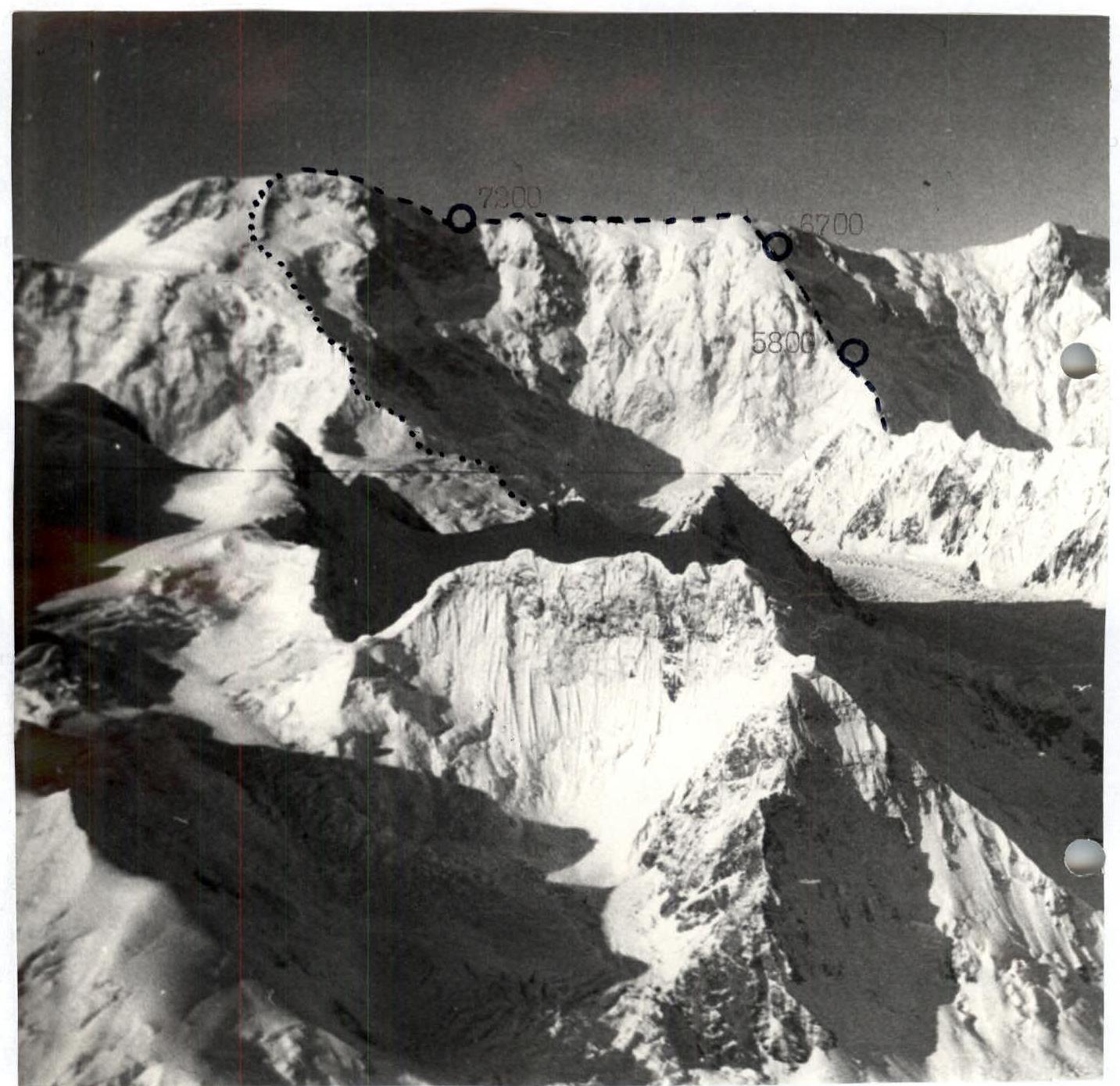
General photo of the summit.
- route taken by the team
- route of V. Abalakov (1956), 5B category
- overnights, altitude
TACTICAL ACTIONS OF THE TEAM
The team arrived at l. Yu. Inylchek on August 3, 1997, and between August 5 and 12 made two acclimatization trips with overnight stays at altitudes of 5300 m and 5800 m and descents to rest in the base camp. Based on the results of the reconnaissance, a route was chosen and a tactical plan for the ascent was drawn up, which took into account:
- the level of preparedness and acclimatization results of the participants;
- the complexity of the route after the snowfalls;
- the danger of the route section when ascending to per. Dikiy;
- the large extent of the high-altitude (above 6500 m) section of the route;
- temperature and weather conditions in the ascent area.
The team's actions on the route were determined by a tactical plan, which was largely implemented. This was facilitated by the participants' correct assessment of their capabilities, good knowledge of the route, as well as stable weather during the ascent.
The team moved along the route in two rope teams. When moving on snow and ice sections, the change of rope teams and the lead climber was made depending on the condition of the snow cover with a frequency necessary to maintain a steady pace of movement and maintain good working capacity of the team members.
Movement on rocky sections was carried out with the interaction of rope teams: the first rope team left belay points for the second rope team or organized handrails on the most difficult sections. The load of the lead climber in the leading rope team was partially distributed among the other participants. Throughout the entire route, the team worked in crampons with anti-sticking pads.
Belaying on snow and ice sections was carried out using ice axes and ice screws. For belaying on rocks, pitons and rope loops were used on ledges from previous expeditions and a set of chocks taken by the team on the route.
Overnights on the route (except the first) were carried out in a "North Face" tent, which was set up in safe places and protected from the wind by a snow wall.
On the first overnight stay, a cave was dug, and a supply of food and gasoline was left there for use on the descent.
For quick preparation of the overnight stay, the following were taken:
- two folding avalanche shovels (duralumin and titanium).
Safety on the route was ensured by:
- choosing an objectively safe path of movement,
- organizing reliable belaying,
- passing the dangerous section under per. Dikiy early in the morning (both on ascent and descent),
- timely stopping for overnight stay,
- using reliable, high-quality and proven equipment.
The team took with them:
- a sufficient amount of high-calorie quick-preparation food,
- fuel reserve,
- stove and burner.
The group regularly contacted the base camp at set hours using portable radios.
The team passed the route with a sufficient margin of "strength", there were no failures or injuries.

Comments
Sign in to leave a comment