

Free Korea. North Face (first ascent). 1999 approx. 6A category. Tian Shan, Kyrgyz Range.
Passport
- Winter category.
- Tian Shan, Kyrgyz Ridge, Ak-Sai gorge.
- Peak Free Korea. North Face. 4740 m.
- Route 6A category (approx.) first ascent.
- Height difference of the route: 640 m (bergschrund 4100 – summit 4740). Route length 845 m.
- Length of the central part 285 m.
- Length of 6th category sections 243 m.
- Average steepness of the route 65° (bergschrund – ridge).
- Average steepness of the central part 83°.
- Number of pitons driven:
| Rock | Bolt | Cams | Ice screws | Sky-hook |
|---|---|---|---|---|
| 114 | 28 | 130 | 41 | 10 |
| 90 | 22 | 110 | 0 | 10 |
- Team's working hours: 120. Days: 14 including preliminary processing and descent.
- Overnights: all overnights were lying on a suspended platform.
- Team leader: Mikhailov Mikhail Mikhailovich – Master of Sports.
Team members:
- Gubaev Alexander Rafaelevich – Candidate for Master of Sports
- Puchinin Andrey Albertovich – Master of Sports
- Akimov Vitaly – Candidate for Master of Sports
Route entry: November 15, 1999. Summit: November 27, 1999. Return: November 28, 1999. Organization: Alpinism Federation of Kyrgyzstan.
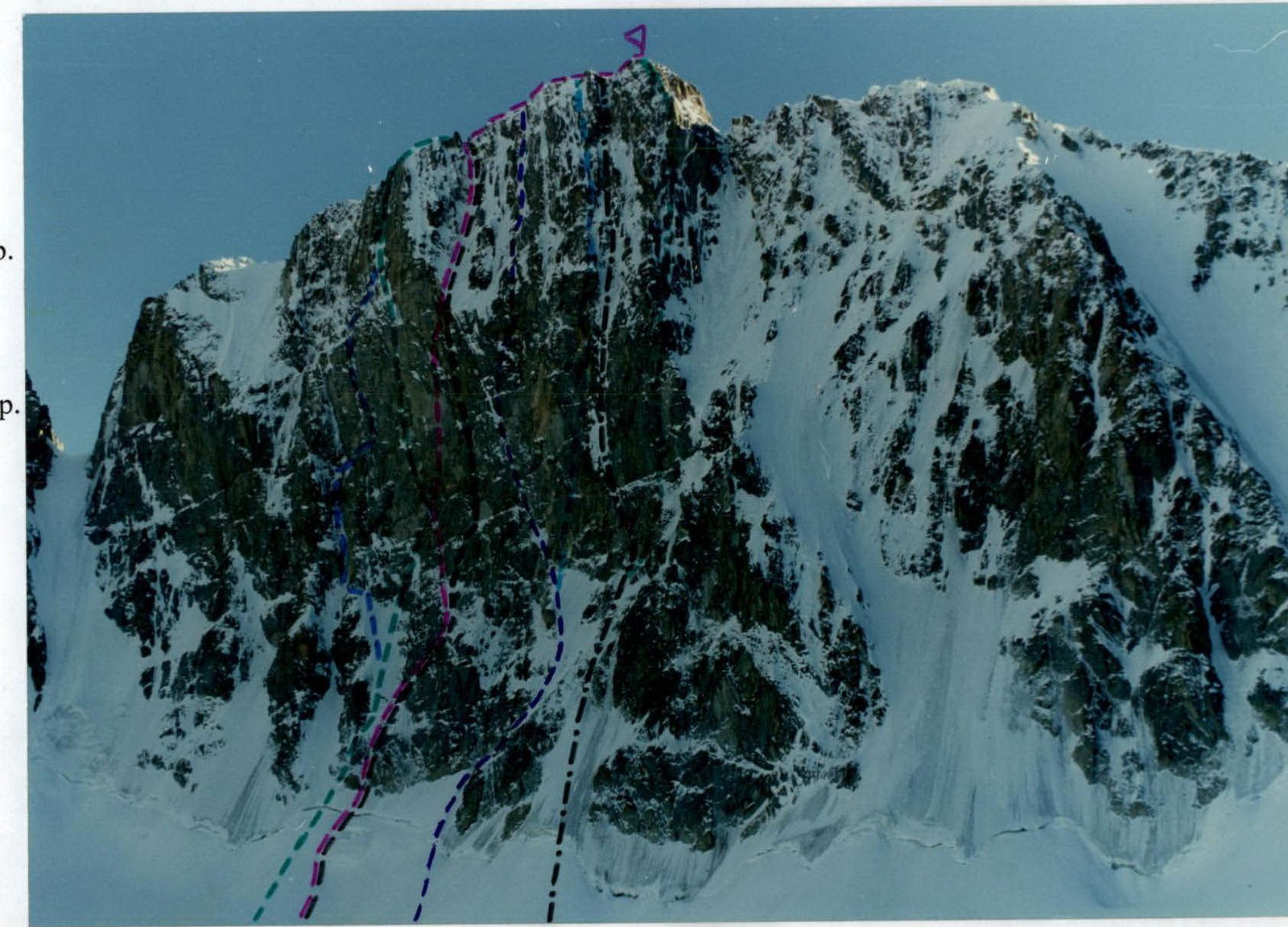
General photo of the summit Free Korea. 4740 m.
Left to right:
- Studenin's Route, 6A category
- Kustovsky's Route, 6A category
- Route climbed by the Kyrgyzstan team
- Semiletkin's Route, 6B category
- Popenko's Route, 6A category
- Bezzubkin's Route, 6A category
- Ruchkin's Route, 6A category
- Myshlyaev's Route, 5B category
 Technical photograph of the route to peak Free Korea (4740 m).
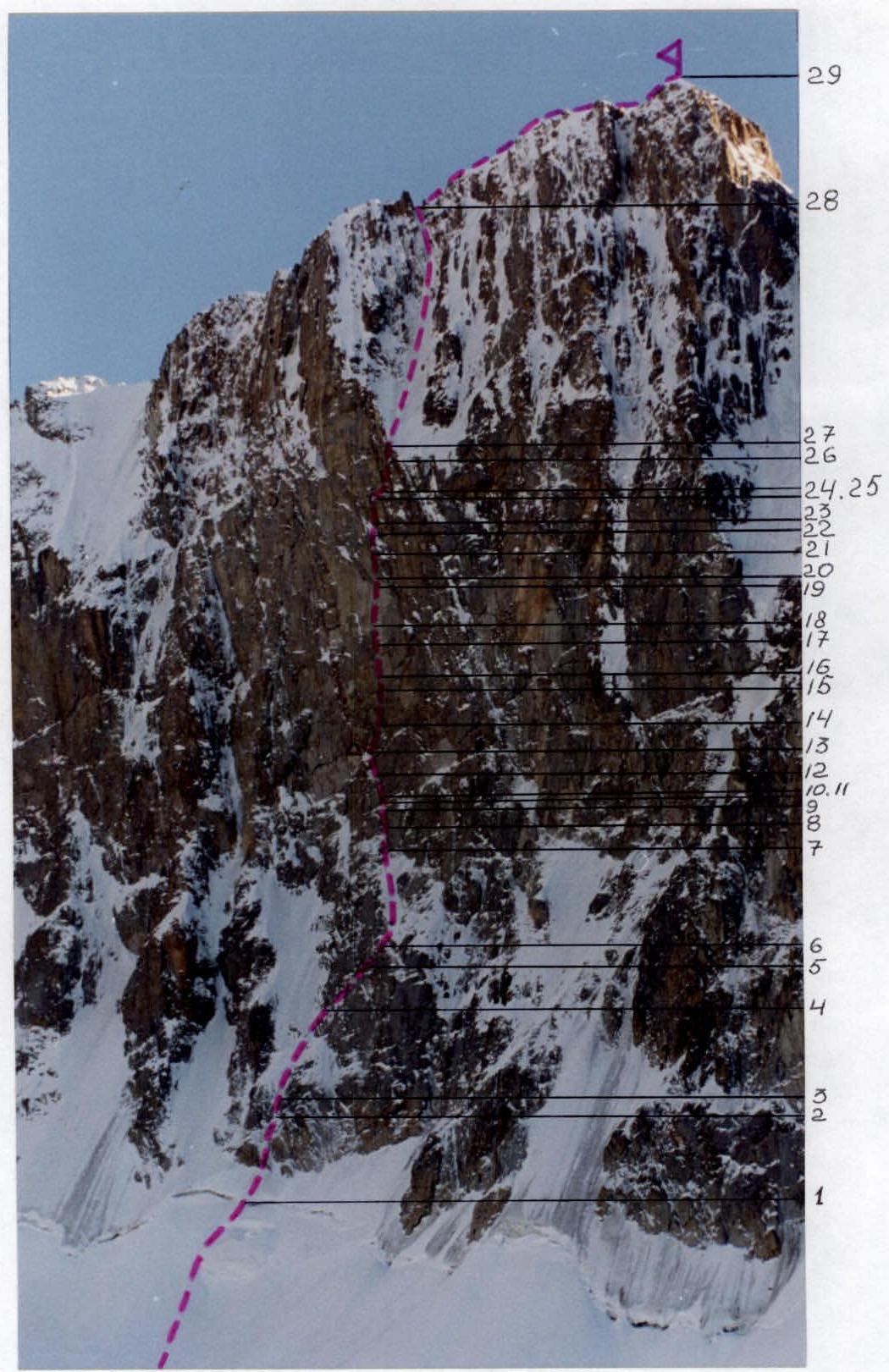 Δ Team's overnight locations.
Tactical Actions of the Team
Given the specificity of the wall and winter conditions, a tactic of working from an "intermediate camp" was chosen.
- Processing the route up to the "carrot top" – the base of the main wall – 8 ropes. A storm camp platform was set up here.
- Processing the main key section of the wall – 5 ropes of extremely difficult climbing. Moving the camp higher was not feasible.
- Without dismantling the camp and the fixed ropes, the team proceeded to the "roof" – 5 ropes of an icy couloir, and then along the ridge to the summit – were climbed in one go.
- Descent was made via the ascent route. R0–R7. According to the tactical plan, on November 15, 1999, the team consisting of Puchinin, Mikhailov, and Akimov started processing the lower part of the route. 285 m of fixed ropes were set in a day, and part of the cargo was hauled. Weather – windy with snow. R7–R10. November 16. Mikhailov – Akimov processed 1 rope, 50 m. The team began processing the main key part of the wall. Part of the cargo was hauled. R10–R13. November 17. Akimov – Gubaev processed 45 m of the wall and reached the previously planned bivouac site "carrot top". Part of the cargo was hauled. R13–R14. November 18. The team in full strength moved up to the bivouac site via the fixed ropes. Akimov, Mikhailov duo conducted further processing. Other team members set up the platform and arranged the camp. In poor weather conditions, 15 m of a smooth slab were processed that day. R14–R15. November 19. Mikhailov – Akimov duo climbed 25 m of a smooth wall with a series of cornices. November 20. Puchinin – Gubaev duo climbed a difficult section with an overhang and part of the first inner corner from section 16. 13 m were covered that day. November 21. Mikhailov – Gubaev duo worked on the wall. They climbed an inner corner and a large cornice. The cornice could not be bypassed, so it was climbed head-on. 25 m were covered. Weather deteriorated in the afternoon, snowfall. November 22. Akimov – Puchinin duo covered a section of 25 m. Steep inner corners on artificial terrain. November 23. Puchinin – Akimov climbed a section of inner corners on loose rock, 17 m. November 24. In strong wind and low temperatures, a 5-meter overhanging inner corner and a rock wall with diagonal cracks were climbed. "Eyebrow" wall section. Total for the day – 20 m. Akimov – Puchinin duo. November 25. Mikhailov – Gubaev duo worked. They climbed 35 m. An overhanging wall with a diagonal crack and a traverse to the right to the base of an inner corner. Weather was clear, frost, wind. November 26. Mikhailov – Gubaev duo climbed one rope length of an inner corner. Reached the "roof". November 27. Departure at 5:00. The team, taking dry rations and a thermos with tea, set out in full strength to storm the summit. In 2 hours, they climbed the previously fixed ropes. Ropes were climbed using headlamps. At dawn, in 5 hours, they climbed the icy couloir "roof" and then along the ridge to the summit. Summit – 13:30. Descent along the ridge via the ascent route, and then down the icy couloir on self-arrests until the start of the fixed ropes. Descent on fixed ropes to the bivouac site on the platform. The team assembled at the bivouac at 20:00. Gubaev – Akimov duo worked first. November 28. Descent down to "Koronskaya" campsite. Departure at 8:00. Mikhailov – Gubaev duo removed ropes above the bivouac. Akimov – Puchinin dismantled the bivouac and packed the cargo into transport bags. Then, together, transporting cargo and pulling down ropes, they descended.
The main difficult central section of the wall was climbed "on-sight", i.e., via a previously unclimbed route, plus an extended section of loose slabs and a large number of cornices, plus bad weather and low temperatures – all this significantly slowed down the pace of movement. Thus, 3 days were added to the planned 11 days, which were allocated in the tactical plan for bad weather. Total time for climbing the wall with preliminary processing and descent – 14 days. The route is specific due to extended sections of loose rock; a large number of small cornices.
The state of the route during this period was less than ideal. More or less positive sections of the wall were heavily snowed, and cracks were filled with ice. During the climb, the team encountered a period of unstable weather. Temperature fluctuated: on the warmest days – −15 °C, and for 3 days (November 24–26) frost with strong wind reached –27 °C. Route processing was done in any weather. The challenging ascent was completed with sufficient reliability and a margin of safety.
Route diagram in symbols

| Rock | Ice | Bolt | Cams | Sky-hook | ROUTE | Section # | Category | Length | Steepness |
|---|---|---|---|---|---|---|---|---|---|
| 4 | 4 | 7 | 5+ | 35 | 65° | ||||
| 6 | 6 | 3 | 80 | 55° | |||||
| 3 | 5 | 5 | 5+ | 15 | 80° | ||||
| 3 | 4 | 4 | 5 | 30 | 50° | ||||
| 6 | 3 | 3 | 80 | 50° | |||||
| 1 | 2 | 5+ | 10 | 80° | |||||
| 5 | 2 | Bergschrund 4100 | 1 | 5 | 70 | 75° | |||
| 0 | 2+ | 120 | 50° |
| Rock | Ice | Bolt | Cams | Sky-hook | ROUTE | Section # | Category | Length | Steepness |
|---|---|---|---|---|---|---|---|---|---|
| 7 | 26 | 25 | 6/A3 | 30 | 80° | ||||
| 7 | 26 | ||||||||
| 2 | 2 | 24 | 5 | 8 | 55° | ||||
| 6 | 1 | 8 | 23 | 6/A3 | 10 | 95° | |||
| 5 | 6 | ||||||||
| 2 | 22 | 5 | 5 | 60° | |||||
| 4 | 4 | 21 | 6 | 12 | 70° | ||||
| 3 | 1 | 12 | 20 | 6/A2 | 15 | 90° | |||
| 9 | |||||||||
| 2 | 1 | 5 | 1 | 19 | 6/A3 | 5 | 100° | ||
| 20 | 12 | 18 | 6/A3 | 30 | 80° | ||||
| 15 | 2 | 10 | |||||||
| 14 | 2 | 6 | 2 | 17 | 6/A4 | 12 | 85° | ||
| 8 | 4 | ||||||||
| 9 | 2 | 11 | 16 | 6/A3 | 26 | 90° | |||
| 3 | 8 | ||||||||
| 5 | 2 | 6 | 15 | 6/A3 | 12 | 90° | |||
| 4 | 4 | ||||||||
| 10 | 4 | 5 | 4 | 14 | 6/A4 | 25 | 90° | ||
| 7 | 3 | 4 | |||||||
| 6 | 3 | 7 | 3 | 13 | 6/A4 | 15 | 80° | ||
| 5 | 5 | ||||||||
| 2 | 1 | 5 | Bivouac site | 12 | 5+ | 24 | 70° | ||
| 2 | 3 | 5 | 11 | 6/A3 | 15 | 85° | |||
| 2 | 3 | ||||||||
| 2 | 1 | 3 | 10 | 6/A4 | 6 | 110° | |||
| 3 | |||||||||
| 1 | 9 | 5 | 5 | 60° | |||||
| 3 | 5 | 4 | Start of wall | 8 | 6/A2 | 10 | 75° | ||
| 2 | 4 | 1 |
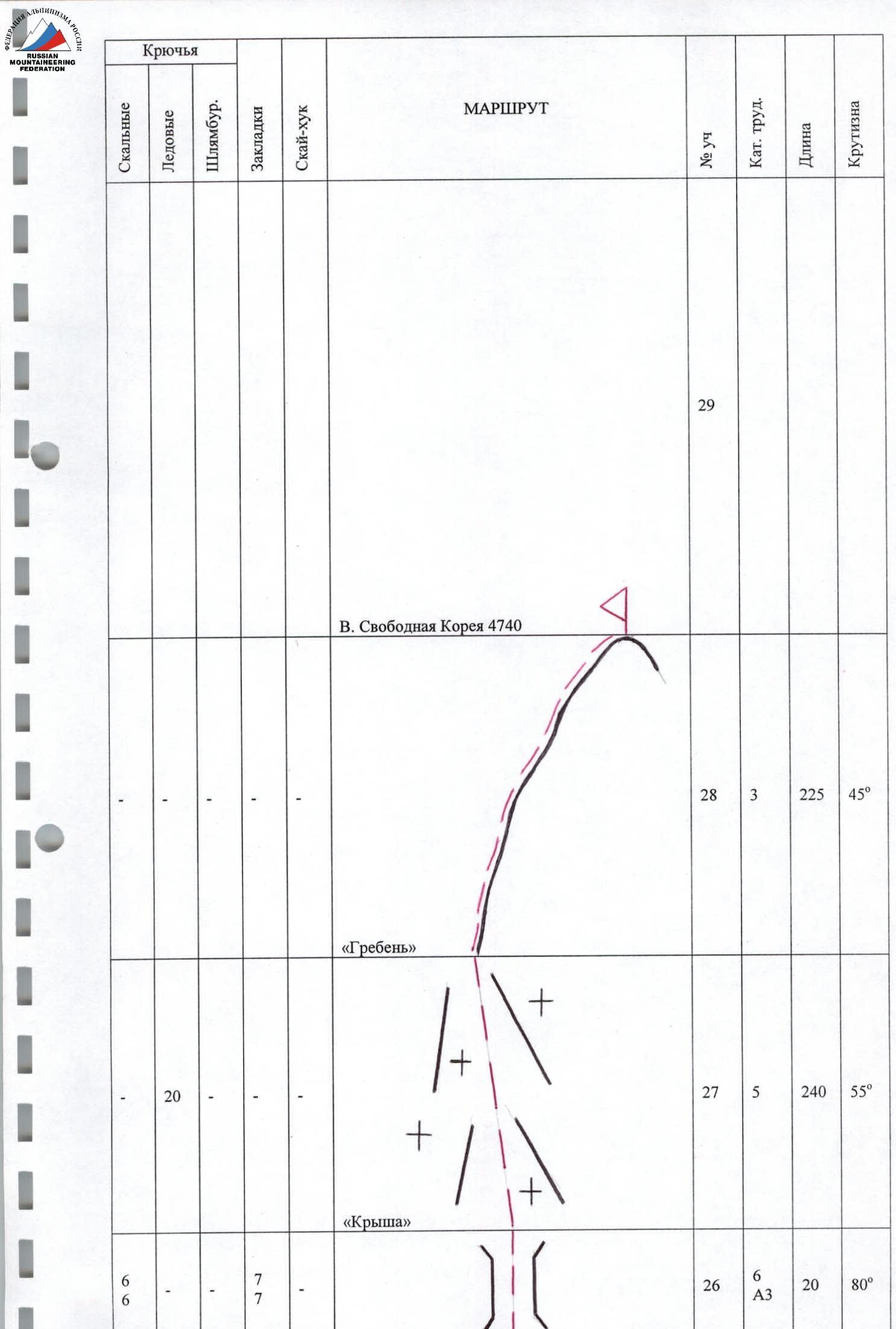
| Rock | Ice | Bolt | Cams | Sky-hook | ROUTE | Section # | Category | Length | Steepness |
|---|---|---|---|---|---|---|---|---|---|
| V. Free Korea 4740 | 29 | ||||||||
| «Ridge» | 28 | 3 | 225 | 45° | |||||
| «Roof» | 27 | 5 | 240 | 55° | |||||
| 6 | 7 | 26 | 6/A3 | 20 | 80° | ||||
| 6 | 7 |
Route Description by Sections
A distinctive feature of the route is a large number of cornices, and the "grey slab" section is loose rock, which psychologically hindered the route's passage. The entire route was climbed with the organization of the first climber setting up fixed ropes and the rest of the team following on these ropes using jumar clamps. The first climber worked without a backpack on a double rope.
Section R0–R1. Simultaneous movement up a steep snowy slope of increasing steepness, leading to the bergschrund.
Section R1–R2. Steep ice slope turning into a steep ice groove with rock outcrops. The upper part is closed by a rock wall, iced and snow-covered. Protection: pitons, cams, ice screws.
Section R2–R3. Steep ice groove. Protection via ice screws.
Section R3–R4. Steep ice slope. Protection via ice screws.
Section R4–R5. A rock shelf running from left to right, iced and snow-covered. Available cracks are filled with ice. Rocks are of the "ram's forehead" type.
Section R5–R6. Inner corner. Cracks are filled with ice. Limited number of sites for intermediate protection. Protection: pitons, cams.
Section R6–R7. Steep ice slope abutting the start of the main rock wall. Protection on ice screws.
Section R7–R8. Inner corner going from right to left. Heavily snowed, rocks are iced in places. Protection: rock pitons, f-rends.
Section R8–R9. Steep, destroyed rock wall, iced. Difficult climbing using artificial terrain. Protection: pitons, cams. For reliability, one bolt piton is driven.
Section R9–R10. Steep, inclined shelf, iced, leading to the base of an overhanging rock wall. Protection on ice screws.
Section R10–R11. Overhanging wall with a slit is climbed using artificial terrain. Protection: pitons, f-rends, bolt piton.
Section R11–R12. Steep inner corner going left. Climbed using artificial terrain on f-rends. Protection on bolts.
Section R12–R13. Heavily destroyed inner corner, snow-covered, cracks are iced. The corner unfolds and turns into a rock wall, also heavily destroyed. Protection uses rock pitons, cams, bolt piton. The wall leads to an inclined shelf, iced. Bivouac site. 1st control point.
Section R13–R14. Steep rock wall with smoothed relief forms. Few sites for intermediate protection and artificial terrain are available and are unreliable. Climbing using artificial terrain is extremely difficult. For safety, bolt pitons were used. Some sections were climbed using sky-hooks. The route goes straight up for 5 m, then along a thin, deep crack slightly to the right towards a series of cornices.
Section R14–R15. Smooth wall with many small cornices. Difficult climbing using artificial terrain with sky-hooks. Protection: pitons, bolt pitons.
Section R15–R16. Overhang leading to a rock wall. The vertical wall is climbed along a thin crack going to the right towards an inner corner. Climbing using artificial terrain. Protection: pitons, bolts.
Section R16–R17. Movement along a grey inner corner. The central part is interrupted by a short rock wall with a small cornice. The corner continues and is closed by a large cornice at the top. This section has many loose blocks, making climbing tense. Artificial terrain. Protection uses cams, f-rends, bolt pitons, sky-hooks. Under the cornice is the second control point.
Section R17–R18. Cornice. Cornice overhang – 2 m. Climbed using artificial terrain. Thin rock pitons are used. Further movement is along an inner corner, cut in the central part by a steep, iced shelf. The corner leads to a spall.
Section R18–R19. From the shelf left – into an inner corner. The corner is interrupted by a 5-meter grey wall after ten meters. Then, another inner corner is again interrupted by a grey rock wall. This system of corners and slabs is climbed using artificial terrain, climbing is tense. A large number of loose rock gives an impression ("like falling tiles"). Protection: pitons, cams, bolt pitons, sky-hooks. Movement on this section is directed towards two large cornices, resembling "eyebrows". The path goes between them. Third control point.
Section R19–R20. Overhanging inner corner is climbed using artificial terrain. Protection: pitons, bolts.
Section R20–R21. Vertical grey rock slab cut by diagonal cracks is climbed using artificial terrain. Cams and pitons work well. Protection on bolt pitons.
Section R21–R22. Rock wall, snow-covered, with a series of cracks filled with ice. Difficult free climbing. Piton protection.
Section R22–R23. Inclined ice shelf. Climbed using ice screws. Protection on ice screws.
Section R23–R24. Rock wall with a diagonal crack leading from right to left. The base of the wall is vertical, then turns into an overhang. Many "living slabs". For climbing, f-rends and cams work well. For reliability, bolt pitons are used. The crack leads to an inclined shelf, iced.
Section R24–R25. Traverse to the right along an inclined, iced shelf without gaining height to the base of a steep inner corner.
Section R25–R26. Steep inner corner. The right wall of the corner is overhanging. Climbed using artificial terrain. Climbing is difficult. F-rends and large cams work well for climbing and protection.
Section R26–R27. Sheer wall, with a small chimney at the top. Climbed using artificial terrain. Protection uses pitons and cams.
Section R27–R28. System of steep ice couloirs and grooves. Protection via ice screws. Ice screws are used for climbing. Upon reaching the ridge – a snowy cornice.
Section R28–R29. Ridge, category 3 difficulty. Snow-covered in places. Protection is through outcrops. Movement is simultaneous in two pairs. Descent is via the ascent route.

Comments
Sign in to leave a comment