
ASCENT DOCUMENT 1576
- Ascent type: technical
- Ascent area, ridge: Tian Shan, Kyrgyz Ala-Too
- Peak, its height, ascent route: peak Svobodnaya Korea, 4740 m, via the North face
- Difficulty category: 6 (third ascent)
- Route characteristics: height difference — 1010 m; length of sections with 5–6 difficulty category — 995 m; average steepness — 78°
- Pitons hammered: for belaying: rock — 186; ice — 45; bolt — 2; for creating artificial anchors: rock — 12; ice — none; bolt — 7
- Number of climbing hours: 32 hours
- Number of bivouacs and their characteristics: 4
- August 18, 1982 — sitting on a rocky "forehead", poor;
- August 19, 1982 — sitting on a snowy-icy ledge, satisfactory;
- August 20, 1982 — sitting on a ledge using a hammock, poor;
- August 21, 1982 — semi-reclining on an icy ridge, good.
- Surname, name, patronymic of the leader, participants, and their qualification: Klykushin Gennadiy Stepanovich — leader — CMS; Stalmakhov Aleksandr Vasil'evich — participant — CMS; Kalyugin Konstantin Viktorovich — participant — CMS; Borodin Sergey Alekseevich — participant — CMS
- Team coach: Kalyugin Konstantin Viktorovich — CMS, 1st category instructor
- Date of departure on the route: July 18, 1982
Date of return from the route: July 22, 1982
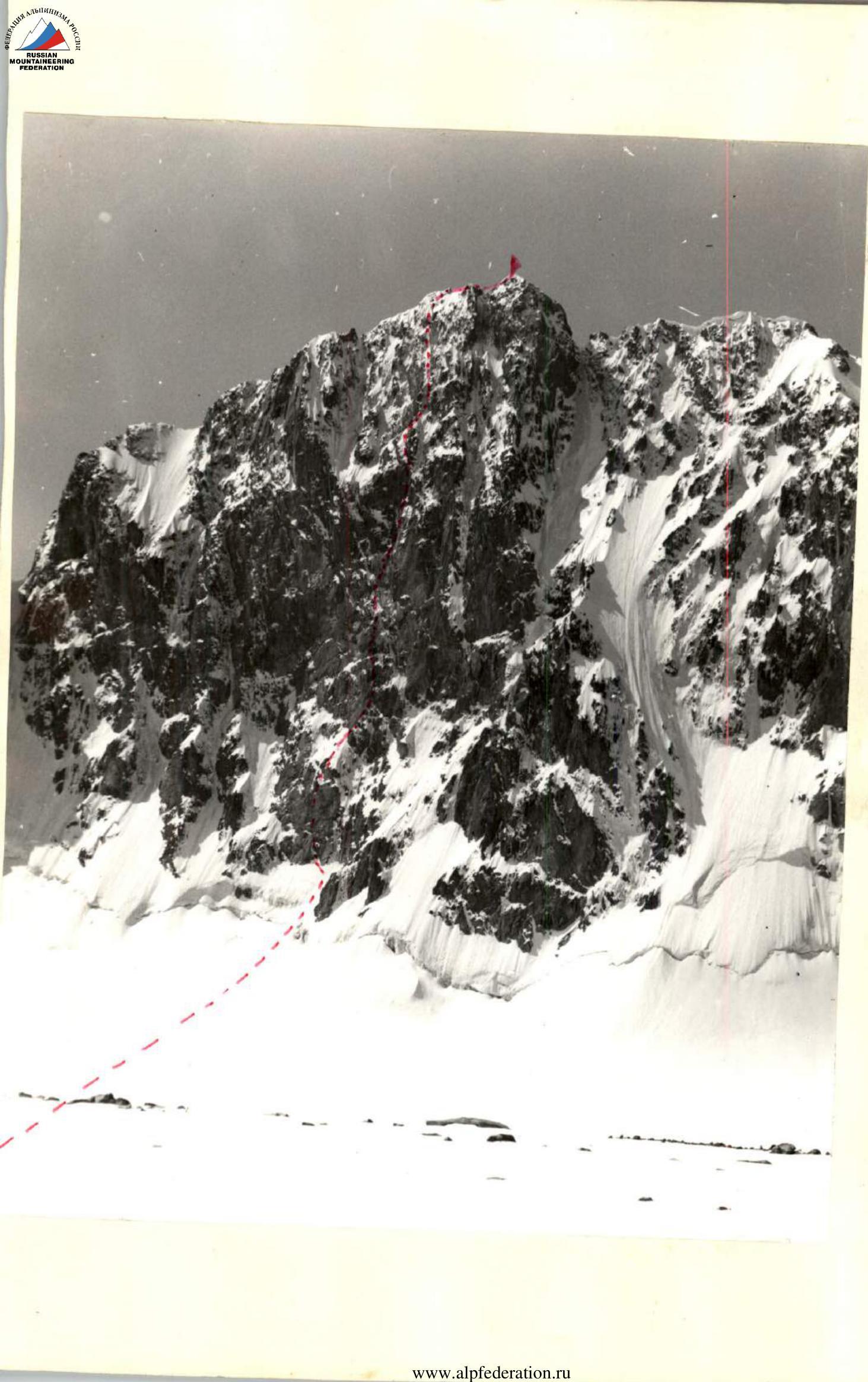
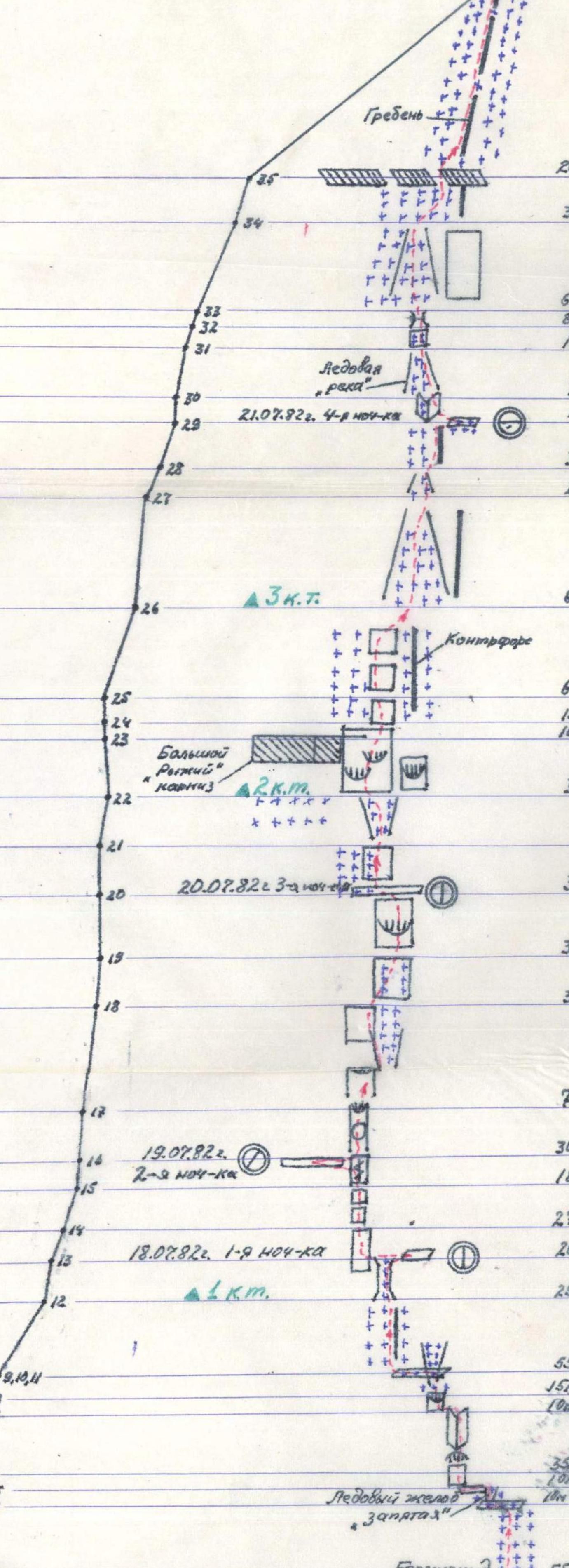
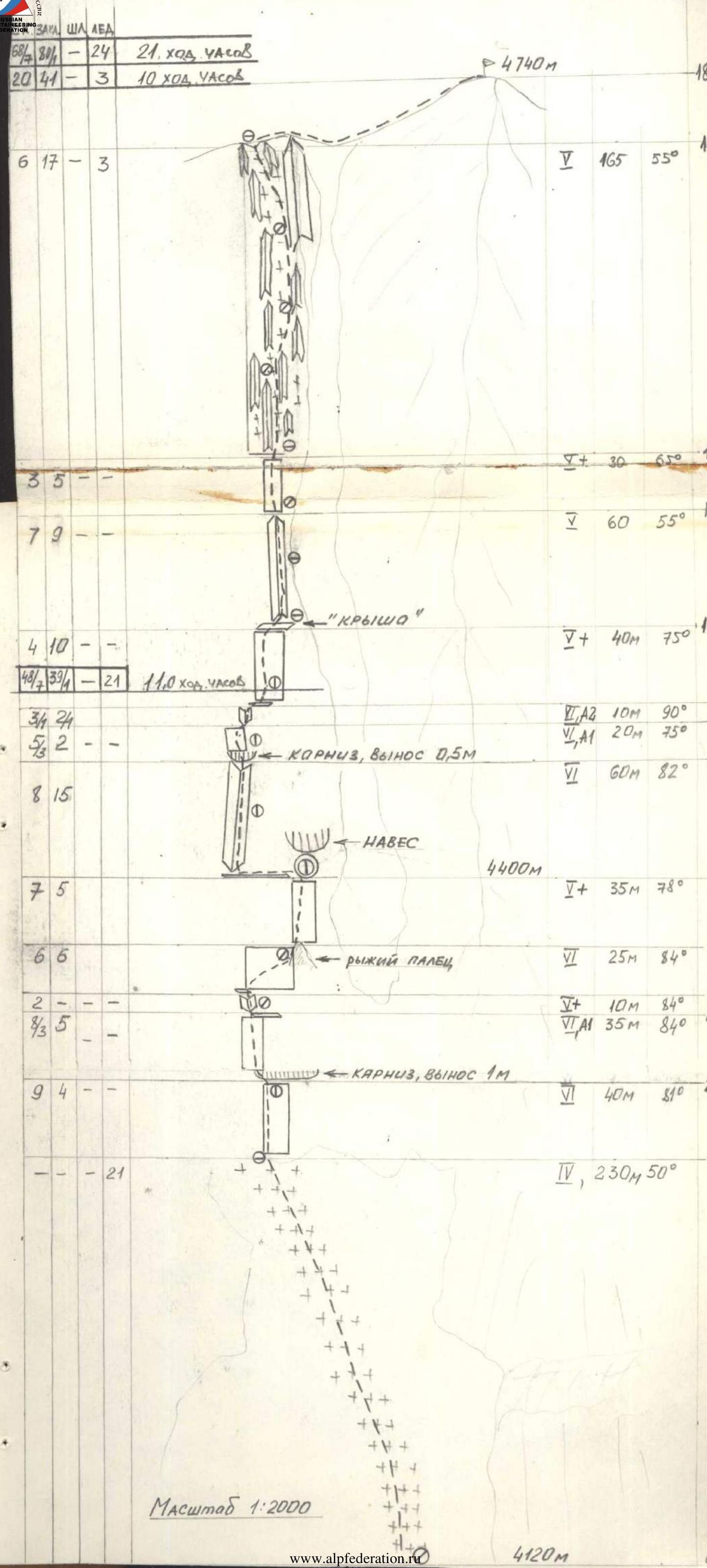
Profile diagram and sketch of the North face route of peak Svobodnaya Korea, 6th cat. diff. (according to UIAA)
TABLE OF MAIN CHARACTERISTICS OF THE ASCENT ROUTE
| Date | Designation | Average steepness, degrees | Length, m | Terrain character | Difficulty | Condition | Weather conditions | Rock | Ice | Bolt |
|---|---|---|---|---|---|---|---|---|---|---|
| I | 2 | 3 | 4 | 5 | 6 | 7 | 8 | 9 | 10 | 11 |
| July 18, 1982 | R0–R1 | 90 | 4 | Bergschrund | 6 | Good weather | — | — | 2 (x) | |
| R1–R2 | 65 | 55 | Ice slope | 5A | Dusty with snow | —«— | — | 3 | — | |
| R2–R3 | — | 70 | Traverse under an overhanging wall | 5B | Icy rocks | —«— | 5 | 3 | — | |
| R3–R4 | 80 | 10 | Ice chute | 6 | Thin, hard ice | —«— | 1 | 1 | — | |
| R4–R5 | — | 20 | Traverse along a ledge | 5A | Icy, snowy | —«— | 2 | 2 | — | |
| R5–R6 | 80 | 10 | Wall | 6 | Destroyed, icy | —«— | 2 | — | — | |
| R6–R7 | 80–85 | 35 | Inner corner | 6 | Icy | —«— | 7 | — | — | |
| R7–R8 | 90 | 10 | Wall with an overhang at the top | 6 | Destroyed | —«— | 3, 1 | — | — | |
| R8–R9 | 60 | 15 | Snow-ice slope | 4B | With protruding stones | —«— | 1 | 1 | — | |
| R9–R10 | — | 5 | Traverse of an ice couloir | 4B | Thin ice | —«— | 1 | 1 | — | |
| R10–R11 | — | 10 | Traverse along an inclined ledge | 5A | Icy | —«— | 2 | — | — | |
| R11–R12 | 60 | 55 | Rock-ice ridge of 1st cat. diff. | 5B | Dusty with snow | —«— | 5 | 3 | — |
Continuation of the table
| Date | Designation | Average steepness, degrees | Length, m | Terrain character | Difficulty | Condition | Weather conditions | Rock | Ice | Bolt |
|---|---|---|---|---|---|---|---|---|---|---|
| I | 2 | 3 | 4 | 5 | 6 | 7 | 8 | 9 | 10 | 11 |
| July 18, 1982 | R12–R13 | 80 | 35 | Chimney | 6 | Filled with ice | Good weather | 15 | — |
14:00–20:00 — organization of a bivouac and route processing. 40 m processed (sections R13–R15). Ice was chopped on a rocky "forehead", and a sitting bivouac for 4 people was organized. The site was clearly too small, and rest was poor.
| July 19, 1982 | R13–R14 | 70 | 20 | Smoothed wall | 6 | Few cracks for pitons | —«— | 5 | — | — | | | R14–R15 | 70 | 27 | Rocks of stepped structure | 5B | Dusty with snow | —«— | 6 | — | — | | | R15–R16 | 85 | 18 | Wall with a crack | 6 | Icy | —«— | 14 | — | — |
14:00–20:00 — organization of a bivouac and route processing. 70 m processed (sections R16–R18). With the help of wet snow, ice, and stones, a site for 4 people was shaped and chopped out. Bivouac was sitting, rest was satisfactory.
| July 20, 1982 | R16–R17 | 85–90 | 30 | Rock-ice couloir | 6 | Highly destroyed | —«— | 12, 1 | 2 | — | | | R17–R18 | 80–85 | 70 | Slab | 6 | Smoothed | —«— | 15 | — | — | | | R18–R19 | 85 | 30 | Cracked rocks | 6 | Destroyed | —«— | 9 | — | — | | | R19–R20 | 90 | 38 | Wall | 6 | With "live" large delaminations | —«— | 16 | — | 5 (xx) |
16:00–20:00 — organization of a bivouac and route processing. 60 m processed (sections R20–R22). On a narrow ledge (20–40 cm) and using a hammock made from a main rope, a tent was suspended. Bivouac was sitting, very uncomfortable, rest was very poor.
Continuation of the table
| Date | Designation | Average steepness, degrees | Length, m | Terrain character | Difficulty | Condition | Weather conditions | Rock | Ice | Bolt |
|---|---|---|---|---|---|---|---|---|---|---|
| I | 2 | 3 | 4 | 5 | 6 | 7 | 8 | 9 | 10 | 11 |
| July 21, 1982 | R20–R21 | 90 | 30 | Wall | 6 | Smoothed, destroyed | Good weather | 8, 1 | — | — |
| R21–R22 | 80 | 30 | Rock-ice couloir of 2nd cat. diff. | 5B | Many "live" stones | —«— | 2 | 2 | — | |
| R22–R23 | 95–100 | 35 | Overhanging wall with cornices | 6 | Monolithic | —«— | 7, 13 | — | 8 (xxx) | |
| R23–R24 | 90 | 10 | Smooth wall | 6 | Monolithic | —«— | 4 | — | — | |
| R24–R25 | 90 | 15 | Delamination | 6 | Destroyed | —«— | 4 | — | — | |
| R25–R26 | 70 | 60 | Rocks of block structure of 3rd cat. diff. | 5B | Icy, destroyed | —«— | 9 | — | — | |
| R26–R27 | 70 | 60 | Ice chute | 6 | Hard, thin ice | —«— | 6 | 5 | — | |
| R27–R28 | 65 | 20 | Rock-ice chute | 5B | With protruding stones | —«— | 3 | 2 | — | |
| R28–R29 | 70 | 30 | Boundary of rocks and ice | 5B | Hard, thin ice | —«— | 13 | 3 | — |
18:00–20:00 — organization of a bivouac. A site for 4 people was chopped out in the ice. Bivouac was semi-reclining — the best on the route. Rest was good.
| July 22, 1982 | R29–R30 | 85 | 15 | Inner corner | 6 | Icy | —«— | 3 | — | — | | | R30–R31 | 80 | 30 | Ice "stream" | 5B | Thin, hard ice | —«— | 1 | 4 | — | | | R31–R32 | 70 | 15 | Wall | 5B | Icy | —«— | 3 | — | — | | | R32–R33 | 65 | 8 | Inner corner | 6 | Icy | —«— | 3 | — | — | | | R33–R34 | 65 | 60 | Ice couloir | 5B | Thin, accretion ice | —«— | — | 8 | — | | | R34–R35 | 70 | 30 | Rock-ice slope with a cornice | 5B | Dusty with snow | —«— | 1 | 4 | — | | | R35–R36 | 35 | 200 | Snow-rock ridge | 3B | Protrusions | —«— | — | — | — |
12:00 — peak Svobodnaya Korea. Descent to Top-Karogay gorge. 19:00 — return to "Ala-Archa" tourist center.
Note.
- (x) Used for bivouac organization (belaying)
- (xx) Used old bolt pitons for bivouac organization (xxx) 5 old bolt pitons were used for passage
- A large number of pitons used on sections R12–R13, R15–R16, R19–R20, R28–R29 was due to bivouac organization.
- Column 9 indicates the total number of pitons and chocks.
Team captain  G. S. Klikushin



















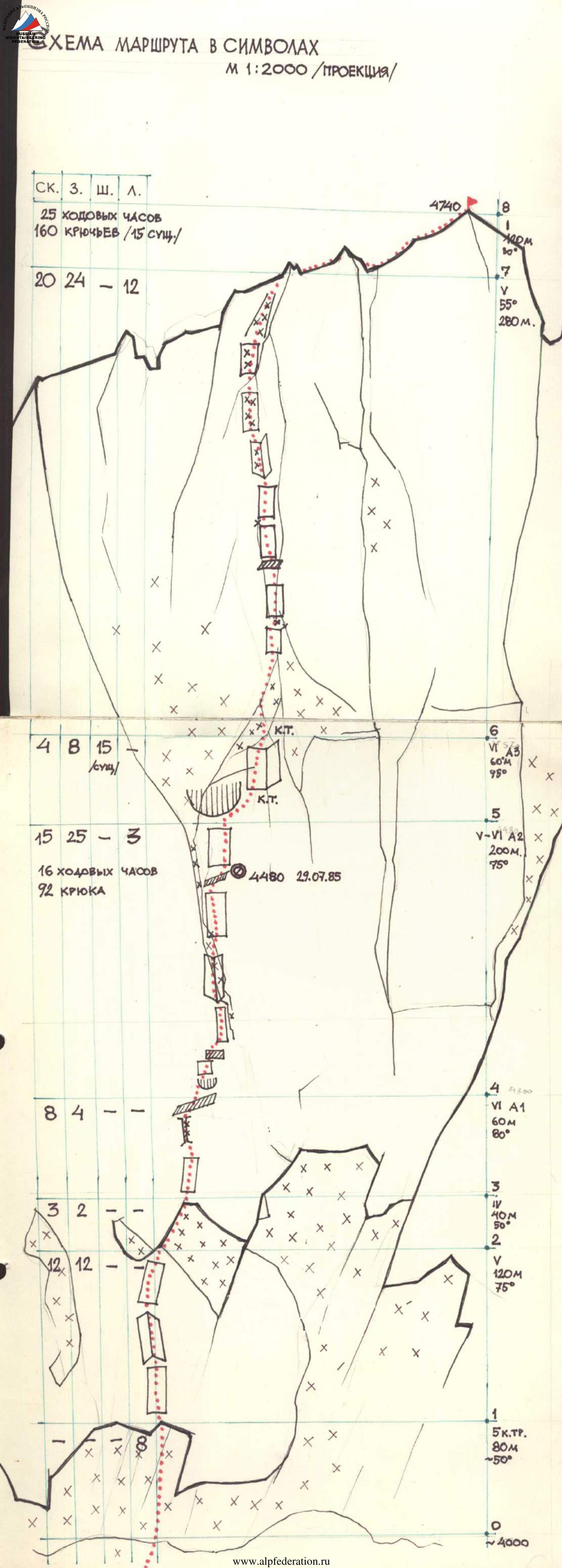
DEBRIEFING PROTOCOL
Debriefing protocol of the ascent to peak Svobodnaya Korea via the North face, 6th cat. diff. (Popenko route), by the team of the Ukrainian Sports Committee, carried out within the framework of the USSR Alpine Championship, technical category, during June 29–30, 1985.
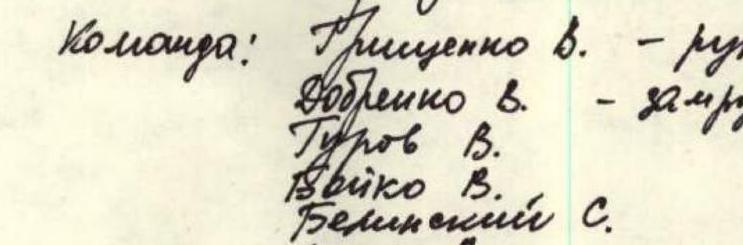
Present: Team: Gritsenko V. — leader Dobrenko V. — deputy leader Turov V. Viyko V. Belinskiy S. Lyapun A. Coach: Tolstousov A. Judges: Tur V.I. — chief judge Korshunov D. Pogorskiy V. Shalygin A. Akimenkov M. Parfenenko V.
Debriefing was led by the 1st releasing, team leader Gritsenko V.I.
Gritsenko V.: The team worked well. In the season, routes of 6th cat. diff. were climbed on peak Chapdara (monogarova) and a first ascent of 5B on peak Agamman. They prepared for the ascent on peak Svobodnaya Korea and wished to climb one of the complex routes of 6th cat. diff., leaving the Popenko route as such. Briefly on tactics: the main option was to pass with one bivouac, which was achieved. Route condition: unsatisfactory, the route is objectively hazardous due to stones. The route was started at 5:00 by links with leading climbers working alternately — Turov, Gritsenko, Dobrenko, Boyko, Lyapun — worked at 14:00. On the route, the first 5 people worked. No comments on the sections. Descent was conducted via the ice couloir "Moy" as planned. The route corresponds to 6th cat. diff. throughout, one cannot relax.
Turov V.: The route is indeed hazardous due to many delaminated slabs. Much time was spent organizing safe passage. The route is better climbed in colder weather. Now is not the best time for passage.
Boyko V.: The route is not very well-pitoned by previous climbers — a menu of pitons. The team worked well and accurately.
Korshunov D.: How was the bivouac? Gritsenko V.: Semi-reclining. Boyko processed a large cornice, and the rest prepared sites for everyone. Korshunov D.: When observing, it seemed that the team was trying to pass the cornice via two options? Boyko V.: There are two options for approaching the cornice, but the passage of the cornice is unambiguous. Akimenkov M.: What time did you depart at 24:00? Gritsenko V.: At 8:00. Shalygin A.: What were the options for emergency situations? Tolstousov A.: Emergency situations were discussed by all 3 teams before the ascent, which is reflected in the minutes of the representatives' meetings. Parfenenko V.: What equipment was used — in particular, ropes? Gritsenko V.: Ropes — 3 imported with the UIAA sign and one domestic. Friends were used. There were AUSTRI pitons, 2 ice axes, and crampons for everyone. Korshunov D.: What explains the increased tempo on the 220th day? Gritsenko V.: Passage of the cornice and exit to a more gentle part of the route. Akimenkov M.: Approximately up to what height is the wall beaten? Gritsenko V.: The bottom up to section 3 and on the wall is dangerous due to the high destruction of rocks. Korshunov D.: Did you see the team from the RSFSR, their ascent — how did it affect your team in terms of competition? Gritsenko V.: Calmly. We understood that it was an ascent, not a race. Akimenkov M.: What bivouac equipment did the team bring? Gritsenko V.: Raincoats, sleeping bags, care mats — mostly individual. Parfenenko V.: How was radio communication carried out? Gritsenko V.: Regularly. The team had "Lastochka" radios.
Gritsenko V.I.: The ascent is counted for you, the leadership agrees.
The protocol was recorded by: Olov / Tolstousov

Comments
Sign in to leave a comment