
Ascent Passport
- Climbing category — technical
- Climbing region — Tian Shan, Kyrgyz Ala-Too Range
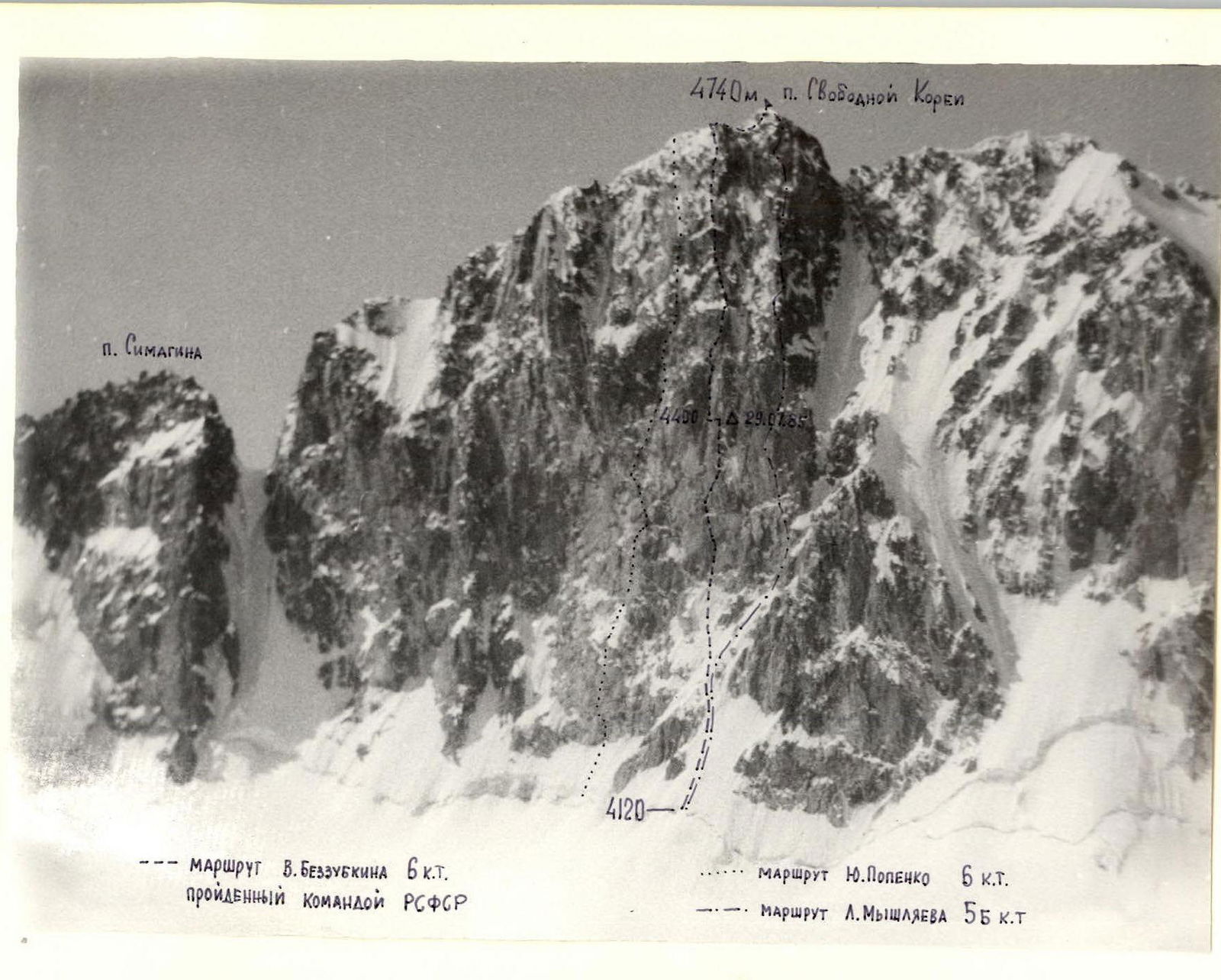
- Peak Svobodnaya Korea, 4740 m, via the center of the North face, combined
- Complexity category — 6
- Route characteristics: height difference — 620 m length of sections with 5B–6 complexity category — 305 m average steepness — 62.5°
- Pitons driven: rock: 68 ice: 24 bolted: 0 used chocks: 80
- Duration — 21 hours
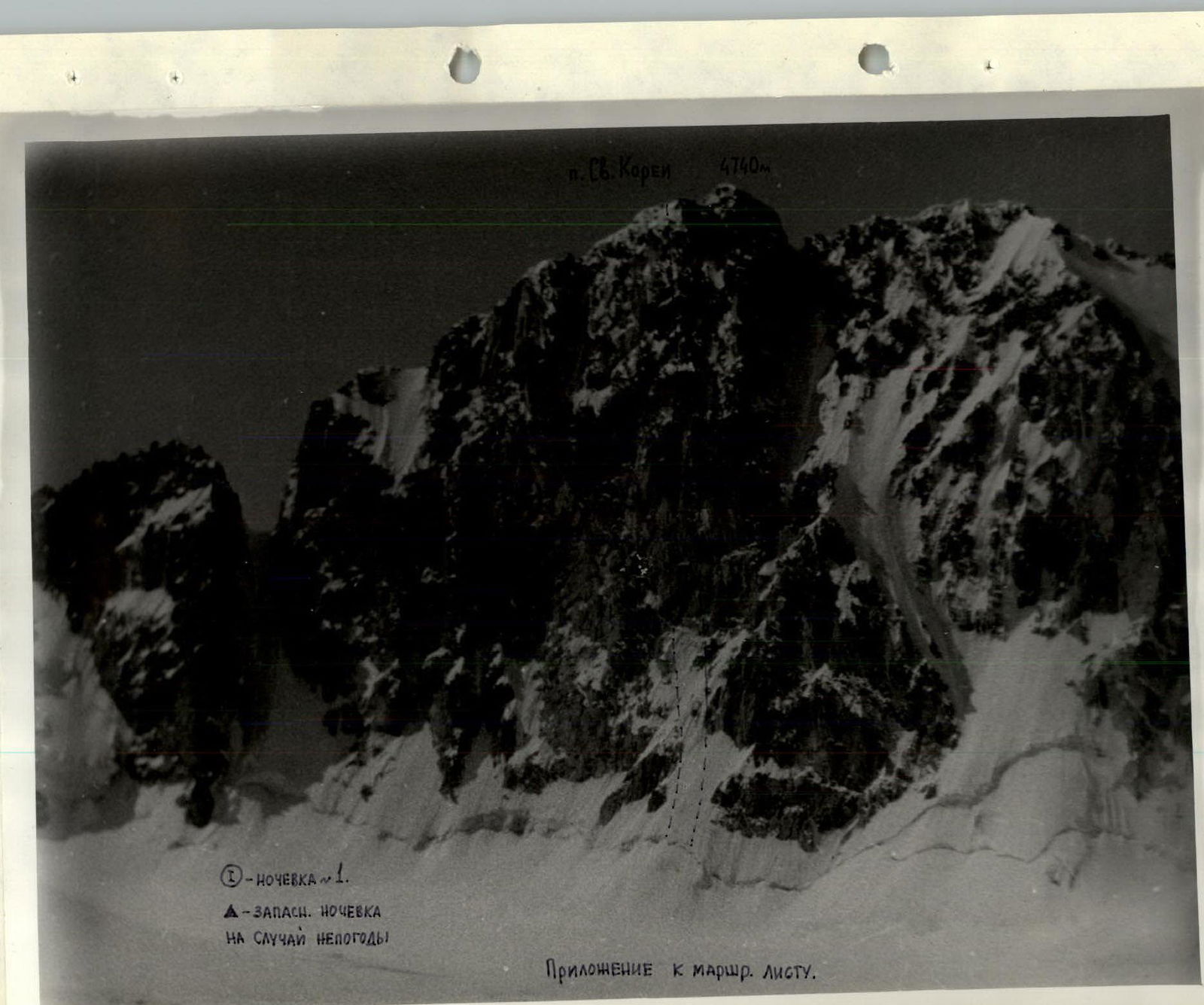
- One bivouac, hanging in hammocks
- Pershin Valery Nikolayevich — Master of Sports, leader Lebedikhin Alexey Veniaminovich — International Master of Sports Efimov Sergey Borisovich — International Master of Sports Vinogradsky Evgeny Mikhailovich — International Master of Sports Mamaev Sergey Vladimirovich — Candidate Master of Sports Ostanin Viktor Vasilyevich — Candidate Master of Sports
- Team coach — Bryksin Valery Mikhailovich
- Departure to the route — July 29, 1985 Summit reached — July 30, 1985 Return — July 31, 1985
- Organization — RSFSR team.
July 31, 1985. Alp. base "Ala-Archa"
Protocol of the ascent review
RSFSR team on peak "Svobodnoy Korei" via the center of the north face, 6th complexity category, completed on July 29–30, 1985, in the following team composition:
- Pershin V.N. — Master of Sports, team leader
- Lebedikhin A.V. — International Master of Sports, deputy leader
- Efimov S.B. — International Master of Sports, participant
- Vinogradsky E.M. — International Master of Sports, — "—
- Ostanin V.V. — Candidate Master of Sports, — "—
- Mamaev S.V. — Candidate Master of Sports, — "—
Present: coach Bryksin V.M., the team in full strength, championship judges, participants of the Sverdlovsk gathering, representatives of other teams.
Pershin V. — "After the 'school,' the team went to the Ak-Sai glacier to review the routes of the 6B complexity category. The condition of the routes seemed good. By lot, the team was assigned to climb the Bezzubkin route."
The tactical plan provided for passing the lower part by 8:00. We left the tents at 4:10. By 8:00, we approached the rock wall, having completely passed the dangerous ice slope. Lebedikhin was the first to work on the ice. The team's tactics are traditional — the first climber goes with a double rope (one of them is 12 mm with a UIIA mark, the other is domestic 10 mm). The domestic rope is fixed as handrails. The rest of the team members move along the handrails with top or bottom belay, typically using two jammers. On the rocks, V. Pershin went first (the lead climber on this ascent always worked with a shock absorber). Pershin worked through 4 very steep pitches and reached the planned bivouac site. Then, the Efimov – Mamaev rope team processed 3 pitches. The entire rock bastion has a very high steepness, unfortunately, some rocks are fragile, and there are large "live" blocks. From the bivouac at 8:00, the Ostanin–Mamaev rope team moved up along the processed ropes. Having moved 15 m higher, Mamaev had to stop because large stones could fall on the climbers below due to the rope movement. Until everyone gathered together in a safe place, Mamaev had to stand. By 13:00, he reached the top of the rock bastion and then climbed another 3 pitches. In a safe place, we had tea and continued moving. Then, Pershin processed 3 pitches along the ice slope with rock outcrops. Lebedikhin was the first to climb the final pitch leading to the ridge. Insurance points on the ice were organized using paired ice screws, on the rocks — through 3–5 blocked points. Ladders for passage were used only a few times, mainly on wet rocks. The terrain allowed for free climbing. At 18:30, we reached the summit and began descending into the Top-Karagay gorge (according to the main variant of the tactical plan). By 21:30, we descended to the moraine.
The route is complex, especially the middle part — it is a very steep wall, unfortunately, not the entire route has equally strong rocks.
The team is cohesive, all participants are from the 1983 USSR Championship. Everyone can lead, although E. Vinogradsky has a hobby — he is a "vybivayushchiy" (hook remover).
On the route, we conducted a goniometric survey. It turned out that 8 pitches of the wall have an average steepness of 80°. Efimov S. — "The team prepared for the Championship directly. The training plan is attached. We reviewed the 6th complexity category routes on 'Svobodnaya Korea' in person. The route profile provided by the judges somewhat puzzled us, so we decided to conduct a goniometric survey with the EV-I device along the route. Based on these data, the route profile was built. According to the tactical plan: we knew the team's strengths, knew that the team's speed on a route of such complexity is approximately 1 hour — 1 pitch. And although we could have climbed higher in a working day, for safety reasons, we chose this specific bivouac site under the cornices. We processed 3 pitches, but from above, ice was dripping and starting to fall, so we didn't hang the fourth pitch. Regarding the work of the lead climbers: Pershin and Lebedikhin worked well as lead climbers — they are high-class "zaboyshchiki" (lead climbers). We implemented shock absorbers — we believe they are necessary. We wanted to climb a new sixth category route for everyone, but the lot didn't allow it. Warm weather led to a deterioration in the route's condition — it became more prone to rockfall. The route has not become easier over the years, and that's pleasant. Nutrition is standard — two hot meals and a snack in individual bags. The route is undoubtedly of the sixth complexity category, it is a complex route — one of the most challenging in this region. We didn't leave our pitons on the route; we also mostly removed others. All the equipment taken on the route (except for drill bits) was used during the ascent." Akimenkо M. — "Is the upper part of the route exposed to rockfall?" Efimov S. — "Yes, the lower part of the 'roof' is slightly exposed to ricocheting rocks from the couloirs." Akimenkо M. — "Where did the stones fall from on the Popenko route?" Efimov S. — "Obviously, they thawed out in the upper part of the 'roof'." Korshunov D. — "Does the presence of competing teams on neighboring routes affect the team's psychology and morale?" Efimov S. — "It doesn't affect us at all; we didn't even think about it." Mamaev S. — "The route is steep and crumbling, the condition is not the best." Vinogradsky E. — "In the team, you feel confident; the pitons hold well; we had to work hard to remove them. The team passed the route with a significant safety margin." Lebedikhin A.V. — "The team drew up a tactical plan that ensured maximum safety of the ascent at a sufficiently high speed of passage. By the time we reached the planned bivouac site, the team had been working for 2 hours. The participants approached the ascent in good physical condition. Maintaining the high performance of the participants over several days of the ascent is one of the ways to improve the safety of the ascent. The route was climbed by the team in good style." Bryksin V. — "The team followed the route according to the tactical plan. The team's actions on the route were correct and competent; they adapted to the changing situation on the route. I consider that the ascent was completed in accordance with the 'Rules'; it is necessary to credit the participants with the ascent and the leader with the leadership, as well as to prepare an ascent report for submission to the USSR Championship judging panel."
The review was conducted by coach Bryksin V.
The review was recorded by A. Lebedikhin.

Comments
Sign in to leave a comment