
Report
On the ascent of Peak "Svobodnaya Koreya" via the center of the North Face, submitted for the USSR Climbing Championship in the 1969 season
Team from the Krasnoyarsk City Committee for Physical Culture and Sports
July 1969
Team Captain (V. Bezzubkin)

ROUTES OF ASCENT:
- 1961 – route by L. Myshlyaev
- 1966 – route by B. Studenin
- 1969 – route by V. Bezzubkin
- 1969 – route by A. Kustovsky
General view of Peak "Svobodnaya Koreya" from the north
I. Description of the Route
July 16 – July 18
At 8:00 AM, the assault group (Valery Bezzubkin, Yuri Andreev, Slava Lyakh) and the observation group (V. Govorin, V. Abakumov, A. Sakash, B. Bogaev) set out towards the Ak-Say glacier under the farewell wishes of the entire camp. The wishes from both those seeing them off and those being seen off boiled down to one thing: "Good weather!"
The path ahead was not easy, but the heavy backpacks made them reconsider their carefully selected supplies of food, warm clothing, and "hardware," ensuring that the backpack weight did not exceed 20 kg upon departure. "Non-essential" items were considered to be ropes and fuel for the "Febus." V. Sukhanov, V. Ushakov, and V. Ponomarev remained in camp to resolve several issues related to the educational process.
The base camp was established on the left-bank moraine of the Ak-Say glacier earlier during training exits. Tents were set up so that the North Face of Peak "Svobodnaya Koreya" was always in view.
With a 15x binocular and a 20x telescope, they observed the face one last time. They rechecked their previous multiple observations: possible paths for rockfall, details of overcoming specific path sections, and especially the section for the third day of the route (a 75-meter-long inner corner and a large overhanging cornice).
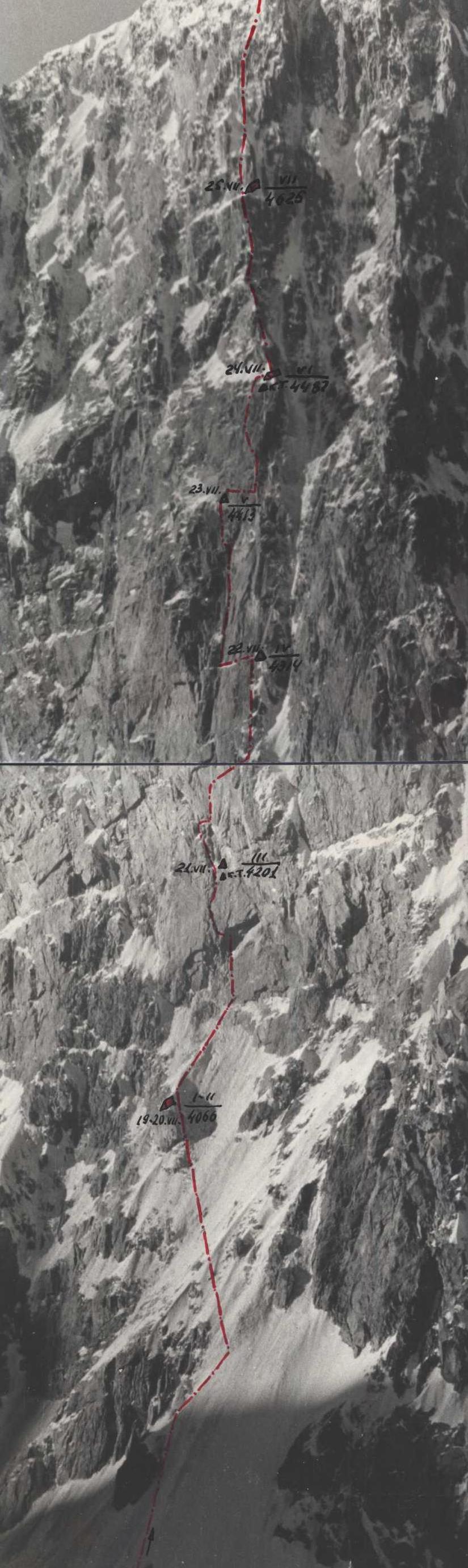
Photo 1. The ascent route of the Krasnoyarsk city team (1969)
Even from a close distance and with high magnification, the face seemed daunting, as it had deterred many who had intended to climb it.
At 5:00 PM on July 17, Viktor Sukhanov, Volodya Ushakov, and Viktor Ponomarev arrived. Now, the entire assault group was assembled.
Towards evening, clouds approached from the Ak-Say "podkova." They understood that every day counted. Thus, the captain decided not to deviate from the planned schedule, and July 18 was dedicated to final observations of the route.
The face was within clear view, eliminating the need for a special exit. The challenging part could be crossing the bergschrund (since it had partially collapsed but the snow-ice bridge they had used on L. Myshlyaev's route to the face still held), followed by a path up the ice slope to the face with a significant gain in height.
They planned to ascend early in the morning, as a daytime descent could be dangerous. Hence, no preliminary route processing was planned.
They decided:
- On July 19, 1969, early in the morning,
- according to the tactical plan,
- to start the assault on the North Face via the center immediately.
In the evening, they reviewed all provisions, equipment, and personal items again. An inventory of each backpack was made and placed in the flap; upon changing in the rope teams and pulling up backpacks, they would need to swap backpacks. They once more cross-checked with the observers the route photographs divided into 25 sections by horizontal lines (they would use these horizontals and route lines to correct their location).
At 5:00 PM, their small camp fell silent.
Notes
I. A route profile (Fig. 1) is appended to the route description.
II. Figures 2–7 are appended to the description of each day, indicating:
- sections of the route covered per day;
- a cross-section along the path of the assault group (profile of the given section).
III. During the ascent, a diary was kept, recording daily outcomes:
- time taken to cover the path;
- nature of the route;
- number of meters covered;
- number of pitons driven;
- weather conditions;
- departure and bivouac stop, among other data.
July 19. Day 1. We set off at 1:30 AM. The observers were already awake, with primuses buzzing and breakfast ready. Preparations and breakfast didn't take much time. At 2:00 AM, we left the cozy base camp. Where would we spend the next night? The moonlit night was clear. We crossed the glacier and moved simultaneously up a snow slope with a steepness of 55° (Section 1), leading to the bergschrund clearly outlining the lower part of the North Face's ice slope of the peak. The snow was dense, and cutting steps was laborious; the first person often changed. On the rightmost part, avalanches and rocks were falling throughout the day; to the left, there was a reddish patch from which rocks occasionally fell. The route line was safe, but we were in a hurry. The bergschrund (Section 2) gaped with a deep crevice, partially filled with ice and snow, about 1.5 meters wide, with a very thin bridge. The opposite side was a 3.5-meter vertical ice wall transitioning into an ice slope. To facilitate and make the bergschrund passage safer via the snow-ice bridge, the first person removed his special backpack. Everyone put on crampons and carefully crossed the bergschrund.
Within 30 minutes, the first rope team reached the ice slope with a steepness of 65–70° (Section 3), leading to the ice ridge ("knife").
We moved alternately, organizing insurance through ice screws (photo). The slope was steep, sometimes reaching 75°, but crampons held well. Moving left upwards, we reached the ice ridge, which led to the sheer rise of the rocks.
The weather deteriorated. Strong wind with snow, poor visibility, and fog. 10:00 AM.
We all gathered on the ice "knife"; it was pointless to continue in such weather. We decided to wait out the bad weather, as our tactical plan had identified several spots on the face for potential bivouacs in case of bad weather. One such spot was planned on the ice "knife."
We cut out a platform, set up a tent, and spent 2 hours on construction work and organizing insurance, driving 8 ice screws. The tent was up. We prepared lunch and rested.
We assessed our progress. The first day's plan was not fulfilled due to bad weather. However, having processed the snow slope, bergschrund, and ice slope (totaling 499 meters) and having climbed 426 meters above the Ak-Say glacier level in 8 hours of continuous work, boosted our confidence in success. The first day's movement speed was 62.4 m/h. Morale was high. 8:00 PM. We slept.
July 20. Day 2. Throughout the night, strong winds tried to rip our tent apart.
During the day, the weather remained unchanged: wind, snow, dense cloud cover, and variable visibility. We stayed in the tent. Observers tried to keep our spirits up, sharing news via radio and stamping out humorous words on the glacier's snow, which we read with laughter when visibility improved.
At 2:00 PM, the wind subsided. Yuri Andreev and Viktor Ponomarev's rope team exited to process the ice "knife" and hang ropes down to the face. They covered 30 meters of the ridge. The weather worsened again with strong wind and snow, but they decided to push on towards the rocks.
The ice ridge (Section 4) with a steepness of 75–80° required about 2 hours of strenuous work to process. Movement was on the front points of crampons, cutting steps, and insurance via ice screws. To ensure safe movement over 50 meters, 8 screws were driven. 5:00 PM – we were all back in the tent, in the same spot.
The day's outcome: the ice "knife" was processed, with a length of 50 meters, and ropes were secured. The average speed of passing the "knife" was 25 m/h. In the evening, the wind died down, and it cooled. A good sign. The weather would improve. 8:00 PM – we slept.
July 21. Day 3. 7:00 AM.
A clear, frosty morning. We set out. Within 30 minutes, Valery Bezzubkin and Yuri Andreev's rope team moved along the hung ropes using "abalazans."
Valery began processing the start of the face (Section 5), essentially the beginning of the face's middle section. It was slightly less steep (average steepness of 85°) than the subsequent section but was the first to receive water and snow falling from above.
Section characteristics:
- Only smooth, almost vertical slabs were ice-free; ice covered most rocks, sometimes forming nearly vertical flows.
- Often, the ice axe's pick would pierce the ice cover and get stuck.
- If ice broke off, often with rocks, it revealed weak rocks.
- Cracks were filled with ice and fine debris.
- Only long, shovel-shaped and ice screws deeply seated in cracks seemed reliable.
Passing this section required both technical skill and caution. The first 20 meters were particularly challenging.
Valery's actions:
- Complex climbing on a double rope with careful insurance, finding and clearing rare holds of ice and frozen snow, he covered 30 meters. There were still 3–5 meters of difficult climbing.
- Afterward, he managed to stand on a sloping ledge, organize insurance, and drive the first piton. He accepted Yuri.
On the ledge:
- He sat in a "harness" as standing was impossible due to the slope.
- Accepted and released Yuri further.
Further path:
- Was no easier: an отвесную стенку с малым количеством залитых льдом зацепок.
- There were cracks.
- The wall led to a cornice.
- Yuri, using ladders, passed the remaining wall section to the cornice.
The cornice (Section 6), 2.5 meters long, overhung above, covered in ice. Using ladders and "zailtzugom," Yuri passed the cornice in 1 hour 30 minutes. At the exit, where the cornice transitioned into a sheer wall, he drove an ice screw and hung a platform. Standing on it, Yuri accepted Valery.
Others:
- Pulled up backpacks,
- stood or sat in "harnesses,"
- patiently waited.
The weather was turning gloomy. Cloud cover.
Upwards and to the right, a smooth, practically sheer wall stretched. To the left began an inner corner, 15 meters long and 87° steep (Section 7), slightly inclined to the left and covered with 10–15 cm thick ice flow. There were no cracks. Valery drove a piton, hung a platform, and began processing the entrance to the inner corner. Much effort and time were spent carefully chipping away ice to avoid bringing down the entire mass. A spot was cleared, a hook was driven, and through strenuous climbing, using ladders in two places, he gradually passed the inner corner, continually clearing it of ice. In a niche formed at the junction of the inner corner and the wall, Valery organized insurance, sitting in a "harness." Yuri joined him via the ropes, using "abalazans." Yuri moved forward.
From the niche, the further path went straight up, initially along the right edge of the corner, then slightly left upwards. From this point (niche, end of Section 7 and start of Section 8), the passage of the main face section (Section 8) began, with a steepness very close to 90°, and in the upper part, the rocks overhung, all covered in ice. This section was traversed with complex climbing initially, then using ladders on the overhanging part, a platform, and for reliable insurance, two pitons were driven. In total, on this 25-meter section, 13 pitons were driven (including two ice and two pitons).
It took 4.5 hours for the entire group to pass these 25 meters and pull up the backpacks (using a 15-meter ladder for the overhanging section) to a narrow ledge where a bivouac was planned. The weather had further deteriorated: strong wind with snow, poor visibility, and a thunderstorm.
At 11:00 PM, we began organizing a bivouac. Despite the darkness, everyone had headlamps. Despite fatigue, a long working day, and bad weather, satisfied with the day's work, we spent another 1.5 hours setting up the bivouac.
The bivouac (photo 9) was on a narrow ledge, 20–30 cm wide, divided into two parts by an ice patch formed from accumulated ice flow and snow. Rocks overhung above and to the right. There was no space for everyone to gather; we organized a seated overnight in groups of three, using:
- 2 ice "stopper" hooks,
- 8 rock pitons (photo).
The thunderstorm passed; it became cold, but tomorrow would bring better weather! We prepared dinner on our knees. One notable aspect was the "Febus" stove; a mesh made from 3 mm wire was woven under it, with a wick attached to two opposite points. The wick could be worn around the neck or secured via a carabiner to the safety rope. Similarly, hermetically sealed pots were secured. Thus, we weren't worried about the "Febus" or pots falling.
While dinner was being prepared, we assessed our progress:
- In 16 hours of continuous, strenuous work in bad weather, we covered the most challenging part of the day (excluding the cornice).
- We processed 145 meters of the face.
- We climbed 135 meters vertically from the glacier's level.
- The day's movement speed was 9.1 m/h.
Dinner was ready. We shared part of it with the others via a block system. At 2:00 AM, despite the discomfort, we fell asleep like "righteous" people. We needed strength for the next day.
July 22. Day 4. 7:00 AM. The sun woke us. Until 8:00 AM, we warmed up and dried off. We had breakfast. On the niche under the overhanging rocks, we set the first control point. 8:00 AM. Time to communicate. We spoke with observers who shared news. They could see us clearly on the face, and we could update our location on the photographs several times a day.
Vladimir Ushakov and Slava Lyakh's rope team processed Section 9 by traversing left upwards. The rocks were of medium difficulty, covered in ice. Climbing was complicated by having to move in crampons; insurance was via pitons. Vladimir, having moved 20–25 meters, secured the rope at the base of a cauldron-shaped inner corner and set up ropes. Viktor Sukhanov and Viktor Ponomarev's rope team ascended via the ropes. Viktor Sukhanov, using complex climbing and cauldron technique, passed the cauldron-shaped inner corner (Section 10). Another meter of difficult path, and he reached a small overhanging wall, under which one or two people could stand on a ledge.
Climbing was hindered by ice flow, which constantly needed to be chipped away. Insurance was via pitons.
The section was very complex. It took 45 minutes to pass, with 4 pitons driven. Yuri followed Viktor up the ropes. Above was a flat, sheer wall (Section 11) with few holds. Initially, a small traverse right, 6 meters to a semblance of an inner corner, and then very complex climbing allowed a 10-meter ascent.
Further up, again upwards, overcoming a 5-meter section of rocks using ladders and a platform, Yuri reached a narrow ledge (photo 10). The ledge allowed rest. There were no cracks visible for the next few meters. A piton had to be driven. To ease the ascent for the rest of the group, a 15-meter ladder was dropped.
Using the piton, Yuri swung right along the smooth, sheer wall, then moved in a "Brownian motion" across the wall in search of a path:
- Initially upwards via very small holds,
- then a short traverse right,
- again upwards and right towards a meter-scale rock detachment ("finger").
Fortunately, it held firmly; three to four people could stand here, and all backpacks were pulled up (photo).
Further movement (Section 12) involved traversing 3 meters right, then again upwards. Climbing was very complex; rocks were of a large-block type. Climbing was further complicated by "live" rock blocks, from which there was no escape for those standing below at the "finger" (photo 11).
A short rock section (almost without holds) was overcome using ladders, and after a few more meters, Valery, moving first, reached an overhanging wall section where a bivouac was planned. A 15-meter ladder was dropped for the rest of the group. The ledge was narrow, with a width of no more than 40 cm in one place, but it was the only spot where everyone could clearly gather. However, it was occupied by a large stone precariously perched on the ledge. 5:00 PM. It was time to stop for the night. Together, we pushed the stone, which fell with a terrible crash, taking a cascade of rocks with it, significantly altering our just-passed path.
We spent some time improving living conditions:
- Secured the tent to pitons,
- previously widening the ledge using the main rope and platforms – fortunately, we had 6 of them.
It made for a fairly comfortable overnight, albeit seated. To organize insurance, foot loops, and suspend two hammocks (since two couldn't fit on the ledge), we drove:
- 6 pitons,
- 10 rock pitons.
As we worked on our second seated bivouac, Valery and Yuri decided to hang 15 meters of rope upwards to swing onto a narrow, ice-covered shelf visible 15 meters away the next day. Yuri, using ladders, climbed 15 meters up (photo), drove a piton, passed the rope through a loop made from the main rope, and descended back to us. The rope for the pendulum was hung. Everything was ready. We had dinner. Two rested in hammocks, while the others sat in tents (photo 13).
We assessed our progress:
- In 10 hours of continuous work, we processed 120 meters of the face.
- We climbed 113 meters vertically from our previous bivouac.
- The day's movement speed was 12 m/h.
Satisfied with our work (we were on schedule according to the tactical plan), we sang and chatted for a while. 8:00 PM – we slept.
July 23. Day 5. 8:30 AM. We set out on the route. The same excellent weather that had set in on July 22 accompanied us. We traversed the processed section pendulum-style left onto a narrow shelf (Section 13). The shelf was ice-covered. Gradually clearing the shelf of ice, we moved towards the inner corner.
The inner corner (Section 14) was very steep, then its walls became vertical, and at the end, the rocks slightly overhung, resting on a large cornice. At the junction of the two faces forming the inner corner, there was a crack extending to the cornice. Climbing was very complex; the walls were smooth, with few cracks (2–3). To pass a slab-like section, a platform, ladders, and a piton were used. For the rest of the group to pass this spot, a 15-meter ladder was used (photo 15). In total, on the 75-meter-long inner corner with a steepness of 87–90°, it took 5 hours 30 minutes. 19 rock, 1 ice, and 1 piton were driven. Insurance was organized sitting in "harnesses" or standing in ladders. Everyone gathered under the 3.5-meter cornice, and backpacks were pulled up. Yuri, using ladders, began "zaitsugom" to pass the cornice (Section 15), which threateningly overhung above us. The cornice couldn't be bypassed; to the right, its size increased, and to the left, it decreased but where it met the wall, the rock was heavily destroyed, making it dangerous to proceed. The cornice was passed in 2 hours. At the entrance, a tiny ledge was found, and a piton was driven for insurance reliability. Yuri accepted Viktor Sukhanov, and Viktor released him further. Others prepared to pass the cornice.
Above were again monolithic, smooth, hold-less rocks (Section 16), covered in ice. A crack sloped left, leading to an ice patch on a small ledge, formed from accumulated ice and snow. Here, another bivouac was planned. They decided to follow the crack. Passing this section required great technical skill. Mostly long, shovel-shaped pitons were driven. Yuri climbed this section and reached the ice patch. Ropes were secured. In total, it took 3 hours of walking time to cover 20 meters, with 7 pitons driven.
At 8:30 PM, the entire group assembled on the ice patch, and backpacks were pulled up. By then, it was clear that this was the best spot for a bivouac, and no better or even satisfactory ledge would be found. All hopes were pinned on a niche in the wall, but it turned out not to exist.
The rocks here were indeed overhanging, but the floor was a smooth, steep slab, and to make matters worse, water ran down the rocks. We decided, after driving two pitons on either edge of the ice patch, to carefully carve out a ledge in this ice flow. The ledge turned out narrow (10–15 cm), but wider was not possible. We extended the ledge with platforms and secured the tent: above on the ropes and below on the ice ledge using pitons. It was the best we could do for a bivouac.
We settled in for the night, hoping it would be our last seated bivouac; we were due to reach the counterfort the next day. One person slept in a hammock (photo 16) – there wasn't enough space for everyone.
In total, for the bivouac organization:
- 6 ice "stopper" hooks,
- 4 pitons,
- 4 rock pitons were driven.
We prepared dinner.
We assessed our progress: in 12 hours of continuous work, we processed 120 meters of the face, climbing 99 meters vertically from the previous bivouac. The day's movement speed was 9.1 m/h. As expected, this section proved to be the key part of our route. 10:00 PM – we slept.
July 24. Day 6. 8:00 AM. The "comforts" of a seated bivouac and the tangible proximity of the counterfort made everyone eager to start. Above the bivouac, the path went left along a steep, ice-covered slab with a single crack leading to an overhanging rock section. Viktor Ponomarev moved forward. He climbed 1.5 meters up the slab, then traversed 8 meters right to a narrow ledge under the overhanging rocks (Section 17). Using complex climbing and ladders, Viktor passed the overhanging section. Then, 5 meters up the wall, and he entered an inner corner that led through 40 meters under an overhanging stone.
Photography was challenging due to the constant complexity of the path and the inability to step back. Sometimes, Vladimir Ushakov or Viktor Ponomarev managed to capture 1–2 good shots, but it took a lot of time and effort.
While Viktor covered his section, the others dismantled the bivouac. Dismantling, like setting up, took a lot of time. In memory of our overnight, 4 pitons remained, to which the tent and rope were attached.
Having climbed 30 meters on a double rope, Viktor secured the ropes. Yuri Andreev and Viktor Sukhanov's rope team followed. They all gathered about 10 meters below the overhanging stone.
Then, Viktor carefully climbed right, driving an ice screw, passed the overhanging stone, and continued with complex climbing. He covered the last 10–15 meters and reached a good ledge (2.5 × 0.6 meters). Yes, here one could rest and gather together.
Backpacks were pulled up, and Vladimir Ushakov climbed last. His task was to extract pitons (Section 17).
This section, 55 meters in total, required 4 hours 30 minutes to pass, with 7 rock and 1 ice piton driven. Climbing was complex; rocks were solid.
Further (Section 18), upwards – a 10-meter wall with a slit, passed with complex climbing using the "repulsion" method and alternating hand and foot placements. A traverse right along heavily destroyed rocks covered in ice, and then along ice, cutting steps, we moved towards the counterfort. Section 18, 35 meters long and 85° steep, took 3 hours 30 minutes. 5 rock and 1 ice piton were driven. Complex climbing was complicated by searching for holds covered in ice.
The counterfort. Here, a bivouac was planned. 4:00 PM. Everyone reached the counterfort. Backpacks were pulled up. We decided to adhere to the tactical plan and organize a bivouac here, especially as we wanted to rest on a good platform after three seated and very uncomfortable bivouacs on the face. We needed to gather strength as two more days of challenging path lay ahead.
Here, we could properly set up a tent after carving out a platform in the ice. Although it was cramped for six in the tent, we could lie down and rest. We organized a bivouac with all technical conveniences.
During organization:
- 6 ice pitons were driven.
We prepared dinner.
We assessed our progress: in 8 hours of walking time, we processed 90 meters, climbing 74 meters vertically from our last seated bivouac on the face. The day's movement speed was 11 m/h. We were on track. We were due in camp by July 26. 8:00 PM – we slept.
July 25. Day 7. 8:00 AM. We quickly dismantled the bivouac and set the second control point. We set out, moving in rope teams as we had on the first day. The counterfort (Section 19) was quite steep (ice steepness reached 70°), representing a rock-ice section with 4 "giants" (rock steepness of the 1st and 2nd "giants" reached 65–80°, the 3rd – 80–87°).
Rope teams worked alternately, constantly using ropes. The first in the rope team climbed in crampons. When passing "giants," the person in front changed, as the second climbed without crampons.
The 1st and 2nd "giants" – rocks of medium difficulty – were passed directly, with piton insurance. Ice between "giants" was traversed on front points, sometimes cutting steps. Movement was alternating.
Despite the route's complexity, for us, after four days on the face, it was a pure delight to move along the counterfort.
However, despite the relative simplicity, we proceeded with maximum caution: after all, six days of very difficult work lay behind us.
The 3rd "giant" presented an unexpectedly complex task. Rocks were complex, slab-like, with an inner corner and an overhanging stone (15 meters), a vertical sheer wall with smoothed holds (20 meters) – all covered in ice. It couldn't be bypassed left or right as the ice was too steep.
We overcame the 3rd "giant" directly:
- With complex climbing and piton insurance.
- The first person passed this 35-meter section (with corrections from below, like "Left foot higher! Higher!").
- Ropes were secured.
- Everyone, using "abalazans," ascended to the top of the third "giant."
- Backpacks were pulled up.
- Viktor Ponomarev, our regular "piton remover," climbed last.
Ahead lay an ice ridge leading to an ice "giant." Slava Lyakh moved forward. Having climbed 6 meters along the ice ridge, he began to bypass the 4th "giant" (to the left) along the boundary between rocks and the ice slope. The 4th "giant" was passed.
Ahead lay an ice slope with rock outcrops, leading to the main ridge. The section was complex and extremely challenging. Organizing a good, comfortable bivouac on such a section was unlikely. It was 2:00 PM. We might not make it to the ridge before dark (as was confirmed the next day; it took 8 hours of good work to reach the main ridge).
Thus, we decided, despite the early hour, to organize our last bivouac. Slava secured the rope at the junction of the ice slope and the 4th "giant" and descended to us. We carved out a platform in the ice on the ice ridge under the "giant" and set up a bivouac.
The bivouac was located below the planned spot:
- under the 4th "giant," not beyond it;
- here was a convenient, good spot for the tent;
- beyond the "giant," as planned, would have required a seated bivouac, which was unreasonable.
During bivouac organization and for insurance, 8 ice pitons were driven. We rested. Prepared dinner.
We assessed our progress: in 6 hours of strenuous work, we covered 200 meters of the counterfort, climbing 138 meters vertically from the start of the counterfort. The movement speed was 34 m/h. We were due on the summit the next day. 6:00 PM – we slept.
July 26. Day 8. 7:00 AM. The weather was capricious again. Cloudy, intermittent snow, and wind. Viktor Sukhanov led. Everyone wore crampons. We bypassed the 4th "giant" via ropes (Section 20, photo 9). It was very challenging. Cutting steps, front points of crampons, and piton insurance. We moved along the boundary between rocks and a steep ice chute (Section 21, photo 20). Viktor climbed on two ropes. He moved initially along the left part of the chute, then along the right part for about 20 meters, followed by a traverse right to a sheer wall 4–6 meters high. Rocks were challenging. The wall was overcome directly, and movement continued up the rocks. The section, 20 meters long, was very complex, with rocks like "ram's foreheads" covered in ice. Ladders were used upon exiting onto the rocks. Backpacks were pulled up. Then, a traverse left, 10 meters along ice from one rock outcrop to another. It was challenging. Cutting steps and grabs for hands and feet, Viktor moved upwards. Another 15 meters of complex climbing, a traverse left 15 meters, and along the boundary between rocks and ice, he entered the main ridge. Everyone ascended via ropes. Backpacks were pulled up. We were on the ridge.
Movement along the ridge (Section 22) presented no difficulty. Within an hour, we were at the summit. 4:00 PM. We left a note. The weather worsened, with strong gusts of wind and fog. Visibility was nil. We waited it out. We fired two shots towards the Ak-Say glacier, as agreed with the observation group. In response, after some time, we heard return shots. Within 1.5–2 hours, everything normalized. The clear sky was above. It was quiet. Yes, "Koreya" once again made us understand that we shouldn't slack off.
We descended via route 4B category of complexity to the Top-Karagay glacier. On the evening of July 26, we returned to camp, where we were warmly welcomed.
The day's outcome: in 9 hours of walking time, we covered 250 meters of ice and rocks to the summit. The vertical ascent from the bivouac under the 4th "giant" was 106 meters. The day's movement speed was 27.8 m/h.
VIII. Table
Key characteristics of the ascent route:
Ascent route – Peak "Svobodnaya Koreya" via the center of the North Face – 4740 m Height difference of the route – 1100 m Route length – 1414 m Including the most complex sections – 435 m Steepness of the route/face – 75–85° Rucksack pulling – 420 m Walking hours – 69
X. Conclusion
Over 8 days (69 hours of continuous work, excluding one day of bad weather when the group had to wait out on a bivouac – July 20), only for the route passage, without organizing bivouacs, etc., the 1100-meter North Face of Peak "Svobodnaya Koreya" was traversed via its center.
The average steepness of the face was 75–85°.
The route length was 1414 m, including the most complex sections – 435 m. Over 498 m, backpacks were pulled.
There were days when the group's average movement speed was 9 m/h.
It is worth noting that no changes were made to the tactical ascent plan. The route itself was not altered from the planned one. The traversed route was significantly more complex than the right-hand variant (L. Myshlyaev's route, which we completed in July 1969 in 2.5 hours) and many other routes of 5B category of complexity in various parts of the USSR:
- "Dombay-Ulgen" (Western peak) via the NW face;
- "Dombay-Ulgen" (Eastern peak) via the NE face;
- "Dykh-Tau" (Main peak) via the NE counterfort;
- "Talgar" (Southern peak) via the W face;
- "Trud" peak from the "Kroshka" glacier via the W face;
- "Baylyan-Bashi" – ascent to the 5th tower via the NW face and further traverse of all towers;
- "Korona" (6th tower) via the W face;
- "Korona" (5th tower) via the SW face (a route completed in the 1968 season for the USSR Championship and ranking fourth in the class of technically complex ascents). It is also more complex than the route to the "Krumkol" peak via the NE and NW faces of 6B category of complexity, completed by a group of instructors from the "Bezengi" alpine camp: 1. Timofeev A.V., 2. Pepin A.M., 3. Rapaport F.A., 4. Kurkalov I.I., 5. Bezzubkin V.V. for the USSR Championship in the 1968 season, which received a prize in the class of technically complex ascents.
The relatively low number of pitons driven on the route of Peak "Svobodnaya Koreya" underscores the group's significant capabilities in traversing difficult sections via climbing. The number of pitons driven was sufficient to ensure safe passage.
Based on the analysis of the ascent outcomes and comparing its technical difficulty with previously traversed routes in the USSR, the group believes it is possible to petition the CLASSIFICATION COMMISSION UNDER THE USSR ALPINISM FEDERATION to assign the route to Peak "Svobodnaya Koreya" via the center of the North Face to the 6B category of complexity.
Team Captain – (V. Bezzubkin) Deputy Team Captain – (Yu. Andreev) Team Members: V. Lyakh V. Ponomarev V. Sukhanov V. Ushakov
| Dates | Section | Steepness (°) | Length (m) | Relief Character | Tech. Difficulty | Method of Overcoming and Insurance | Weather Conditions | Bivouac Time | Departure Time | Walking Hours | Rock Pitons | Ice Pitons | Pitons | Bivouac Conditions | Daily Ration Weight (g) |
|---|---|---|---|---|---|---|---|---|---|---|---|---|---|---|---|
| 19.07 | 1 | 55 | 180 | Snow slope leading to bergschrund. Dense snow. | Not complex | Simultaneous. Steps in snow. | Good | - | 2:00 | 1 h 30 min | - | - | - | - | - |