
Ascent Passport
- Ascent class — high-altitude
- Ascent area, ridge — Central Pamir, Academy of Sciences Ridge
- Peak, its height, ascent route — Peak Korzhenevskaya, 7105 m, via the center of the West wall
- Proposed difficulty category — 6
- Route characteristics:
- height difference — 1605 m
- height difference of the wall section — 1200 m
- length of sections:
- 5th category — 715 m
- 6th category — 243 m
- average steepness of the wall section — 69°
- Pitons driven:
- rock — 112 (2 for aid climbing)
- bolt — 0
- ice — 0
- chocks — 35 (5 for aid climbing)
- Total climbing hours — 51
- Number of bivouacs and their characteristics: 4 bivouacs, R1–R3 — sitting, R4 — lying
- Surname, name, patronymic of the team leader, participants, and their qualification:
- Troshchinenko Leonid Andreevich — Master of Sports — team leader
- Bashmakov Mark Ivanovich — Candidate Master of Sports — participant
- Sapozhkov Lev Konstantinovich — Master of Sports — participant
- Tulaev Ivan Ivanovich — Candidate Master of Sports — participant
- Team coaches — Troshchinenko Leonid Andreevich, Gorenchuk Yuri Fedoseevich
- Date of departure and return — July 30 – August 6

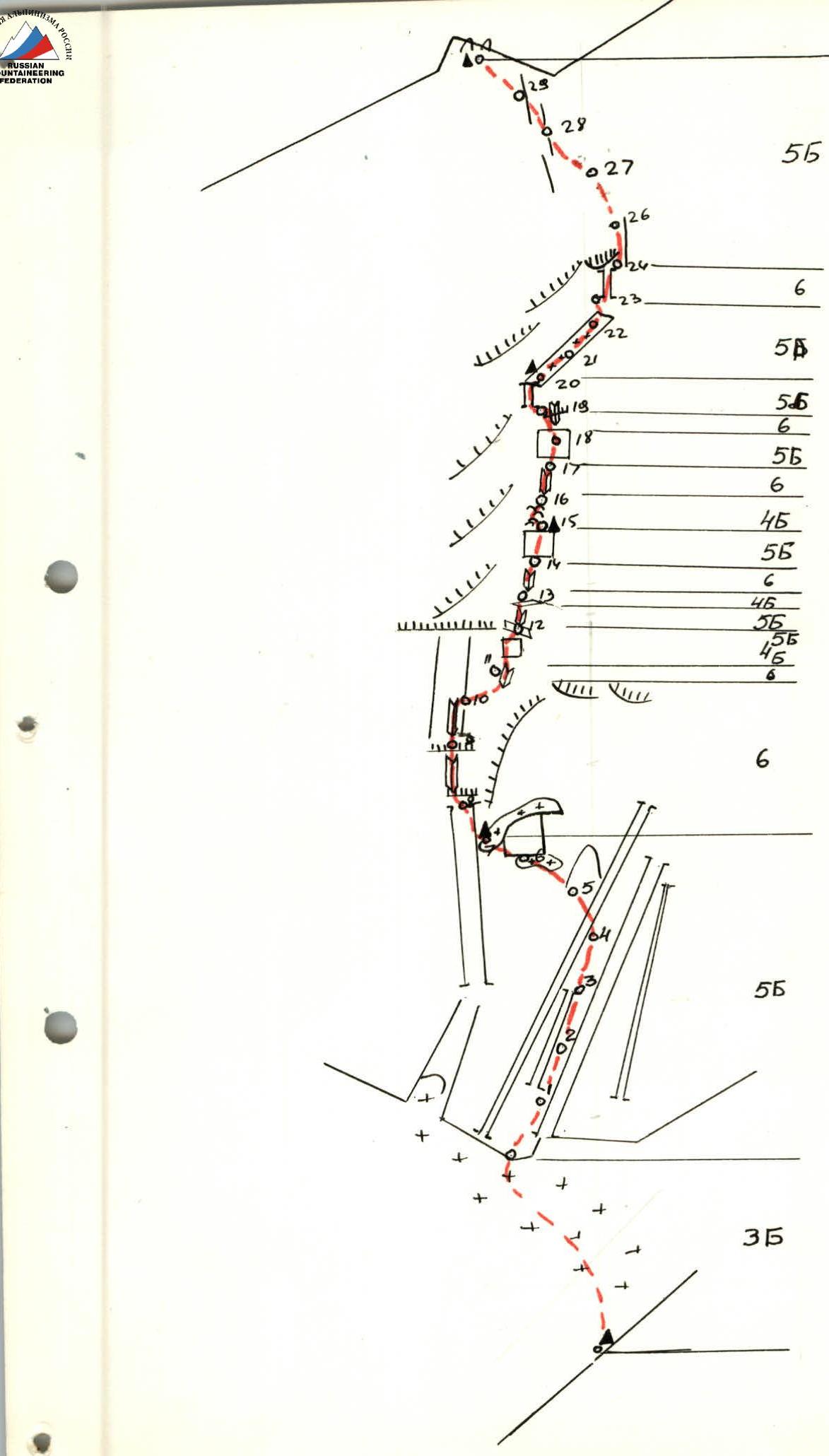
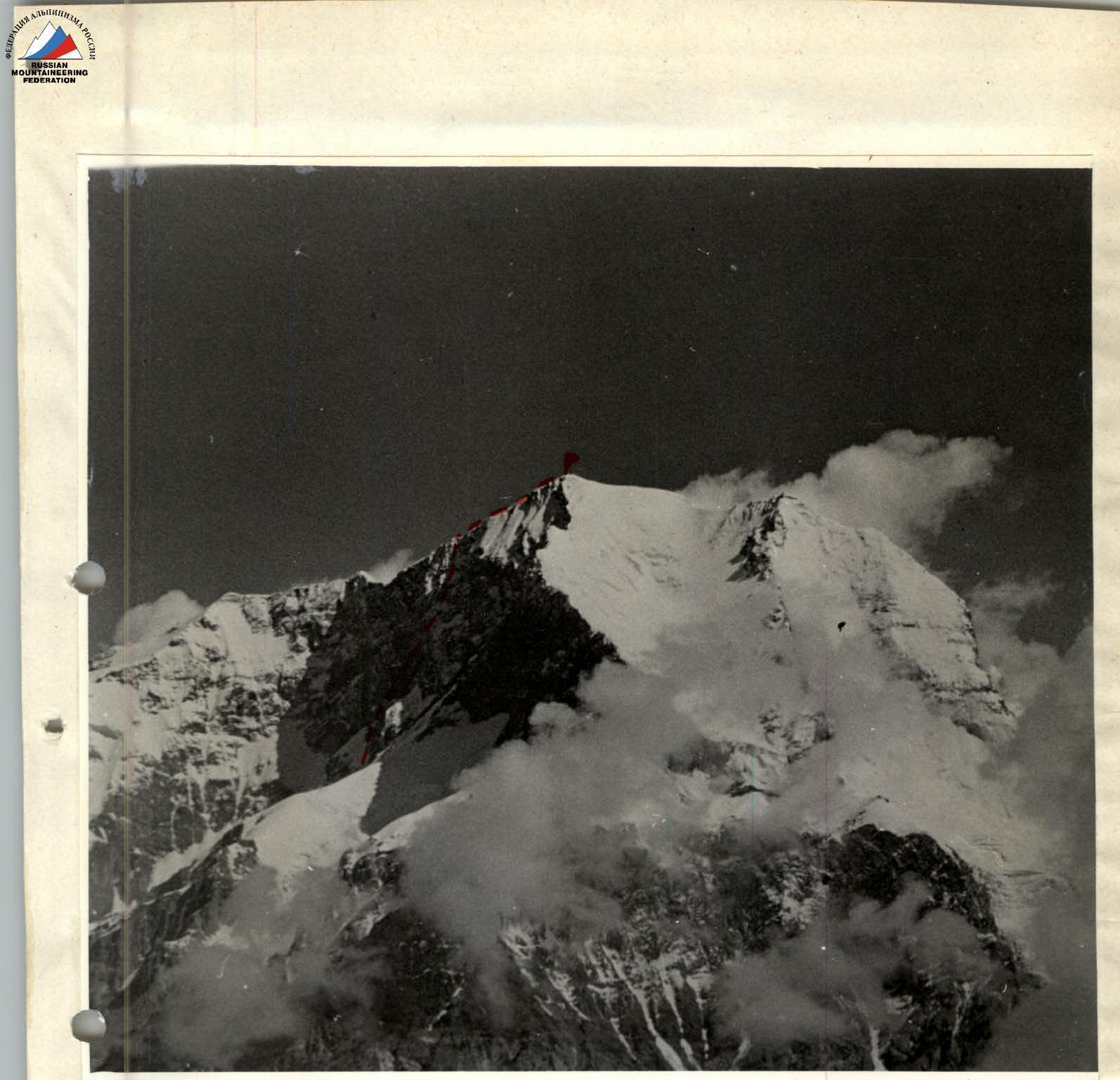
Profile shot of Peak Korzhenevskaya's West wall (taken from the summit of Peak Kommunizma).
Brief description of the approach to the route
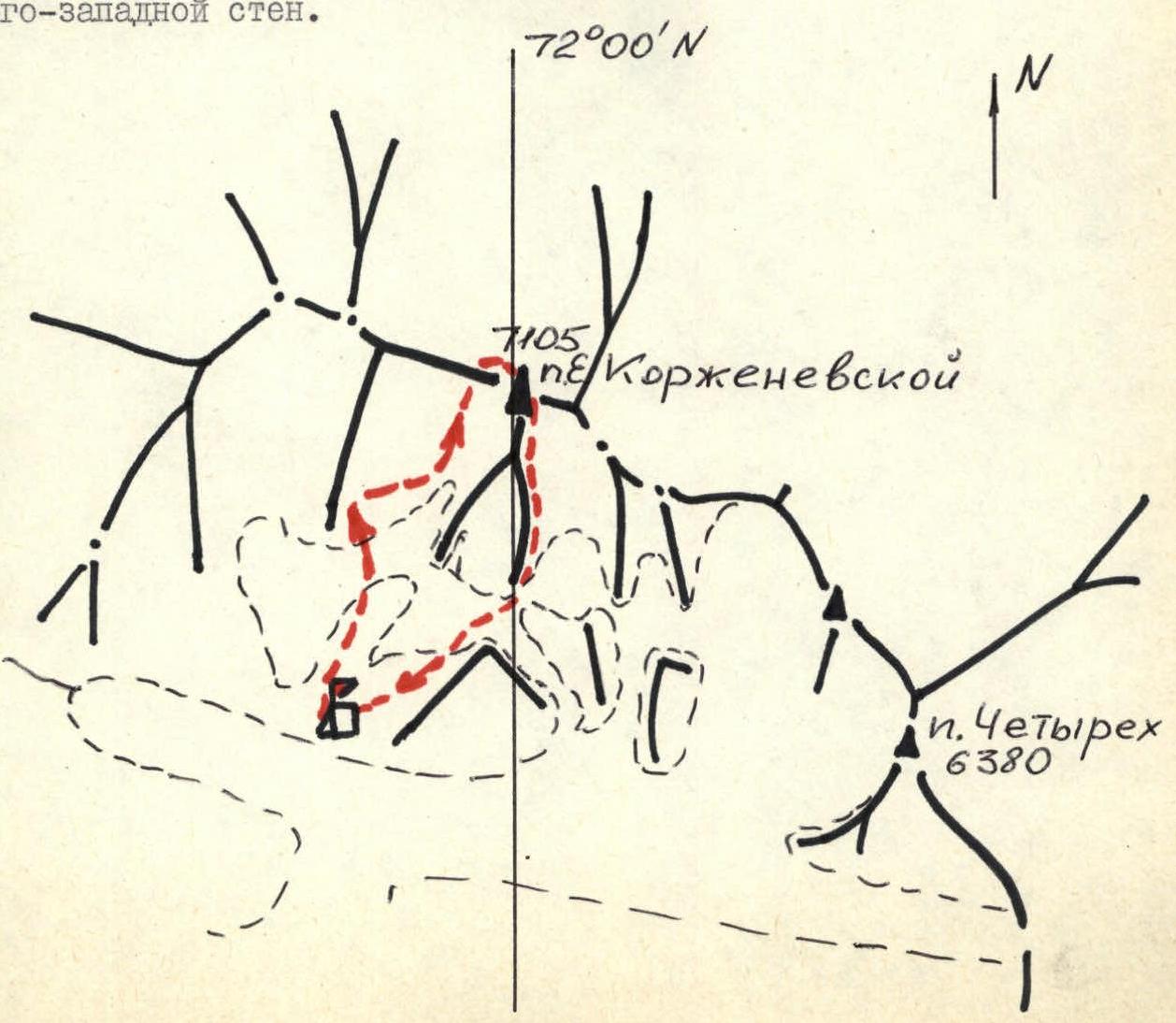
Peak Korzhenevskaya (7105 m) is located at the northern end of the Academy of Sciences Ridge. As the fourth seven-thousander in the country, the peak has attracted the attention of many mountaineers. Routes from the south lead from the Moskvina Glacier and its tributaries. The most accessible is the route by V. Tsetlin, which goes along the southern ridge. West of this route, there is a route by I. Khatskevich, bypassing the southern and southwestern walls from the west. Between Tsetlin's and Khatskevich's routes, a route by L. Dobrovolsky runs along the southern wall, and a route by A. Putintsev runs along the western wall.
Our team's route passes through the center of the western wall (between Putintsev's and Khatskevich's routes). The approach to the route from the base camp on the Moskvina Glacier is via its tributary, the Soldatov Glacier. From the "Dusty Bivouacs," the destroyed moraine leads to the tongue of the glacier, which steeply rises and leads to the rock islands at the foot of the southern and southwestern walls.
Preparation for the ascent
The team prepared for the ascent throughout the entire preparatory period.
The general physical training program included:
- regular joint training sessions;
- cross-country running;
- cross-country skiing.
Special training included:
- training on rocks;
- winter outings to the rocks of the Karelian Isthmus;
- technical training gathering on the Eastern Caucasus, "Yarydag".
Great attention was paid to mastering modern ice climbing techniques and improving climbing skills.
During the immediate preparation for the ascent, the main focus was on increasing the team members' high-altitude experience.
All participants made ascents to:
- Peak Korzhenevskaya, Tsetlin's route;
- Peak Kommunizma, Borodkin's route.
During acclimatization outings and the ascent via Tsetlin's route, observations of the wall were made, including the selection of specific route sections and bivouac sites. Observations from the camp on the Soldatov Glacier allowed for a more precise understanding of the wall's structure and potential rockfall paths.
Based on the information gathered from observing the wall, a tactical ascent plan and movement schedule were developed.
Tactical ascent plan
- July 30 — 12:00 — approach to the Soldatov Glacier, observation of the route.
- July 31 — 6:00 — departure from the observers' camp to the bivouac on the rock island (5500 m) — Camp I.
- August 1 — 6:00 — departure. Camp on the rock island — Camp II (5800 m), passage of the lower part of the wall.
- August 2 — processing of the central section of the wall (bivouac in Camp II).
- August 3 — passage of the lower part of the black wall to Camp III (6100 m).
- August 4 — passage of the central part of the wall to Camp III (6350 m).
- August 5 — passage of the upper part of the triangle to Camp IV (6650 m).
- August 6 — departure to the ridge and ascent to the summit.
- August 7 — descent to the base camp.
The adopted tactical plan was fully executed and ensured a safe and technically competent passage of the route within the established timeframe.
Ascent chronicle
(Brief explanation of the table of main characteristics)
July 30, 15:40. The team departed the base camp "Dusty Bivouacs" near the Moskvina Glacier in full. After a three-hour ascent, they stopped for the night at the entrance to the western cirque of Peak Korzhenevskaya.
July 31, 8:00. Departed the intermediate camp and arrived at the ridge of a rock outcrop within 1 hour's walking distance from the wall at 17:00. 200 m to our right, on top of the rock outcrop, was a team led by A. Putintsev.
August 1, 10:00. The lead pair departed the camp and began advancing towards the foot of the wall. The slope leading to the wall is mostly icy, covered with a layer of firn in some places. We proceed in crampons, simultaneously.
The approach took 40 minutes. Mark Bashmakov leads today. The wall is bathed in sunlight and gradually warming up. We must begin cautiously due to the unusual terrain. Vertically layered black slate forms easily destructible, brittle steps that strip the skin off hands and boots like sandpaper. There are almost no cracks. From the start, we use universal pitons, specifically made for this wall, i.e., wide and long. Climbing is mainly on body positioning.
After a couple of ropes, the wall becomes steeper, but the terrain doesn't simplify. Our goal is the snow patches under the large, crescent-shaped cornice.
The wall is dissected by deep grooves-chimneys where stones continuously fall with the sun's rise and, when warm, at night. We cross a groove and exit onto a snow patch under the cornice via a rock slab.
The snow layer is very thin, with a conglomerate of ice and stones underneath. The ledge is steep, and it takes two hours to create an acceptable platform. As the sun sets, we climb into the tent.
August 2, 11:00. It's very cold in the morning, but as soon as the sun illuminates the wall, we start working. Today's task, according to the tactical plan, is to process the central section of the wall. The lead is with L. Troshchinenko – L. Sapozhkov.
The central part is an almost vertical rock ascent, adorned with numerous cornices and cut through by grooves. The rock structure is the same as below — layered, black slate, heavily destroyed.
We enter under the cornice and swing left into an internal angle (section R3), which is the right wall of a wide rock groove intersected by cornices in several places.
25 m up the internal angle to the first cornice, made of hanging stones, and again a swing left to the other side of the groove. In this angle, there's a wide slit convenient for chocks. The cornice here is not as heavily destroyed and is passable by climbing.
20 m further, the groove is intersected by the next cornice, which is passed directly up through a slit filled with dirt and rock debris. The angle then becomes less steep but after 20 m, it abuts against a huge cornice.
We traverse right into a small, 25 m internal angle.
The ropes end, evening arrives, and directly below us is a tent. We descend. The day was warm, and the entire evening and night, we were bombarded with stones ejected from the groove. By morning, the tent was thoroughly punctured.
The angle abuts against a wall of a reddish color, section R4, washed by water, virtually devoid of relief. The top of the wall overhangs with a small, 0.5 m strongly destroyed cornice. To ensure safety, we have to move left to the edge of the wall where there are cracks, then cross the wall and cornice from left to right. Safety is achieved with a chock placed in a flake. Again, a destroyed internal angle, section R5, but there are slits.
August 3, 7:00. Early departure. We need to pass the fixed ropes before the sun illuminates the wall. The ropes suffered significantly overnight. The fixed ropes are passed, and Ivan Tulaev leads forward. He passes to the end of the internal angle and reaches a narrow ledge, section R6. Along the ledge, right up to the next internal angle, section R7, whose walls are polished by water. Here, the rock is somewhat stronger. The angle leads to the next ledge, covered in snow, section R8. Again, black rock, section R9, destroyed and very sharp.
The wall ends in a narrow chimney cutting through an overhang. After the chimney, the ledge is sufficiently gentle to organize a bivouac. Ivan and Mark continue working, while the other two attempt to prepare a platform, scraping together the snow that has thawed by evening. 21:30 — we climb into the tent. The bivouac is less comfortable than below.
August 4, 10:00. We've already passed the ropes hung last night. Ivan works ahead again. We pass to the end of the wall, section R10, 20 m of which we processed yesterday, and along the stepped rock structure, we approach the base of the "White" cornice belt, which has been hanging over us since the beginning of the route. Troshchinenko leads forward. A нависающий внутренний угол был пройден с использованием закладок. An overhanging internal angle is passed using chocks. Further, along a smooth wall of red color, section R13, to a cornice with characteristic rock feathers. The feathers significantly ease the passage of the cornice. After the cornice — an internal angle filled with ice. The angle overhangs, so the ascent is made with the help of a ladder hung on an icicle. The angle ends and transitions into a wide slit, which leads to a narrow ledge. The "White" belt is behind, or rather below; the next rope is quickly passed — under the bottom of a chimney, heavily destroyed. The chimney, like everything on this wall, ends in an overhang. To the left under the overhang — a small ledge with a snowdrift; we organize a bivouac there. The ledge is triangular, so one of us simply hangs in the tent.
August 5, 9:30. We move right along a steep rock-ice slope, section R16, along its very edge. The summit ridge and upper part of the route are visible. Through a narrow, overhanging throat of the couloir, we exit onto a rock-snow slope, section R18. The snow is "high-altitude," powdery, and very deep, so we move along the rock ridges, transitioning from one to another through chest-deep snow. It's very cold today, with strong wind. 30 m from the summit ridge, under the protection of rocks, we trample a platform. 21:00 — we lie down for the first time. The wind howls in the rock feathers of the ridge.
August 6, 9:00. The wind hasn't subsided. We exit onto the ridge, put on crampons, and move along the ridge to the summit. At 12:00, we are on the summit of Peak Korzhenevskaya. The descent via Tsetlin's route is familiar, so by 19:30, the team has safely descended to the base camp.
Table of main route characteristics

Continuation of the table
| Date | Designation | Average steepness | Length | Terrain character | Difficulty | Condition | Weather conditions | Rock | Ice | Bolt | Chocks |
|---|---|---|---|---|---|---|---|---|---|---|---|
| August 5 | R16 | 95 | 20 m | wide chimney (throat of couloir) | 6 | monolith | good | 3 | – | – | 2 |
| R17 | 65 | 250 m | rock-snow slope | 5 | — | — | 10 | – | – | 8 | |
| August 6 | R18 | 30 | 800 m | summit snow ridge | 3 | good | — | – | – | – | – |

Transition to the internal angle, start of section R3

Through cornices and overhangs on section R3
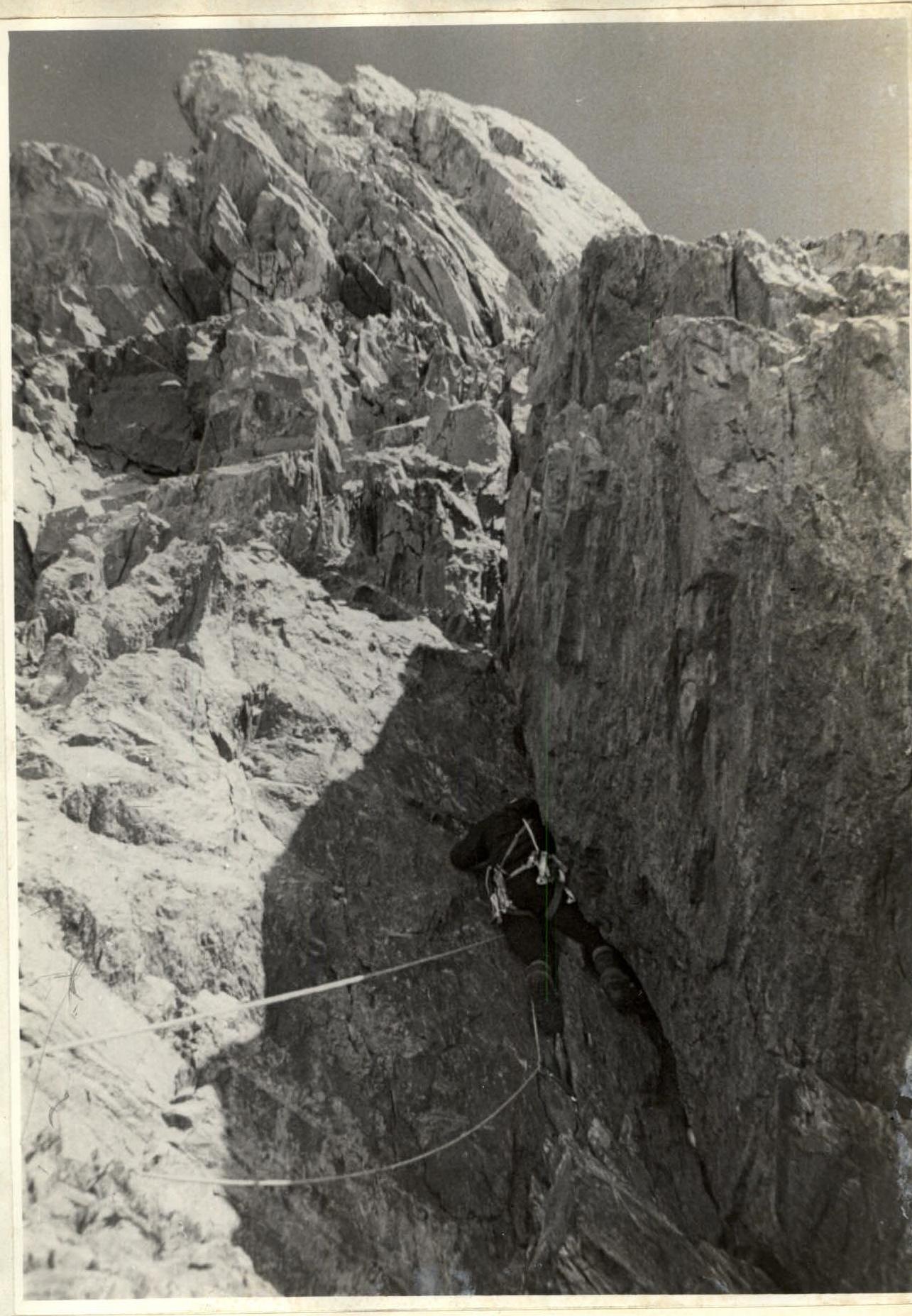
Free climbing in the internal angle, section R11
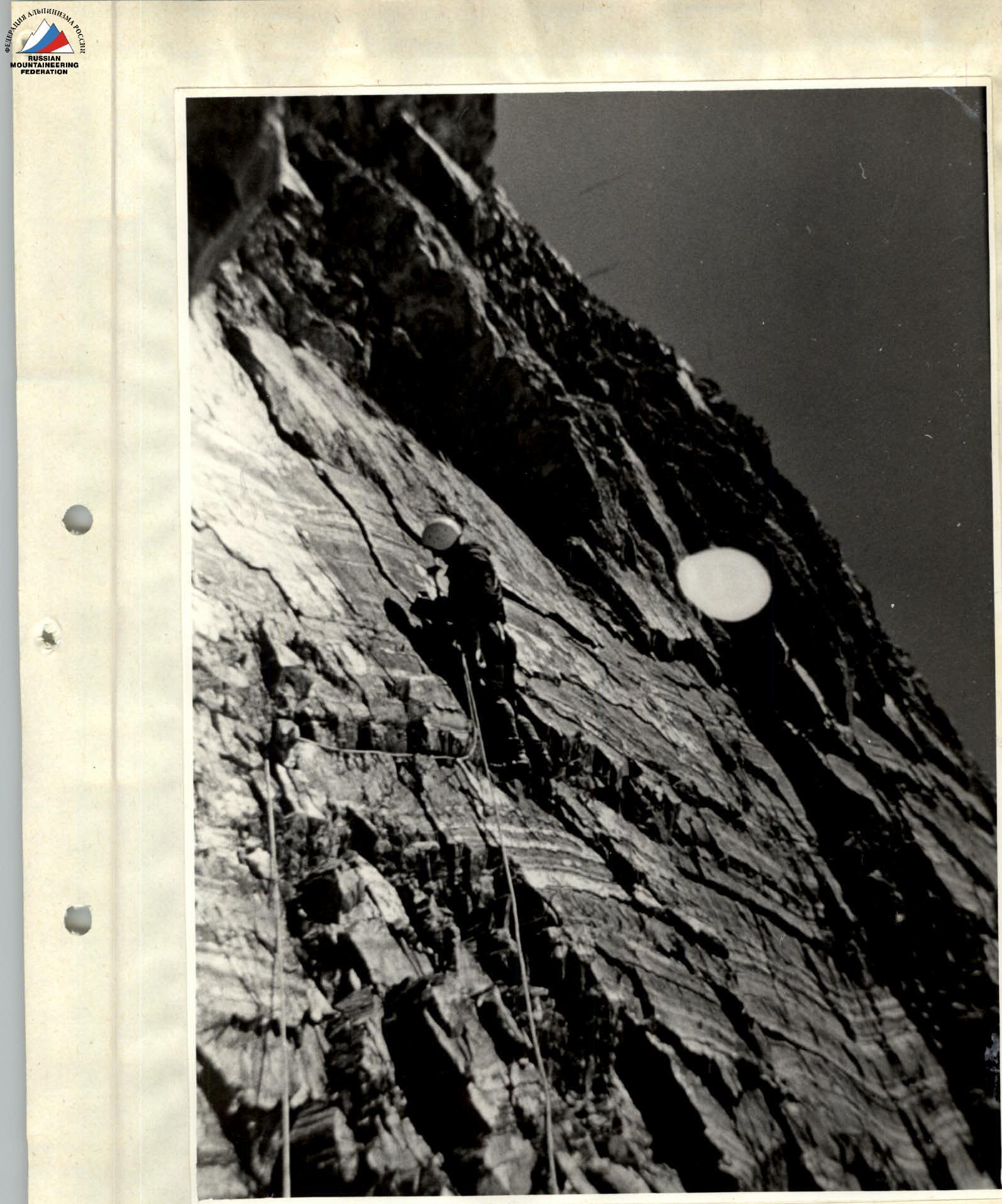
Under the cornice on section R12
| Date | Designation | Average steepness | Length | Terrain character | Difficulty | Condition | Weather conditions | Rock | Ice | Bolt | Chocks |
|---|---|---|---|---|---|---|---|---|---|---|---|
| August 1 | R1 | 40 | 200 m | ice, firn | 3 | good | simultaneously | – | – | – | – |
| 10:00–18:00 (8 h) sitting | R2 | 65 | 260 m | wall | 5 | destroyed | – | 30 | – | – | 7 |
| August 2 | R3 | 85 | 140 m | internal angle with two cornices | 6 | – | good | 26 | – | – | 3 |
| 11:00–18:30 (7 h 30 min) sitting | R4 | 82 | 38 m | wall with cornice | 6 | – | – | 2 | – | – | 3 |
| August 3 | R5 | 60 | 25 m | ledge | 4 | good | – | 4 | – | – | – |
| 8:30–21:30 (13 h) sitting | R6 | 73 | 40 m | internal angle | 5 | – | – | 5 | – | – | 1 |
| R7 | 48 | 30 m | ledge | 4 | sections of ice and firn | – | 2 | – | – | 4 | |
| R8 | 68 | 55 m | wall | 5 | destroyed | – | 4 | – | – | 4 | |
| August 4 | R9 | 80 | 40 m | wall | 5 | – | good | 5 | – | – | 1 |
| 10:00–21:00 (11 h) sitting | R10 | 65 | 20 m | stepped rocks | 4 | "live" stones | – | 3 | – | – | – |
| R11 | 95 | 25 m | internal angle | 6 | – | – | 2 | – | – | 2/A.C. | |
| R12 | 75 | 40 m | wall | 5 | monolith | – | 5 | – | – | – | |
| R13 | 90 | 20 m | internal angle with 1.5 m cornice | 6 | monolith, iced | – | 4 | 1 | – | 2 | |
| R14 | 70 | 40 m | wide chimney | 5 | "live" stones | – | 3 | – | – | 1 | |
| August 5 | R15 | 60 | 80 m | rock-ice slope | 5 | monolith | good | 6 | – | – | 2 |
| 10:00–19:30 (9 h 30 min) lying |

Comments
Sign in to leave a comment