
4.1.41.
Alpinism Federation of the Lithuanian SSR
Report on the ascent via the eastern counterfort of Peak Kommunizma to 6500 m by the team of the Committee for Physical Culture and Sports of the Lithuanian SSR
1971
Team composition:
- G. Bernatonis — captain
- E. Adomaitis
- D. Makauskas — coach
- S. Miglinas
- V. Šaduikis
- J. Jurgelionis
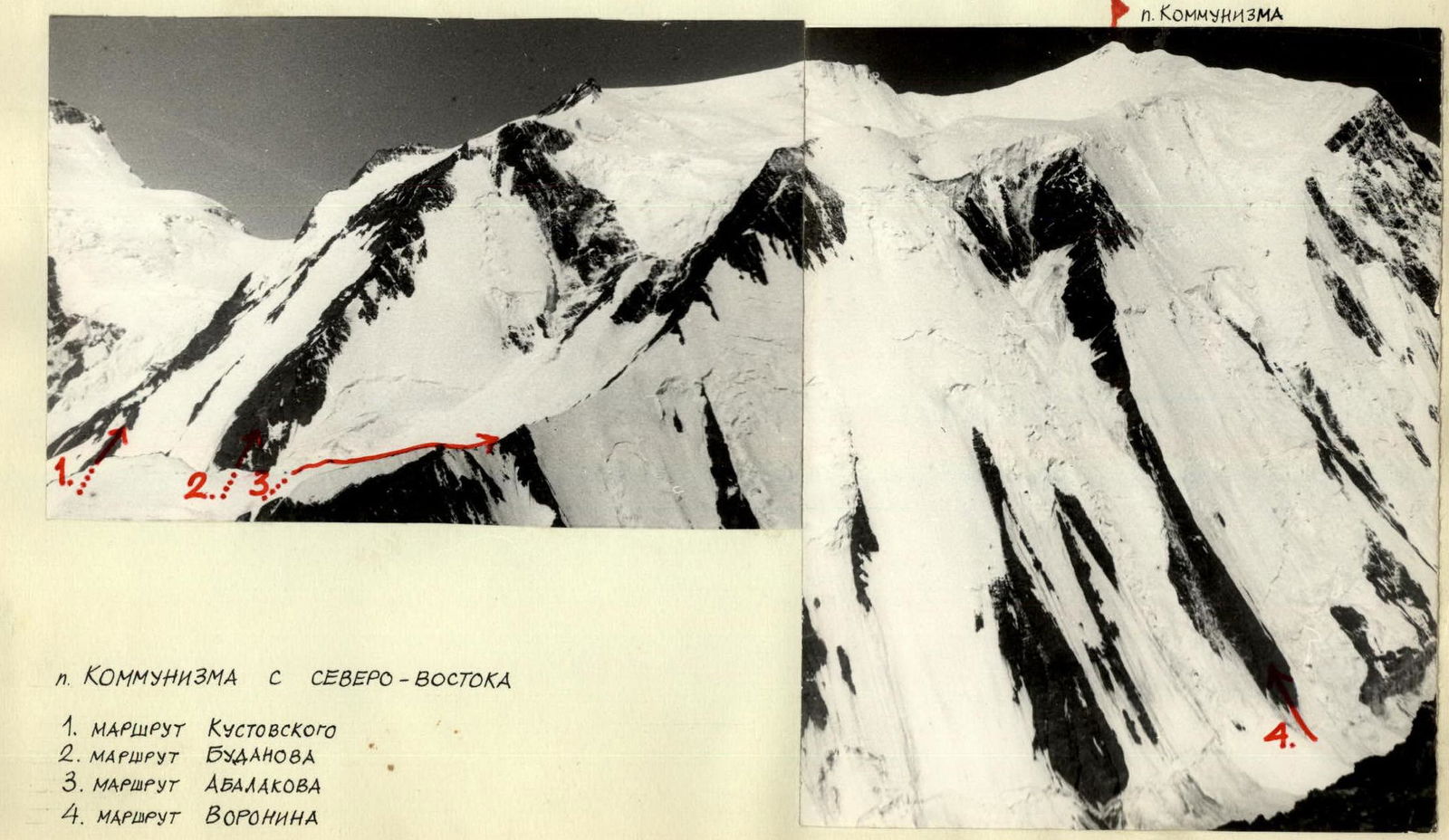 Peak Kommunizma from the northeast
 Peak Kommunizma from the northeast
- Kustovsky's route
- Budanov's route
- Abalakov's route
- Voronin’s route
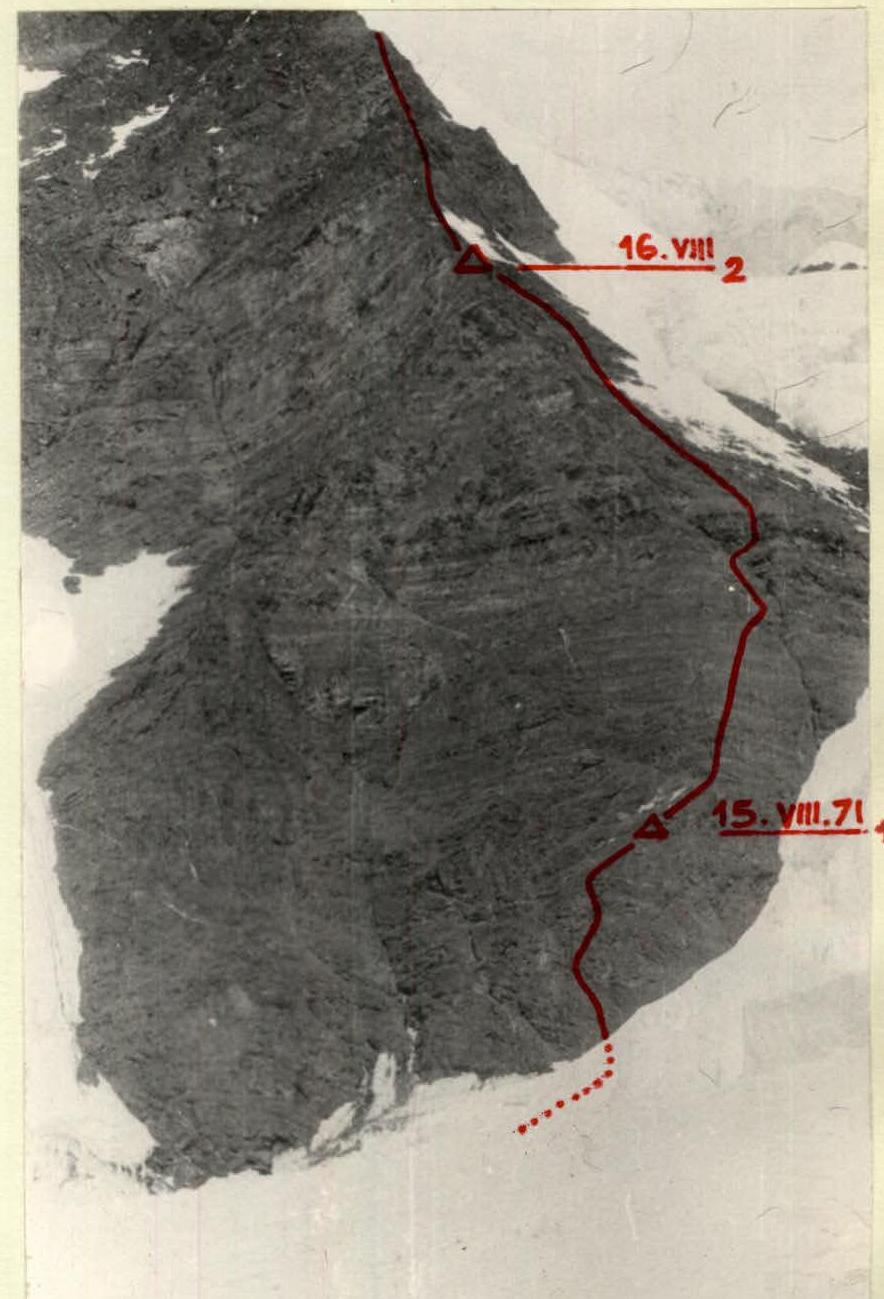
The lower part of the eastern counterfort of Peak Kommunizma
Ascent Progress
August 12. Entered the high-altitude camp at 9:00 via the trail, arrived at the 3900 m camp by 15:00.
August 13. Departed from the 3900 m camp at 10:00. Arrived at the "4600 m" camp by 15:00.
August 14. The pair D. Makauskas — V. Šaduikis set out at 9:00 to recon the passage of the Stalin Glacier. The other participants prepared gear and supplies for the ascent. By 15:00, the observation group arrived at the 4600 m camp. Radio contact with the reconnaissance pair every 2 hours. By 18:00, the pair returned, having surveyed the path around the dome part of the glacier and checked the state of the hung rope.
August 15. The group departed at 5:00, leaving observers at the "4600" camp. Backpacks were packed and prepared for the route the night before, so one backpack weighed only 12 kg. After each rest, the light backpack changed hands. At 11:30, they began the ascent up the NE counterfort. The first rope goes hard. Additionally, they brought a large polyethylene bag of snow, as there would only be enough snow at the bivouac site for breakfast. After prolonged work, they managed to construct a platform where the entire six-person team could fit in a semi-reclining position.
August 16. At 8:00, the first rope began work. They departed too early — it was very cold. The rocks are going, but the backpacks are still very heavy — 27 kg. Therefore, the movements are not very fast. At 12:30, a snow-ice avalanche descended but did not reach the spot where the Voronezh team's tent had previously stood. Everyone was covered in a centimeter layer of snowy dust, which instantly evaporated as the sun warmed up. They turned into builders early. While the pair hung the rope further, the others built platforms. After spending 2 hours and 30 minutes, by 18:30, everyone was lying down comfortably and spaciously. They reviewed the past two days — everything was fine, but they needed to be more careful as there were still too many falling rocks.
August 17. Yesterday's construction work paid off — they slept well, although this section was more challenging, but the first pair moved faster. They arrived at the rocks. The route looks straightforward and "pulls" to the right. The 1st pair, tempted, lost 2 hours and, after going up a rope, traversed back left 15 m — above the "bolted" sections. Only because the first ones were on a double rope, the others didn't have to traverse and went straight. A clear schedule emerged:
- Start working at 9:00
- Build a platform at 16:30–17:00
- Cook at 17:00 (sometimes still outside)
- By 18:00, they could already take a nap, while the duty team prepared tea and food
August 18. Departed from the bivouac site at 9:00. There was no point in leaving earlier, as the sun only starts warming up around that time. They fell into the rhythm of the Budanov team, and their pace corresponded to theirs — working 9–10 hours a day. By 16:00, they approached the bivouac site and a very challenging rock section. The foursome prepared platforms, while Julius froze, belaying Ervis, who was processing the route for the next day.
August 19.
- Left one rope at the bivouac.
- Part of the rope frayed and became unusable.
- After two ropes, they passed another very challenging section — managed without bolted hooks, but had to pull up the backpacks.
- Everyone's condition was good.
- From above, they could see Kustovsky's route, which was much simpler and less steep.
- They built a bivouac 80 m higher than the pioneers' bivouac.
- Giedrius processed one more rope further.
August 20.
- Departed as usual.
- During the passage, they got accustomed to the character of the rocks, and the pace slightly increased.
- Passed two challenging sections and reached the ridge — quite simple and not steep.
- The top of the III — last bastion was visible, and with it, the end of the technically challenging part.
- After moving along a ledge to the left and straight up a steep gully, they reached the junction of Budanov's and Kustovsky's routes.
- Found a set of steel channel hooks.
- Further on, they were not needed.
- Stopped at a bivouac.
- Hung one rope.
- Further on, a snow-ice ridge was visible.
August 21.
- Ascended via the hung rope and then simultaneously along the ridge.
- Everyone felt good.
- Julius was having a tough time.
- After an hour of walking, they unloaded him several times and continued.
- By 18:00–19:00, having passed the snow-ice ridge, they approached the rocky ridge.
- Removed crampons, rested.
- Suddenly, Julius complained of numbness in his hands, and 5 minutes later — in his face and abdomen.
- Decided to descend urgently.
- Conducted a rapid descent down a steep snow-ice slope, and by 16:00, Julius was at an altitude of 6000 m.
- His health improved.
- By 18:00, everyone gathered.
- Decided to spend the night, as Julius felt almost normal, pulse 76, breathing even.
- Surveyed the descent path — decided to descend:
- first along the upper rocky outcrop of Kustovsky's route,
- then down a long ice slope, veering rightward — this was the safest path.
August 22.
- Descended along the rocks.
- Julius felt almost normal, carried his personal belongings.
- On the ice slope, used and left almost all ice hooks.
- By 18:00, stopped at a bivouac.
August 23.
- Further descent was uneventful.
- It proceeded along the rocks to the right of Kustovsky's route.
- Rocks were constantly falling along Kustovsky's route.
- Moved simultaneously and by 14:00 descended to the upper part of the Stalin Glacier.
- By 16:00, approached the 4600 m camp, where they met the observers.
Ascent Evaluation
Although the team did not complete the route to Peak Kommunizma, the main technically challenging part was behind them, and the group still got a general impression of the route. The eastern counterfort, with its logical progression, technical difficulty, and safety, is undoubtedly one of the most interesting routes for ascending Peak Kommunizma and one of the most challenging. The character of the rocks, the alternation of sections of varying difficulty and coverage, requires passing groups to have strict mountaineering discipline, apply all means (except "bolted") for passing rocky sections, and have excellent physical and tactical preparation. For example:
- They had to "pull up" heavy backpacks using a "prusik" tied to the main safety rope of participants passing along the fixed ropes;
- Primarily used steel channel rock hooks up to 150 mm long and 20 mm thick;
- Constantly monitored falling rocks;
- Chose spots for possible lying-down overnight stays, etc.
The group was generally physically and technically prepared enough to complete the route, and the shortcomings of some participants were compensated by the capabilities of the others. The counterfort was traversed calmly, steadily, adhering to the pioneers' schedule, with "academic" belaying, which helped avoid falls, rockfalls, and getting lost. The successful passage was facilitated by:
- Well-chosen food supplies,
- Good overnight stays,
- Sufficient reserve of strength in five participants (except Jurgelionis) at an altitude of 6500 m.
However, there were issues:
- Careless handling of fuel selection significantly affected the operation of the stoves and increased cooking time,
- The first-aid kit was insufficiently equipped,
- Mass-produced gear (ropes, backpacks) proved to be fragile and unsuitable for such ascents.
During Julius Jurgelionis's acute cardiopulmonary insufficiency, the group showed high mobilization and cohesion, allowing them to descend the patient by 500 m in altitude within 4 hours (stopped for the night at 18:00), thus avoiding unpleasant consequences. This is an undeniable merit of the team coach D. Makauskas, his technical and tactical competence.
Team captain — G. Bernatonis
Coach's Notes
The Lithuanian team in this composition was participating for the first time. Therefore, great attention was paid to pre-season preparation, focusing primarily on:
- Physical preparation,
- Psychological preparation.
Technical preparation was secondary, as all participants had ascended Peak Jigit (6th category of difficulty). Physical preparation was assessed through control norms.
High moral and psychological preparation withstood all tests. The death of team captain K. Zubovas two weeks before the start of the expedition and the death of Voronezh climber I. Vaganov under the eastern counterfort of Peak Kommunizma only mobilized the team. Later, Julius Jurgelionis's illness confirmed the team's cohesion and clear actions at the critical moment. During the ascent, some tactical and technical shortcomings became apparent:
- Reluctance to put on crampons on short sections to save time, although in the end, they lost both time and strength (safety was never compromised).
- Distrust of ascenders (except for the coach, no one used them).
On the route, G. Bernatonis and E. Adomaitis stood out with their activity. V. Šaduikis passed the route calmly and steadily. J. Jurgelionis was not sufficiently physically prepared, although he had passed all control norms well. S. Miglinas stood out for his passivity on the route and carelessness on loose sections, having committed most of his best ascents as a participant in Lithuanian mountaineering expeditions.
The remaining team members:
- Fulfilled the standards of the 1st sports category based on mountaineering camps
- Have instructor training.
In conclusion, I would like to note the very clear and detailed consultation on the route passage, on possible bivouac sites both on the route and on the approaches, on cargo drop-off points and their packaging methods, on gear selection received from USSR Master of Sports K. Kletsko. Unfortunately, the same cannot be said about the Uzbek climbers, who, when asked for consultation, suggested reading their 1970 report on the ascent of Peak Kommunizma.
Team coach, USSR Master of Sports — D. Makauskas
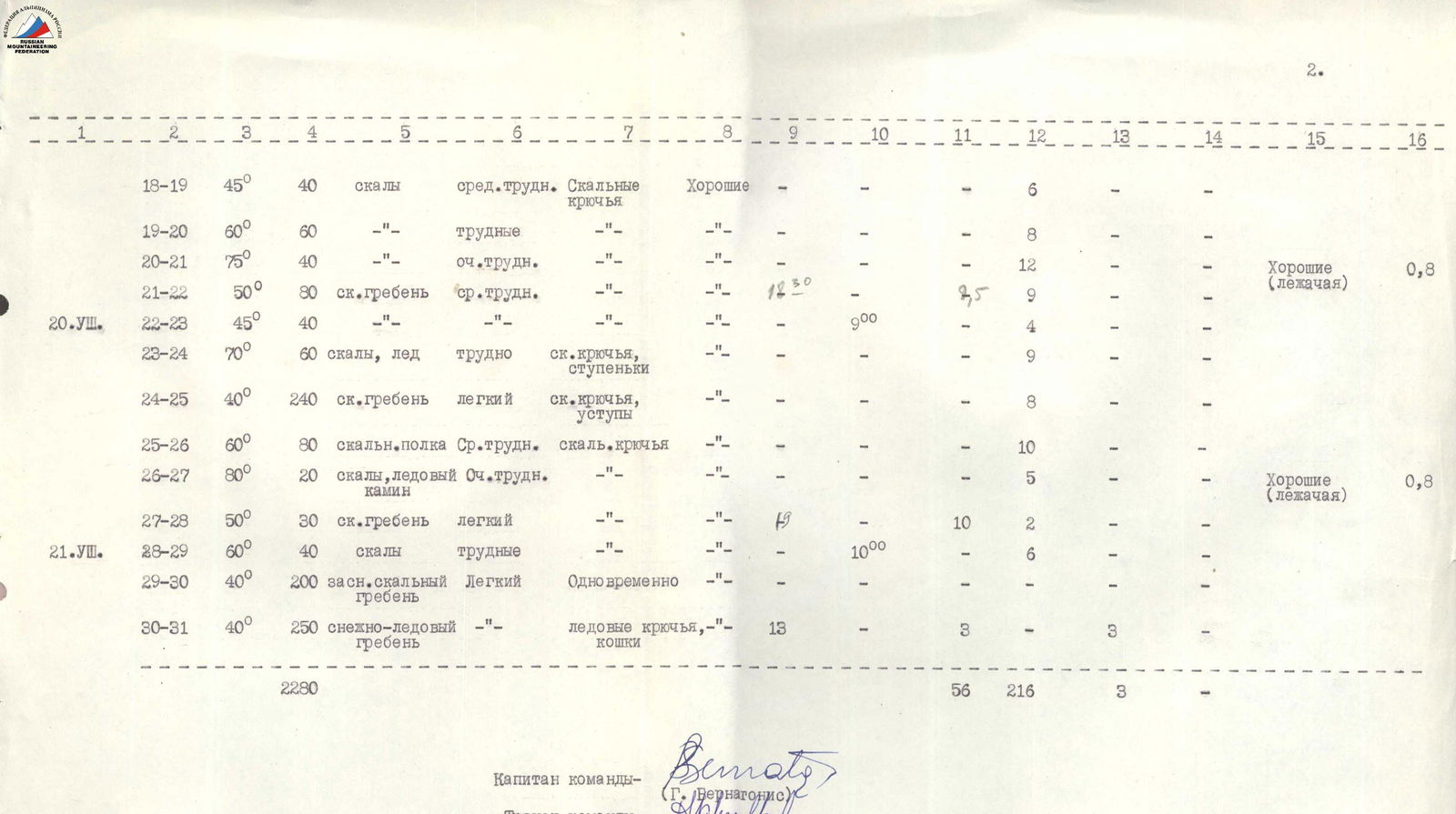
Route Characteristics Table
Ascent route — via the eastern counterfort of Peak Kommunizma to an altitude of 6500 m. Route height difference — 1400 m. Including the most challenging sections — 190 m. Route steepness — 60°.
| Date | Passed Sections | Average Steepness of Section | Section Length (by length) | Section Characteristics and Passage Conditions | Bivouac Stops | Departures | Working Hours | Hooks Driven | Overnight Conditions | Daily Ration Weight |
|---|---|---|---|---|---|---|---|---|---|---|
| By Relief Character | By Technical Difficulty | By Passage Method and Belaying | By Weather Conditions | Rock | ||||||
| 15.08. | 0–1 | 80° | 50 | rocks | very difficult | climbing, rock hooks | good | 14:30 | 11:30 | 3 |
| 16.08. | 1–2 | 40° | 40 | — | easy | — | — | 8:00 | ||
| 2–3 | 70° | 40 | — | difficult | — | — | ||||
| 3–4 | 60° | 60 | — | medium difficulty | — | — | ||||
| 4–5 | 50° | 120 | — | — | — | — | 18:00 | 10 | 10 | |
| 17.08. | 5–6 | 40° | 110 | rock-ridge | medium difficulty | — | — | 8:30 | ||
| 6–7 | 70° | 90 | rocks | difficult | — | — | ||||
| 7–8 | 60° | 80 | — | — | — | — | ||||
| 8–9 | 70° | 30 | — | — | — | — | 18:30 | 10 | 5 | |
| 18.08. | 9–10 | 60° | 60 | — | medium difficulty | — | — | 9:00 | ||
| 10–11 | 50° | 40 | — | — | — | — | ||||
| 11–12 | 45° | 50 | rock ridge | — | — | — | ||||
| 12–13 | 60° | 30 | rocks | difficult | — | — | ||||
| 13–14 | 45° | 150 | rock-mixed ridge | medium difficulty | — | — | 18:00 | 9 | 7 | |
| 19.08. | 14–15 | 85° | 40 | rock wall | very difficult | rock hooks | — | 9:00 | ||
| 15–16 | 45° | 40 | rock ledge | easy | — | — | ||||
| 16–17 | 80° | 40 | rocks | very difficult | rock hooks | — | ||||
| 17–18 | 60° | 80 | rock gully | difficult | — | — | ||||
| 18–19 | 45° | 40 | rocks | medium difficulty | rock hooks | good | ||||
| 19–20 | 60° | 60 | — | difficult | — | — | ||||
| 20–21 | 75° | 40 | — | very difficult | — | — | ||||
| 21–22 | 50° | 80 | rock ridge | medium difficulty | — | — | 18:30 | 8.5 | 9 | |
| 20.08. | 22–23 | 45° | 40 | — | — | — | — | 9:00 | ||
| 23–24 | 70° | 60 | rocks, ice | difficult | rock hooks, steps | — | ||||
| 24–25 | 40° | 240 | rock ridge | easy | rock hooks, ledges | — | ||||
| 25–26 | 60° | 80 | rock ledge | medium difficulty | rock hooks | — | ||||
| 26–27 | 80° | 20 | rocks, ice chimney | very difficult | — | — | ||||
| 27–28 | 50° | 30 | rock ridge | easy | — | — | 19:00 | 10 | 2 | |
| 21.08. | 28–29 | 60° | 40 | rocks | difficult | — | — | 10:00 | ||
| 29–30 | 40° | 200 | snow-covered rock ridge | easy | simultaneously | — | ||||
| 30–31 | 40° | 250 | snow-ice ridge | — | ice hooks, crampons | — | 13:00 | 3 | 3 | |
| Total | 2280 | 56 |


Comments
Sign in to leave a comment