

PASSPORT
- Rock climbing.
- Caucasus, Tsey Gorge.
- Mt. Passionaria, 4000 m via the chimney of the Western bastion wall and NW ridge.
- Proposed: Category 5B difficulty for first ascent (second ascent).
- Elevation gain 800 m, length 1150 m. Length of Category 5B–6 sections — 160 m. Average steepness of the main part of the route — 85° (3400–3560 m).
- Pitons hammered: rock: 32, bolted: 0, chocks: 25, ice: 0.
- Team's travel time — 9 hours.
- Overnights — none.
- Leader — Leonid Borisovich Volkov, Master of Sports.
Participants:
- Aleksey Ivanovich Trasevich, Master of Sports
- Viktor Dmitrievich Pecheritsa, Candidate for Master of Sports
- Petr Vladimirovich Evteev, Candidate for Master of Sports
- Coach — Viktor Aleksandrovich Gerasimov, Master of Sports.
- Route entry and exit: June 25, 1984.
- Organization: Tsey Region Climbing Club.
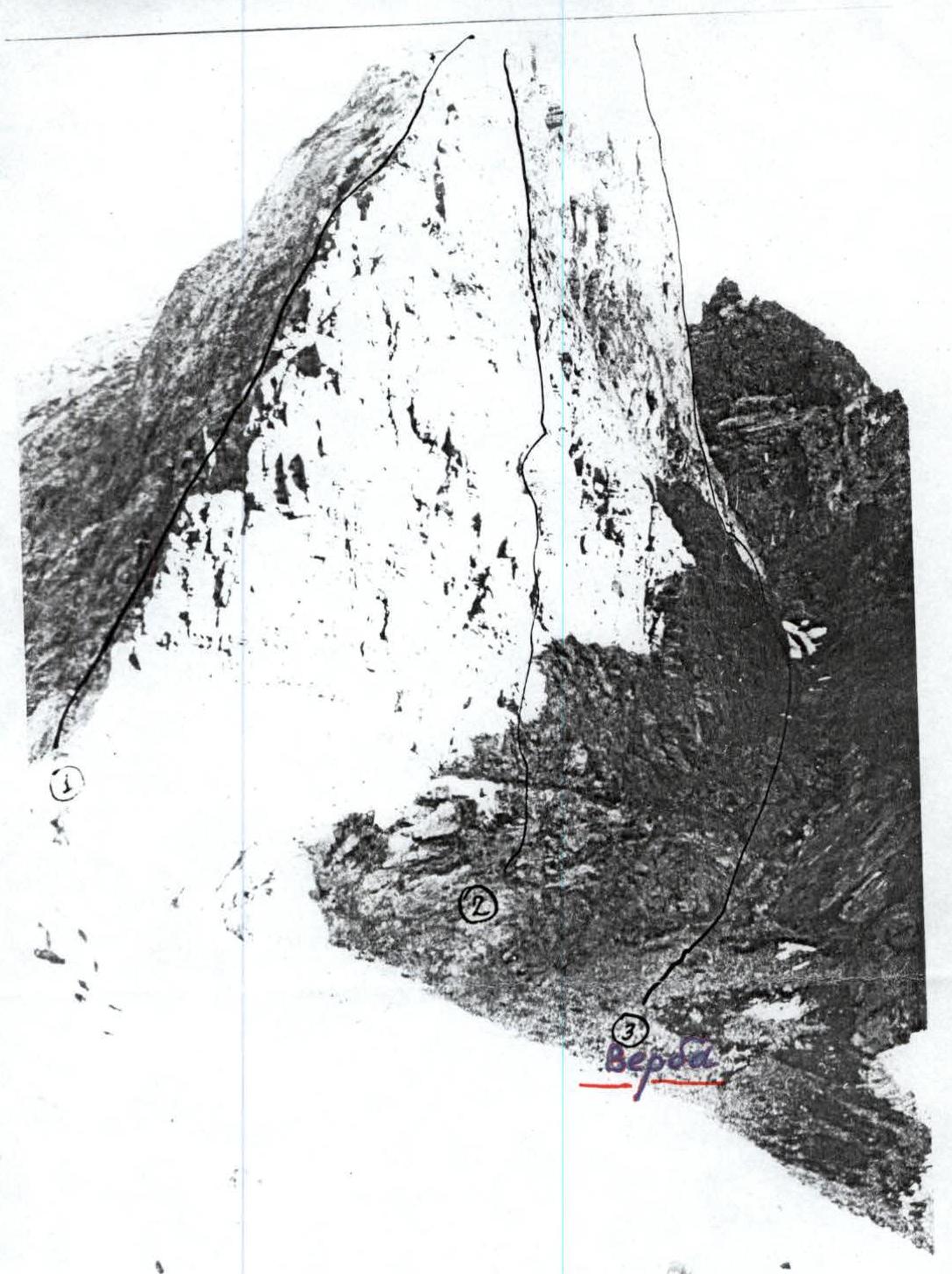
Profile of Mt. Lassiokariya bastion from the left
- Polevoy's Route (Category 5A)
- Grigorenko–Prigoda Variation (unclassified)
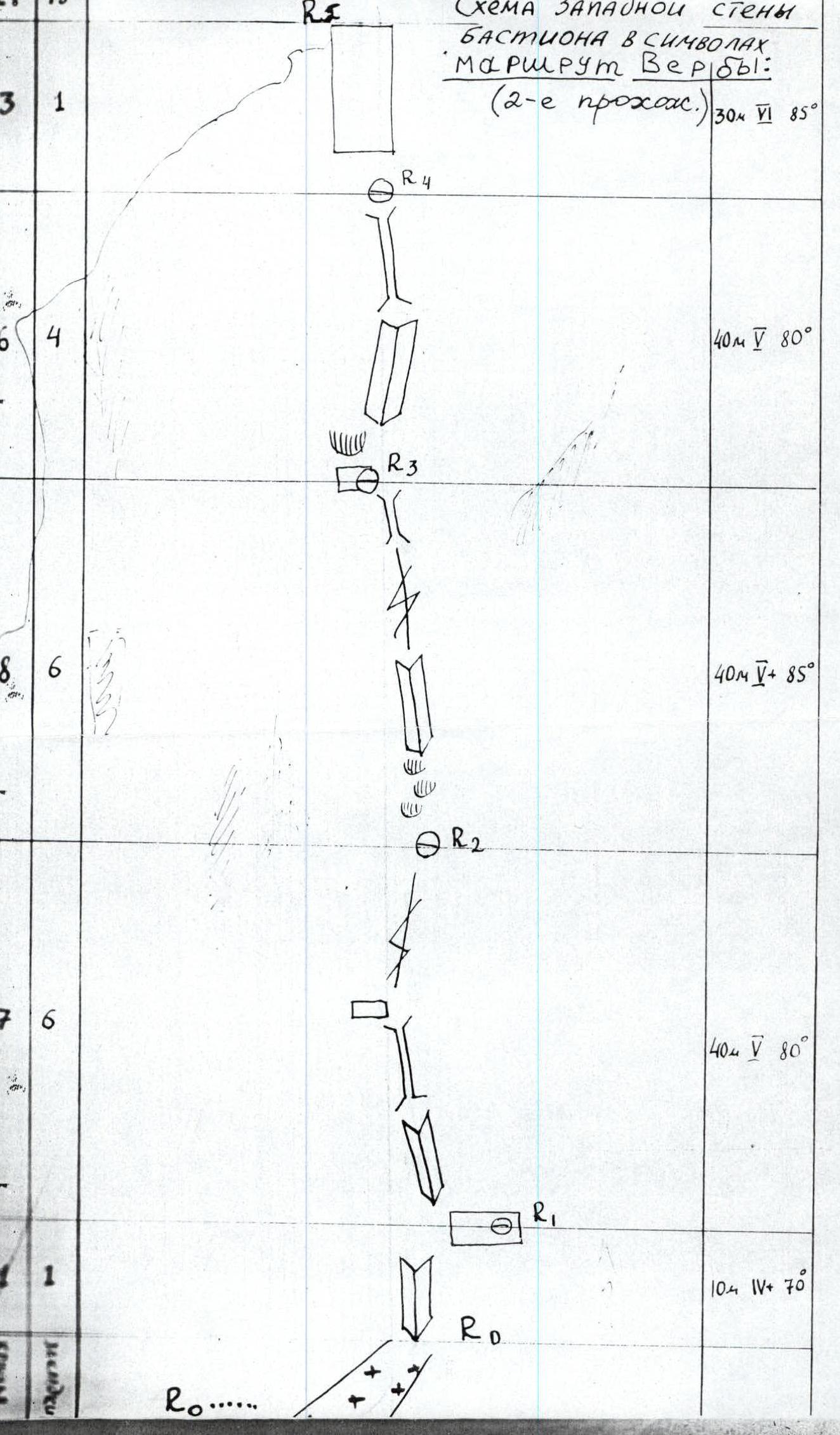
- KSP Group's Route (second ascent of Verba's route)
Bastion of Mt. Passionaria
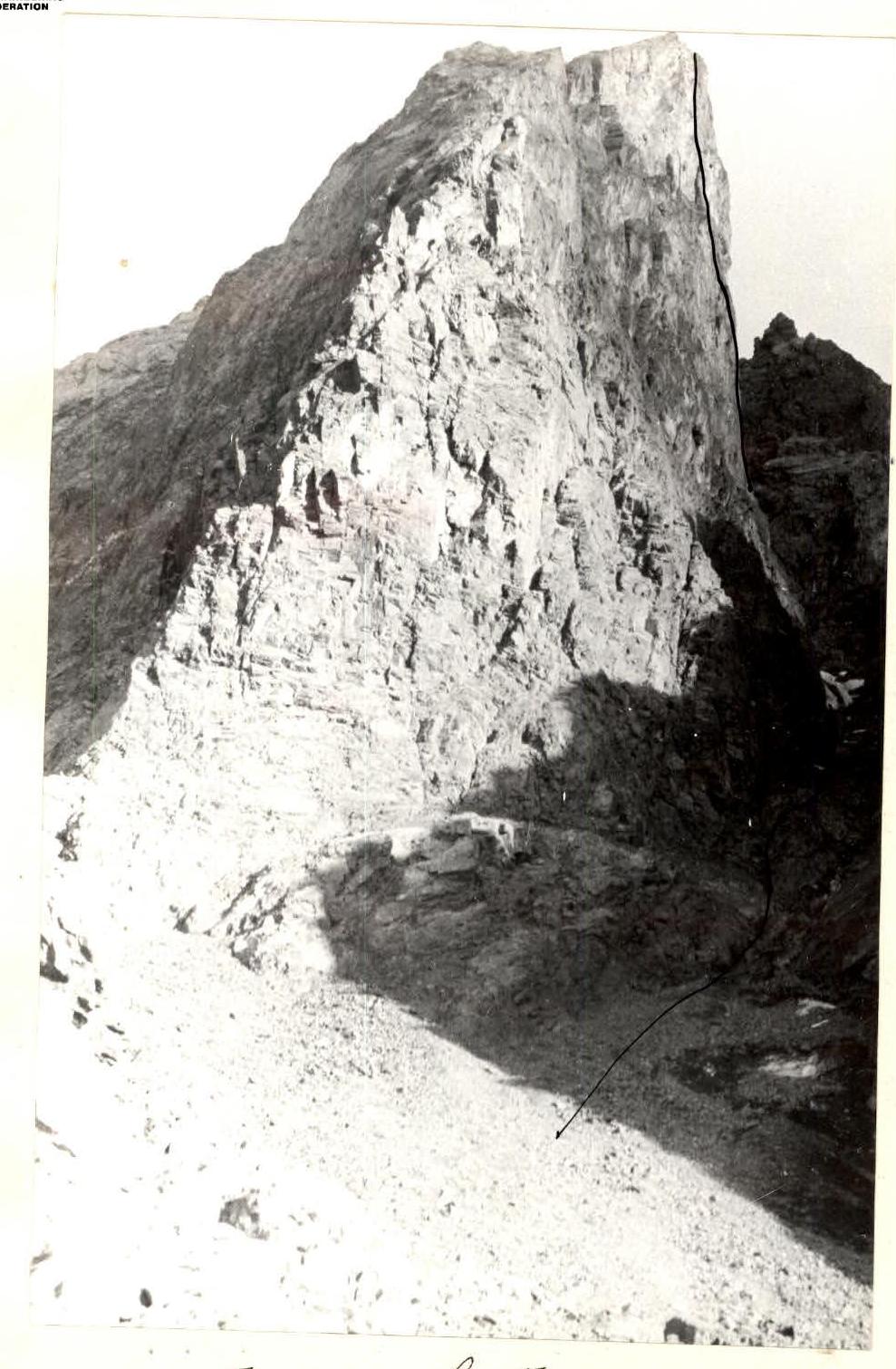
Overview of Summit Conquest
Mt. Passionaria (4000 m) is located in the Skazskiy Gorge, in the spurs of the Main Caucasian Range. Three routes lead to the summit. In 1947, a group led by Stroganov ascended from the west via the "103 ridge" couloir. In 1966, Yu. Grigorenko–Prigoda, planning a first ascent via the NW ridge, "processed" its bastion but postponed the ascent for some reason.
Meanwhile, G. Polevoy's group ascended using the pre-installed ropes, and the route was classified as Category 5B. To this day, this route remains one of the most popular in Tsey: the approach takes one and a half to two hours, and it is relatively simple technically, making it a reserve option for instructor ascents in case of bad weather or during "peak" shifts.
However, the potential of Mt. Passionaria is far from exhausted. The bastion's "mirror" surface, illuminated by the setting sun, continues to attract climbers. The Western wall, despite its relatively small height difference (200 m), is sheer and composed of monolithic smooth rocks. Grigorenko–Prigoda's group was the first to ascend this wall. This variation (see photo 3) has been repeated by three more groups, including the author of these lines, who ascended in a duo with V. Sukharev, the head of the rescue team at the "Tsey" camp. This route is interesting and undoubtedly deserves consideration by the Climbing Classification Committee.
Further to the right, the bastion becomes higher and steeper. Somewhere around here, B. Vasiliev's group ascended in 1976. The category of the route was unfairly downgraded to 5A, the original description was lost, and subsequent groups have been ascending the rocky ridge defined by the couloir from the bastion, which has no relation to the bastion itself (although the classified route is named: "via the Western wall of the bastion and NW ridge" (!)). In fact, its difficulty does not exceed Category 3.
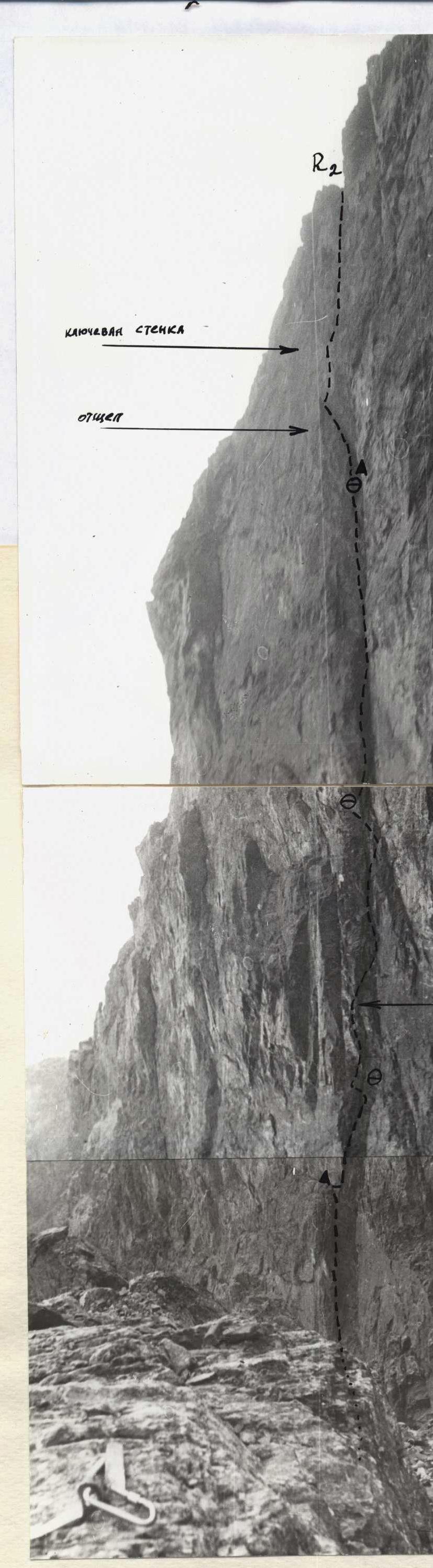
In 1979, the bastion attracted the attention of Ukrainian climbers. A group led by A. Verba, gathering climbers from the Ukrainian SSR Council of the "Burevestnik" Sports Society, ascended a new route via the chimney of the Western wall. The route won first place at the 1979 Ukrainian SSR Championship. However, it remained unclassified, and no materials related to it were found in the region's Climbing Club. We repeated Verba's route (found notes from his group on the marked cairns). We hope that this beautiful and challenging route will be classified.
Photo 3. Profile of the wall from the left. Point 3. "Industar-50" lens, f=50 mm. L=400 m, h=3350 m. June 26, 1984, 18:30. Routes marked:
- Polevoy's, Category 5B
- Grigorenko–Prigoda (unclassified)
- First ascent route

Route Description by Sections
From the "Tsey" alpine camp, ascend via the trail and scree to the "Sail" rock. Continue up the slope to the rocky outcrop at the start of the route on the Passionaria bastion (Polevoy's). Camp.
R0–R1. From the rocky outcrop, traverse the slope to enter a snowy, 35° (icy at the end of the season) couloir. Under the cover of the bastion's rocks (left edge of the couloir), ascend 300 m to the base of the large chimney on the Western wall of the bastion. (Protection. Possible falling rocks in the afternoon.)
R1–R2. Ascend 10 m straight up via moderately difficult, broken rocks to a ledge with a cairn marking the start of the route. Convenient belay spot. Traverse 5 m left along the ledge and ascend via broken, feather-like rocks to enter the chimney. After a few meters, the rocks become reliable and monolithic. Moderate climbing difficulty. After 20 m, a small ledge is on the left. Control cairn. Continue up 30 m via steep, complex rocks under an overhanging section of fragmented rocks. Safe belay spot. Then, move 1.5 m left and ascend 10 m via overhanging rocks to a small platform. The rocks ease to 80°. Climb via the inner corner and then via a crack (difficult climbing, but with sufficient belay opportunities) to enter the chimney's widening section. Ascend 20 m straight up via the chimney's wide part, then move to its left wall and reach a small ledge. Safe belay spot. From the ledge, move right to re-enter the chimney, with difficult climbing (30 m) to a flake. At the base of the flake is a second cairn. Convenient belay spot. Start of the route's crux.
R2–R3. Ascend 10 m via the flake to its sharp top. Then, climb via monolithic rocks with few crack opportunities for pitons. Difficult climbing on the edge of a potential fall — 30 m — and reach a gentler, fragmented rock section. Continue 15 m to the ridge of the "iron" — the classified Category 5B route to the "iron" summit and then along the NW ridge to the Passionaria summit — 700 m.