
Góra Sokoł, marusz "Podaroczny nabor" (duża spacerówka) 2А
Autor: Iwanow Gennadij
W czerwcu 2012 roku moja żona Ania i ja odwiedziliśmy Sudak i wykonaliśmy wspięczkę na górę Sokoł maruszem "Podaroczny nabor" 2А–2Б.
Marusz łatwiejszy niż Wilka lub PK w Forosie. Więc najprawdopodobniej jego kategoria to 2А.
Moje komentarze do opisu (kursywą)
R0–R1 35 m: 5c+
- ubezpieczenie zorganizowane jest przy użyciu drzew, a w razie potrzeby — swoje.
- Stacja na haku i drzewie, na małej półce.
Długość odcinka 45 m, na 35 m jest pierwszy hak, ale stacja jest 10 m wyżej.
R1–R2: 25 m, 5Б — łatwą wspinaczkę z łatwym zorganizowaniem ubezpieczenia przy użyciu drzew i w razie potrzeby swoimi punktami.
Stacja na półce na drzewie.
R2–R3: 50 m, 5C — od drzewa w lewo do góry przez niewielkie przewisnięcie, potem po wygodnych do ubezpieczenia szczelinach na prawo w górę.
Stacja na ogromnej półce na drzewie.
R3–R4: 50 m, łatwa trawers w prawo po półce obok drzew. Stacja na drzewie.
Na odcinku jest zjazd w dół. Szliśmy z ubezpieczeniem.
R4–R5: 50 m, 4C, trawers półki z postepennym podnoszeniem się na siodło. Stacja na drzewie po lewej stronie siodła.
R5–R6: 50 m, 5C+
- Przejść przez niewielki fragment "lustra"
- Przejść na szczelinę nad zniszczonym fragmentem skały
- Wyjść na drzewo
Ubezpieczenie zorganizowane jest łatwo. Stacja na drzewie. Ta linia liny pokrywa się z linią "Jednostki".
Podczas przechodzenia przez zniszczony fragment staraliśmy się go nie obciążać. W ogóle odcinek jest łatwiejszy niż 5c, połogie skały, głazy stają na nich pewnie.
R6–R7: 25 m, 5а:
- Po półce w prawo
- Potem po szczelinie na płaskowyż
Pokrywa się z "Jednostką". Stacja na płaskowyżu na małym
jałowiec.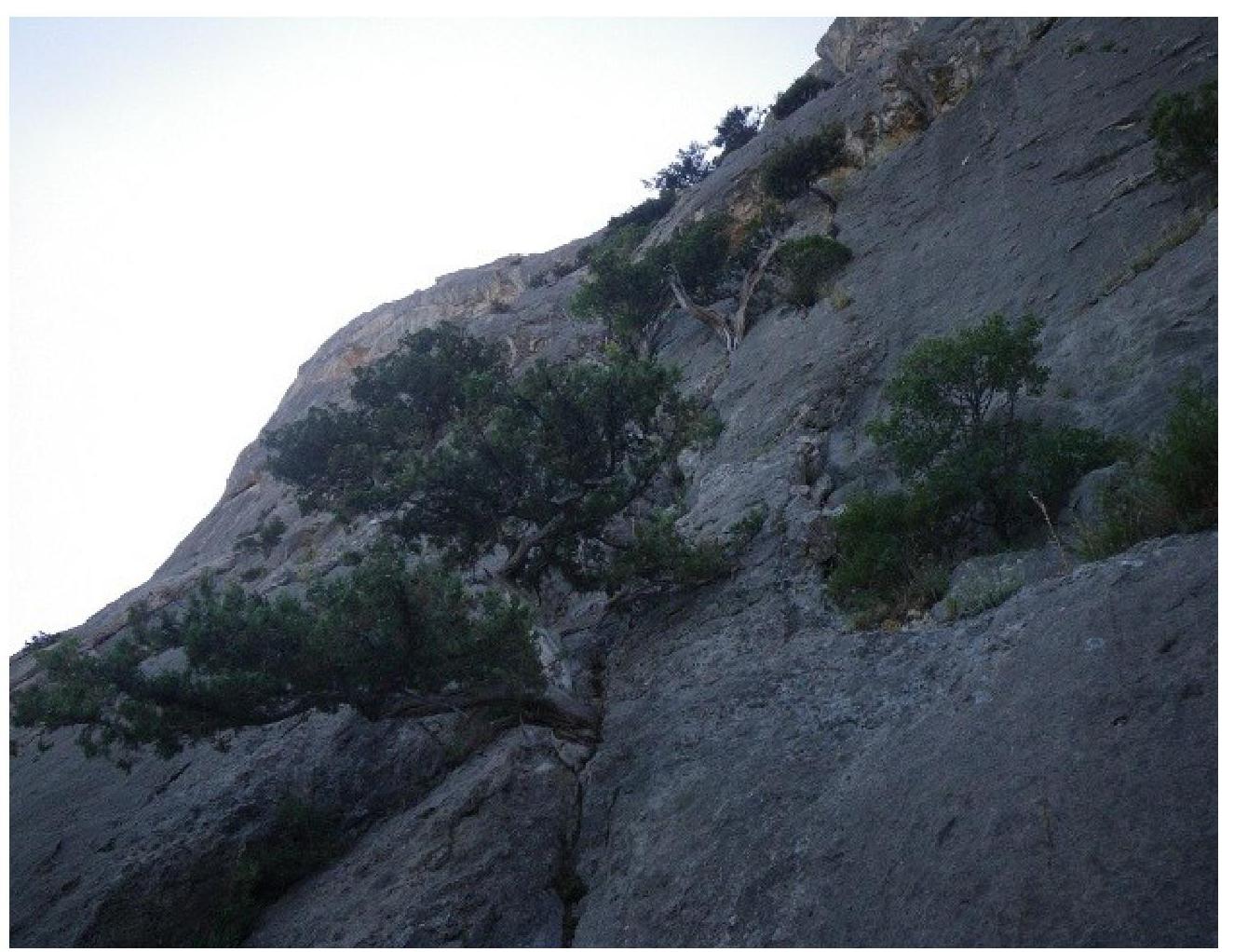
Pierwsza linia liny
trasy
1. Introduction
This document provides an overview of the key concepts and methodologies used in the study of quantum mechanics. It covers:
- Fundamental principles
- Mathematical formulations
- Practical applications
2. Fundamental Principles
2.1 Wave — Particle Duality
Quantum mechanics introduces the concept of wave — particle duality, where particles, such as electrons and photons, exhibit both wave-like and particle-like properties. This duality is central to understanding quantum behavior.
2.2 Superposition
The principle of superposition states that a quantum system can exist in multiple states simultaneously until it is measured. This is mathematically represented by a wave function, denoted as |ψ⟩.
2.3 Uncertainty Principle
The Heisenberg Uncertainty Principle states that it is impossible to simultaneously know the exact position and momentum of a particle. This is expressed as: Δx ⋅ Δp ≥ ℏ/2 where Δx is the uncertainty in position, Δp is the uncertainty in momentum, and ℏ is the reduced Planck constant.
3. Mathematical Formulations
3.1 Schrödinger Equation
The Schrödinger equation is a fundamental equation in quantum mechanics that describes how the quantum state of a physical system changes over time. It is given by: iℏ ∂/∂t Ψ(r, t) = Ĥ Ψ(r, t) where Ψ(r, t) is the wave function, Ĥ is the Hamiltonian operator, and Ĥ is the Hamiltonian operator.
3.2 Dirac Notation
Dirac notation is a convenient and convenient way to represent quantum states and operators. It uses bra-ket notation, where a quantum state is described by a quantum state, and bra-ket notation is used to represent quantum states and operators.
4. Practical Applications
4.1 Quantum Computing
Quantum computing leverages the principles of superposition and entanglement to perform computations that are infeasible for classical computers. Quantum bits, or qubits, are the fundamental units of quantum information.
4.2 Quantum Cryptography
Quantum cryptography uses the principles of quantum mechanics to secure communication. Quantum key distribution (QKD) is a cornerstone of quantum computing, where key distribution (KDD) is a subset of classical computers.
5. Conclusion
Quantum mechanics is a cornerstone of modern physics, providing a framework for understanding the behavior of particles at the smallest scales. Its principles have led to groundbreaking technologies and continue to inspire new research and development.
6. References
- Griffiths, D. J. (2005). Introduction to Quantum Mechanics. Pearson.
- Shankar, R. (2012). Principles of Quantum Mechanics. Plenum Press.

Komentarze
Zaloguj się, aby zostawić komentarz