
Montaña Sokol ruta "Подарочный набор" (gran caminata) 2A
Autor: Gennadi Ivanov
En junio de 2012, mi esposa Anya y yo visitamos Sudak y realizamos la ascensión a la montaña Sokol por la ruta "Подарочный набор" 2A-2B.
La ruta "Подарочный набор" es más sencilla que Vilka o PK en Foros. Por lo tanto, lo más probable es que su categoría sea 2A.
Mis comentarios sobre la descripción (cursiva)
R0–R1 35 m: 5c+
- La seguridad se organiza mediante árboles y, si es necesario, puntos de seguridad propios.
- Estación en un perno y un árbol, en una pequeña repisa.
La longitud del tramo es de 45 m, a los 35 m se encuentra el primer perno, pero la estación está 10 m más arriba.
R1–R2: 25 m, 5b — escalada sencilla con organización ligera de seguridad mediante árboles y, si es necesario, puntos de seguridad propios.
Estación en una repisa en un árbol.
R2–R3: 50 m, 5c — desde el árbol hacia arriba y hacia la izquierda a través de un pequeño techo, luego por grietas cómodas para la seguridad hacia la derecha.
Estación en una enorme repisa en un árbol.
R3–R4: 50 m, travesía fácil hacia la derecha por la repisa pasando por árboles. Estación en un árbol.
En este tramo hay un descenso. Se avanzó con seguridad.
R4–R5: 50 m, 4c, travesía de la repisa con ascenso gradual hacia la silla. Estación en un árbol en el lado izquierdo de la silla.
R5–R6: 50 m, 5c+
- Pasar a través de un pequeño tramo liso
- Cruzar hacia una grieta sobre un tramo de roca descompuesta
- Salir hacia un árbol
La seguridad se organiza con facilidad. Estación en un árbol. Esta cuerda coincide con la cuerda de "Единичка".
Al pasar por el tramo descompuesto, se intentó no cargar sobre él. En general, el tramo es más sencillo que 5c, rocas suaves, los bloques de roca están firmes sobre ellas.
R6–R7: 25 m, 5a:
- Por la repisa hacia la derecha
- Luego por la grieta hacia la meseta
Coincide con "Единичка". Estación en la meseta en un pequeño enebro.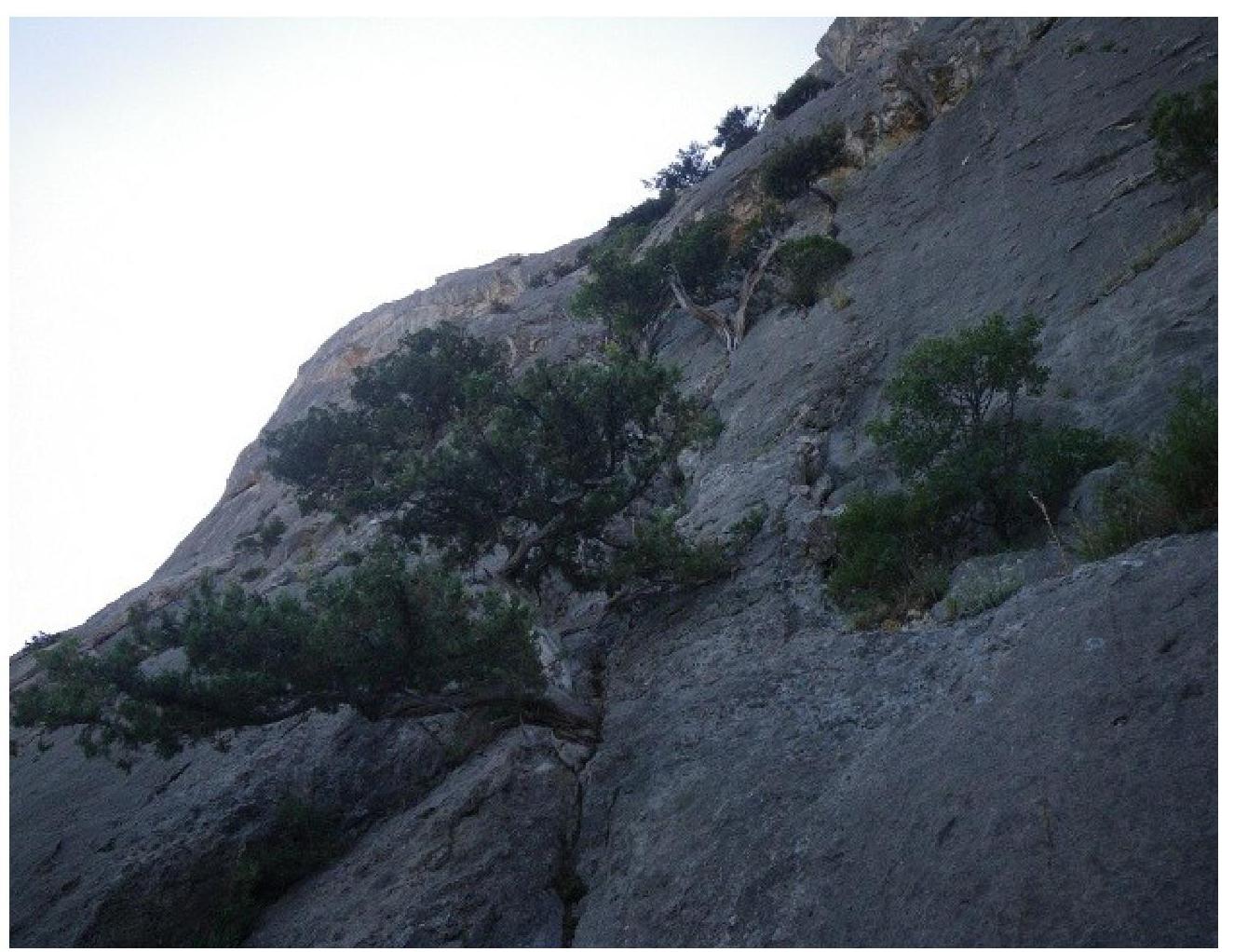
Primera cuerda de la ruta
1. Introducción
This document provides an overview of the key concepts and methodologies used in the study of quantum mechanics. It covers:
- Fundamental principles
- Mathematical formulations
- Practical applications
2. Fundamental Principles
2.1 Wave — Particle Duality
Quantum mechanics introduces the concept of wave — particle duality, where particles, such as electrons and photons, exhibit both wave-like and particle-like properties. This duality is central to understanding quantum behavior.
2.2 Superposition
The principle of superposition states that a quantum system can exist in multiple states simultaneously until it is measured. This is mathematically represented by a wave function, denoted as |ψ⟩.
2.3 Uncertainty Principle
The Heisenberg Uncertainty Principle states that it is impossible to simultaneously know the exact position and momentum of a particle. This is expressed as: Δx ⋅ Δp ≥ ℏ/2 where Δx is the uncertainty in position, Δp is the uncertainty in momentum, and ℏ is the reduced Planck constant.
3. Mathematical Formulations
3.1 Schrödinger Equation
The Schrödinger equation is a fundamental equation in quantum mechanics that describes how the quantum state of a physical system changes over time. It is given by: iℏ ∂/∂t Ψ(r, t) = Ĥ Ψ(r, t) where Ψ(r, t) is the wave function, Ĥ is the Hamiltonian operator, and Ĥ is the Hamiltonian operator.
3.2 Dirac Notation
Dirac notation is a convenient and concise way to represent quantum states and operators. It uses bra-ket notation, where a quantum state is described by a ket, and bra-ket notation is used to represent quantum states and operators.
4. Practical Applications
4.1 Quantum Computing
Quantum computing leverages the principles of superposition and entanglement to perform computations that are infeasible for classical computers. Quantum bits, or qubits, are the fundamental units of quantum information.
4.2 Quantum Cryptography
Quantum cryptography uses the principles of quantum mechanics to secure communication. Quantum key distribution (QKD) is a cornerstone of quantum computing, where key distribution (KDD) is a subset of classical computers.
5. Conclusion
Quantum mechanics is a cornerstone of modern physics, providing a framework for understanding the behavior of particles at the smallest scales. Its principles have led to groundbreaking technologies and continue to inspire new research and development.
6. References
- Griffiths, D. J. (2005). Introduction to Quantum Mechanics. Pearson.
- Shankar, R. (2012). Principles of Quantum Mechanics. Plenum Press.

Comentarios
Inicia sesión para comentar