
User ratings have been added to the SummitX website. Now, your completed climbs automatically build not only your personal history but also several ratings: mastery, explorer rating, current form, and altitude rating.
Ratings are recalculated once a day, at night. Therefore, if you added or updated climbs today, the changes will not appear instantly but after the next recalculation.
User rating page: https://ru.summitx.info/ru/users/64744074/ratings ↗
Detailed user analytics: https://ru.summitx.info/ru/analytics/users/64744074 ↗
Global analytics and leaderboards: https://ru.summitx.info/ru/analytics ↗
Why ratings are needed
Let's be honest: people like to compare themselves. There are several other common expressions to describe this phenomenon, but I won't quote them :)
Who is stronger? Who is in shape right now? Who climbs more? Who has been higher? Who travels to different regions more often? Who is truly leading, and who is mostly climbing as a participant? These are common questions. In alpinism, people have always been interested in them; it’s just that previously they were more often discussed in conversations, route lists, and personal memories.
I wanted to do this more carefully. That is why the site features several ratings instead of just one. They show different aspects of mountaineering experience.
Four ratings instead of one total number
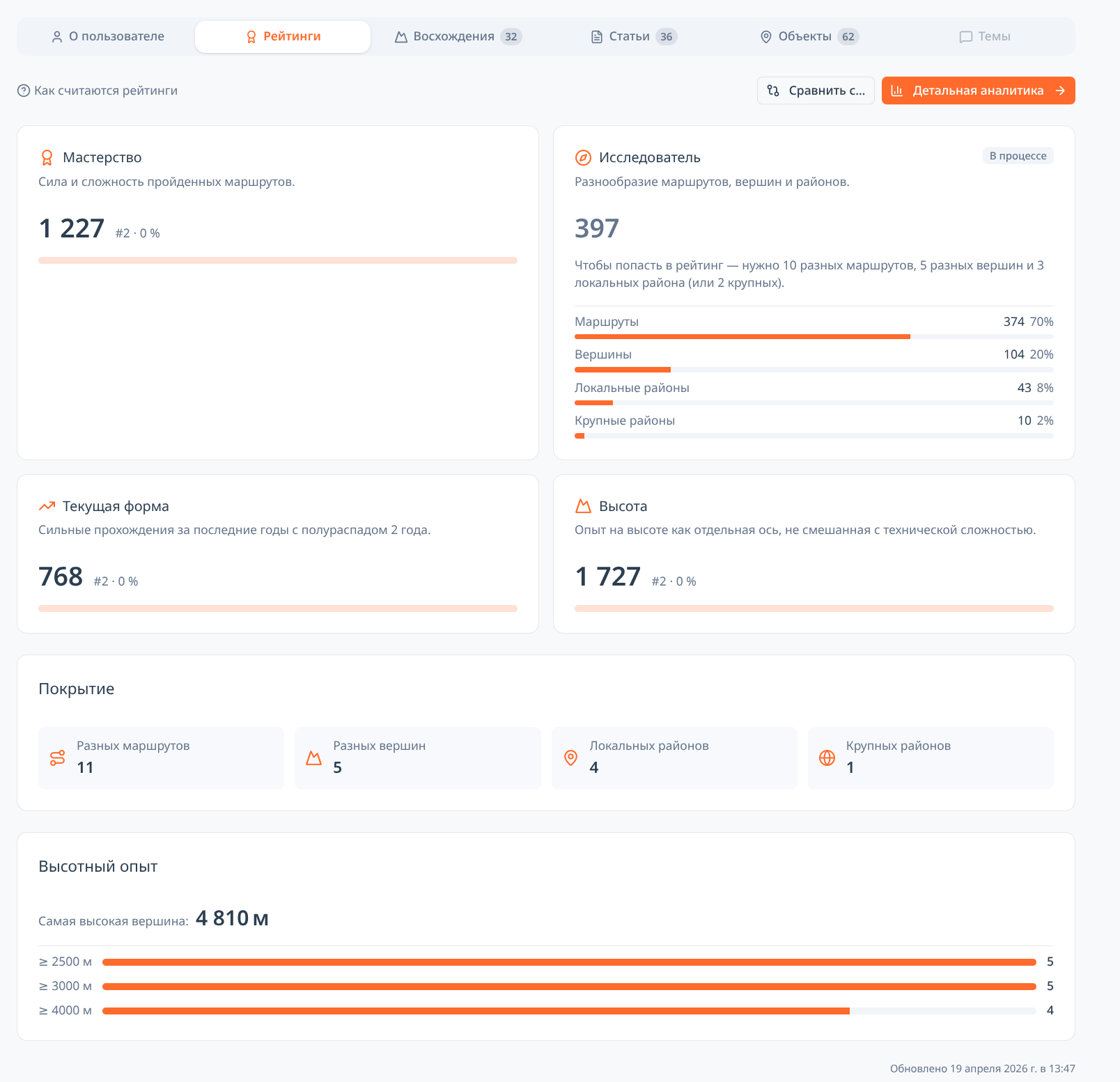
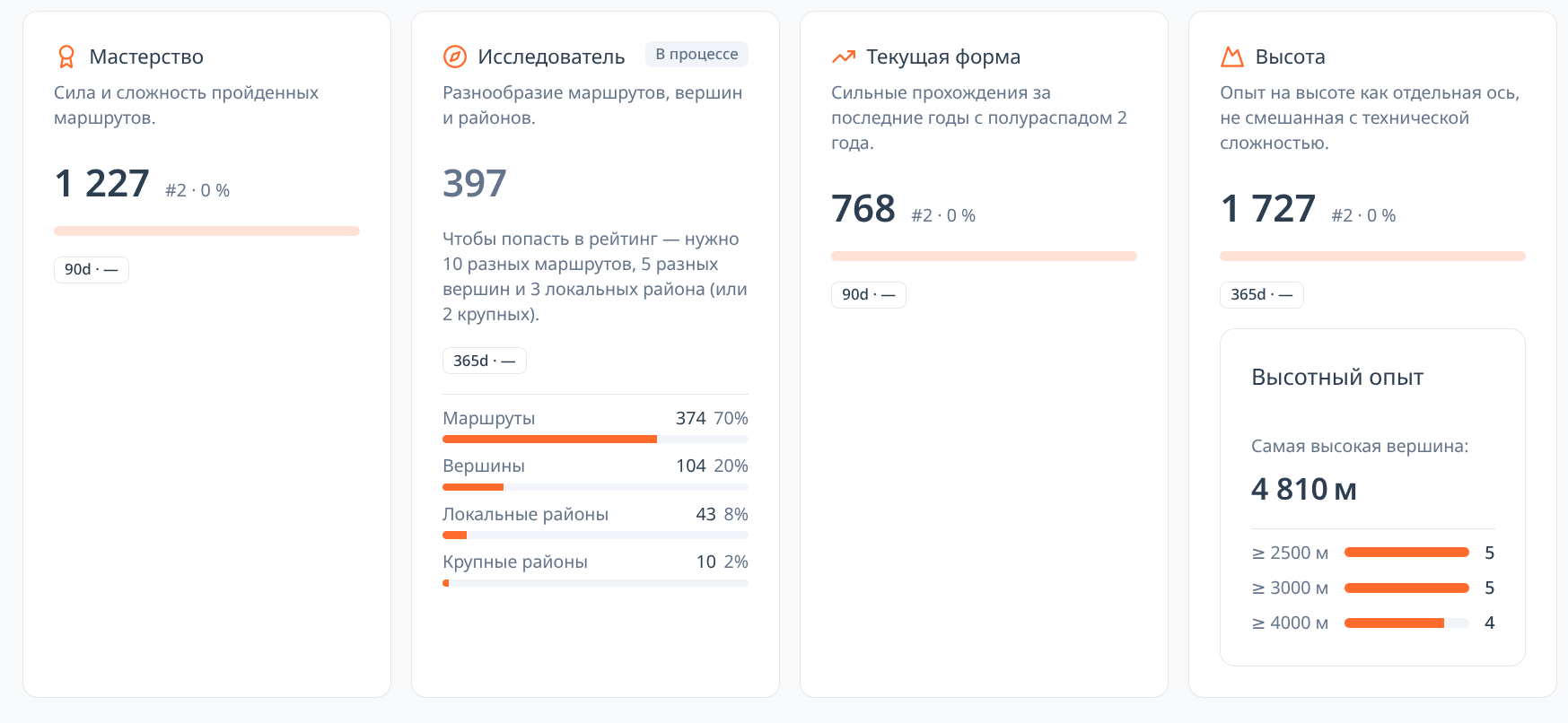
A user profile now features four main ratings.
The first is mastery. It shows the technical level and complexity of the routes you have completed. It is influenced by route difficulty, seriousness, confidence of the assessment, your technical role, style of ascent, and the use of pre-placed fixed ropes.
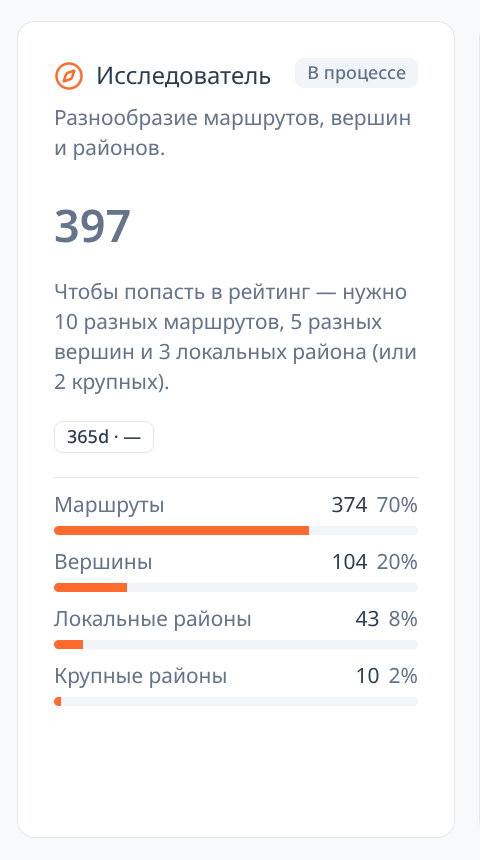
The second is explorer. It shows the diversity of experience: different routes, different peaks, different local and major regions. If a person climbs the same route many times, it is not the same as ten different routes of similar difficulty.
The third is current form. It answers the question of what you are demonstrating right now. Old climbs do not disappear, but their contribution gradually decreases. This allows for distinguishing vast past experience from current activity.
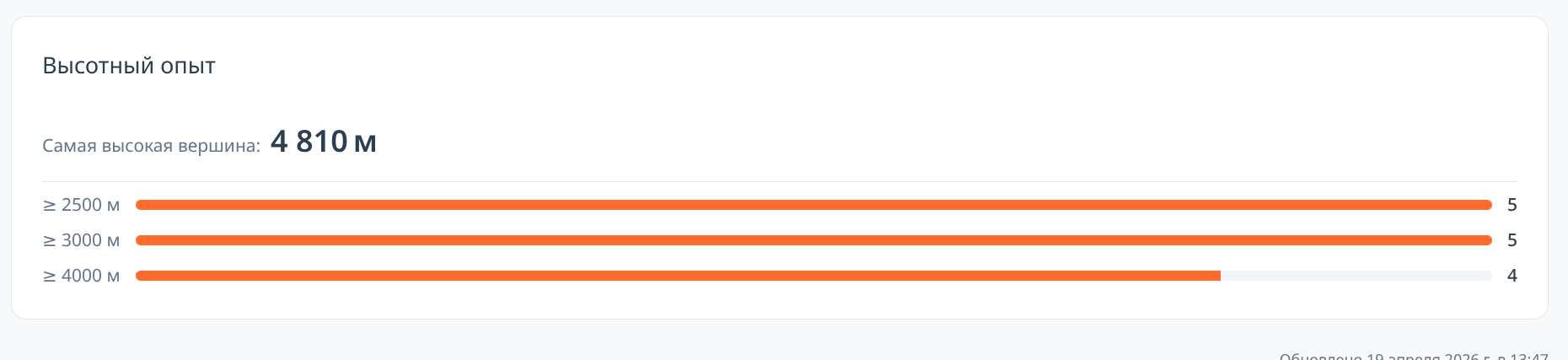
The fourth is altitude. This is a separate rating for high-altitude experience. It is not mixed with technical mastery because they are different things. One can be a strong technician at 4000 m and have almost no high-altitude experience. One can climb high mountains often but not engage in extreme technical walls.
[Space for screenshot: four rating cards — Mastery, Explorer, Current Form, Altitude]
Why a rating might be lower than you expected
If you imported your climbs and saw that the rating is lower than expected, the reason is likely not that the system "doesn't value" your routes. The reason is often different: your routes lack a confident technical assessment.
The rating is not built simply based on the route name and an old category. The site attempts to calculate difficulty based on the route's pitches and data from real ascents. If no one has "marked" the route—i.e., specified the pitches and their difficulties—the system cannot reliably understand its technical complexity. Unfortunately, if a route has not been technicality broken down by anyone, it won't be able to participate in the rating.
Such routes remain in your history. They are visible in your profile and are important as a matter of experience. However, they contribute little or not at all to the rating until they have proper data.
This is done intentionally, otherwise, the rating would quickly become unfair: one user carefully described the pitches, another imported a hundred routes without details, and a third climbed routes that no one has described yet. Such data cannot be compared directly. If you want your routes to be better accounted for, add the route pitches and their difficulty. This can be done when editing each of your climbs. Even one good technical breakdown from a real participant is much more useful than a weak automatic estimate based on an old description.
How ratings are linked to climbs
A rating grows from completed climbs. You add a route ascent. If you can, you specify the pitches. The system gradually classifies the route. After the nightly recalculation, the rating is updated. This means that the ratings and the route database are inextricably linked. The better the route data, the fairer the ratings. The more users fill in real ascents, the more accurate the classification becomes.
In other words, the rating here is not a toy, but a motivator to put the routes in order.
Mastery
The mastery rating shows how strong the routes you have actually climbed are.
It doesn't just sum up all climbs in a row. Repetitions of the same route fade quickly. If you have climbed the same route ten times, it should not be equal to ten different routes of the same difficulty.
The style of ascent is also taken into account. For example, a route climbed using pre-placed fixed ropes should not provide the same contribution as an independent ascent with your own ropes. At the same time, I intentionally do not give bonuses for risky styles like free solo. The rating should not encourage dangerous behavior. Mastery is not about "who took the scariest risks," but an attempt to evaluate the technical level based on routes and the quality of data about them. Too many friends have perished in the mountains to send those remaining to war...
Explorer
The explorer rating is for a different side of alpinism.
One can be strong but climb in the same region all the time. One might not chase extreme technicality but have vast experience across different mountains, peaks, and massifs. These things are also important.
Therefore, the explorer rating takes into account not only routes but also geographical diversity: peaks, local regions, and major regions. Rare routes may give a small bonus, but it is specifically limited so as not to break the system.
This is a rating for those who love to travel, discover, compare regions, and gather broad experience.
Current Form
Current form shows relevance. Many climbers have strong routes in their past. This is important, and they remain in the mastery rating. But if a person hasn't climbed for a long time, this should also be visible.
Current form weighs recent climbs more heavily, while old ones gradually lose weight. Therefore, you can see not only "what is my maximum historical level," but also "where am I now."
This is useful for the climber themselves, as well as for instructors and group leaders. For a trip or a training camp, it is often more important not what a person climbed ten years ago, but how good they are right now.
Altitude
The altitude rating is a separate story. I didn't want to mix altitude with technical complexity. These are different competencies. Altitude requires acclimatization, experience, high-altitude resilience, understanding of one's body, logistics, and patience. But a high route is not always technically difficult, and a technically difficult route is not always high.
Therefore, a separate altitude rating appeared. It takes into account various high peaks and does not inflate infinitely from repetitions of the same mountain. The profile also shows clear counters: maximum altitude, peaks above 2500, 3000, 4000, 5000, 6000, 7000, and 8000 meters.
Detailed user analytics
Ratings are just the top layer.
I have also created detailed user analytics: https://ru.summitx.info/ru/analytics/users/64744074 ↗
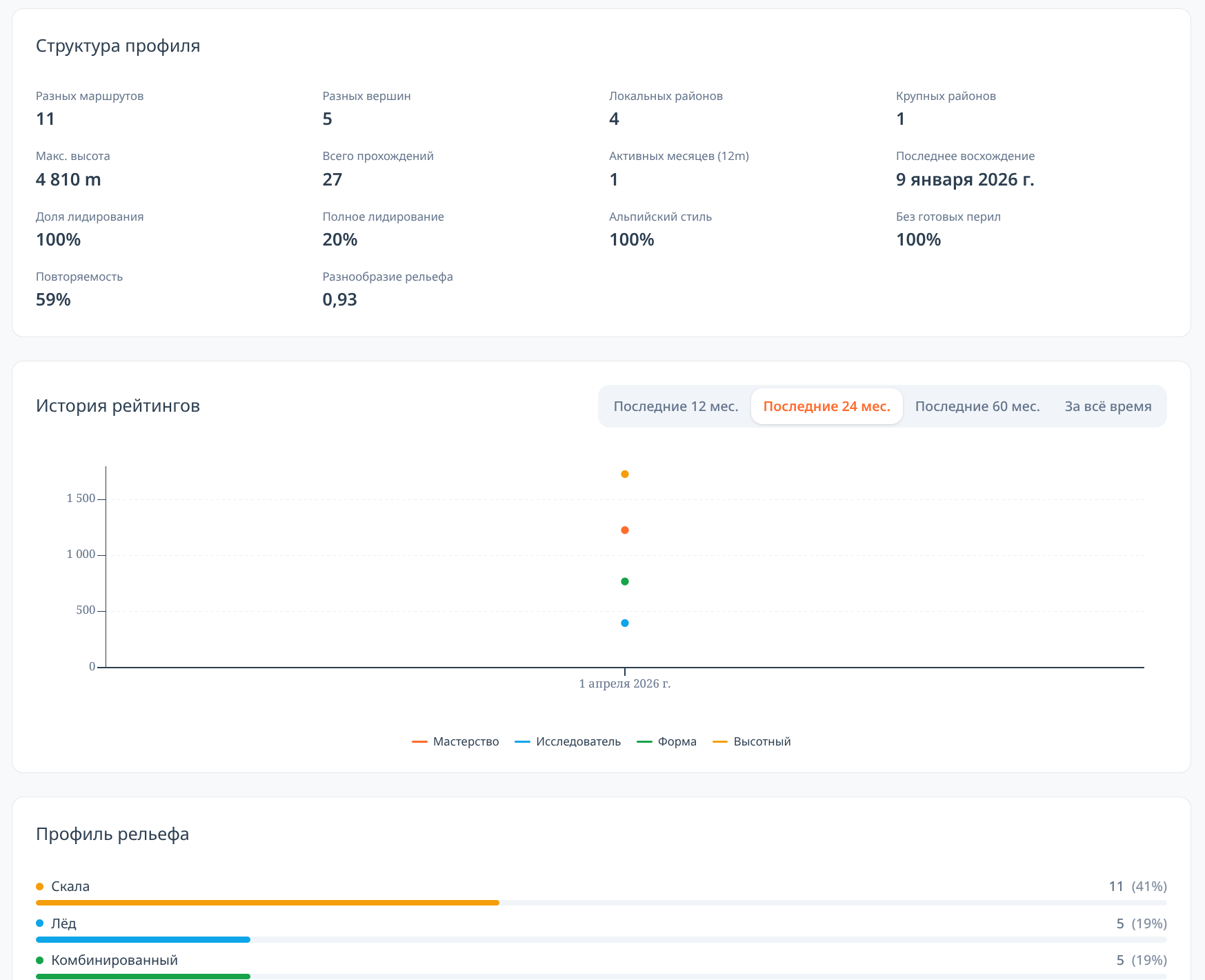
There you can see what your profile consists of. Not just "I have this many points," but how many different routes, peaks, and regions, what the maximum altitude is, the share of leading, how much alpine style, how many ascents without pre-placed fixed ropes, how much the same routes are repeated, and the terrain profile. Your personal mirror of experience.
For example, you can see that a person has a high mastery rating but low current form. Or that they climb a lot but mostly repeat the same routes. Or that they have strong technique but almost no high-altitude experience. Or vice versa: a large high-altitude background but few technically difficult routes.
Global analytics and leaderboards
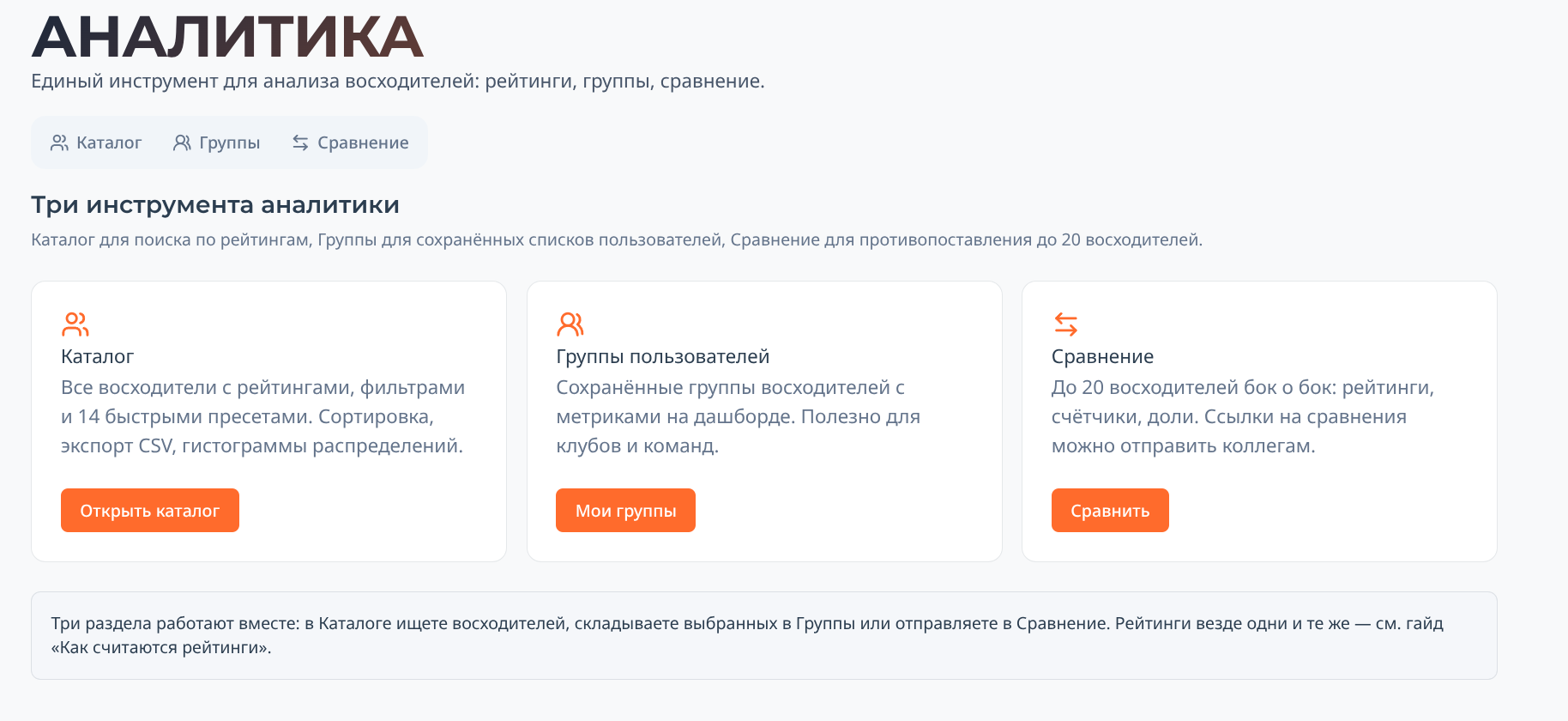
There is also a general analytics section: https://ru.summitx.info/ru/analytics ↗
There you can view users, tops, and comparisons. This is already useful not just for personal interest, but for instructors, coaches, and club leaders.
Currently, the site does not yet have a full club system. But the analytics already allow for solving some of these tasks: you can compare users with each other, check activity, altitude experience, current form, technical level, and diversity.
This can be useful before training camps, trips, educational events, or simply for understanding who is in what shape right now.
User comparison
Separately, there is user comparison. Sometimes it’s interesting to understand exactly how people differ: one is higher in mastery, another in current form, a third is stronger in altitude. A fourth is more of an explorer. A fifth leads more often. A sixth climbs more diverse terrain.
For a group or club leader, this is more useful than a single total figure. For the user themselves as well. Sometimes comparison shows not "who is better," but "how we are similar and how we differ."

Who this might be useful for
For beginners: to see growth. Not only by route categories but also by the structure of experience: more routes appeared, current form emerged, the share of leading grew, new regions appeared, altitude was added.
For experienced climbers: to gather their long history in one place and see which routes truly shape their profile.
For instructors and coaches: to look at students and understand who is active, who is leading, who is gaining form, who lacks diversity, and who is ready for more complex tasks.
For club leaders: to analyze the roster. You can use global analytics and comparison: who is in shape now, who has the technique, who has the altitude, where the gaps are, and who can be assigned to which tasks.
Why there are no bonuses for risk
I specifically decided not to give rating bonuses for free solo, rope solo, high objective danger, or poor protection. Such things can be recorded in the ascent history, but the rating should not encourage risk for the sake of points. Otherwise, the system would quickly become harmful.
Alpinism is dangerous enough as it is. The website should not further push people toward decisions made for the sake of a place in a table.
What you can do now
If you are already registered, open your profile and look at the ratings, for example: https://ru.summitx.info/ru/users/64744074/ratings ↗
You can also open detailed analytics there: https://ru.summitx.info/ru/analytics/users/64744074 ↗
If the rating somehow turned out to be zero :) – add your climbs. You can add a climb from the route page. Start with the routes you consider key for yourself: add the pitches and their difficulty.
If you are a current or former member of FAR and have many old climbs, you can import them from the FAR database and then gradually refine them.
If you want to compare yourself with others, open the global analytics: https://ru.summitx.info/ru/analytics ↗
Summarizing
I have long wanted alpinists to have not just a list of routes, but a proper system where personal history, route database, classification, and analytics develop as a single organism. And finally, it has appeared!
For now, much depends on the quality of data. And yes, all of us will have to gradually put our climbs and route descriptions in order. This is not the easiest work. But it is exactly where the value comes from. Completed climbs improve the routes. Refined routes improve the ratings. Ratings help to see growth.
You can find more details about the rating calculations on the page: https://ru.summitx.info/ru/pages/user-routes-ratings-overview ↗

Comments
Sign in to leave a comment