
Triangle — 4
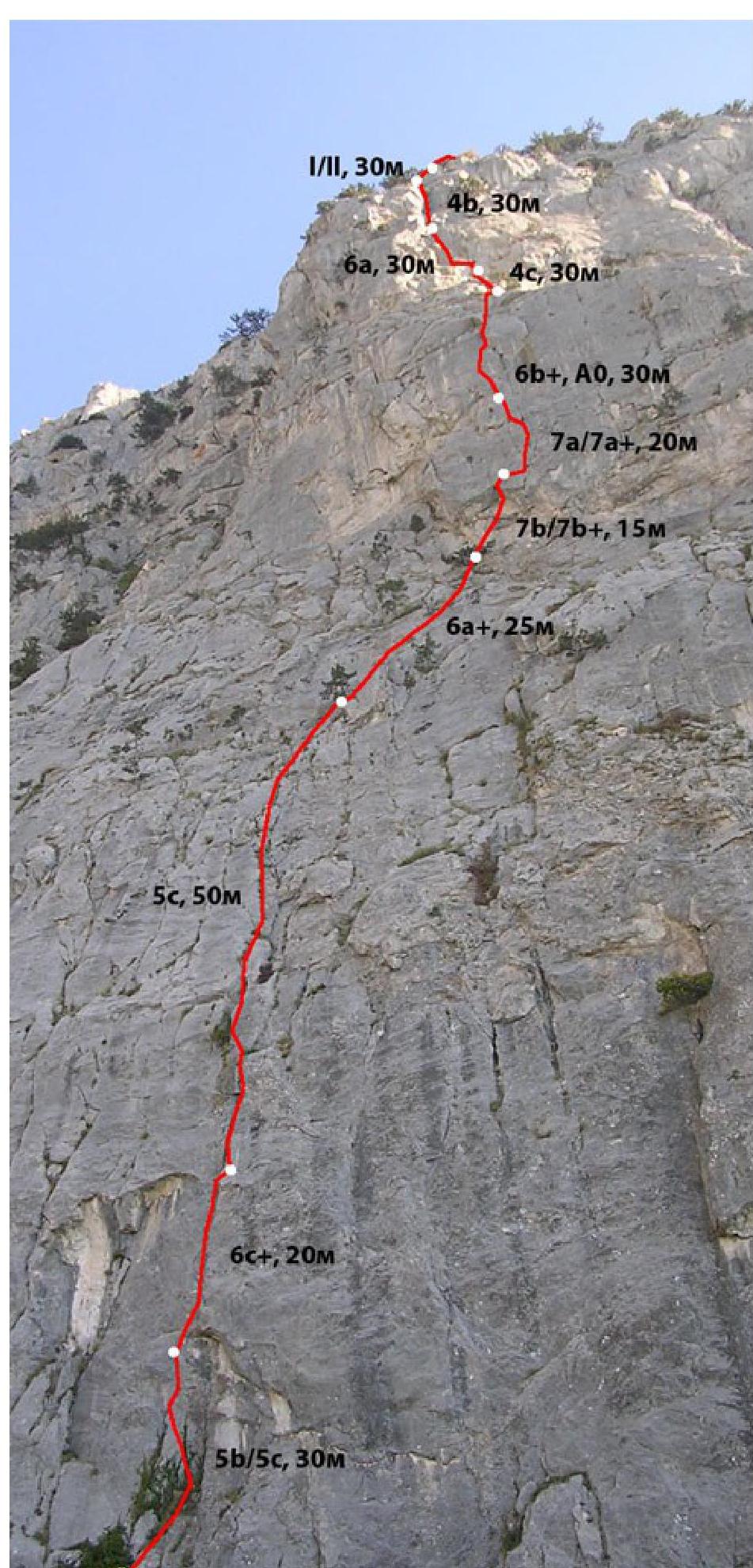
The material was prepared by: Max Kostrov and Olga Kostrova
Triangle, route "Renaissance" 6A, F7b/7b+, A0 (or VI, A3), 440 m — Crimea
The "Renaissance" route* to the Triangle summit via the left part of the Western wall was first climbed in autumn 2001 by a team from Odessa consisting of:
- Alexey Zhilin
- Sergey Kalachev
- Alexander Lavrinenko
- Vladimir Mogila
(see Alexander Lavrinenko's "Odessit" description — 6A, VI, A3).
- RENAISSANCE — (from French Renaissance) REVIVAL — … an era in history that marked the beginning of the Modern era. In October 2005, the Mountain.RU team (Max and Olga Kostrov) climbed almost the entire route using free climbing, except for 5 m at the beginning of the R6–R7 section** (A0) — in the Odessa team's description, this is the end of section 8–9.
** Note that the numbering of sections in this description and the Odessa team's description DIFFERS!
Protection on the route: friends, nuts, pitons, and some bolts. Overall, the route is not overly "littered" with pitons.
To get to the route, take the old "upper" road Yalta — Sevastopol until you reach the quarry below Morcheka. Then follow the serpentine road, trying to stay on the left side of the "rock" excavations. At the point where the road turns right towards Morcheka, and a wide path goes left down towards the spring, you should turn left upwards and ascend the scree into the forest that borders the quarry from the west. Then, through the forest (there are cairns), approach the Triangle wall. The "Renaissance" route passes through the left (farther along the path) part of the wall.
The forest is very close and dense around the rocks, so to get a better view and see the route, it's advisable to step back from the wall by 70 m to a viewing rock (there are many of them).
The start of the route is a wide, overgrown with ivy, internal corner located to the right of a large "white slab", 10 m from the base of the wall.
R0–R1: Ascend a sloping shelf to the left and upwards to a tree, under the aforementioned internal corner. Then upwards through a crack to the right of the overgrown internal corner. After that, where the ivy hasn't reached yet, move left into the internal corner and up it — to an old bolt station. 5Б, 30 m (previously described as V)
R1–R2: From the station, through a crack and a small overhanging block to the right and upwards to a "wavy" groove, then up it. There are 3 old bolts. The station is on two bolts (one old, one new with a ring) to the right of the groove. $6 c+ (obbl.** 6b+/6c), 20 m (previously described as VI, A3)
The holds for hands and feet are on the walls of the groove. The distance between the bolts is 5–6 meters.
There's nothing to "place" or "hit" — you just need to climb.
*** obbl. — abbreviation for obligatory — the required level of climbing.
R2–R3: Up a gully (with "graspable" edges) 8 m to a small overhanging block. Then up a crack, veering slightly left, through two small pine trees (there's a bolt) to a "thin-stemmed" bush, from which you move right and upwards to a large pine tree.
- 5c, 50 m (previously described as V/V+)
- "Typical Crimean V"
- A 50-meter rope is just enough.
R3–R4: Along a sloping ledge (II, 7 m) to the right and upwards to a small ledge (bolt with a ring). Then up the wall (6a+, 8 m) — there's an old "two-ear" bolt. Further along a very crumbling, gently sloping wall, approach a strongly twisted pine tree under a large overhang and through its branches, ascend to a bolt (III, 10 m) — station.
- 6a+ (obligatory 6a)
- 25 m
- Previously described as V+, A1
To the left, before the pine tree, there are rusty "two-ear" bolts that bypass the overhang. They rejoin the "Renaissance" route in the middle of the R6–R7 section. "Renaissance" goes right and upwards through the overhang — and this is a very interesting solution!
R4–R5:
- To the right and upwards (there are two bolts) to a blind crack, which is the "ridge" of the overhang.
- Then up through the overhang.
For handholds, there's a protruding "rhombus" in the cracks on the roof of the overhang. Feet are on friction, widely splayed. Before reaching this section, prepare thin pitons in advance.
At the exit from the overhang, there are a couple of excellent relief features on the right in the form of "otkidki" (outward-facing holds), so you can "drive in" the pitons into the thin crack on the left with ease.
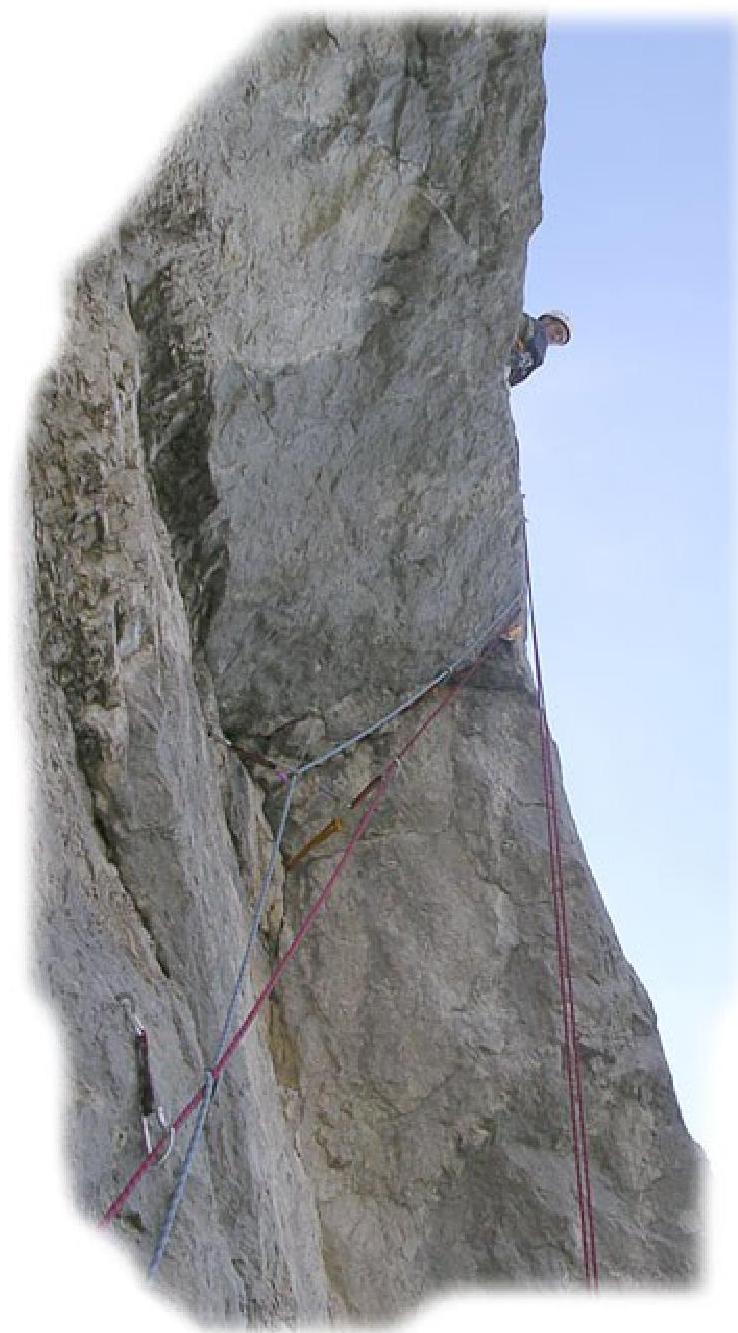
Section R4–R5
The station is on two bolts, slightly above the overhang on a slab to the right.
7b/7b+ (obbl. 7b/7b+), 15 m
(Previously described as VI, A3)
R5–R6:
- From the station, a 3-meter traverse to the right into a crack and up it
- After about five meters, there's a bolt
- When the crack splits into two, it's more convenient to start with the right crack and then move to the left one
- At the end of the crack, there's a bolt
- From it, along ledges and "shells" (to the right) to the next bolt — station (it can be reinforced with friends in the nearby "shells")
7a/7a+ (obbl. 6c), 20 m
(Previously described as VI — in the Odessa team's description, this is the first half of section 8–9)
R6–R7: Up a gully with small protrusions (A0, 5 m) — in the Odessa team's description, this is the end of section 8–9.
In the gully, I placed two nuts, then a couple of "purely psychological" pitons, and a bit higher, a thin piton fit well — I used these points as handholds. Feet are on friction on the "wall of a very wide-open angle". Be attentive when placing protection — they "fall out" easily :)
Further (in the Odessa team's description, this is section R9–R10), carefully, on balance, traverse left to a "new" bolt. From it, upwards (there are two "two-ear" bolts and horizontal cracks for protection), then traverse right into an internal corner. Up the corner, through a small tree, onto a ledge ("the higher, the easier"). In the upper part of the corner, a titanium piton is driven — from it, a horizontal traverse to the right to two pine trees — the station is on them. 6Б, A0, 30 m (previously described as VI, A3 and VI, A1)
R7–R8: From the pine trees, upwards to a "prickly", strongly crumbling wall. Be careful — the rock is very fragile! Up the wall to a large, flat, sloping ledge (bolt). 4c, 30 m (previously described as V)
R8–R9: From the sloping ledge, through a rock "step" into an internal corner. Up it to a bolt, and then traverse left. Further up, "zigzagging" — right, then left along a flake with good holds (friends go well here) into an internal corner (6a, 20 m)
Before the flake, the rocks are mossy — be careful.
Up the internal corner (there's a piton with a cable loop) (5c, 10 m). In the upper part of the corner, you can organize a station: the existing piton and a "carrot" can be reinforced with friends.
- 6a (obbl. 5b–5c), 30 m (previously described as VI)
- R9–R10: Up to a sloping ledge, then along an internal corner, with a thin, swaying pine tree in the middle, exit onto a ledge with a large pine tree
- 4b, 30 m (previously described as V)

On the yayla
R10–R11: Up simple rocks to big pine trees growing at the start of a forested terrace. I–II, 30 m
R11–R12: Over a small ridge, then walk about 10 meters along the slope, turn right, and go up among the trees along a faintly visible path. "Walking", 120 m
R12–R13: Up a small rock ascent to the yayla. I/II, 10 m
PS: Later, Sasha Lavrinenko ("Odessit") said that the rusty bolts on "Renaissance" mark the intersection with a route done by a Crimean team in the 70s. The start of this route is 20–30 meters to the left of "Renaissance". "Renaissance" itself was started in 1993 by Mikhail Voloshanovsky — he climbed 2 ropes at that time.
Author: Alexander Lavrinenko ("Odessit"), Odessa
Route "Renaissance"
Crimea, Triangle mountain, via the "bastion" of the left part of the Western wall, 6a, VI, A3, 400 m
The route was climbed in autumn 2001 by an Odessa team consisting of:
- Alexey Zhilin,
- Sergey Kalachev,
- Alexander Lavrinenko,
- Vladimir Mogila.
They completed the route in 22 hours of climbing time (over 3 days) — 2 days of processing, and on the 3rd day, they climbed to the top. The route is entirely crack climbing; skyhooks were used only 5 times throughout the route.
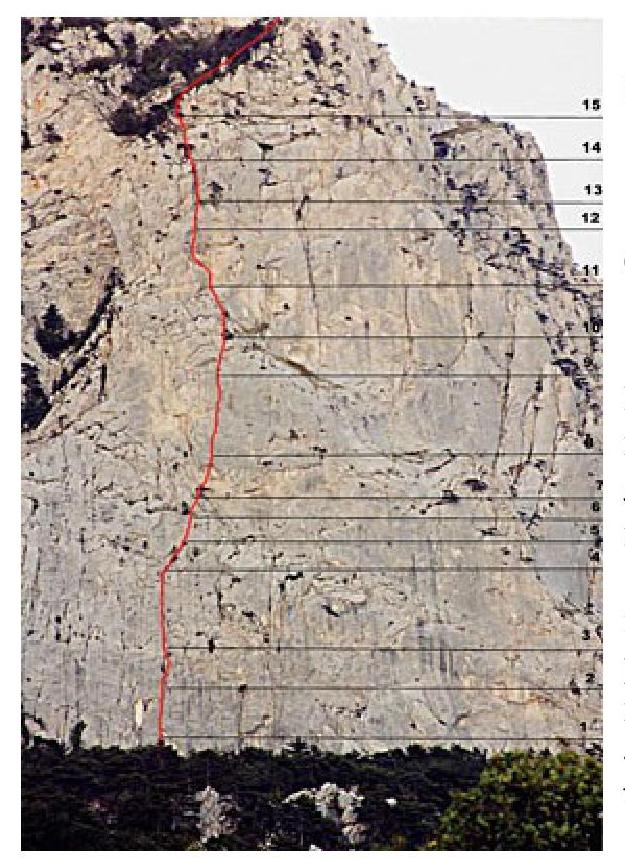
Description of the route by sections. R0–R1
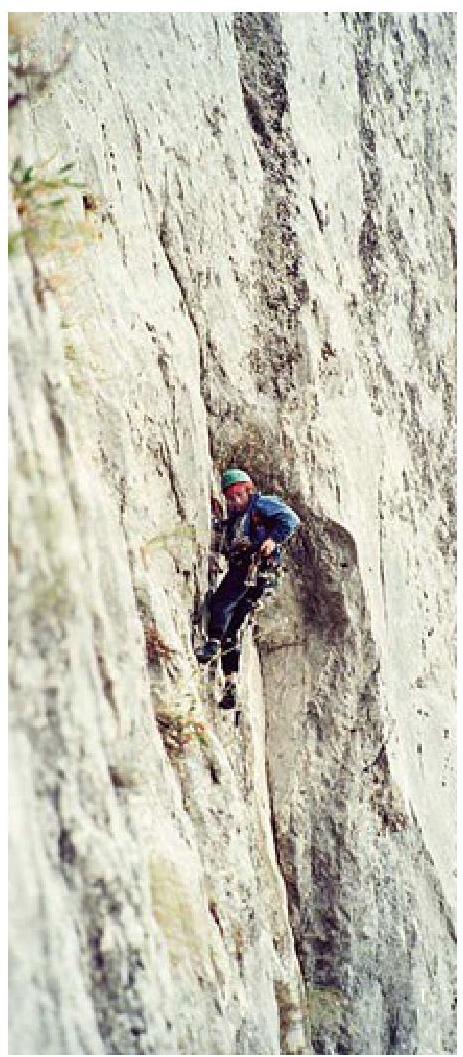
Internal corner, overgrown with ivy in the lower part. Climbed using free climbing. Protection — pitons, small and medium stoppers.
- 30 m
- 70
- V
R1–R2. Vertical wall with a groove, open in the lower part. AID climbing through blind cracks and "shells". Protection — 3 bolts, small stoppers.
- 20 m
- 85
- VI
- A3
R2–R3. Gully with good holds. Nuts, friends.
- 10 m
- 80
- V
R3–R4. Crack, passable using free climbing. Pitons, nuts, there's a bolt.
- 40 m
- 70
- V+
R4–R5. Sloping ledge with loose rocks. 5 m, 30
R5–R6. Wall, crumbling in the upper part. Difficult climbing. There's a bolt. 10 m, 70, V+, A1
6–7 Simple but has strongly crumbling rocks. 10 m, 55, III
6–7 Overhanging wall, difficult AID climbing under the overhang. The overhang is climbed through the center via a blind crack using AID. 2 bolts, pitons, skyhooks, small stoppers. 15 m, 90, VI, A3
8–9 Blind, interrupted crack. Movement is mostly AID. Protection — pitons, stoppers, friends.
- 3 bolts
- 25 m
- 85
- VI
- A3
9–10 Internal corner, then crack. Can be climbed using free climbing.
- 3 bolts
- Nuts
- Friends
- 20 m
- 80
- VI
- A1
10–11 Crumbling rocks, sometimes with steep walls. Difficult to organize protection.
- Pitons
- Friends
- 40 m
- 65
- V
11–12. Series of overhanging internal corners, tense climbing. Friends, nuts. There's a bolt. 30 m, 85°, VI
12–13. Steep internal corner, overgrown with grass. Difficult climbing. Pitons, nuts. 20 m, 80°, VI
13–14. Internal corner with a tree. Free climbing. Friends, nuts. 30 m, 70°, V
14–15. Simple, gently sloping rocks lead to a sloping terrace. 80 m, 50°, II–I.
15–16. Along the terrace, overgrown with forest, to the right and upwards to the yayla. 150 m, easy walking.