
Federation of Alpinism of Russia
Report
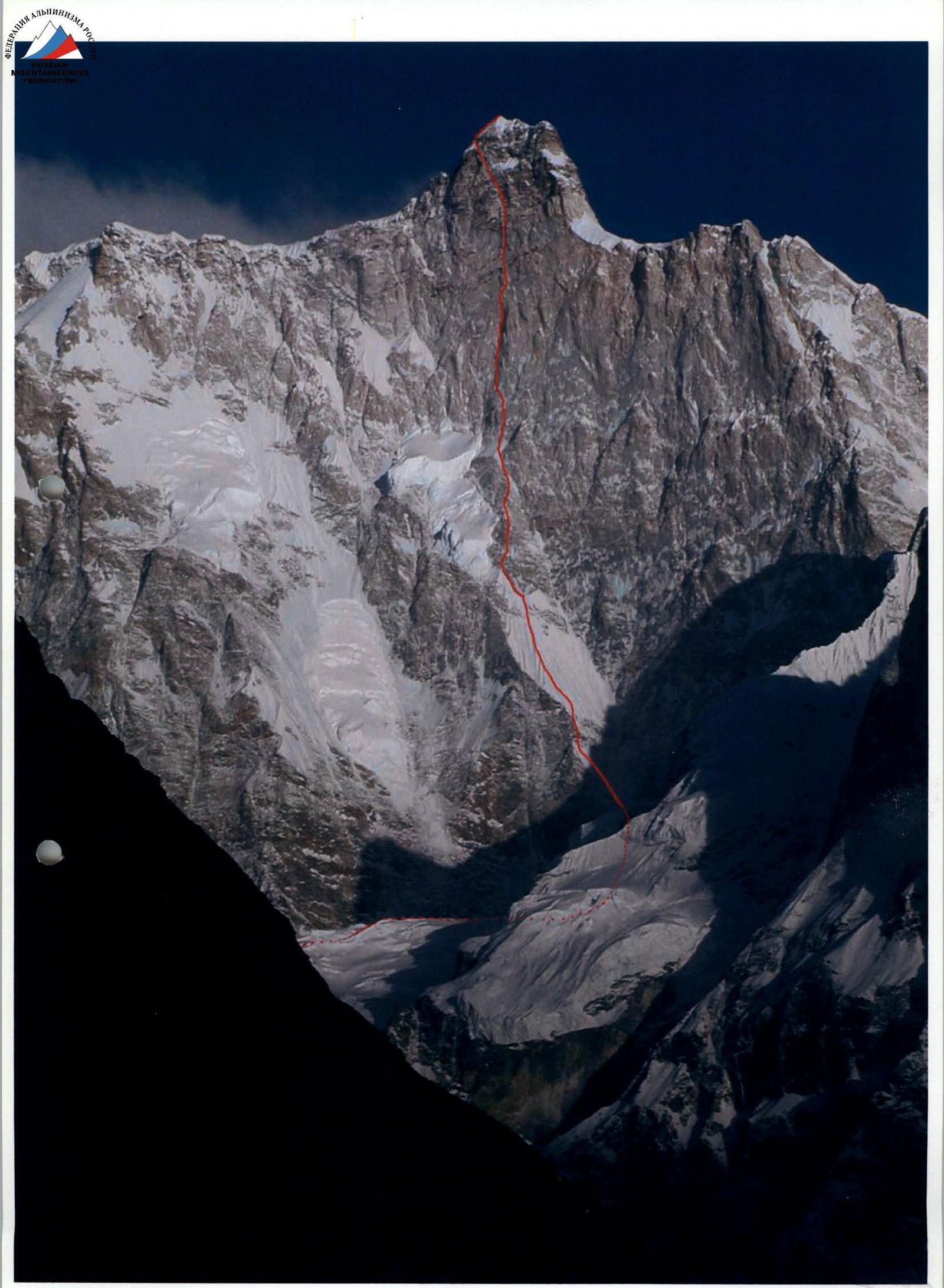
On the ascent to Jannu peak (7710 m), Nepal, Himalayas, via the center of the North face, 6B cat. difficulty (approximately), by the team "Russian Path — Walls of the World", on May 26, 2004.

Leader: Odintsov A.N. Participants:
- Totmyanin N.A.
- Ruchkin A.A.
- Mikhailov M.M.
- Pershin M.V.
- Borisov S.V.
- Kirievsky G.P.
- Bolotov A.V.
- Prilepa E.V.
- Pavlenko D.V.
St. Petersburg, 2005
Passport
-
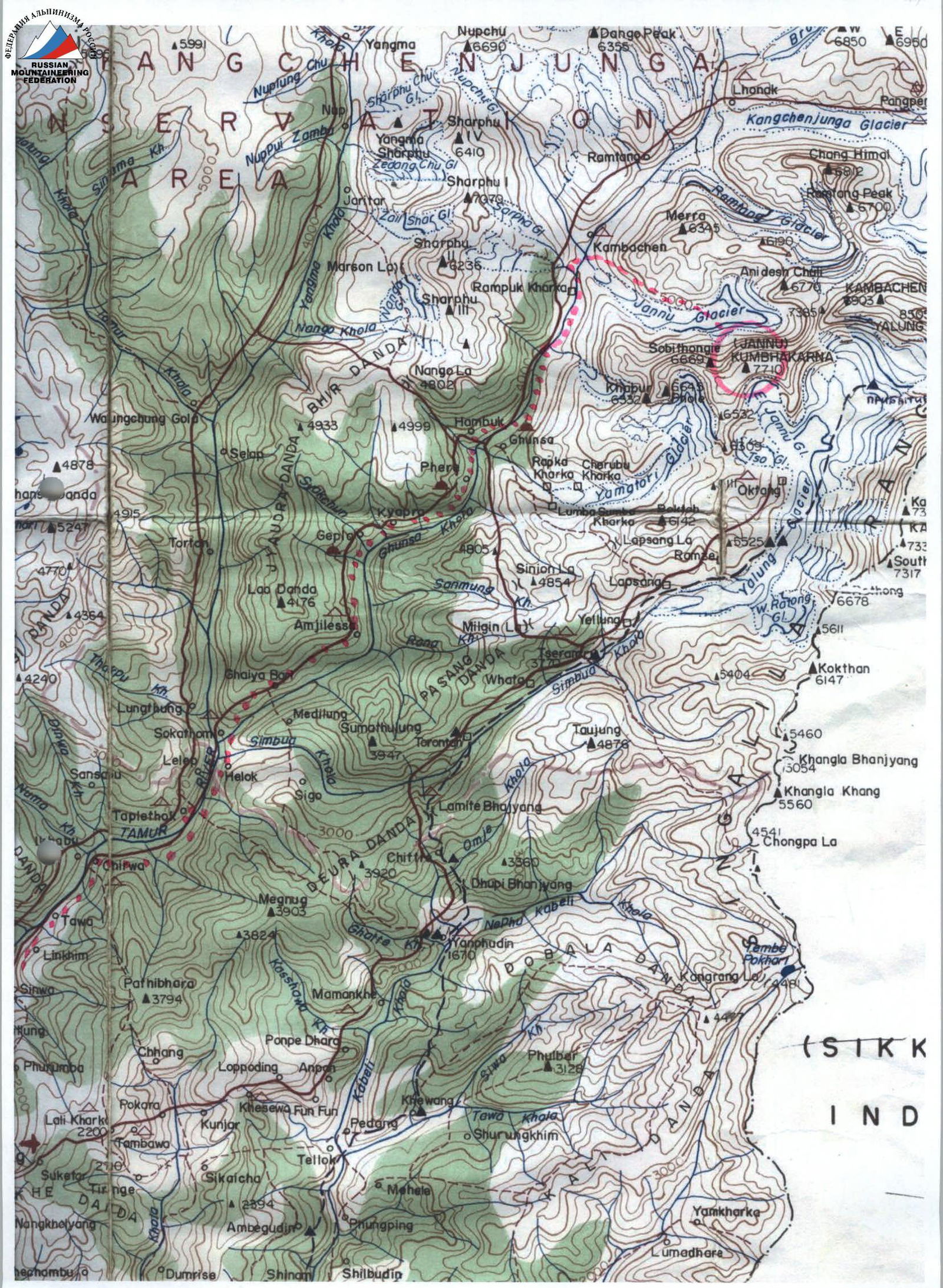
Region: Nepal, Himalayas, Kangchenjunga Region
-
Peak: Jannu, 7710 m, Russian route.
-
Proposed: 6B cat. difficulty, new route.
-
Route type: Combined
-
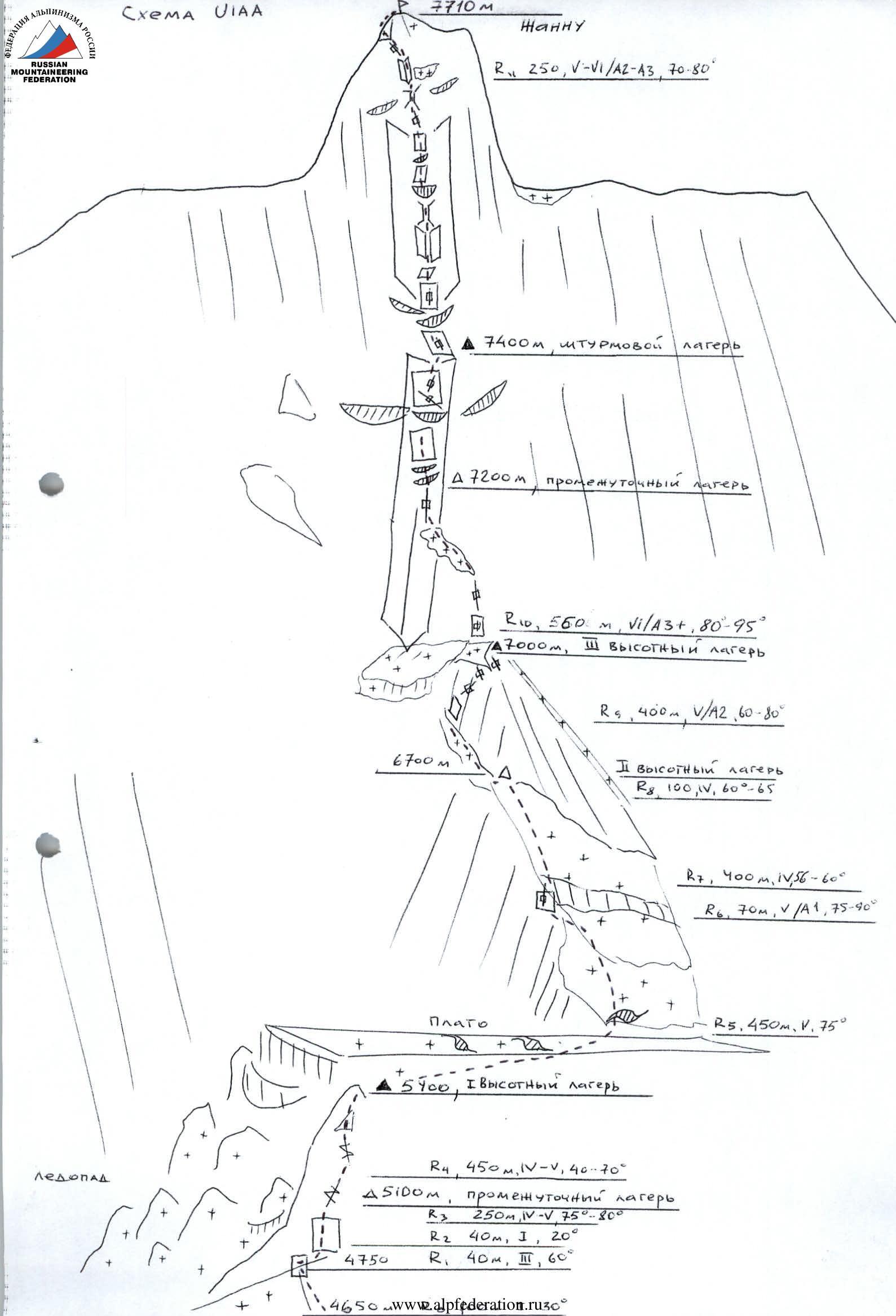
Height difference: 4650–7710 m Route length: 3100 m. Length of sections: V cat. difficulty 700 m, VI cat. difficulty 800 m. Average steepness: main part of the route: 85°, total route: 67°.
-
Hooks left on the route: 52 rock hooks, 10 chocks, 3 shl. kr. used: removable shl. kr. – 5
-
Team's working hours: 55 days
-
Leader: Odintsov A.N. — Master of Sports of International Class
Participants:
- Totmyanin N.A. — Master of Sports
- Ruchkin A.A. — Master of Sports of International Class
- Mikhailov M.M. — Master of Sports
- Pershin M.V. — Master of Sports of International Class
- Borisov S.V. — Master of Sports of International Class
- Kirievsky G.P. — Master of Sports
- Bolotov A.V. — Master of Sports
- Prilepa E.V. — Candidate for Master of Sports
- Pavlenko D.V. — Master of Sports
-
Coach: Odintsov A.N.
-
Departure for the route: 7:00, April 7, 2004
-
Summit ascent: May 26, 2004
-
Return to base camp: May 29, 2004
Russian Path — Walls of the World «Panasonic — North face of Jannu II»
Team members:
Alexander Odintsov (St. Petersburg) — leader of the project "Russian Path — Walls of the World", Master of Sports of International Class, highest category instructor, multiple winner and prize-winner of USSR and Russia Championships in technical class.
Alexander Ruchkin (St. Petersburg) — Master of Sports of International Class, winner and prize-winner of USSR and Russia Championships in technical class.
Mikhail Pershin (St. Petersburg) — Master of Sports of International Class, best climber of Russia in 1999, member of Russian national team in multi-sport (survival racing).
Nikolai Totmyanin (St. Petersburg) — Master of Sports, mountain guide, winner and prize-winner of USSR and Russia Championships in altitude class, the only climber to ascend 15 May 2003 on Everest summit without oxygen.
Mikhail Mikhailov (Bishkek) — Master of Sports, mountain guide, high-altitude cameraman.
Alexei Bolotov (Yekaterinburg) — Master of Sports, Champion of USSR and Russia, member of Russian national team in multi-sport (survival racing). Holder of the "Golden Ice Axe" for the ascent on Makalu West face in 1997.
Dmitry Pavlenko (Moscow) — Master of Sports, winner and prize-winner of Russia Championships. Holder of the "Golden Ice Axe" for the ascent on Makalu West face in 1997.
Sergei Borisov (Yekaterinburg) — Master of Sports of International Class, multiple winner and prize-winner of USSR and Russia Championships. Best climber of USSR (1990–1991).
Gennadiy Kirievsky (Magnitogorsk) — Master of Sports, multiple prize-winner and winner of USSR and Russia Championships in rock climbing.
Mikhail Bakin — expedition doctor, Candidate of Medical Sciences, surgeon of the highest category.
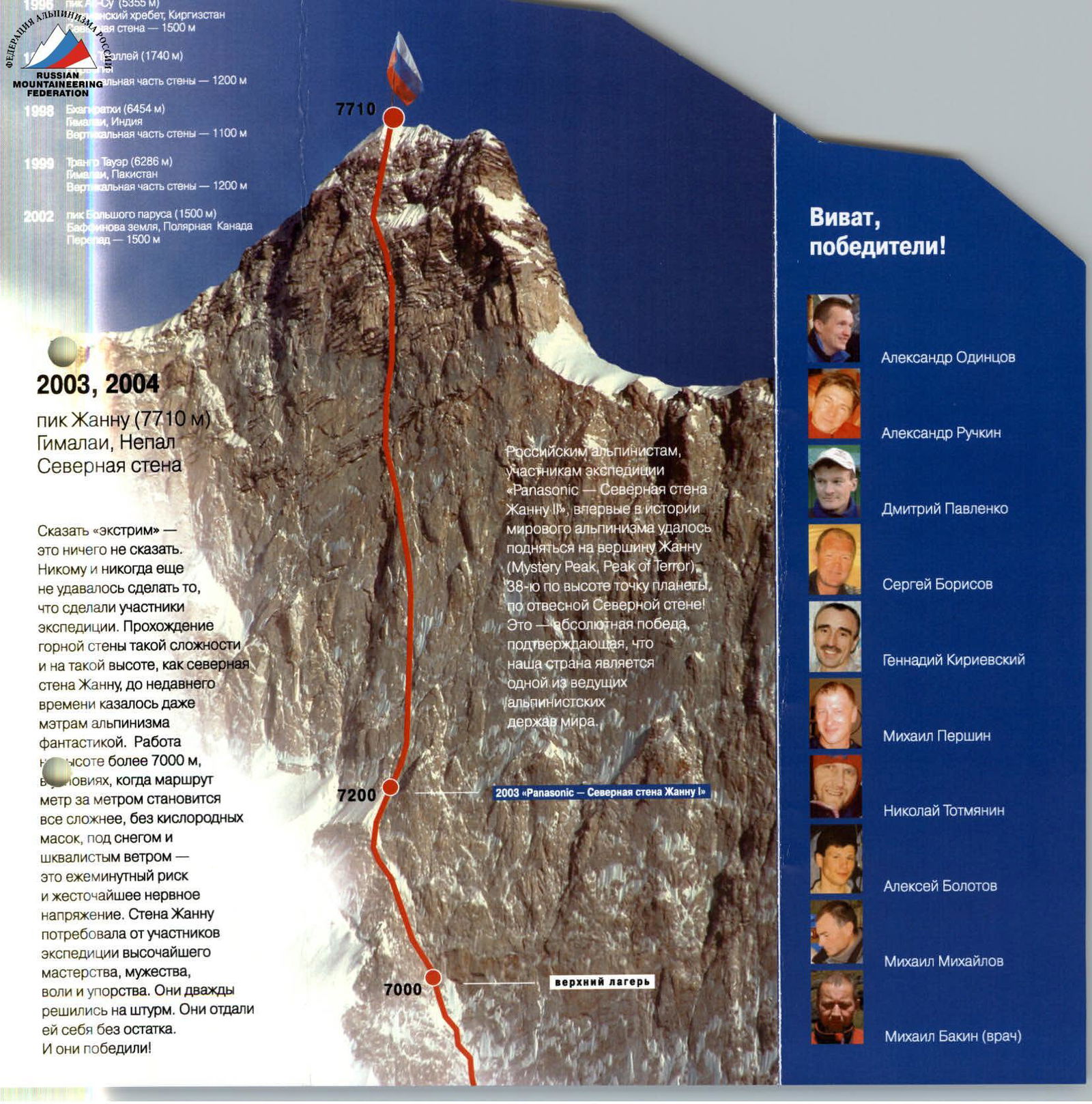
Hurray, the winners!
Alexander Odintsov
Alexander Ruchkin
Dmitry Pavlenko
Sergei Borisov
Gennadiy Kirievsky
Mikhail Pershin
Nikolai Totmyanin
Alexei Bolotov
Mikhail Mikhailov
Mikhail Bakin (doctor)

Ten years of the "Russian Path — Walls of the World" project history is ten years of intense struggle, ten years of hopes and victories of a team of Russian climbers led by Alexander Odintsov. During these years, exclusive "Russian" routes have been laid on six of the most famous mountain walls in the world. The year 2004 brought the team another brilliant victory. Out of ten initially planned targets, seven were achieved. The Odintsov team has three more walls ahead. To be continued...
The general sponsor of both expeditions to Jannu peak is Panasonic company. Its new global philosophy "Panasonic ideas for life" perfectly reflects the стремление to неизвестному, загадочному, экстремальному, desire to lay new routes and open new paths, create new technologies, change the usual notion of human capabilities. "Contribute to the development of society" is the company's credo that has remained unchanged for eighty-five years. In Panasonic, Russian climbers found mutual understanding, genuine interest in Russia's future, and the development of Russian sports.
NATIONAL GEOGRAPHIC
РОССИЯ

ТВОЙ
КУРС

СНИР
САСТИРЕЕ!
 russianclimb.com
Outstanding victory of Russian climbers! The "Panasonic — North face of Jannu II" expedition successfully completed
The Russian team has solved the most difficult problem in the Himalayas. The North face of Jannu (7710 m, Eastern Himalayas) has been climbed. The highest professionalism, courage, and perseverance allowed the participants of the "Russian Path — Walls of the World" project to lay a "Russian" route in honor of Russia. Alexander Ruchkin, Dmitry Pavlenko, Nikolai Totmyanin, Gennadiy Kirievsky, and Sergei Borisov were the first climbers in the world to ascend the impregnable North face.
Jannu peak (7710 m) — Mystery Peak, Peak of Terror, the 38th highest point on the planet, was considered the last unsolved problem in the Himalayas by climbers. At an altitude of 7000 m from the north begins the Big wall (large sheer wall) of Jannu, which no one in the world had been able to climb before the Russians. The challenge to the wall was taken up by Alexander Odintsov's team, which has been implementing the "Russian Path — Walls of the World" project since 1996, a project without analogues in the history of world mountaineering. Its goal is to lay routes on ten of the most famous walls by a single group. Two of the six completed stages of the project are included in the list of the top 100 ascents of the 20th century.
The team attempted to climb the North face of Jannu twice. In autumn 2003, the team managed to reach a record height of 7200 m (previously, the maximum height reached was 6700 m in 1999 by an Uzbek team). However, bad weather and injuries stopped the athletes. They retreated to return in the spring.
The general sponsor of the spring expedition, like in autumn 2003, was Panasonic company. Numerous social and sports events initiated and organized by the company as part of the implementation of the global strategy "Panasonic ideas for life" traditionally cause a wide public response. The company pays special attention to supporting extreme projects that can change our understanding of human capabilities. Panasonic also provided the expedition participants with professional photo and video equipment, with which they were able to capture their work in extreme high-altitude conditions. The main equipment supplier for the expedition is traditionally BASK company, which has been supplying special gear for all stages of the "Russian Path — Walls of the World" project for four years. BASK's involvement in many legendary expeditions helps specialists accumulate and use the unique experience of participants in extreme projects.
The triumphant spring ascent did not seem certain until its very completion. Having safely passed the part of the route from the base camp to the 7000 m mark in two weeks, the team continued with the most difficult work and injuries higher up the wall. Instead of the planned two weeks to climb the 710-meter section, it took almost four. Information from the participants made it clear that the complexity of the North face of Jannu had been greatly underestimated. At 7400 m, Nikolai Totmyanin was hit by a rock, his face was injured, and he had a deep wound on his leg from hitting the rock. Two days later, Sergei Borisov was caught in a rockfall on the wall. His helmet was pierced, and he had a bruised wound on his head (fortunately, there were no more serious injuries). On the same day, Alexei Bolotov fell and broke a rib. The ascent was halted for four days. On May 22, Mikhail Mikhailov was forced to abandon the ascent due to poor health.
Additional difficulties were caused by the weather. The monsoon arrived in the mountains earlier than expected, and the climbers had to climb the most difficult part of the route under heavy snow and hurricane-force winds.
"The fighters are fighting like Mtsyri. Maybe God will reward them for their heroism, courage, and endurance," "Every hour of work on the mountain is overcoming the impossible… Psychological tension is growing. We cannot demand 'more' from each other, as we do not even know our limits… We must be cautious, we cannot afford to make a mistake now," — the team members reported from the route.
On May 26, 2004, at 11:00, after six days spent at an altitude of more than 7500 m, the duo Ruchkin — Pavlenko reached the summit. On May 28, three more climbers were able to repeat their feat: Nikolai Totmyanin, Sergei Borisov, and Gennadiy Kirievsky.
The victory of the Russian team caused a wide resonance among the world mountaineering community. Dougald MacDonald, editor of Rock & Ice Magazine (Climbing, USA), called the entire year 2004 a "stellar year for Russian mountaineering." "The ascent is without a doubt the most technically complex ascent made (in all the years!) in mountaineering at such an altitude. Any parallels with other ascents are certainly risky, but climbing Everest now looks like a 'health-promoting walk' considering the unprecedented conditions on Jannu wall as a whole, which until now were considered absolutely impossible, unsolvable for humans!" — it is stated in the official congratulations from the Federation of Alpine Clubs of France.
The victory of Russian athletes makes Odintsov's team one of the most serious contenders for the "Golden Ice Axe" — the most prestigious mountaineering award in the world.
Contact persons:
St. Petersburg: Anna Stolbova, project press secretary, phone (812) 943-10-34. Moscow: Roman Akhmedov, phone (095) 788-00-44. Larisa Martynkina, phone (095) 232-67-02
Russian Path — Walls of the World «Panasonic — North face of Jannu II»
Ascent chronicle
March 24, 2004. The team of the "Panasonic — North face of Jannu II" expedition flew to Nepal. March 26. Arrived in Kathmandu. A third of the cargo sent by air freight was lost. Among the lost items was part of Dr. Bakin's medical kit. April 2. The first incident in the mountains — during the transition to the base camp, the leader of the expedition, Alexander Odintsov, was injured. An old suspension bridge made of wire and boards collapsed under him. The fall height was 2 m. From Dr. M. Bakin's notes: "Barely had Sasha taken the first step when a whole piece of the flooring under him collapsed. Fortunately, he was wearing a backpack with sleeping bags and clothes, which softened the blow. It was also lucky that the bridge broke off near the shore, not in the middle of the river. Otherwise, the expedition would have ended at the very beginning. Nevertheless, there was a serious concussion. Not a great start for the second Russian expedition to Jannu's North face. We decided that Odintsov and I would stay until his condition improved and catch up with the rest of the group." April 5 — base camp Jannu was set up (4600 m). From A. Ruchkin's letter: "The wall is much cleaner than in the fall. There is not much snow, and the blue ice of the couloirs is visible. Tomorrow we are waiting for the yak caravan with our equipment and preparing to start processing the lower part of the wall, bypassing the icefall." April 9 — reached an altitude of 5600 m. From A. Ruchkin's letter: "In some places, there are our tracks from last year. It seems that the winter was low in snow or there were strong winds that blew away the snow, revealing clean ice. Hard, winter ice, into which pitons can barely be driven. The ropes are partially still there, but no one dares to risk climbing on them like on fixed ropes, and we have to climb on hammer-driven pitons, using a jumar for insurance on the previous year's rope." April 12 — 6300 m. A. Odintsov by phone from BC: "The weather is deteriorating. The wall is almost without snow. It seems it won't be possible to dig out caves at either 6500 m or 7000 m. Everything is going as planned. Everything is fine." April 16. From N. Totmyanin's message: "The lead duo, Mikhailov — Ruchkin, hung a fixed rope up to an altitude of about 6600 m, i.e., 100 m higher than last year's 6500 m camp (cave). They confirmed that it is impossible to dig out a cave anywhere, under a thin layer of snow is ice. Therefore, camp 1 was set up at an altitude of 6200 m. This is a suspended platform with a tent — a kind of hammock on a vertical wall for three people." April 19 — 6700 m. From M. Bakin's message: "The previous night was spent fighting a thunderstorm, lightning, and snowfall. The whole night we were shaking the platform's fabric to prevent snow from accumulating on it and tearing it off. The work schedule and acclimatization are ongoing. The plan is simple but labor-intensive, including:
- work on the wall,
- hauling supplies for life support at such an altitude,
- acclimatization — overnight stays as high as possible,
- and finally, descending back down to rest.
Three groups, replacing each other, head upwards."
April 21 — 7000 m.
From M. Bakin's message: "Bolotov's group hung a platform at 7000 m. The guys didn't make it before the bad weather. A strong snowfall with wind started. The platform is not hanging in the best way. The night was spent fighting avalanches falling from the wall. We couldn't even properly warm up water. We were counting on the weather improving in the morning, but that didn't happen. It's still snowing."
April 23.
From M. Bakin's message: "The snowfall continues throughout the day. The groups remain at the same altitudes (4600 m — BC, 5600 m, 7000 m). Bolotov's group adjusted the platform, and their living conditions can be considered settled. Plans for tomorrow depend on the weather and the state of the route."
April 27. The duo Ruchkin — Mikhailov began work directly on the wall and went further than the upper point of the previously hung fixed ropes (above 7200 m).
From N. Totmyanin's message: "I have been on seven-thousanders thirty-five times, but for the first time in my life, setting up a bivouac at 7000 m took so much time and effort."
May 2. Work on the wall continues. Climbers don't climb more than one rope (50 m) per day.
May 14 — 7500 m. It was decided to raise the platform by 200 m. This was to be done by Mikhail Pershin and Nikolai Totmyanin, who had finished their section. But in the morning, Misha's condition worsened — hemorrhage in the retina. He urgently descended. Nikolai Totmyanin alone raised the platform and fixed it at 7400 m. Alexei Bolotov, Sergei Borisov, and Gennadiy Kirievsky, who came up from below, raised the remaining equipment and set up camp at 7400 m.
For the first time in mountaineering history, a suspended platform was brought and installed on a wall at such an altitude.
A. Odintsov from BC by phone: "We pray to all gods... The lead group goes out into 'open space' every day and conquers meter by meter from the vertical wall..."
May 16. When approaching the upper point of the fixed ropes, a rock hit Sergei Borisov. On the same day, Alexei Bolotov, while climbing a very complex cornice (the last one before the summit), fell and broke a rib. Mikhail Pershin started having vision problems. All three had to descend to the base camp.
May 18 — altitude 7550 m.
From N. Totmyanin's letter: "The psychological shock from the first acquaintance with the wall has passed. Climbing a rope a day is no longer rare. Every hour of work on the mountain is overcoming the impossible. Higher up, it's not visible, so it should be 'easier'. Psychological tension is growing. We can't demand 'more' from each other because we don't even know our limits… We have to be cautious; we can't afford a mistake now… The weather is still with us."
May 22 — only 30 m were climbed in a day.
From M. Mikhailov's message: "There is not a single meter where you can relax: either vertical or overhanging."
From S. Borisov's message: "The fixed ropes all 500 m are hanging in the air...".
May 23 — 80 m were climbed.
M. Bakin by phone from BC: "Maybe God will reward them for their heroism, courage, and endurance."
May 24 — Alexander Ruchkin and Dmitry Pavlenko reached an altitude of 7700 m. Bad weather forced them to descend to camp 7400 m. Tense waiting lasted for two days.
May 26 — for the first time in mountaineering history, two Russian climbers, Alexander Ruchkin and Dmitry Pavlenko, ascended to the summit of Jannu via its North face.
Commentary by Oleg Kapitanov, President of the Federation of Alpine Climbing, Rock Climbing, and Ice Climbing of St. Petersburg: "This wall has repelled many attacks by well-known and strong teams and still remains an unconquered titan. The world mountaineering community is well aware of all the complexities of the route and the climatic conditions of the mountain. The victory on Jannu's North face will undoubtedly put Odintsov's team at the forefront among the nominees for the 'Golden Ice Axe' — the highest international mountaineering award."
May 27.
From M. Bakin's message: "...around 18:00 on May 26, Ruchkin descended to the platform at 7400 m. He planned to spend the night there. However, around 20:00, Sasha Ruchkin's condition worsened, and it became necessary to descend lower, to camp 7000 m, where the altitude is lower, conditions are better, and the medical kit is more diverse. Ruchkin descended to 7000 m in the company of Gennadiy Kirievsky by 24:00, and in the morning, together with Dima Pavlenko, he descended to the base camp. There is no threat to his life."
May 28. At 11:00, Nikolai Totmyanin, Gennadiy Kirievsky, and Sergei Borisov ascended to the summit of Jannu and began their descent to the base camp.
May 29 — the evacuation of the upper camps was completed. All participants descended to the base camp.
May 30. At 9:00, the "Panasonic — North face of Jannu II" expedition started down by caravan.
June 3 and 4, a briefing was held at the Ministry of Tourism of Nepal.
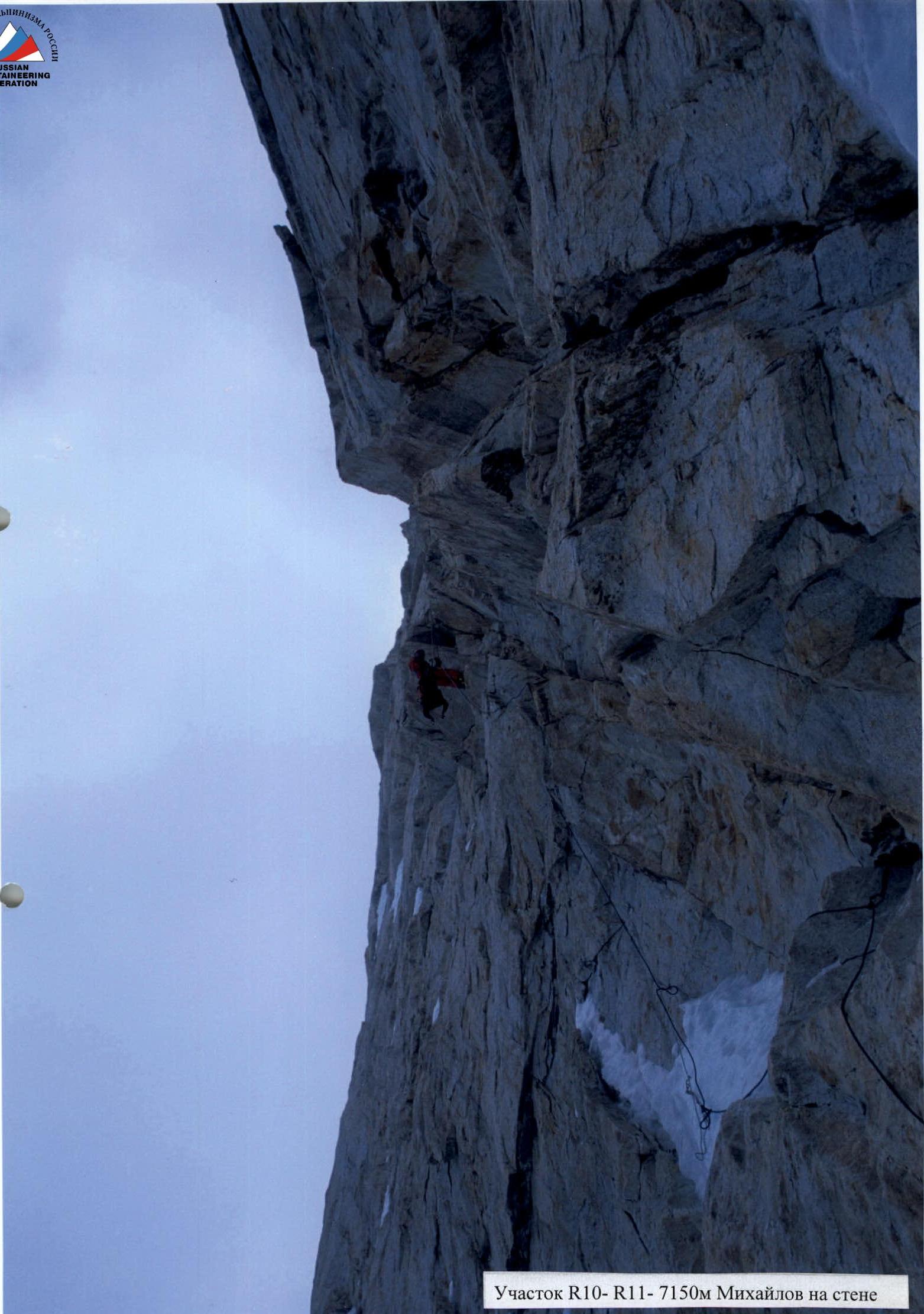
Section R10–R11 — 7150 m Mikhailov on the wall
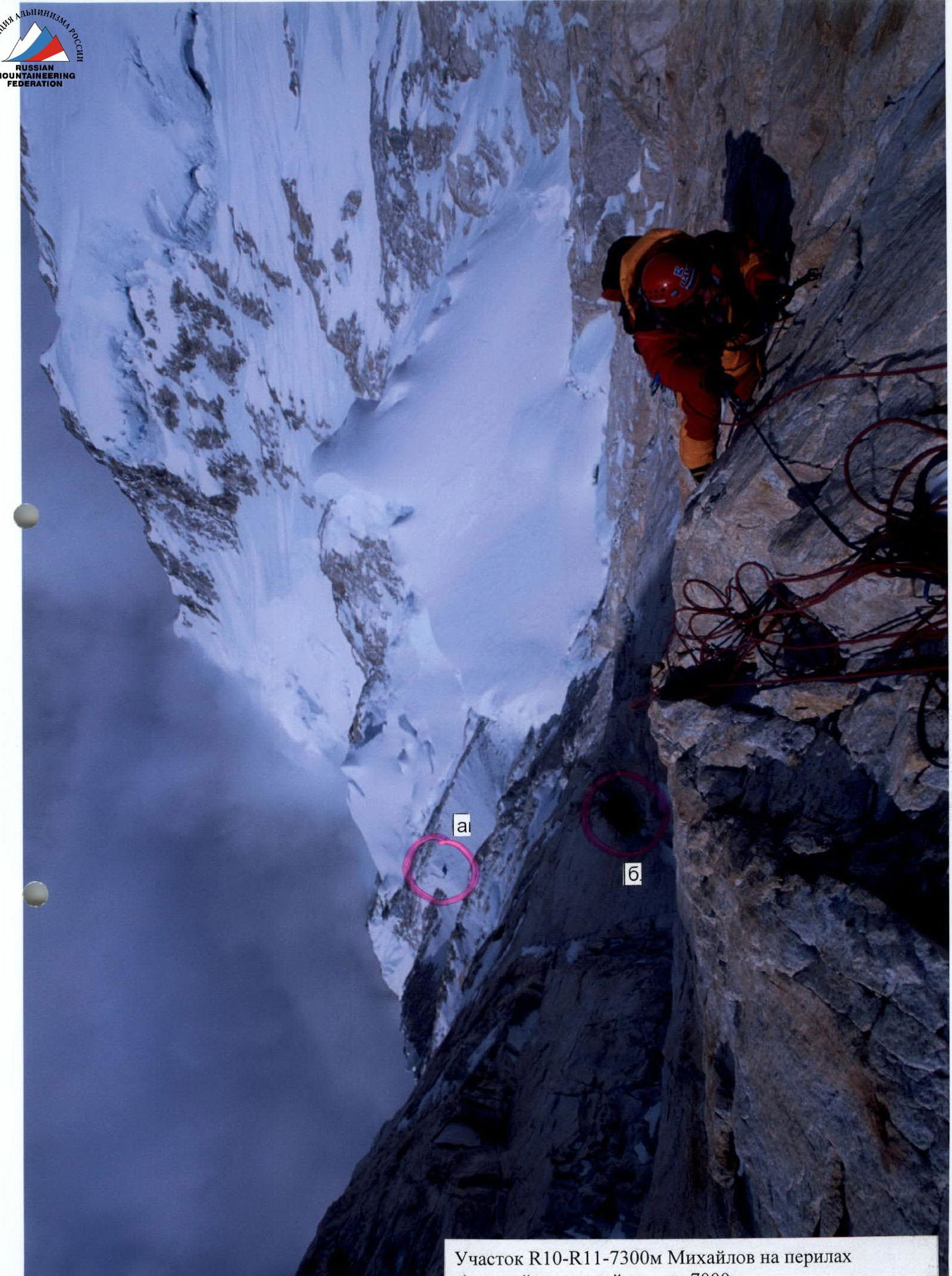
Section R10–R11 — 7300 m Mikhailov on the fixed ropes a) third high-altitude camp — 7000 m b) intermediate high-altitude camp — platform 7200 m
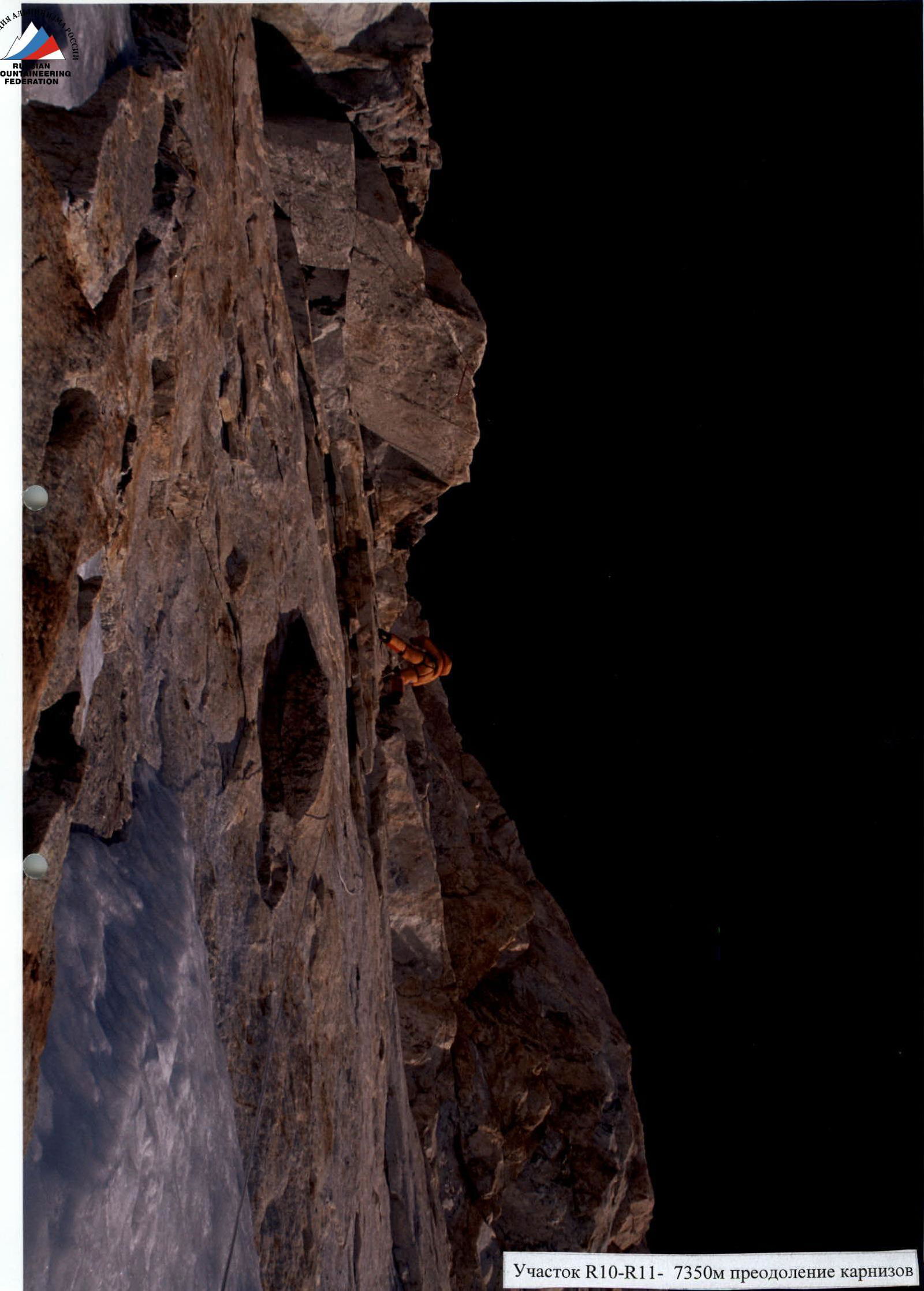
Section R10–R11 — 7350 m overcoming cornices

Comments
Sign in to leave a comment