
Passport
- Technical class.
- Pamir-Alay, Kara-Su gorge.
- Peak 4810 via the center of the NW wall (Kopeyka route)
- Category of difficulty — 6B, third ascent.
- Height difference — 1200 m, length — 1425 m.
Length of sections with 5–6 category of difficulty — 945 m (6 category of difficulty — 725 m). Average steepness — 75° (3600–4810), including 5–6 category of difficulty — 83° (3650–4520). 6. Pitons driven:
| Rock | Nuts | Bolt |
|---|---|---|
| 52+5* | 238 | 2+39* |
| 14+2* | 76 | 1+29* |
-
Team's working hours: 62 and days — 7.
-
Overnight stays: 1,2 — three in hammocks, three on a ledge, — 3 — semi-sitting on a ledge, — 4 — one in a hammock, five semi-sitting on a ledge, — 5 — lying on a ledge.
-
Leader: Bogdanov Boris Borisovich CMS Participants: — Boldyrev Aleksey Sergeyevich CMS — Zabolotnykh Andrey Vladimirovich CMS — Menshenin Sergey Leonidovich CMS — Shirokov Dmitriy Mikhaylovich CMS — Shtarkov Mikhail Lolliyevich CMS.
-
Senior coach: Arefyeva Rufina Grigoryevna. Coach: Zabolotnykh Andrey Vladimirovich.
-
Start of the route: July 13, 1990. Summit: July 19, 1990. Return: July 19, 1990.
-
Organization: MSU, R.V. Khokhlov mountaineering club.
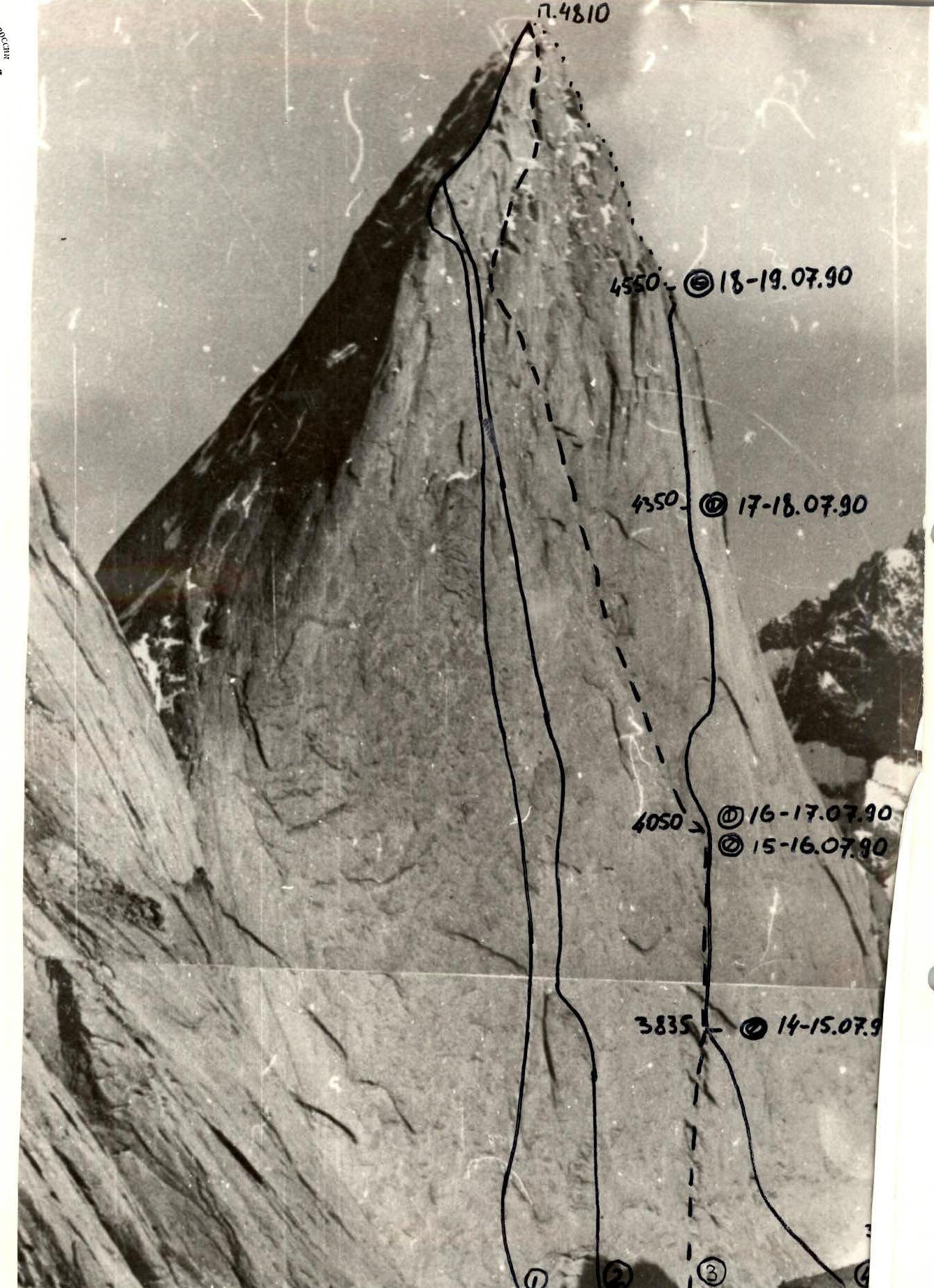
Photo 1. General photo of the summit (№ 1). — Date taken: July 18, 1990, 17:00 — Distance: 5 km — Lens: Mir-26 — Height: 3800 m
- Kritsuk's route via the center of the NW wall 6B category of difficulty.
- Rusyaev's route —
- Voronov's route —
- Kopeyka's route — (team's route).
Team's Tactical Actions
The team approached the route on July 12, 1990. The wall was still wet after bad weather. There was snow on all overnight stays, so they decided not to bring water.
On July 13, 1990, the Zabolotnykh — Menshenin — Shtarkov team started processing the route. The rock was still damp in some places, making movement difficult. They managed to process 5 ropes. When they were working on the last rope, it started snowing, which greatly complicated the ascent.
July 14, 1990. Very cold in the morning. The lead team (Menshenin — Shirokov — Bogdanov) quickly passed the fixed ropes (photo 5) and began working further. By 12:00, they stopped for an overnight stay and started processing. Shirokov worked first (photo 6). The second team set up a bivouac, making snow platforms. During processing, it started snowing. After 2 hours, it stopped, but then resumed with renewed force. In these conditions, it was decided to stop processing. They managed to pass 3 ropes from the overnight stay. Three people slept in hammocks, and three slept separately on a ledge, on snow platforms. It was very cold at night.
July 15, 1990. In the morning, as soon as it warmed up a bit, the Boldyrev — Shtarkov — Menshenin team moved forward. After the evening bad weather, there was snow on the holds, making climbing very difficult. In the middle of the day, it started snowing, and then the wall was covered in fog. Visibility was 15–20 m, with rime on the rocks. The pace of movement slowed down noticeably. They reached the second overnight stay by 19:00 and processed 1 rope. They made snow platforms on the ledge. Overnight stay: 3 people in hammocks, 3 people separately on the ledge. It was cold (photo 8).
July 16, 1990. The Bogdanov — Shirokov — Zabolotnykh team worked ahead. The rocks were in decent condition, and the team worked fairly quickly. However, when passing the 3rd rope, bad weather started (snow grains). The snow intensified, and the team decided to descend to an overnight stay. Streams of snow grains flowed down the wall and crashed onto the ledge. The bad weather continued until 19:00. The team sat under plastic sheets during this time. Even after the snow stopped, streams continued to flow down the wall for a long time. It was impossible to sleep in hammocks, so they expanded (made) the platforms and slept semi-sitting in pairs (photo 9). A total of 4 ropes were processed from the overnight stay. The large cornice remained unpassed.
July 17, 1990. The lead team (Shirokov — Boldyrev — Shtarkov) left later than usual, when the ice on the wall started to melt. The condition of the terrain was disgusting: snow on the holds, wet rocks. The pace of movement was low. Nevertheless, Shirokov confidently passed the cornice and continued moving towards the 3rd overnight stay. They stopped for the night late and didn't manage to process anything. Again, they made a platform out of snow (photo 13). Overnight stay: 1 person in a hammock, 5 people semi-sitting on the platform. This was supposed to be the 3rd control point, but it wasn't there. Only a piece of string was left on the bolt. So, they made their own control point.
July 18, 1990. The Menshenin — Bogdanov — Zabolotnykh team moved ahead. 3 ropes were passed without major problems (photo 14), although there was snow on the holds. Problems started in the internal corner (photo 15). As they had assumed, the only crack was filled with ice. In the second half of the day, the sun lit up the wall, and a stream ran down the corner, adding to the difficulties. However, despite all the challenges, the team completed the wall section of the route by evening and reached the pre-summit section. They stopped for an overnight stay on the first suitable ledge and fixed 2 more ropes. They made a platform. For the first time, they slept lying down in a tent.
July 19, 1990. The team quickly packed up their bivouac. The Shtarkov — Boldyrev team led. The rocks were relatively simple, but there were many "live" stones. By 12:00, the entire team gathered at the summit.
The weather was excellent, and for the first time, they could see the entire panorama of the area.
At 13:00, they started descending towards p. LOMO, reached the ridge by 19:00, and stopped for an overnight stay near the Ak-su river by 21:00.
The team completed the route with 5 overnight stays, as planned. There was a slight deviation from the tactical plan: they were unable to process the route above the 3rd overnight stay. This was due to the bad weather the previous day, which took half a day and didn't allow them to pass the cornice. Additionally, they left late the next day, waiting for the wall to thaw. The ascent proceeded according to the tactical plan thereafter.
The fast pace of the ascent was ensured by changing the leading teams daily and the leaders during the day. The order of the teams' work corresponded to the tactical plan. Processing was significantly accelerated by working in teams of three, as the second person didn't waste time removing pitons and nuts.
The first climber always used a double rope, one of which was UIAA. The others followed with top-rope protection. The first climber was belayed using a Sticht plate. Belay points were blocked using 3–4 anchors. The first climber worked without a backpack, while the others carried their backpacks.
Work on the route began between 8:00 and 9:00, when it warmed up a bit. It was very cold at night. Overnight stays were safe (under cornices) but uncomfortable: very narrow, sloping ledges. Therefore, they brought hammocks, made snow platforms, and slept separately. They only set up a tent on the last overnight stay. They cooked on an "Ogonyok" primus stove in the morning and evening, and had pocket food during the day. The ration was fairly caloric and satisfactory for all participants.
Various nuts, "Friends", and universal pitons were widely used on the route. Bolt pitons were mostly used from previous ascents; they only drove 2 of their own. Many seemingly smooth walls were climbed using free climbing techniques on small holds. Skyhooks were used for artificial technical climbing.
All participants demonstrated high physical, technical, and moral-volitional preparation. The team completed the route with a good margin of safety. This is evident from the fact that the team was able to ascend another 6B category route just two days later. Bad weather and the difficult condition of the wall didn't stop the team, only slowing them down. The gear taken was fully utilized and suitable for the route. There were no falls or injuries.
Radio communication was maintained with observers under the route and with the base camp. The communication was stable, without any losses. The base camp had a rescue team, jointly with the "Mikrograph" SP and a team from the Moscow region.
 |
|---|

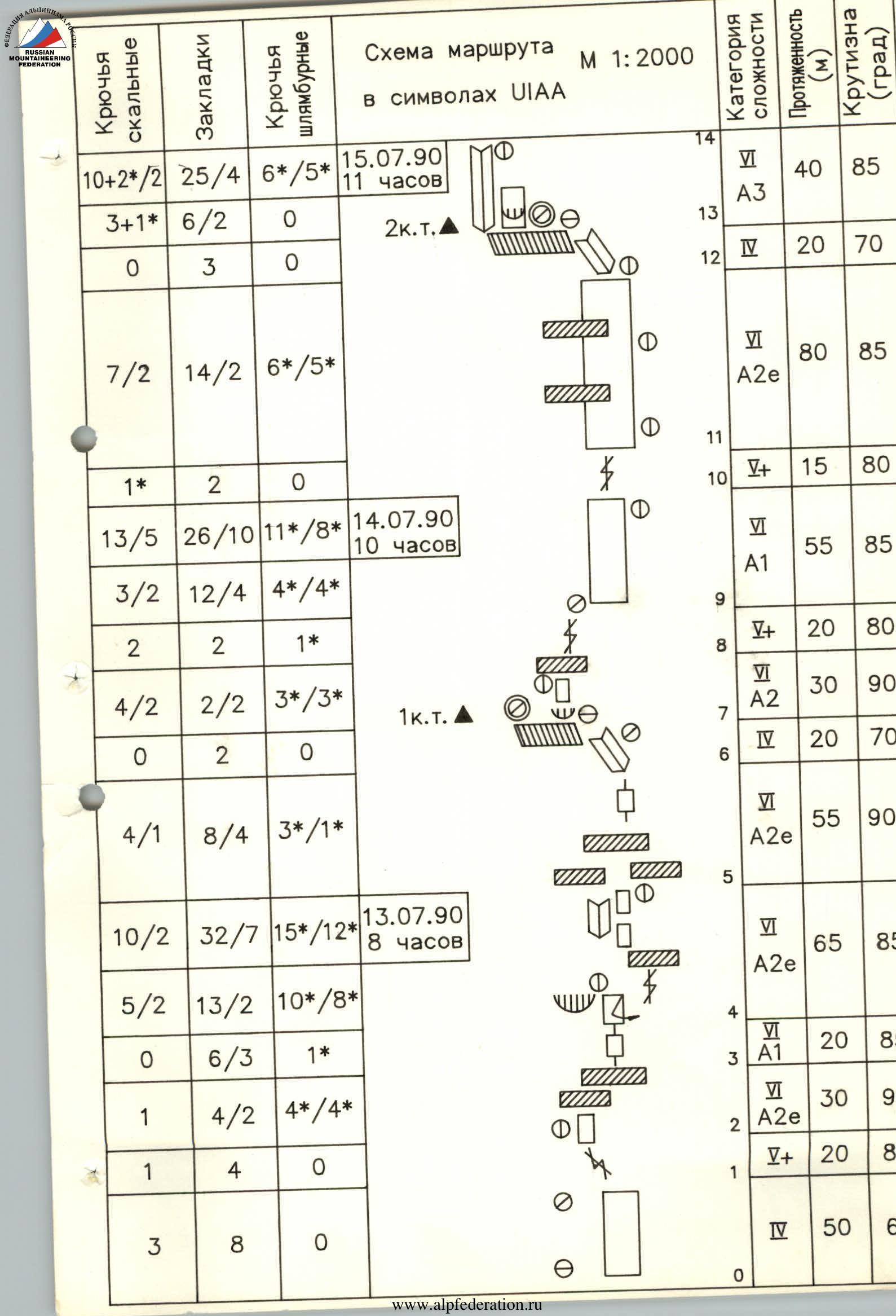
Route Description by Sections
The route starts opposite v. Usen, 150 m to the right of a wide quartz vein crossing the wall from left to right and upwards. The approach from the overnight stay under peak Usen takes 10 minutes.
SECTION R0–R2. The slabs lead to a not very distinct internal corner with a crack, which is not technically difficult. The crack is climbed using free climbing.
SECTION R2–R3. The crack ends with a smooth slab. The slab is climbed using artificial technical climbing, with bolt pitons driven for protection. From the slab, move right and upwards to the 1st cornice, which is climbed using artificial technical climbing on the right side. Then, a small smooth slab leads to the 2nd cornice, which is climbed through a rusty spot using artificial technical climbing. Skyhooks are used. Protection is provided by bolt pitons, "Friends" (photo 5).
SECTION R3–R4. The 20-meter crack above the cornice is climbed using strenuous free climbing, jamming hands and feet, and artificial technical climbing. The edges of the crack are smooth, with no microrelief for climbing. Such cracks are characteristic of the entire route. Nuts and "Friends" are used for protection.
SECTION R4–R5. From the end of the crack, a vertical 10-meter smooth slab leads to a belay point on bolts. Skyhooks are used. From the belay point, a pendulum swing is made to a crack that unfolds to the right, and then free climbing is used under the cornice. The cornice is climbed using artificial technical climbing. Above, move left and upwards to a not very distinct internal corner along smooth slabs. This section is of maximum difficulty. Protection is provided by bolts. The internal corner has a deep crack (8–10 m) and leads to a vertical smooth slab. The top of the internal corner and the beginning of the slab are climbed using artificial technical climbing and skyhooks. Here, a hanging belay point is established on bolts. Above, the slab (20 m, slightly gentler) is climbed partly using free climbing, partly using artificial technical climbing and skyhooks, to a system of small cornices.
SECTION R5–R6. The cornices are climbed through the center. Under them, strenuous free climbing is used, and through them, artificial technical climbing. Nuts, "Friends", pitons, and skyhooks are used.
SECTION R6–R7. A simple, inclined internal corner leads left and upwards to a ledge for the 1st overnight stay. First control point.
SECTION R7–R8. From the middle of the ledge, move upwards through an overhanging section (artificial technical climbing, skyhooks), then under a small overhang, traverse 5–7 m left using free climbing. From the end of the traverse, move upwards along a slab with small cornices and flakes (free climbing, artificial technical climbing) to a large cornice. Belay point is on bolts. The cornice has a 2-meter overhang and is climbed through the center using artificial technical climbing. Extremely difficult section (photo 6).
SECTION R8–R9. The crack above the cornice is climbed using strenuous free climbing. At the end of the crack, under a small overhang, a belay point is established.
SECTION R9–R11. From the belay point, traverse right and upwards, bypassing an overhang — 15–20 m. The overhang ends with a flake oriented to the right (photo 7). Above, there is a system of slabs with small flakes. Steep. Partly difficult free climbing, partly artificial technical climbing. Belay point is under a small cornice. Above, a slab with short flakes is climbed using free climbing.
SECTION R11–R12. This section is similar to section R4–R6. The general direction of movement is right and upwards, bypassing small overhangs. Smooth slabs are climbed partly using strenuous free climbing, partly using skyhooks. Bolts are used for protection. The last 25–30 m are climbed directly through overhangs to an internal corner.
SECTION R12–R13. A simple internal corner leads to a ledge. 2nd overnight stay here (photo 8). Control point. The ledge is narrow and sloping.
SECTION R13–R14. From the left part of the ledge, move directly upwards along a slab for 10 m, then through a small overhang, left and upwards to the middle of an internal corner, which leads to the base of a huge chimney — the "big" flake. Very difficult free climbing. The top of the internal corner is climbed using artificial technical climbing. Nuts and "Friends" are used.
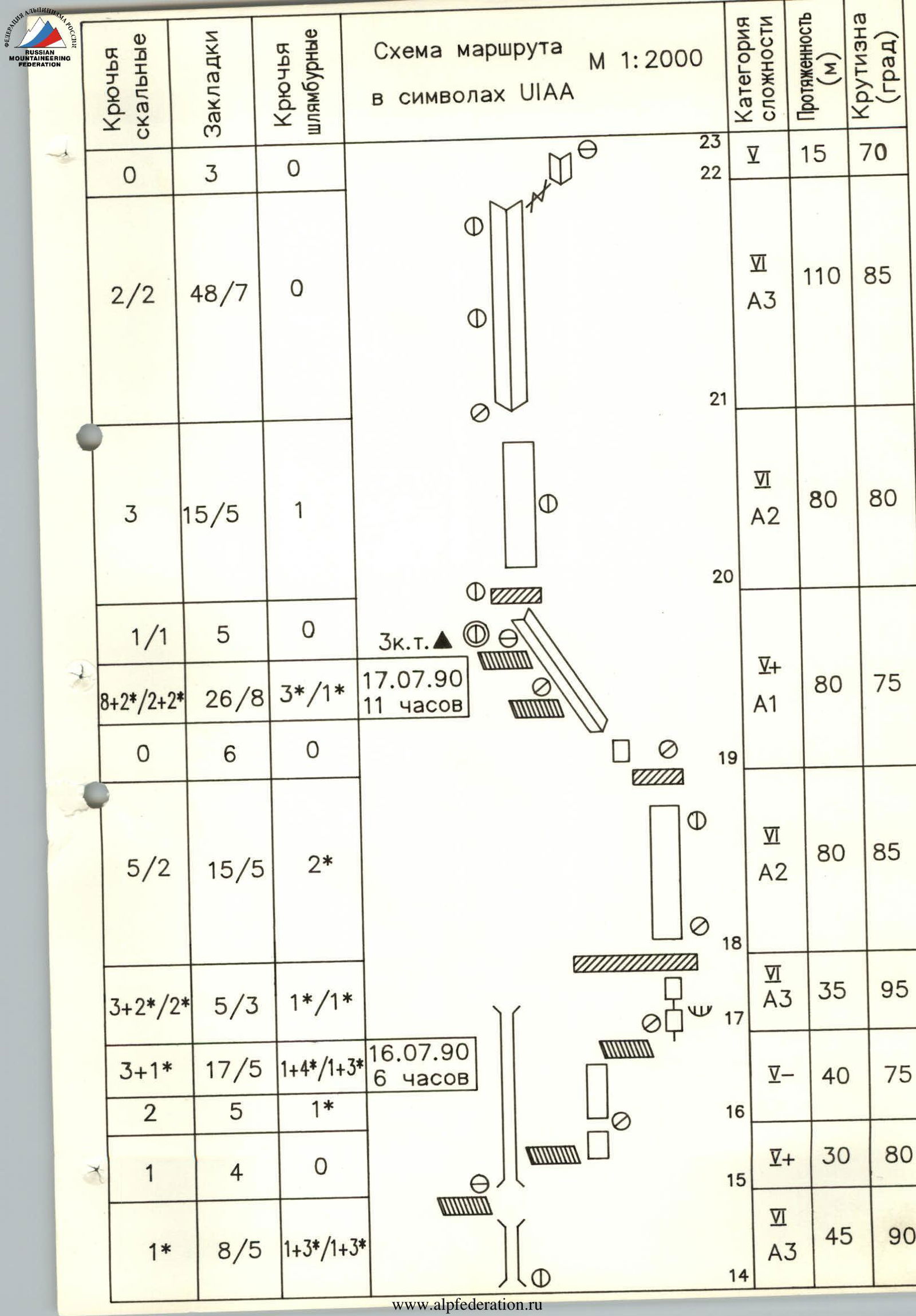
SECTION R14–R15. The chimney is huge, and chimney technique is not applicable. The walls of the chimney are smooth, with ice inside, and it's wet. Nuts, "SECTION R15–R16. From the "feather" along the chimney (it has become much narrower) — 15 m using free climbing to a narrow horizontal ledge. Further, right and upwards, there is a system of ledges and slabs with microrelief (photo 10).
SECTION R16–R17. Along the slabs and ledges, free climbing is used under the middle of the large cornice. Universal pitons and stoppers are used.
SECTION R17–R18. From the end of the last ledge, move 2–3 m further to the right and then upwards along a flake to a small overhang. Left of the overhang, along a quartz slab (photo 11), move under the large cornice. Difficult free climbing, partly artificial technical climbing, skyhooks are used. In the middle, the cornice has broken into "tiles". Climbed using artificial technical climbing on nuts, "Friends", and "corrugated" pitons.
SECTION R18–R19. Above the cornice, along a slab to a niche. Belay point. Above, a steep slab with very poor microrelief — very difficult free climbing. Skyhooks are used for artificial technical climbing. The slab ends with a small cornice, which is climbed on the left side (photo 12).
SECTION R19–R20. After the cornice, traverse left 7–8 m (difficult) to the base of an internal corner. Along it, move upwards to a ledge — 3rd overnight stay. 3rd control point. The ledge is small, the most uncomfortable overnight stay (photo 13). The internal corner ends with a cornice.
SECTION R20–R21. The cornice is climbed using artificial technical climbing. Above, a quartz vein leads right and upwards (photo 14). Follow the vein for about 60 m, then move left, bypassing a smooth slab, to a flake. Along the flake, move right and upwards to the base of an internal corner.
SECTION R21–R22. The classic internal corner (photo 15) starts with a cornice (climbed on the left) and is climbed mainly using artificial technical climbing along a crack. The crack is filled with ice. The entire set of nuts and "Friends" is used. Belay points are hanging.
SECTION R22–R23. The internal corner, after 110 m, is interrupted by a small narrow (half a foot) ledge-crack that goes right, bypassing a bastion. The path to the left requires artificial technical climbing. The bastion is bypassed using free climbing to the right, leading to a ledge.
SECTION R23–R24. Upwards, a dissected internal corner leads, with many ledges; the walls are climbed using free climbing.
SECTION R24–R25. Traverse right along scree-covered ledges under a poorly defined, destroyed ridge.
SECTION R25–R26. Along the ridge upwards (rockfall hazard!) — 80 m.
SECTION R26–R27. From the ridge, move right along large, destroyed ledges and walls to the base of the pre-summit ridge.
SECTION R27–R28. A simple ridge leads to the summit.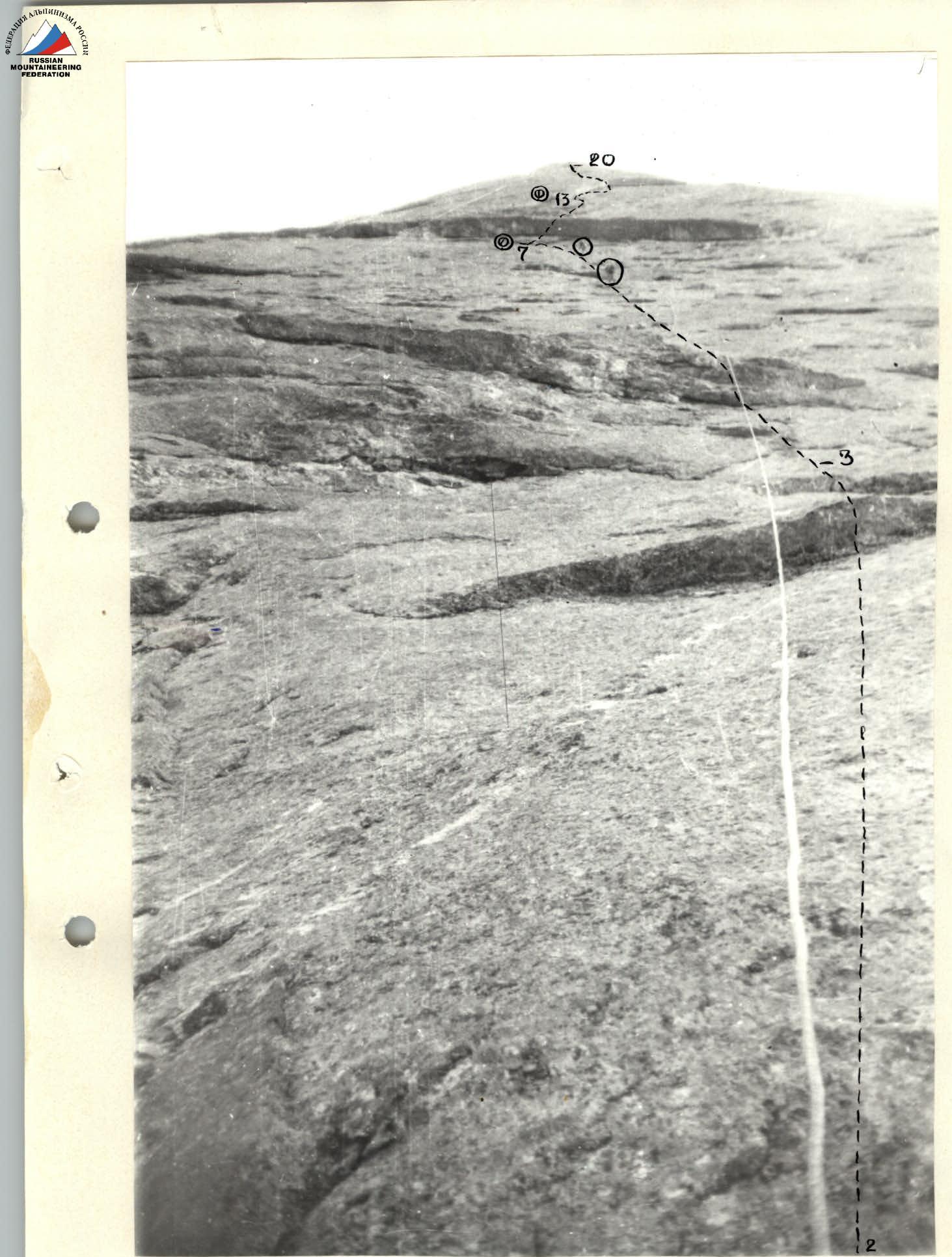
Photo 5. Section 2–3. Ropes through cornices. The cornice above the 1st overnight stay is visible.

Comments
Sign in to leave a comment