
Passport
- Technical class.
- Pamir-Alay, Turkestan Ridge.
- Peak 4810, via NW wall.
- Proposed — 6B cat. diff., first ascent.
- Height difference — 1200 m, length — 1425 m. Length of sections with 5–6 cat. diff. — 945 m, of which 6 cat. diff. — 725 m. Average steepness — 75° (3600–4810 m), of which 5–6 cat. diff. — 83° (3650–4520 m).
- Pitons driven:
| Bolted pitons | Chocks | |
|---|---|---|
| Rock | 69 | 268 |
| 16 | 93 | |
| 22+9x | ||
| 18+9x | ||
| x |
x — use of previously driven pitons.
7. Climbing hours — 53.5 and days — 5. 8. Overnight stays: 1, 2, 3, 4 — four in hammocks, two — on a ledge. 9. Team leader: Gennadiy Vasilievich Kopeyka CMS Valentin Leonidovich Gorenko CMS Anatoliy Aleksandrovich Tanets CMS Vladimir Timofeevich Polyanskiy CMS Vladimir Dmitrievich Rybchenko CMS Yuriy Mikhailovich Strelnikov CMS 10. Coach: Sergey Igorevich Bershov HMS 11. Approach to the route: 7.07.1988 — 6 — processing Summit — 11.07.1988 Return — 12.07.1988 12. Kharkov City Alpine Club.

Photo 1. General view. June 8, 1988, 10:00. Taken from a helicopter. Distance — 3000 m, height — 3800 m, lens "Helios 44" (f=44 mm). 1. — Route of the Odessa Alpine Club 1986, 5B cat. diff. 2. — Route of the Kharkov Alpine Club team.
Due to prolonged bad weather on the first day of ascent, we were only able to process 15 m above the 1st overnight stay (sect. 7, Photo 11), so on the 2nd day we didn't make it 20 m of difficult climbing (Photo 13) to the second overnight stay as planned. Therefore, we conducted the 1st and 2nd overnight stays on the first ledge (sect. 7). The team spent one night on the second ledge (sect. 13, Photo 14) instead of two as planned. Thus, the time schedule was largely adhered to. The 4th overnight stay was at the planned location (sect. 20, Photo 20). The team then proceeded ahead of schedule, shortening the stay on the "roof"; traversing the "roof" presented no technical difficulties despite strong bad weather (sect. R23–R28 — III–IV cat. diff.). There were no other deviations from the tactical plan.
The fast pace of the ascent was ensured by changing the leading rope teams daily (the team didn't change during the day) and switching the lead in the middle of the working day. It was challenging for one person to lead the entire day due to the route's high difficulty and intensity. The order of rope teams' work followed the tactical plan. On the route, the team worked in pairs:
- Kopeyka — Gorenko: R0–R7, R20–R28
- Tanets — Polyanskiy: R7–R12, R18–R20
- Rybchenko — Strelnikov: R12–R18
The first climber always used a double rope (diameter 11 mm), one of which was UIAA marked. Belaying was done through a "Bukashka" descender by Koshevnik. Belay points were backed up with 3–4 anchors. Other participants followed the "perilous" sections with top-rope belay. Backpacks were carried on the climbers' backs as they weighed no more than 7–9 kg. Two water flasks were either carried attached to harnesses or pulled up in an additional 6th backpack in challenging sections (across cornices). The lead climber went without a backpack.
Work on the route started at 8:00–9:00 as the wall was cold and only received sunlight in the afternoon, but usually, it was cloudy and the weather was unstable.
Food was prepared on a "Yuvel" primus stove and a gas burner in the morning and evening and was high-calorie. The team took two flasks — 16 liters of water. This simplified meal preparation, although ice could be found deep in crevices near the ledges (sect. 7 — 10–12 m down to the left from the left end of the ledge; sect. 13 — above the ledge on sect. 14 deep in a chimney; sect. 20 — in the inner corner between sect. 19–20, 21). On a daily basis, a snack was issued, and balanced drinks were prepared in flasks.
Overnight stays were safe: 1st and 3rd ledges were under cornices, 2nd under the protection of a large "skull" fragment of rock, and there were only 3 ledges suitable for overnight stays for the entire group on the route before reaching the "roof". The ledges were small, so for comfort, the team used hammocks and polyethylene sheets. No tent was taken, which proved to be a good decision (Photo 10, 14).
On the route, various chocks and "friends," as well as universal pitons, were frequently used. Mainly, bolted pitons were driven in the first third of the wall to ensure safety. The rock relief ("very small holds" — "miners") allowed for mostly free climbing on seemingly smooth walls. For artificial climbing techniques (ACT), skywires were sometimes used (Photo 24).
All participants demonstrated high technical, physical, and moral-volitional preparation. The team's climate was favorable. The route was completed with a safety margin. Daily bad weather in the afternoon didn't stop the leading rope team (except on the 1st day of ascent — heavy rain), although it significantly slowed them down. The equipment taken on the route was fully utilized and suited for the given route. Radio communication was carried out using a "Kaktus" radio station and was stable and reliable. Visual observation of the team from under the route was constantly maintained.
Organization of support:
- Rescue team, jointly with the Alpine Club of Dnipropetrovsk, was located 2–2.5 hours from the start of the route on the Archaiana glade.
- There were no falls or injuries.
Overall assessment of the ascent:
- The team completed the route confidently, with a safety margin, focusing primarily on safety according to the tactical plan.
UIAA Scheme M 1:2000
| Rock pitons | Chocks | Bolted pitons | Category of difficulty (I.T.O.) | M/Steepness |
|---|---|---|---|---|
| 1 | 8 | 0 | ||
| 1 | 4 | 0 | R13 A3 40 85 | |
| 9 | 16 | 1+4 | R12 IV 20 70 | |
| 1 | 3 | 0 | ||
| 5 | 14 | 5 | 8.07.1988 104 | |
| 2 | 3 | 0 | R11 A2e 80 85 | |
| 5 | 3 | 3 | R10 V 15 80 | |
| 1 | 3 | 0 | R9 A1 55 85 | |
| 1 | 3 | 0 | R8 V+ 20 80 | |
| 3 | 10 | 3 | R7 A2 30 90 | |
| 1 | 5 | 7 | R6 IV 20 70 | |
| 6 | 14 | 10 | ||
| — | — | — | R5 A2e 55 90 | |
| 2 | 7 | 8 | ||
| 1 | 5 | 0 | R4 A2e 65 85 | |
| 1 | 4 | 4 | R3 V 20 85 | |
| 1 | 3 | 0 | R2 A2e 30 95 | |
| 1 | 3 | 0 | R1 V A1 20 85 | |
| 7 | 8 | 0 | R0 IV 55 60 | |
| — | — | — | ||
| 6.07.1988 44 asa | 3/0; 14/1; 0/0 | 5 | ||
| 2 | 11 | 0 |
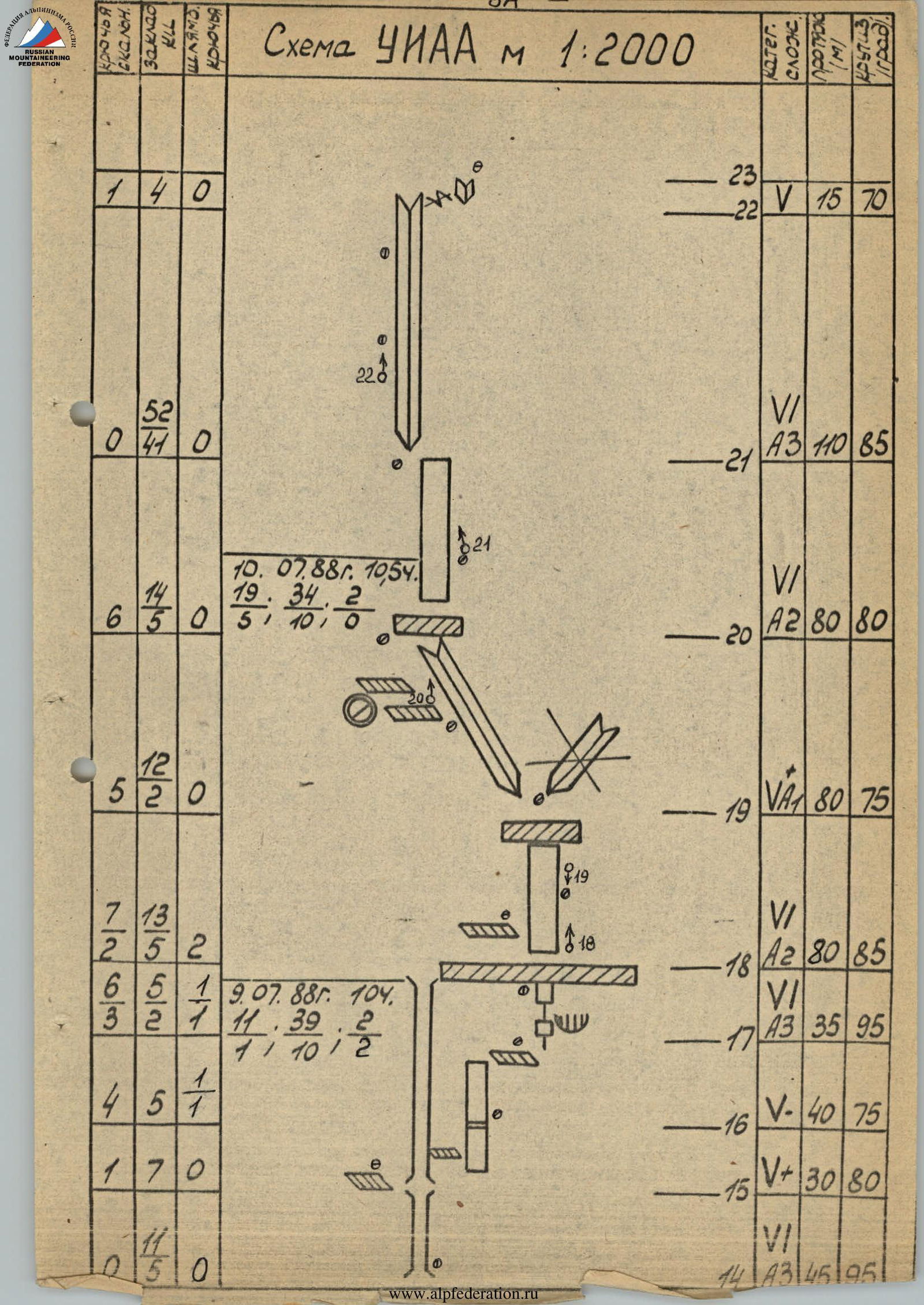
UIAA Scheme M 1:2000
| Rock pitons | Chocks | Bolted pitons | Category of difficulty (I.T.O.) | M/Steepness |
|---|---|---|---|---|
| 1 | 4 | 0 | R23 V 15 70 | |
| 52 | 0 | 410 | R22 VI A3 110 85 | |
| 14 | 10.07.1988 10.54 | 19.34.2 | ||
| 6 | 5 | 0 | R21 VI A2 80 80 | |
| 12 | 5 | 2 | R20 V A1 80 75 | |
| 7 | 13 | 2 | R19 VI A2 80 85 | |
| 6 | 5 | 1 | R18 VI A3 35 95 | |
| 3 | 2 | 1 | R17 V- 40 75 | |
| 4 | 5 | 1 | R16 V+ 30 80 | |
| 1 | 7 | 0 | R15 VI A3 45 95 | |
| 1 | 5 | 0 |

Route Description by Sections
From the base camp, the team departed under Peak 4810 on July 5, 1988. However, the processing of the route by the 2nd pair was only done in the second half of the day on July 6 due to a delay by the "Height" Alpine Club team. Approach to the route: from the moraine under Peak 4810 and Peak 4520, along a small steep snowfield (possibly ice in the second half of summer) between the NW wall and a sheer "sentinel" "pillar" until the snowfield levels out. From here, the entire route is visible. The start is to the right, 100–150 m from the "quartz vein" that crosses the wall upwards from left to right. A landmark is a double cornice, to which a non-obvious inner corner with a crevice leads 50–70 m from the snow. The approach to the route from the overnight stay on the moraine takes 30–40 minutes.
Route Processing
Section R0–R2. Rust-colored slabs that lead to a non-obvious inner corner with a crevice are not technically difficult. The crevice is traversed by free climbing.
Section R2–R3. A smooth slab that ends the crevice is traversed using skywires on ACT, with bolted pitons driven for belaying. At this point, the 2nd pair waited out a snowfall — the rocks became wet. They splintered upwards to the right under the 1st cornice, which is traversed on ACT on its right part. Then a small smooth slab leads under the 2nd cornice, which is traversed through a rust-colored "spot" on ACT. Skywires. Belaying is done through bolted pitons, "friends" (Photo 9).
1st Day of Ascent
Section R3–R4. A 20-meter crevice above the cornices is traversed with strained climbing, wedging hands and feet into the crevice, and on ACT. Steep. The edges of the crevice are smoothed, lacking micro-relief for climbing — such crevices are characteristic of the entire route. For belaying — chocks, "friends." The crevice ends with a small ledge, onto which one can:
- throw a loop
- rest on a self-belay
Section R4–R5. From the end of the crevice to the belay point on bolted pitons (hanging, standing on an aluminum plate) leads a sheer 10-meter slab. Skywires. From the belay point, a pendulum swing to a crevice opened to the right and along it by free climbing under a cornice, then traversed on ACT. Upwards to the left towards a non-obvious inner corner along smooth slabs. A section of maximum difficulty. The lead climber, Kopeyka, examines the micro-relief 4–5 m upwards, climbs with maximum effort along "miners" to a convenient "hold," on which he can stand, freeing his hands, and quickly drives a bolted piton into the hole for a "skywire." From it, he drives a bolted piton. There's no other relief for organizing different belaying here. This is how "mirrors" were traversed on the route (Photo).
Along the inner corner with a deep crevice (8–10 m) to a sheer smooth slab. The top of the inner corner and the start of the slab are traversed on ACT and "skywires." Here is a hanging belay point on "bolted pitons." Above, along the slab (20 m, slightly easier) partly by climbing, partly on ACT and "skywires" under a system of small cornices. They are oriented downwards to the right by a system of cracks (most cracks on this section are oriented to the right) and are clearly visible from the pass between Peak 4810 and Peak Usan, although the wall appears smooth from the front. The entire section is characterized by complexity and tension during traversal.
Section R5–R6. Cornices with cracks are traversed centrally on ACT. Under them, by strained free climbing, through — on ACT. Sheer. There's micro-relief for climbing and belaying. Chocks, "friends," rock pitons. "Skywires" are used for traversal.
Section R6–R7. A simple inclined inner corner leads upwards to the left to the 1st overnight ledge (Photo 10). Here is the 1st control point. The ledge is 70–80 cm wide and is made of slabs. Above the ledge, bolted pitons are driven for hammocks; higher up, a small overhang, and even higher (30 meters away) — a large cornice (Photo 12). The overnight stay is safe. As the 2nd pair reached the ledge and the rest followed along the "perilous" sections, a snowfall began.
Section R7–R8. From the middle of the ledge through an overhang onto a slab (skywires, ACT), then under a small overhang, a traverse 5–7 m to the left by climbing. The snowfall intensified. Water flows down the wall. A real downpour cascaded from the cornice onto the ledge. Kopeyka quickly descended to the overnight stay. We endured the heavy rain under large polyethylene sheets, thoughtfully taken on the route. By 24:00, the thunderstorm ceased, but water continued to flow from the cornice for another 2 hours.
Four team members settled in hammocks, two — on the ledge under polyethylene sheets. It became very cold and windy. By morning, the wall was covered in a thin icy sheen.
2nd Day of Ascent
Section R7–R8 (continued). The 2nd pair began work only after the ice on the wall started to melt. From the end of the traverse upwards along a slab with small cornices and cracks (climbing, ACT) under a large cornice. Belay point on bolted pitons driven by the "Height" Alpine Club team. From the overnight stay on ledge R7 to the overnight stay on sect. 13, our routes coincided. The Leningraders' route led to ledge R7 from the left along the "quartz vein" and deviated from the ledge on sect. 13 to the left, traversing to the middle of the wall.
The cornice with a 2-meter overhang is traversed centrally on ACT (Photo 12). Extremely complex section.
Section R8–R9. The crevice above the cornice is traversed with strained free climbing. The edges of the crevice are smoothed. The rocks dried, and the lead pair worked faster. At the end of the crevice under a small overhang — a belay point (hanging):
- a bolted piton driven by Leningraders,
- in combination with chocks (Photo, from top to bottom).
Section R9–R10. From the belay point, a traverse to the right and upwards, bypassing the overhang — 15–20 m. Strained climbing along "miners." The overhang, crossing the wall, ends with a crack oriented to the right. Above — a system of slabs with small cracks. Sheer. Partly complex climbing, partly ACT. Belay point under a small cornice. Above — a slab with short cracks.
Section R10–R11. Change of lead. Polyanskiy traverses cracks by climbing, sections of slabs on skywires. The relief character remains the same on this section — slabs with cracks oriented to the right.
Section R11–R12. This section resembles sect. 4–6 (Photo 13). The general direction of movement is to the right and upwards, bypassing small overhangs. Smooth slabs are traversed partly by strained free climbing, partly on skywires. For belaying, we use bolted pitons driven by Leningraders. Some have broken ears. The last 25–30 m of the section are traversed straight upwards through small overhangs to an inner corner. A section of maximum difficulty.
The last meters of the section proved challenging. The weather worsened, and it was late. Remembering the downpour that drenched us the previous evening and night, the team captain decided to descend to the previous overnight stay on sect. 7. The next day, it turned out we were only 20 m short of a simple inner corner (R12–R13) — the inner corner wasn't visible from below due to the section's steepness.
3rd Day of Ascent
It's cold in the morning. The temperature is sub-zero. We traverse the previously hung "perilous" sections quickly. The lead pair, Rybchenko, traverses the last meters of the section on ACT.
Section R12–R13. A simple inner corner leads upwards to the left to a ledge. The lead, Rybchenko, reaches the ledge at 10:30. Here is the 2nd control point. The overnight stay resembles the ledge on sect. 7, long and narrow, making it impossible to set up a tent. Bolted pitons are driven for hammocks. 120–140 m above the ledge is a large cornice of a huge crack, resembling a "skull" from afar. While Rybchenko traverses the first meters of sect. 13–14, we discuss options for traversing the 2nd large cornice:
- along the "large crack" to the end and upwards through the "ceiling" of the cornice at the junction of the crack and cornice;
- if possible, approach the center of the cornice and traverse through it centrally — here, the huge cornice-"ceiling" breaks into "scales" of smaller cornices, and relief is visible.
Section R13–R14. From the left part of the ledge straight upwards 10 m along a slab, then through a small overhang to the left and upwards into the middle of an inner corner that leads to the base of a huge chimney of the "large crack." Very complex climbing. The top of the inner corner is on ACT. Chocks, "friends."
Section R14–R15. The chimney is huge, and chimney technique is not applicable. Above, the chimney narrows slightly — chimney technique can be used in places. Chocks, "friends," and petal pitons are used. The walls of the chimney are smooth, with ice inside, and it's wet. This part of the chimney (1/3 of the entire chimney) ends with a huge "feather," and we exit onto it through an overhang. A convenient belay point. One can stand and even sit. After hanging belay points, which are on the entire route except for overnight stays, it feels very comfortable. While work was being done in the chimney, it snowed.
Section R15–R16. From the "feather" along the chimney (became significantly narrower) by free climbing 15 m to a narrow horizontal ledge. The lead pair chooses the 2nd option for traversing the 2nd large cornice — to the right and upwards, a system of slabs with micro-relief is visible, intersected by long narrow horizontal ledges. From the ledge along a slab (several meters of complex climbing) to a horizontal ledge (here is a belay point).
Section R16–R17. The ledge leads to the right. Short walls and long horizontal ledges lead to the middle of the 2nd large cornice. The lead, Strelnikov, quickly traverses this section, which from below appears smooth — the ledges are not visible. Universal pitons and small stoppers are used.
Section R17–R18. Simple climbing on 5th category rocks has ended. Serious work resumes. From the end of the last ledge, another 3–4 m to the right and then upwards along a crack under a small overhang. To the left of the overhang along a quartz slab under a large cornice. Complex climbing, partly ACT, skywires.
It's late. The 3rd pair descends to the overnight stay. Four team members are in hammocks, two — on the ledge. It's cold at night, sub-zero temperatures.
4th Day of Ascent
The cornice of the "large crack" "skull" is traversed by the 2nd pair as planned tactically. At this point, the ceiling of the 2nd large cornice has broken into "scales" of smaller cornices, resembling tiles. Tanets confidently traverses the "tiles," using:
- "friends";
- large chocks.
In the upper part, he drives:
- wedges;
- boxes.
A maximally difficult section.
Section R18–R19. Above the cornice along a slab into a "niche" — it's clearly visible through binoculars from the "sentinel" "pillar." Belay point. Above, a steep slab with very poor micro-relief — very complex climbing. For ACT, skywires are used. Resembles sect. R4–R6 and R11–R12. Climbing manages to traverse 2–4 m. Thin deep crevices for chocks (small ones) are encountered. The slab ends with a small cornice, which is traversed on its left part (Photo 18).
Section R19–R20. After the cornice along an inner corner to the right and upwards 8–10 m. Convenient belay point. To the left along a slab, a traverse 7–8 m (complex) to the base of the left inner corner. Along it (Photo) upwards to the second ledge (1st is small) — 3rd control point. Overnight stay:
- 4 people in hammocks;
- 2 people on the ledge.
Many "live rocks."
The inner corner ends with a cornice (Photo 20). To the left under the cornice — a ledge (a foot wide) — a convenient belay point.
Section R20–R21. Polyanskiy traverses the cornice on ACT. Above the cornice, upwards slightly to the right leads a quartz "vein," initially sheer, then slightly easier. The "tiles" of cornices face downwards — such quartz "veins," oriented from left upwards to the right, cross the entire wall. Polyanskiy traverses the rope and descends to the overnight stay. It's cold at night, strong wind.
5th Day of Ascent
The night passes normally. In the morning, the 1st pair begins work. We plan to reach the summit on this day if the weather is good. After another 25 m, the "tiles" of the quartz "vein" deviate to the right and upwards. From here, to the left by climbing along "miners" to a crack, bypassing a smooth slab, and along the crack to the right and upwards under the base of an inner corner.
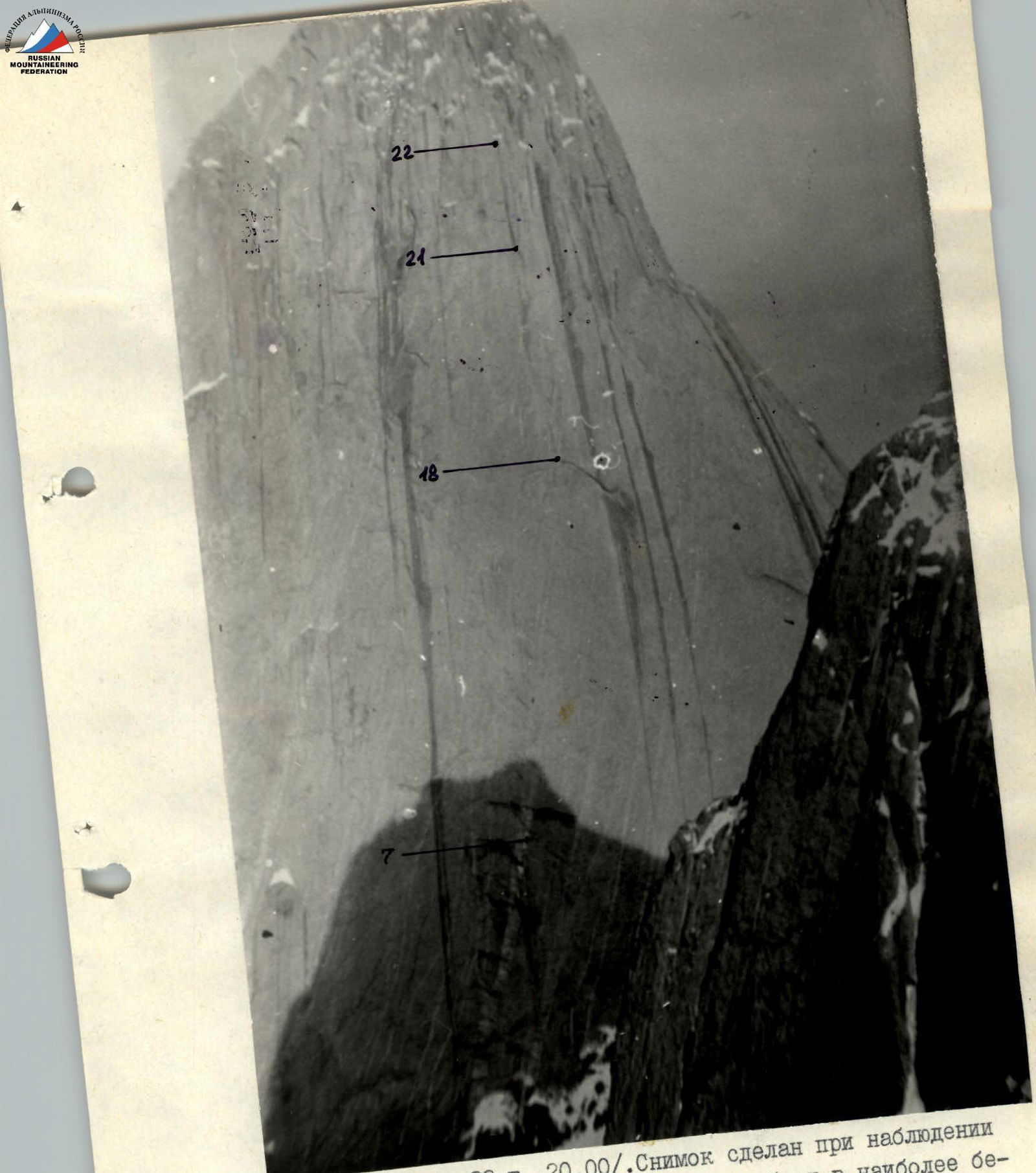
Section R21–R22. A classic inner corner (Photo 22) starts with a cornice, traversed from the left, and goes along a crevice mainly on ACT. The entire set of chocks and "friends" is used. The walls of the inner corner are smooth, like polished. Belay points are hanging (Photo). In places, climbing is possible in the upper part of the inner corner.
Section R22–R23. The inner corner breaks off after 140 m onto a small narrow (half a foot) ledge-crevice, going to the right and upwards, bypassing a bastion. The path to the left requires ACT. The bypass to the right by free climbing leads to a ledge. Relief is visible for climbing between bastions along an inner corner. This is already the "roof," the wall is traversed!
Section R23–R24. Upwards leads a dissected inner corner — many ledges, walls are traversed by free climbing. Finally, one can rest a bit after tense days of climbing 6th category rocks.
Fog. The summit is not visible, the path is guessed in breaks in the clouds. It starts snowing, turning into wet snow, requiring maximum attention.
Section R24–R25. Traverse to the right along osseous ledges under a non-obviously expressed ridge, rocks are simple, but wet snow adds complexity to climbing. We slowly ascend, all being extremely attentive.
Section R25–R26. Along a strongly osseous ridge upwards 80 m. Rockfall hazard, pace is not high, the first — Gorenko — goes very cautiously. The path is unclear, requiring stops to await breaks in the fog to examine the path; polyethylene sheets come in handy.
Section R26–R27. From the ridge to the right along large osseous ledges and walls under the base of the pre-summit ridge. Snowfall intensified, we wait out for about an hour, sitting under a film. Finally, we determine — we're at the base of the pre-summit ridge.
Section R27–R28. A simple ridge leads to the left and upwards to the summit. Until the last meters, it's unclear where it is. But here's the control point, the last participant — Rybchenko — reaches it at 18:30. We quickly descend to the right from the summit — thunderstorm. We spend the night on a convenient ledge below the summit under polyethylene sheets.
6th Day of Ascent
Morning. Almost for the first time during the ascent, the sun is out. We return to the summit, descend along the North ridge, 35 rappels.

Comments
Sign in to leave a comment