
I. Rock Climbing Category
- Pamir-Alay, Turkestan Range, Karavshin valley
- Peak Asan, 4280 m, via the center of the NW wall (Rusiaev's route) 5th ascent
- Route difficulty: 6B
- Height difference - 820 m, route length - 1035 m, length of sections with 5-6 difficulty category - 935 m, including 790 m of 6th category. Average steepness of the route - 73°. Average steepness of the wall section - 69°.
- Pitons driven:
rock pitons 80/32, chocks 86/18, bolt pitons 5/5 + 40 previously used 7. Team's climbing hours - 30.0 Days on the route - 2 8. Overnight stays - I - lying on a ledge for 5 people 9. Team Leader: Kirievsky Gennadiy Pavlovich Master of Sports of the USSR
Team Members:
- Gorbenko Timofey Alekseyevich Candidate Master of Sports
- Zaitov Renat Nurulovich Master of Sports of the USSR
- Igolkin Viktor Ivanovich Master of Sports of the USSR
- Lutsenko Vladimir Anatolyevich Candidate Master of Sports
- Soldatov Sergey Yuryevich Master of Sports of the USSR
- Coach: Igolkin Viktor Ivanovich Master of Sports of the USSR
- Route reconnaissance: July 9, 1991 Departure onto the route: July 10, 1991 Reached the summit: July 11, 1991
- Organization: Alpcclub of MGTU, Magnitogorsk
Team Captain G.P. Kirievsky
Team Coach V.I. Igolkin
Senior Coach A.V. Ivanov
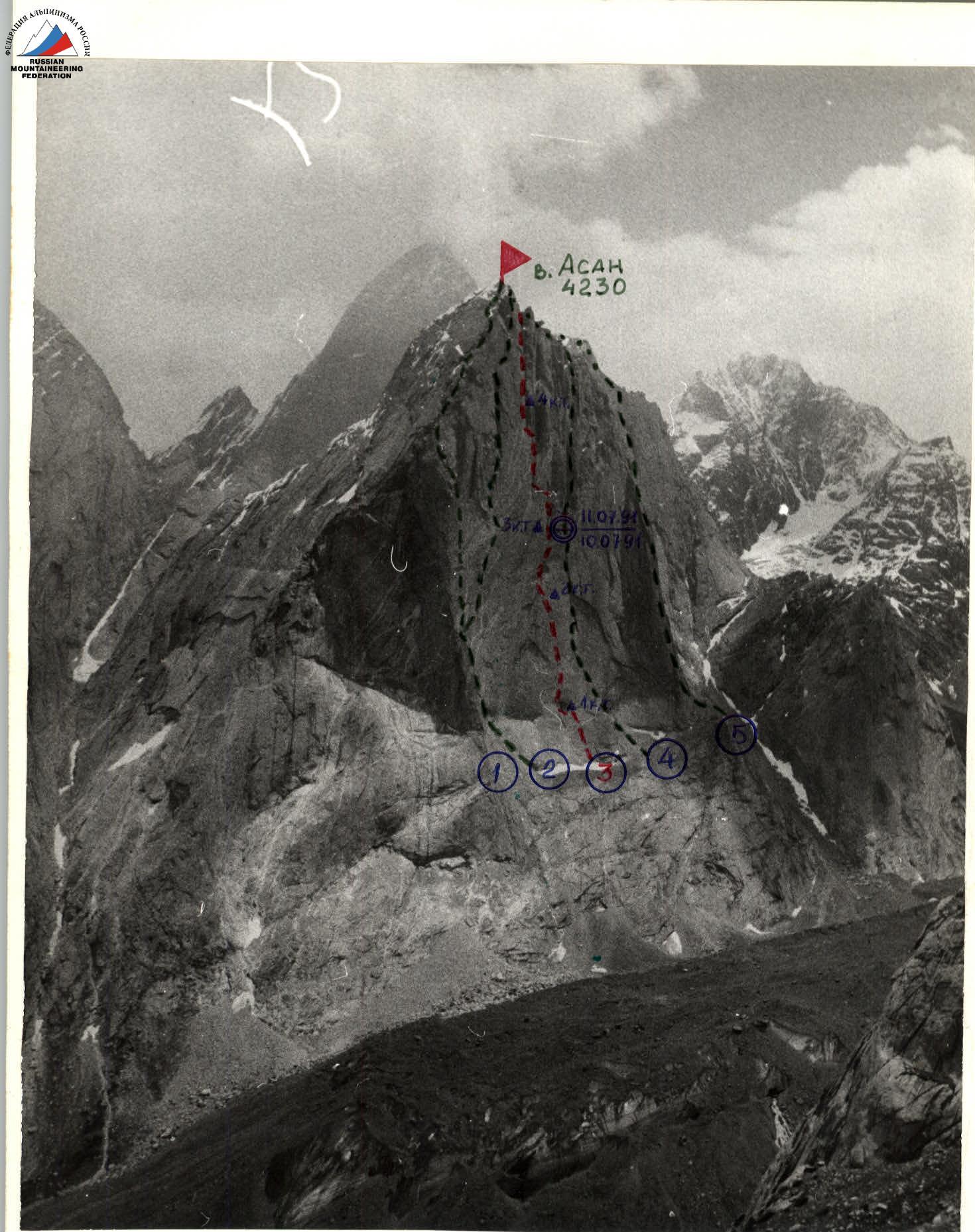
Photo 1. General photo of the peak
R1 - Pogorelov's route, R2 - Gorbenko's route, R3 - Rusiaev's route, R4 - Timofeev's route, R5 - Alperin's route
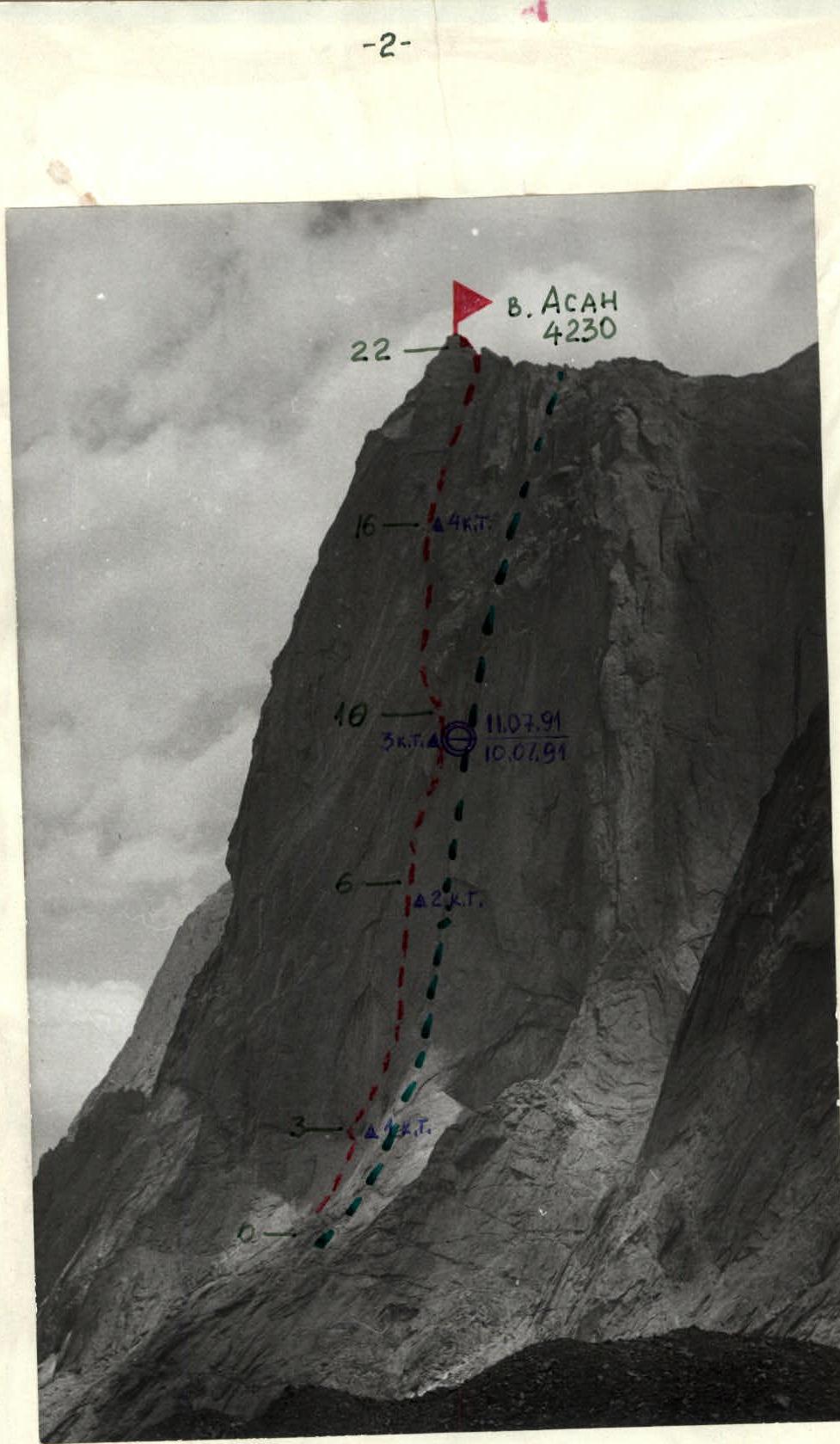
Photo 2. Profile of the wall from the right
July 11, 1989, "Helios"-44M-4 lens, distance - 1500 m, height - 2800 m.
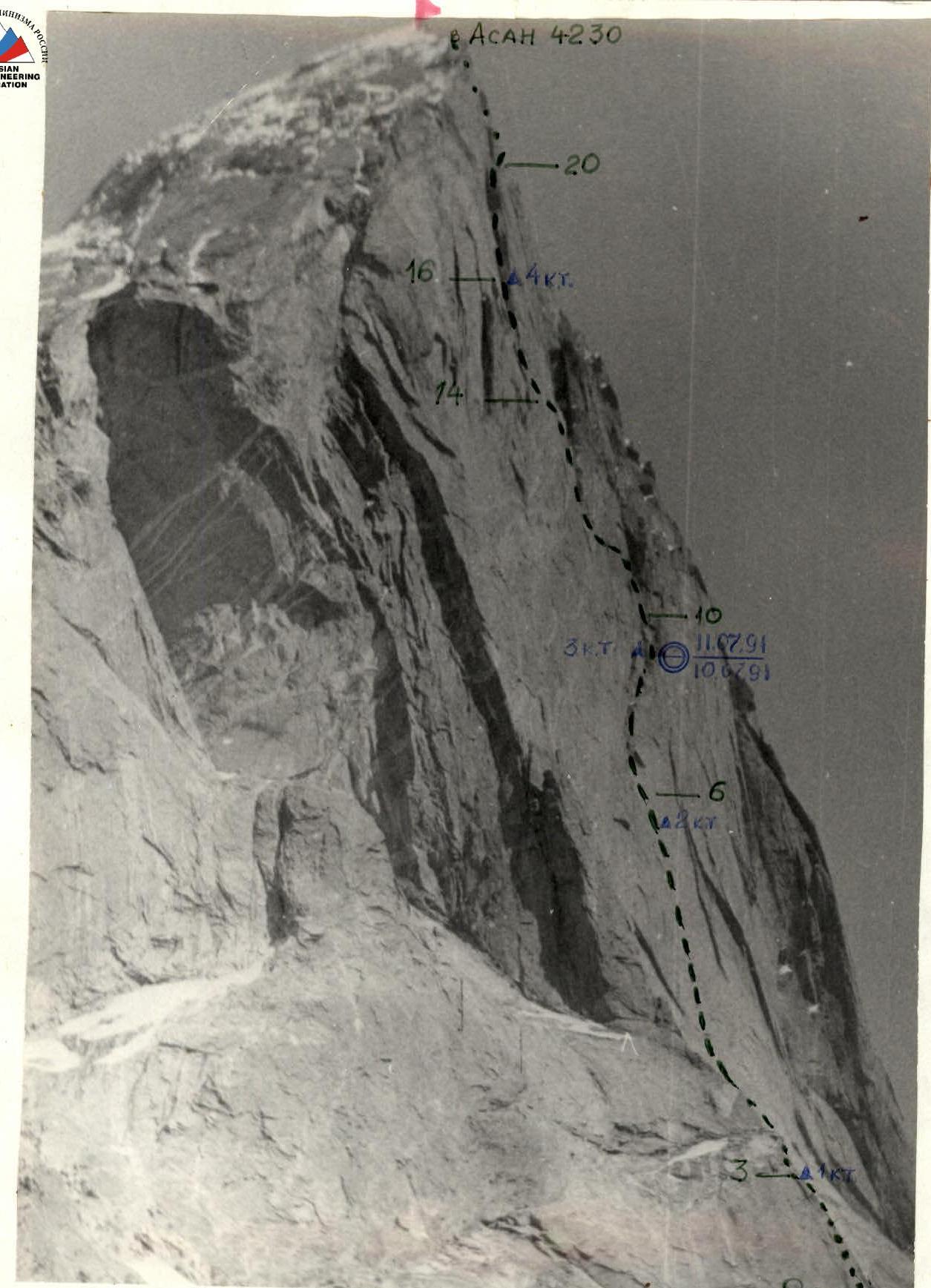 Photo 3. Profile of the wall from the left
 July 10, 1989, "Helios"-44M-4 lens, distance - 800 m, height - 3200 m.
Tactical Actions of the Team
The team chose Peak Asan via Rusiaev's route on the center of the NW wall, 6B category, as their second objective within the USSR Championship - the strongest in this region. The choice was motivated by:
- good knowledge of the wall specifics;
- personal competition with main rivals.
Considering the need for a high climbing tempo and only three days and 3 hours left until the end of the Championship with unstable weather conditions, two ascent variants were tactically planned: 1 - normal weather conditions (70% of working time); 2 - bad weather conditions (rain, snow, fog, more than 30% of working time).
It was planned:
- To process the maximum number of ropes in one day.
- On the next day, a team of two would continue work early in the morning, and the rest of the team members would follow with a short interval.
Under normal working conditions:
- One overnight stay was planned, followed by further processing.
- This allowed for a reserve of daylight hours for descent from the summit on the next day (Variant 1).
In bad weather:
- Two overnight stays were planned on the section.
- The second one - on the summit.
According to the Championship regulations, the team was required to return to the base camp by 10:00 on July 12, 1991.
Such a high climbing tempo could be maintained due to:
- organized work of each rope team and participant (first and last);
- early departures;
- obligatory (regardless of weather) route processing in the evening;
- work in bad weather.
The first to work on sections were: Igolkin, Soldatov, Kirievsky, Gorbenko, Lutsenko. The team used the entire arsenal of modern technical means tested at the USSR Championships. The first climber used a double rope (one UIAA), the rest - with top rope on fixed ropes.
The overnight stay was shared on one ledge on the section. The team ascended according to the first variant of the tactical plan. Later, heavy bad weather made the traverse, which was done solely on friction, unsafe, and the team continued the ascent on the second day, 2 hours ahead of the second variant of the tactical plan.
Food was two times a day (morning and evening) using high-calorie individual rations and a drink from flasks during the day. There were no falls or injuries.
Due to the practical absence of protrusions, intermediate anchors were organized on pitons and chocks, on the "mirror" using bolt pitons. "Stations" for belays and fixing ropes were organized on three to four elements, including pitons (including bolt pitons).
Communication with the base camp, where a combined rescue team was located, was maintained via radio and through an observer under the route.
The team's reserves were:
- multiple ascents of 6B category in this region over four years;
- excellent technical and physical preparation;
- a combination of experience and youth in the team;
- good material base (food, equipment, medicine, rescue team);
- planning of main work by all participants.
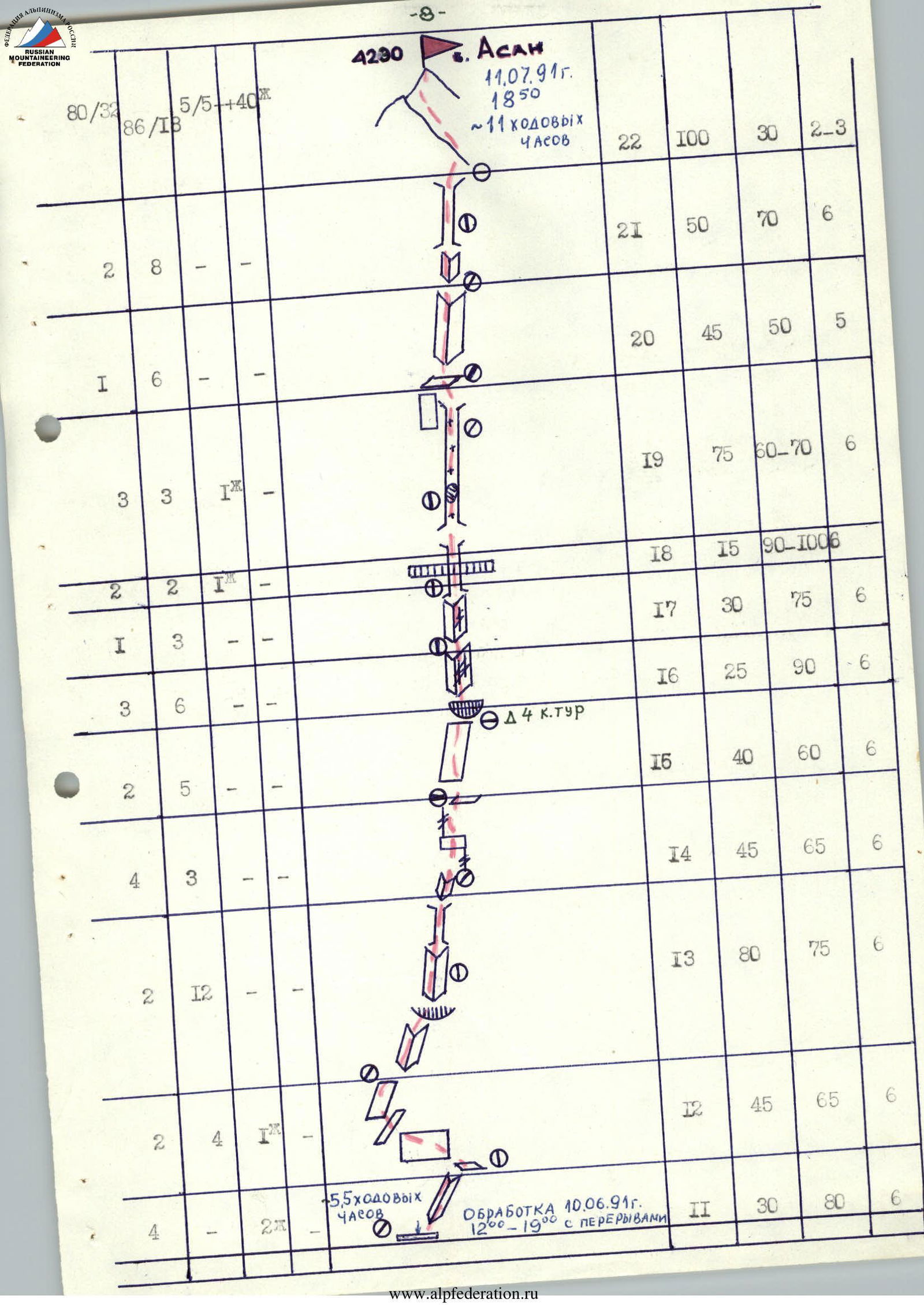
Asan, 4230 m. July 11, 1991 18:50 - approximately 11 climbing hours
| Section N | Section Length (m) | Steepness (degrees) | Difficulty Category |
|---|---|---|---|
| R22 | 100 | 30 | 2–3 |
| R21 | 50 | 70 | 6 |
| R20 | 45 | 50 | 5 |
| R19 | 75 | 50–70 | 6 |
| R18 | 15 | 90–100 | 6 |
| R17 | 30 | 75 | 6 |
| R16 | 25 | 90 | 6 |
| R15 | 40 | 60 | 6 |
| R14 | 45 | 65 | 6 |
| R13 | 80 | 75 | 6 |
| R12 | 45 | 65 | 6 |
| R11 | 30 | 80 | 6 |
+5.5 climbing hours. Processing on June 10, 1991 12:00–19:00 with breaks.
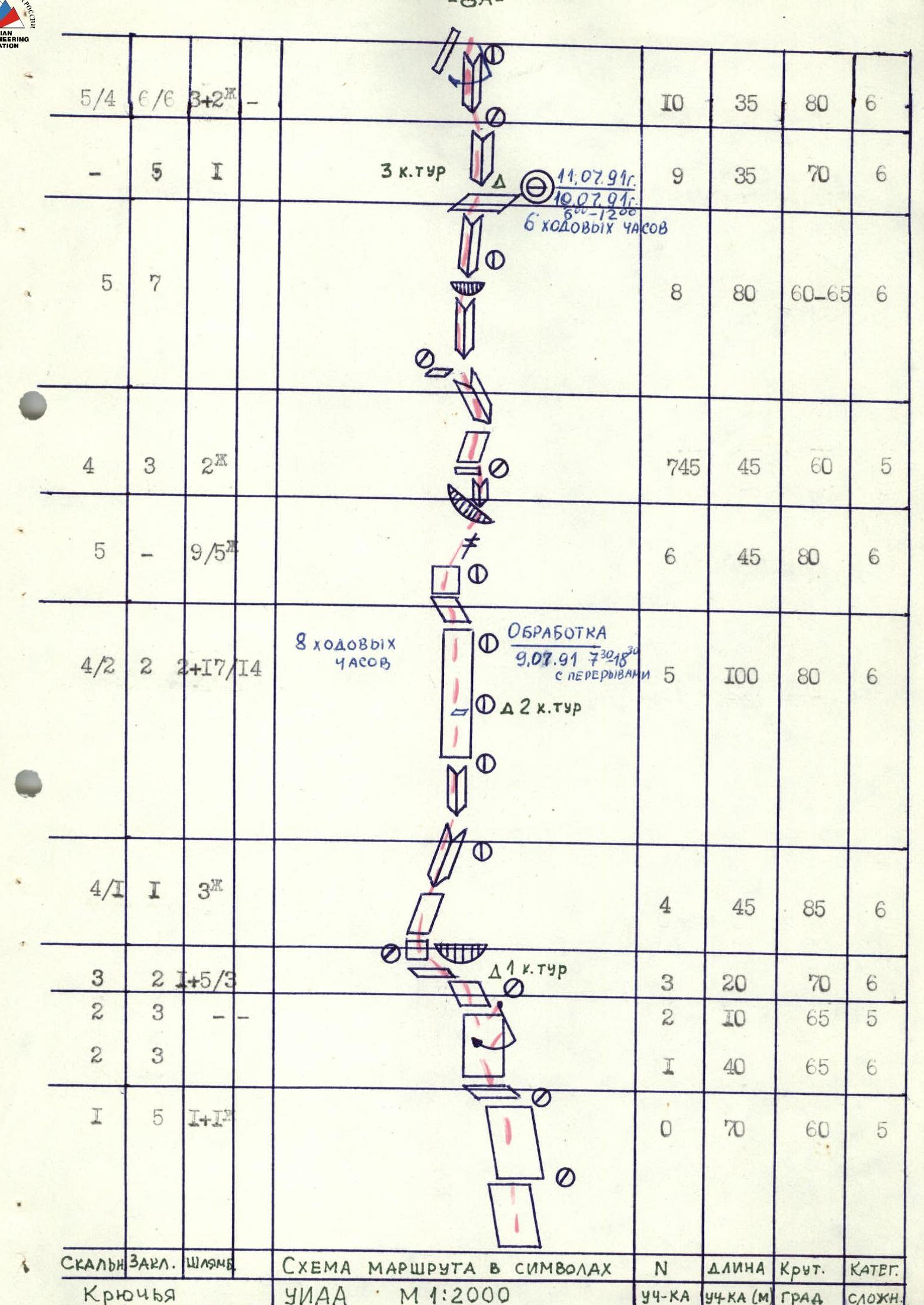
| Section N | Section Length (m) | Steepness (degrees) | Difficulty Category |
|---|---|---|---|
| R10 | 35 | 80 | 6 |
| R9 | 35 | 70 | 6 |
| R8 | 80 | 60–65 | 6 |
| R7 | 45 | 60 | 5 |
| R6 | 45 | 80 | 6 |
| R5 | 100 | 80 | 6 |
| R4 | 45 | 85 | 6 |
| R3 | 20 | 70 | 6 |
| R2 | 10 | 65 | 5 |
| R1 | 40 | 65 | 6 |
| R0 | 70 | 60 | 5 |
Route diagram in symbols, scale 1:2000
Route Description by Sections
- R0 - inclined slab is climbed using free climbing, holds are smooth.
- R1-R2 - the slab becomes steeper, pendulum move left - sky hooks.
- R3-R6 - smooth slab with minimal holds, aid climbing.
- R7-R8 - after an overhanging roof to an inside corner, transition from aid climbing to free climbing.
- R9-R10 - along a large inside corner to pendulum bolt pitons, pendulum left to a ridge, abseil 20-25 m.
- R11 - along a ledge left to a corner, straight up.
- R12 - traverse, protection on flakes.
- R13 - up a chimney, wet.
- R14 - the chimney widens, up to a crack and left to long ledges, possible bivouac.
- R15-R17 - up a slab to the base of an inside corner, up the right part.
- R18 - a large overhanging roof is traversed left, ice, aid climbing.
- R19 - chimney climbing.
- R20 - transition to the left side to an inside corner.
- R21 - a small inside corner turns into a chimney, free climbing.
- R22 - along a ridge to the summit.

Comments
Sign in to leave a comment