
Passport
- Rock class.
- Pamir-Alay, Turkestan Range.
- Peak 4230 m (Asan), center of the NW wall.
- 6B category of difficulty.
- Height difference 830 m, length 1015 m, length of sections 5–6 cat. diff. — 865 m, of which 6 cat. diff. 415 m, 5 cat. diff. — 450 m. Average steepness of the route 78° (sections R0–R26, heights 3400–4230 m) and in them 6 cat. diff. 85° (260 m, 3540–3800 m, 110 m, 3890–4000 m).
- Pitons driven:
| Piton type | Total | Driven |
|---|---|---|
| Rock | 129 | 21 |
| Bolt | 23ˣ | 20 |
| Chocks | 120 | 38 |
ˣ — use of previously driven pitons
7. Team's working hours 29 and days 3. 8. Overnights: 1st convenient on a ledge, 2nd sitting — three on a ledge, two in hammocks. 9. Leader: Rashkin Valery Fedorovich CMS Participants: * Polyak Viktor Efimovich CMS * Minaev Alexander Mikhailovich CMS * Plakushchev Ivan Denisovich CMS * Iosipenko Vladimir Danilovich CMS 10. Coach: Polyak Viktor Efimovich CMS 11. Approach to the route: July 16, 1988. Summit: July 18, 1988. Return: July 19, 1988.
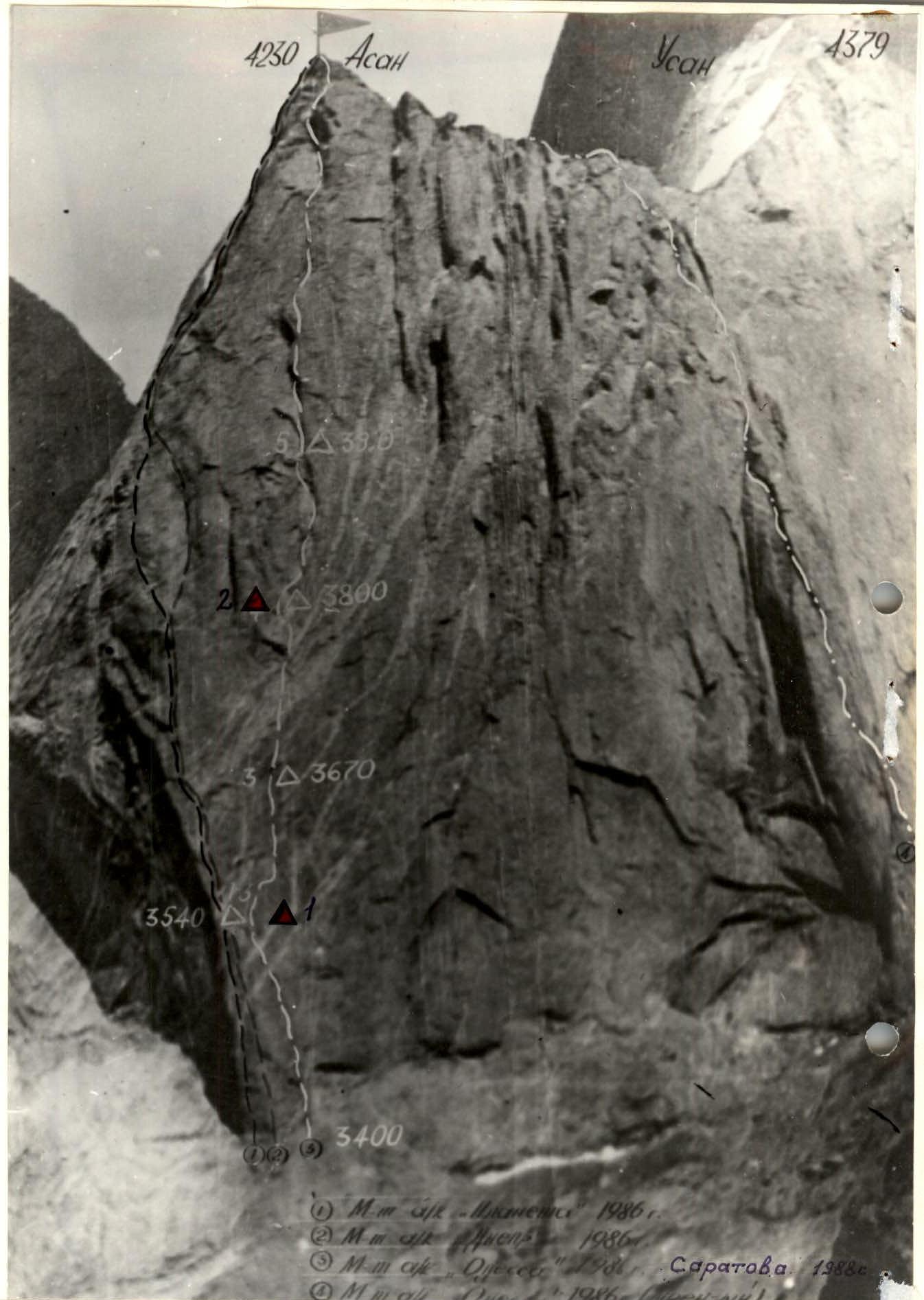
General photo of the summit
The photo was taken from the opposite slope on July 19, 1986, at 15:00. Lens "Helios-44", focal length 58 mm, distance to the object 2000 m, shooting point No. 1 on the area diagram, height of the shooting point 3800 m. The photograph is taken from the report of the team M. Gorbenko. Δ — team's overnight stays Δ — overnight stays of M. Gorbenko's team
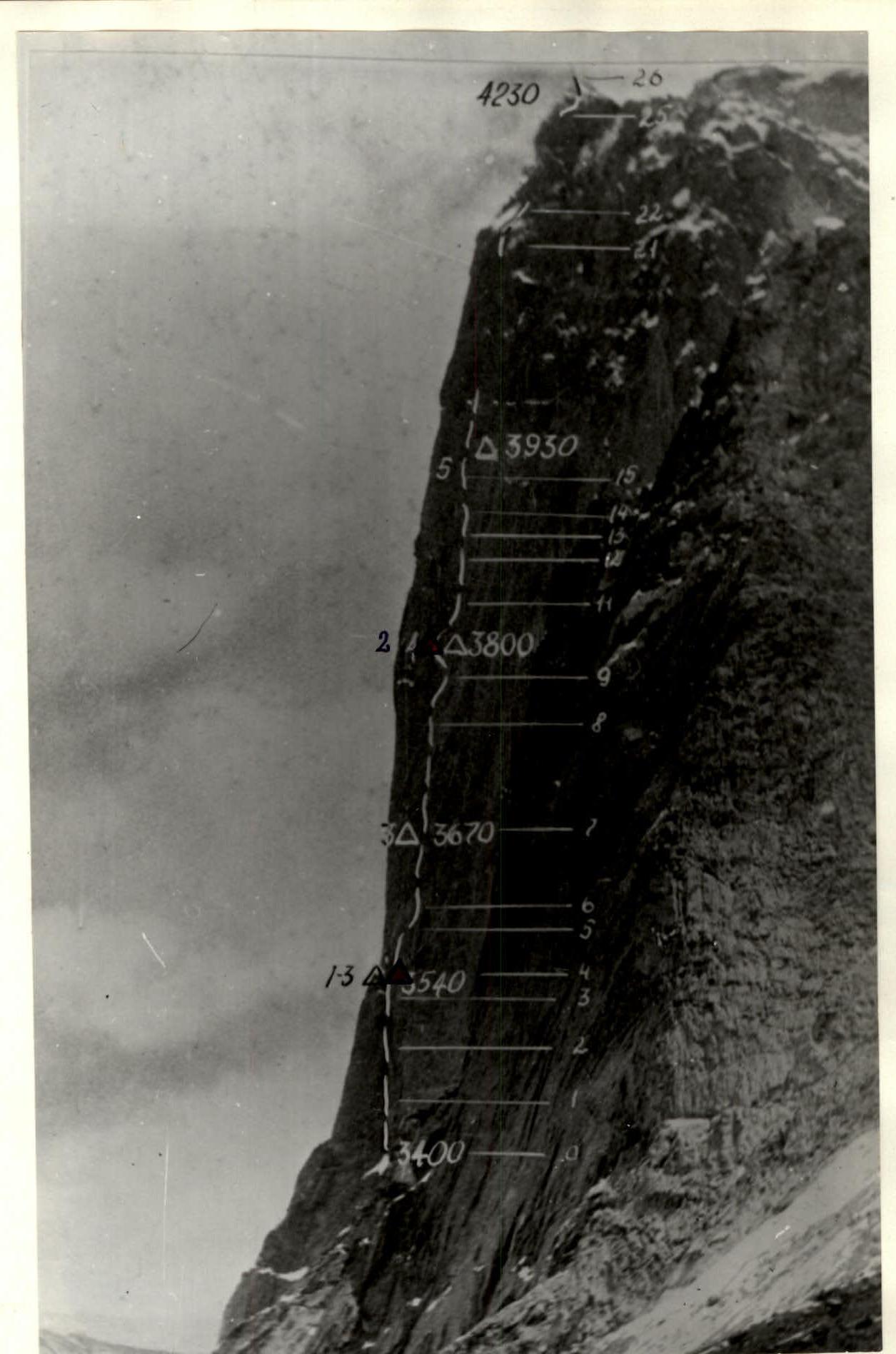
Profile of the wall on the right
The photo was taken from the right moraine of the glacier on May 28, 1986, at 16:00; lens "Tairos-44"; focal length 58 mm, distance to the object 2000 m, shooting point No. 2 on the area diagram, height of the shooting point 3300 m. The photograph is taken from the report of the team M. Gorbunov.
Δ — team's overnight stay Δ — overnight stay of M. Gorbunov's team
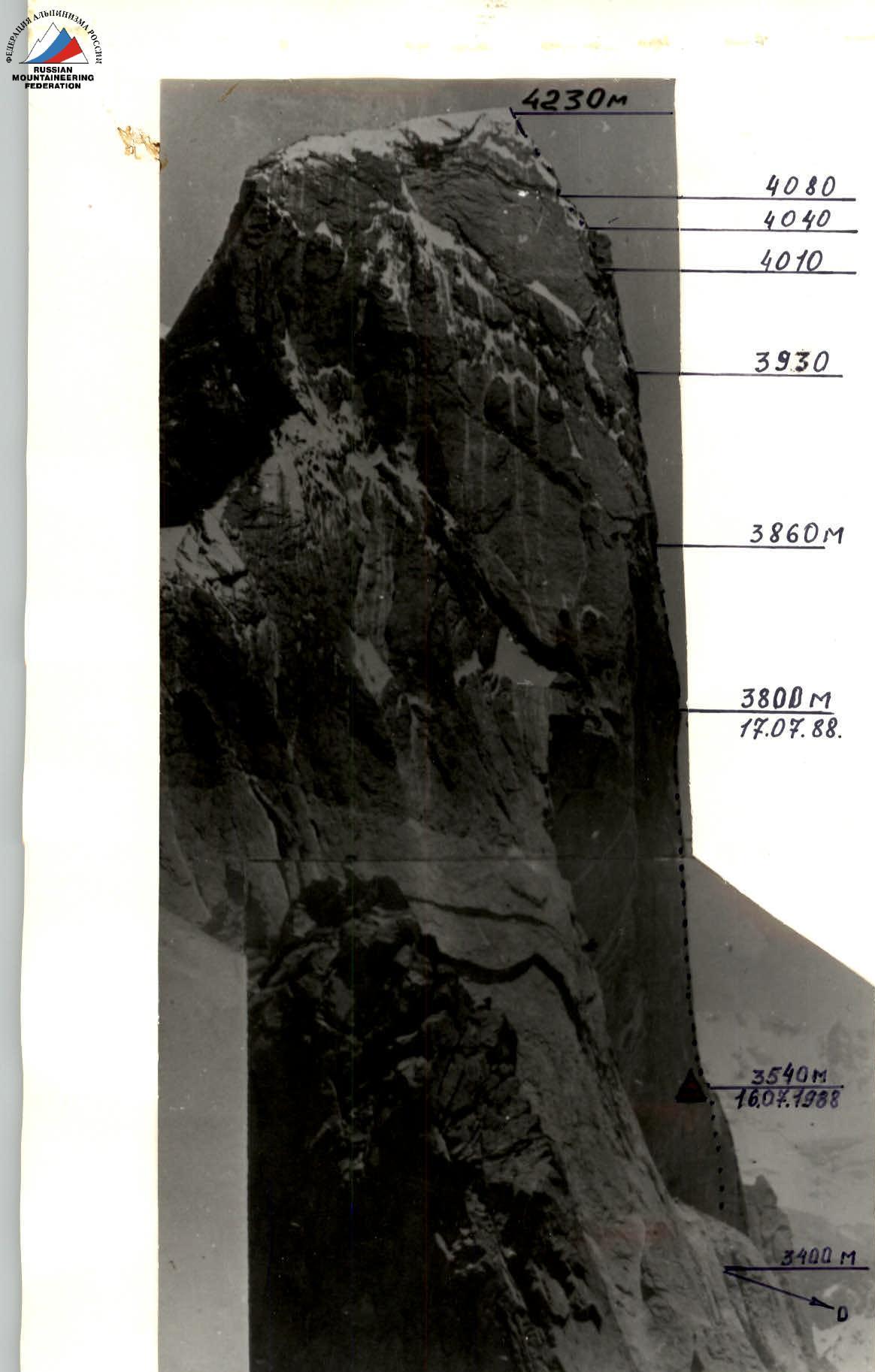
Profile of the wall on the left
The photo was taken on July 5, 1986, at 15:00, lens "Telemar-22", focal length 300 mm, distance to the object 3000 m, shooting height 3400 m, shooting point No. 3 on the area diagram.
The photograph is taken from the report of the team A. Pogorelov.
Team's overnight stays: The tactical plan of the ascent was drawn up taking into account:
- the weather established in the area (from 16:00 to 17:00 rain, snow);
- the speed of our progress on various routes;
- the features of the wall relief ("mirror", cornices);
- the weight of backpacks (12 liters of water);
- compliance with safety measures.
Assuming good weather, it was planned to process the route above the overnight stay.
The route was completed in full accordance with the tactical plan.
Nutrition regime on the route:
- in the morning and evening — hot food and tea.
Taking into account the planned reserve days, food for the route was taken for 5.5 days at the rate of 350 g per person per day.
As planned, the load on the participants was distributed evenly.
In the lower and middle parts of the route (section R0–R18), the team's tactical actions were as follows:
- the leading rope pair ensured the processing and passage of sections;
- the 5th member of the group provided communication with the support rope pair (carried ropes, carabiners, food).
When organizing the belays, the autonomy of the rope pairs was maintained. The group worked with four backpacks — the first one went without a backpack. On the first day of work (sections R0–R3), a water backpack was pulled out.
The upper part of the route (sections R18–R26) was passed by free climbing with independent movement of the rope pairs, which allowed to gain 430 m in a day and reach the summit.
On sections R9–R10, two pendulums of 15 and 10 m were applied sequentially, which made it possible to pass the planned relief without using bolt technique and reach the overnight stay (3850 m).
The team worked on the route in rope pairs according to the following schedule:
- Iosipenko — Polyak: sections R0–R5
- Rashkin — Plakushchev: sections R6–R11, R18–R26
- Plakushchev — Rashkin: sections R12–R17
The first to work were:
- Iosipenko: sections R0–R5
- Rashkin: sections R6–R11, R18–R26
- Plakushchev: sections R12–R17
The problem of passing "mirrors" with a small number of holds and cracks was solved by using skyhooks and free climbing at the limit of the possible.
From the special equipment on the route were used:
- hooked legs;
- ladders for hooked legs;
- "friend" chocks;
- shock absorbers;
- slings;
- other equipment.
Passing small and large cornices required the use of the entire arsenal of mountaineering techniques.
There was always a double rope on the belays. Movement along them was carried out either with two jammers and on a "clutching" rope, or with top rope belay. The first one always went on a shock absorber. The route thread was laid out so that it excluded the possibility of falling stones on those on it.
There were no falls or injuries.
Throughout the ascent, radio communication with the base camp and the observation group was stable and regular. In addition, the observation group was located directly under the wall around the clock and carried out visual observation of the team.
| Pitons | UIAA Diagram | Cat. diff. | Length (m) | Steepness (deg) | ||||
|---|---|---|---|---|---|---|---|---|
| rock | chocks | bolt | Scale 1: 2000 | Sect. No. | ||||
| 2 | 5 | - | 9.5 h, rock 32, chocks 36, bolt 19 | 12 | 5A | 50 | 70 | |
| 1 | 9 | - |  | 11 | 5B | 40 | 75 | |
| 2 | 8/2 | 1ˣ | 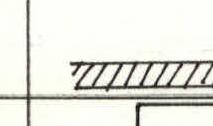 | 10 | 6 | 45 | 85 | |
| 6/4 | 2 | 7ˣ/7 | 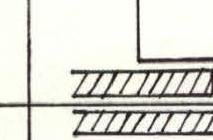 | 9 | 6A2e | 40 | 90 | |
| 10/7 | 3/3 | 2ˣ/9 | 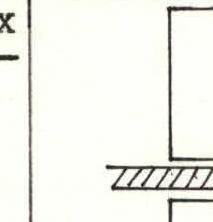 | 8 | 6A2e | 80 | 85 | |
| 9 | 6 | - | 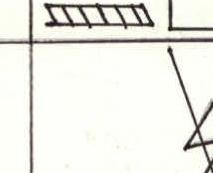 | 7 | 6 | 60 | 80 | |
| 2 | 3 | - | 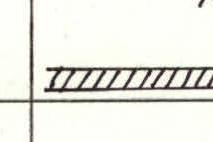 | 6 | 5B | 20 | 85 | |
| 2/7 | 1/1 | 4ˣ/4 | 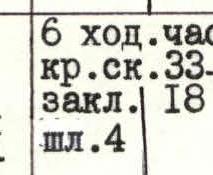 | 5 | 6A2e | 60 | 90 | |
| 4 | 3 | - | 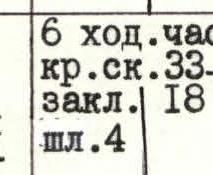 | 4 | 5 | 20 | 85 | |
| 6 | 4 | - | 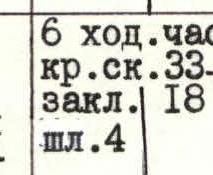 | 3 | 5A | 40 | 70 | |
| 7 | 4 | - |  | 2 | 5B | 40 | 90 | |
| 5 | 6 | - |  | 1 | 5 | 40 | 85 | |
| Pitons | UIAA Diagram | Cat. diff. | Length (m) | Steepness (deg) | ||||
| :--: | :--: | :--: | :---------------: | :---- | :--- | :--------- | :--------- | :-------------- |
| rock | chocks | bolt | Scale 1: 2000 | Sect. No. | ||||
| 129 | 120 | 23 | ||||||
| 21 | 38 | 20 | 29 h | |||||
| - | 1 | - | 13.5 h, rock 64, chocks 66 | 26 | 2 | 30 | 45 | |
| 9 | 3 | - | 25 | 5 | 50 | 70 | ||
| 1 | - | - | 24 | 3 | 20 | 45 | ||
| 4 | 1 | - | 23 | 4 | 40 | 60 | ||
| - | 1 | - | 22 | 3 | 30 | 45 | ||
| 5 | 6 | - | 21 | 5 | 45 | 75 | ||
| 3 | 1 | - | 20 | 4 | 30 | 50 | ||
| 10 | 6 | - | 19 | 5B | 60 | 80 | ||
| 9/1 | 3/3 | - |  | 18 | 6 | 20 | 100 | |
| 4/2 | 3/26 | - | 17 | 6 | 60 | 80 | ||
| 8 | 3/3 | - | 16 | 6 | 20 | 95 | ||
| 6 | 4 | - | 15 | 6 | 30 | 80 | ||
| 3 | 3 | - | 14 | 5 | 20 | 75 | ||
| 2 | 2 | - | 13 | 5 | 25 | 80 |
Route description by sections
The approach to the route along simple rocks and talus ledges crossing the entire base of the northwest and west walls up to a height of 3400 m is not difficult. The route can be conditionally divided into three main parts: a system of steep internal corners formed by a "pillar" — a steep counterfort on the left, and the main wall on the right (sections R0–R3), a "mirror" — steep, poorly articulated rocks, the problematic part of the route (sections R3–R9) and a large internal corner with two cornices in the middle part (sections R14–R18).
It is characteristic that, standing under the wall, we saw the top hanging over us, and after passing the wall — its base.
Section R0–R3: Difficult free climbing begins from under the overhanging rocks along the right side of the inner corner. Initially along the wall with a large, but difficult to use due to the sloping relief, then along the corner — exit to a small ledge. Here is a belay point and pulling up backpacks. The overall steepness of this section is such that the belay ropes and backpacks hang 3 m from the wall. From the ledge along the overhanging chimney — very difficult climbing 10 m, then it is easier to go along the left side of the corner. After 30 m, the steepness decreases, the inner corner leads to the upper part of the "pillar". From here, the route continues straight up, the only overnight stay is located higher and to the left by 30 m on top of the "pillar".
Section R3–R9: The "mirror" is a steep, smooth (when observed from below) 300-meter wall. The only way is along cracks, chips and walls separated by smooth sections of rocks and cornices. There are no places for overnight stay on the "Mirror".
Preliminary processing of the section and a good pace of the group's movement made it possible to pass the route to the base of a large chimney, where a group overnight stay is possible in a niche.
Technically, the "Mirror" was passed by the most difficult free climbing along a weakly expressed micro-relief, often interrupted by smooth sections passed only on skyhooks, and cornices passed on ITO.
The great steepness of the "Mirror" made it possible to navigate well, since the base of the large inner corner in the upper part of the wall was clearly visible from below.
Belaying was mainly carried out with removable pitons and chocks, but on smooth sections bolt pitons were used.
Section R9–R14.
After passing the "Mirror", the path runs along monolithic, articulated rocks of diverse micro-relief. To reach the overnight stay in the niche, it was necessary to traverse left along a smooth slab using two "pendulums".
From the overnight stay:
- a vertical 40-meter crack — interesting, but difficult climbing up under an overhang;
- then a traverse along narrow shelves to the right;
- the base of a large inner corner.
Belaying was mainly done with the help of chocks.
The huge inner corner is passed along the right wall by free climbing and on ITO in the middle part. Climbing is diverse, reliable belaying was carried out on chocks and, less often, on pitons. The first cornice is passed on the right side by the most difficult climbing.
After it begins a long 80-meter crack in the right wall of the inner corner, going with the help of "friends" and on chocks (ITO). The crack becomes narrower and narrower, turns into a cornice with an outreach of 1 m and a 20-meter overhanging section.
Sections R19–R26
Further, difficult climbing continues along the right wall. In the corners appears ice formed from meltwater, meltwater on the rocks. Here, the difficulty of climbing is sometimes reduced to 4 cat. diff. The rope pairs can move independently, without belays, but the route does not allow to relax and ends with a difficult exit to the summit along a wall with a small number of holds for climbing and cracks for belaying.
In our opinion, the route is logical, passes mainly along the relief with great steepness and complexity of rocks, along the shortest path from the base of the wall straight to the summit, while remaining the longest in terms of the length of sections 5–6 cat. diff. from possible routes on this wall.
- Passes along the relief with great steepness and complexity of rocks.
- Goes along the shortest path from the base of the wall straight to the summit.
- Is the longest in terms of the length of sections 5–6 cat. diff. from possible routes on this wall.
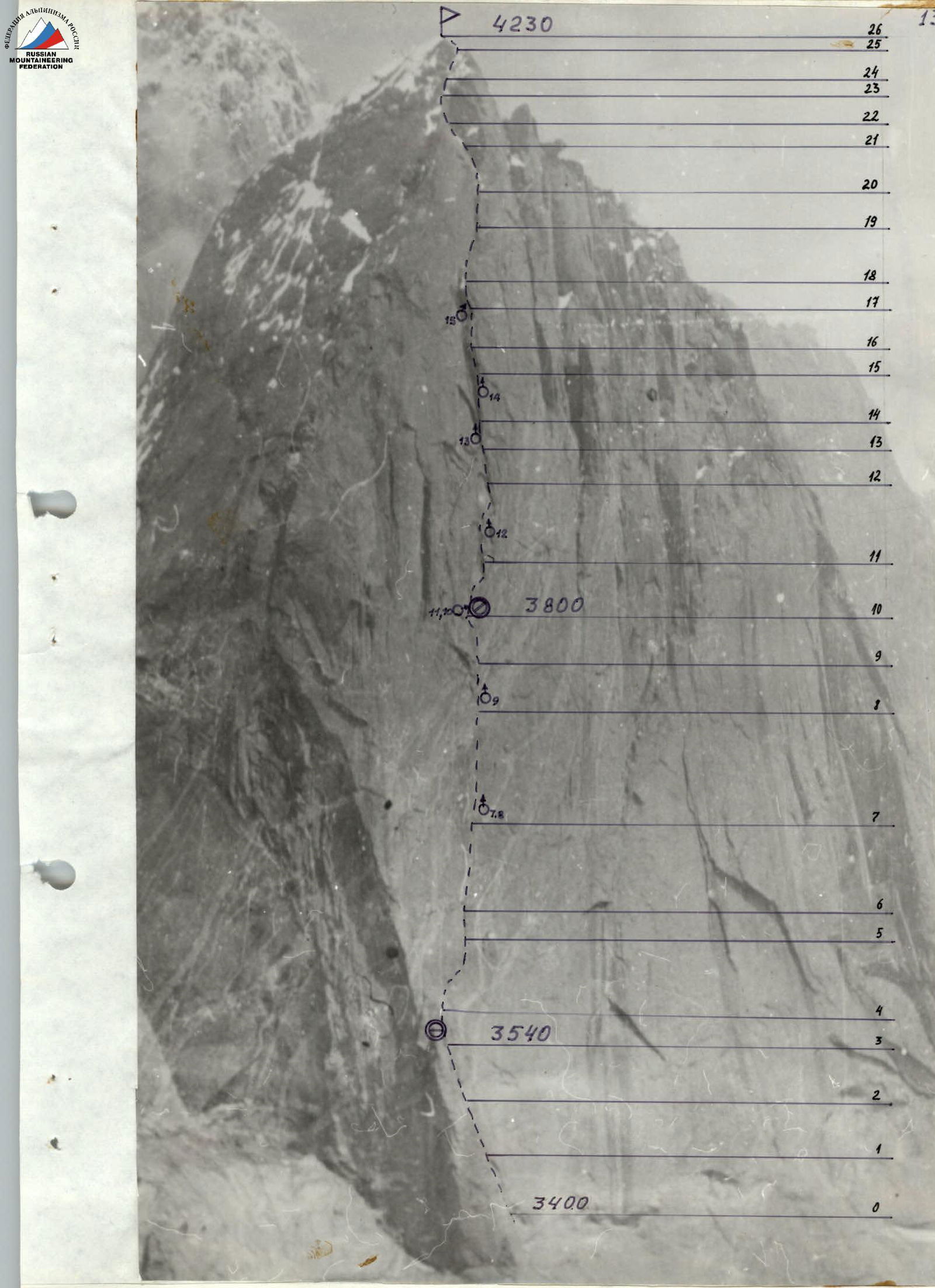
PHOTO 5. Technical photograph.
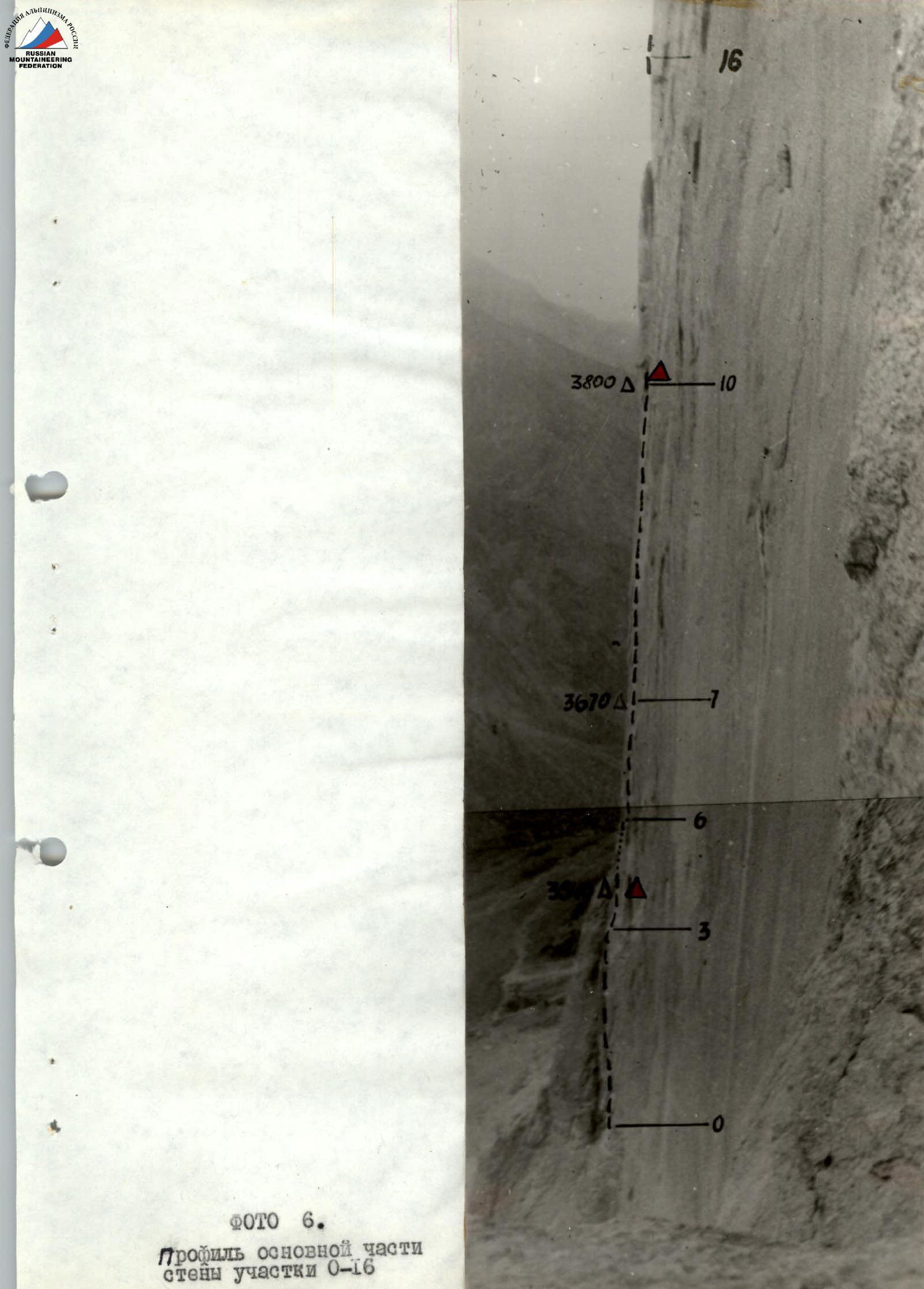
PHOTO 6. Profile of the main part of the wall
Sections R0–R16, July 9, 18:00.

Comments
Sign in to leave a comment