
Ascent Passport
- Ascent class — technical.
- Ascent area: Pamir-Alay, Turkestan Range, Laylyak gorge.
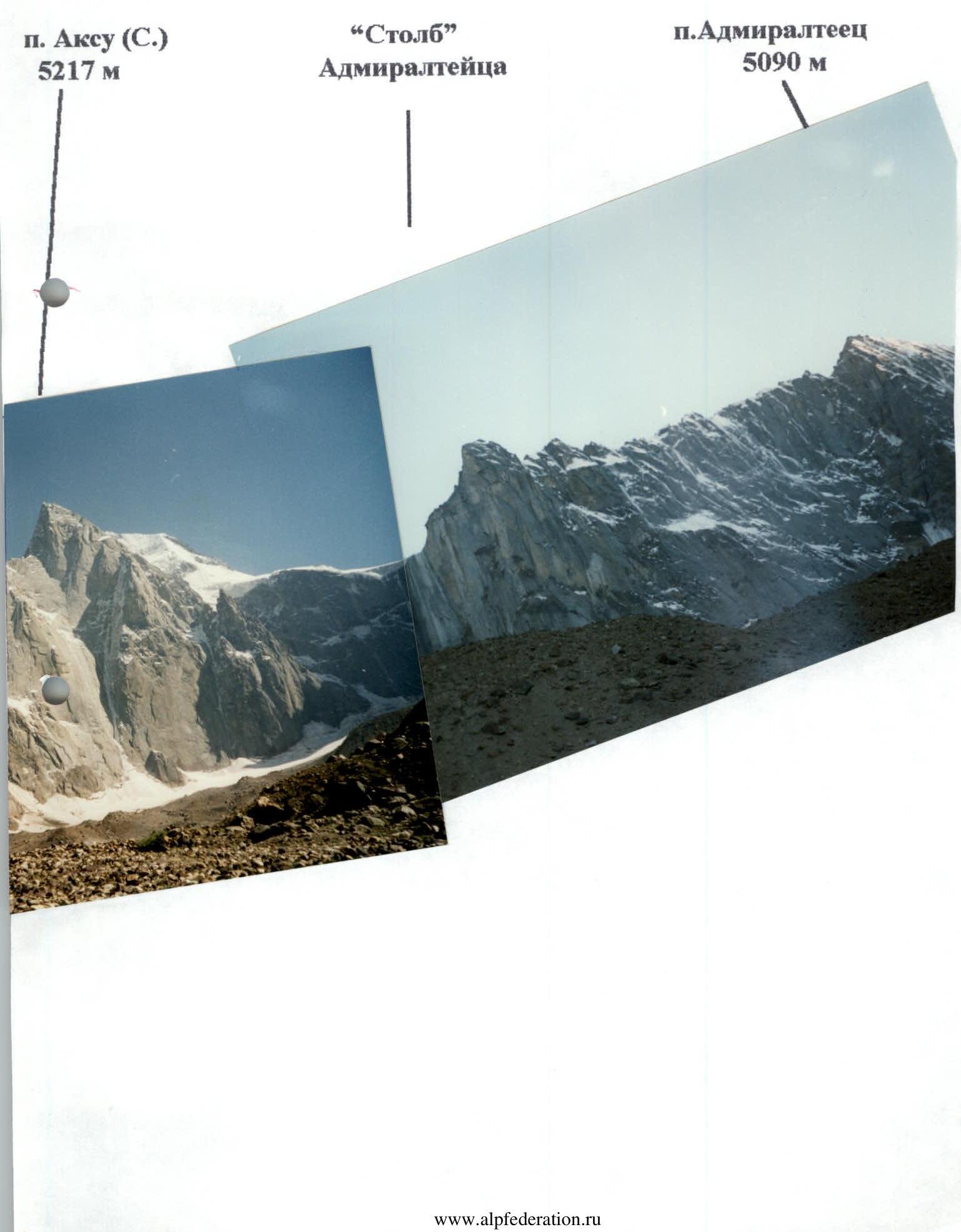
- Peak, route: p. AkSu N. 5217 m, via the center of the N. face through the "nose" (P. Shabalin's route).
- Complexity category — 6B, second ascent.
- Height difference: — 1467 m.
Route length — 1940 m, length of sections with 5th cat. diff. — 255 m, length of sections with 6th cat. diff. — 1350 m. Average steepness:
- main section of the route — 75.5°;
- entire route — 68°.
- Pitons hammered: rock — 196/116, chocks — 234/141, ice — 50, bolted — 70* + 29 / 59* + 5. * — reusing previously hammered pitons
Left on the route: rock — 2, chocks — 0, bolted — 1. 7. Team's travel hours: 93 h and 10 days. 8. Overnights: * 1st – 9th — in a tent on a platform; * 10th — in a tent on a site (on the descent under the tower).
-
Team leader: Shavrovich Alexander Leonidovich — Candidate for Master of Sports, Perm, ul. P. Osipenko, 56–20. Participants:
- Zhizhin Yuri Alexandrovich — Candidate for Master of Sports, Perm, ul. Yursha, 7–83;
- Mochalov Alexander Vyacheslavovich — 1st sports category, Perm, ul. Ivanovskaya, 13–29;
- Puchnin Vyacheslav Evgenievich — Candidate for Master of Sports, Perm, ul. Uinskaya, 8–198;
- Zhirnov Sergei Viktorovich — Candidate for Master of Sports, Perm, pr. Parkovy, 10/2–95;
- Rylov Nikolai Valerievich — 1st sports category, Perm, ul. Lenina, 59–32.
-
Coach: Muchkin Alexei Borisovich — Master of Sports, Perm, ul. Svyazistov, 18–32.
-
Departure to the route: — August 7, 1997. Summit: — August 16, 1997. Return to base camp: — August 17, 1997.
-
Organization name: Perm Regional Sports Committee — Perm, ul. K. Marksa, 1.
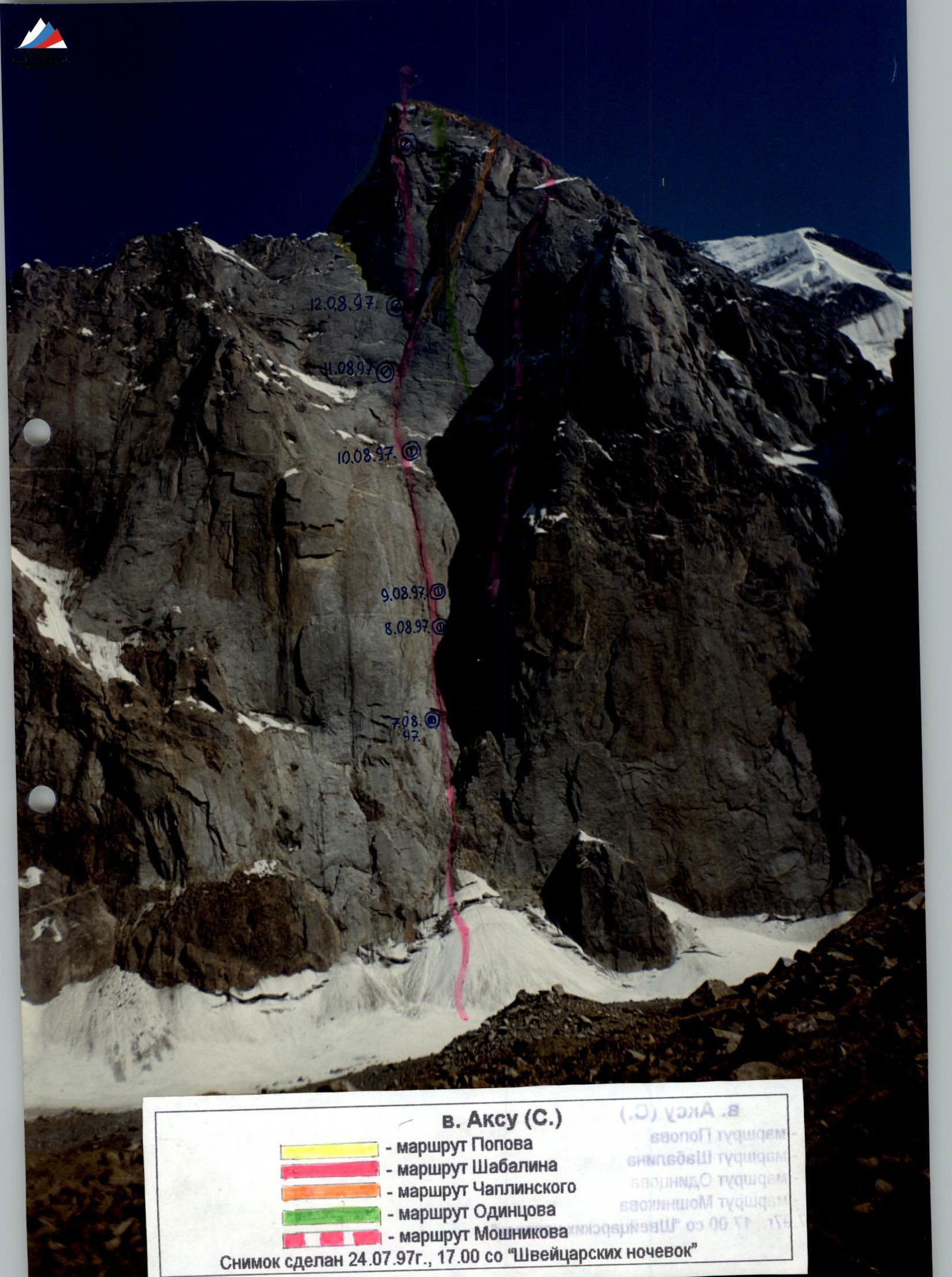
Profile of the upper part of the route (view from the right)
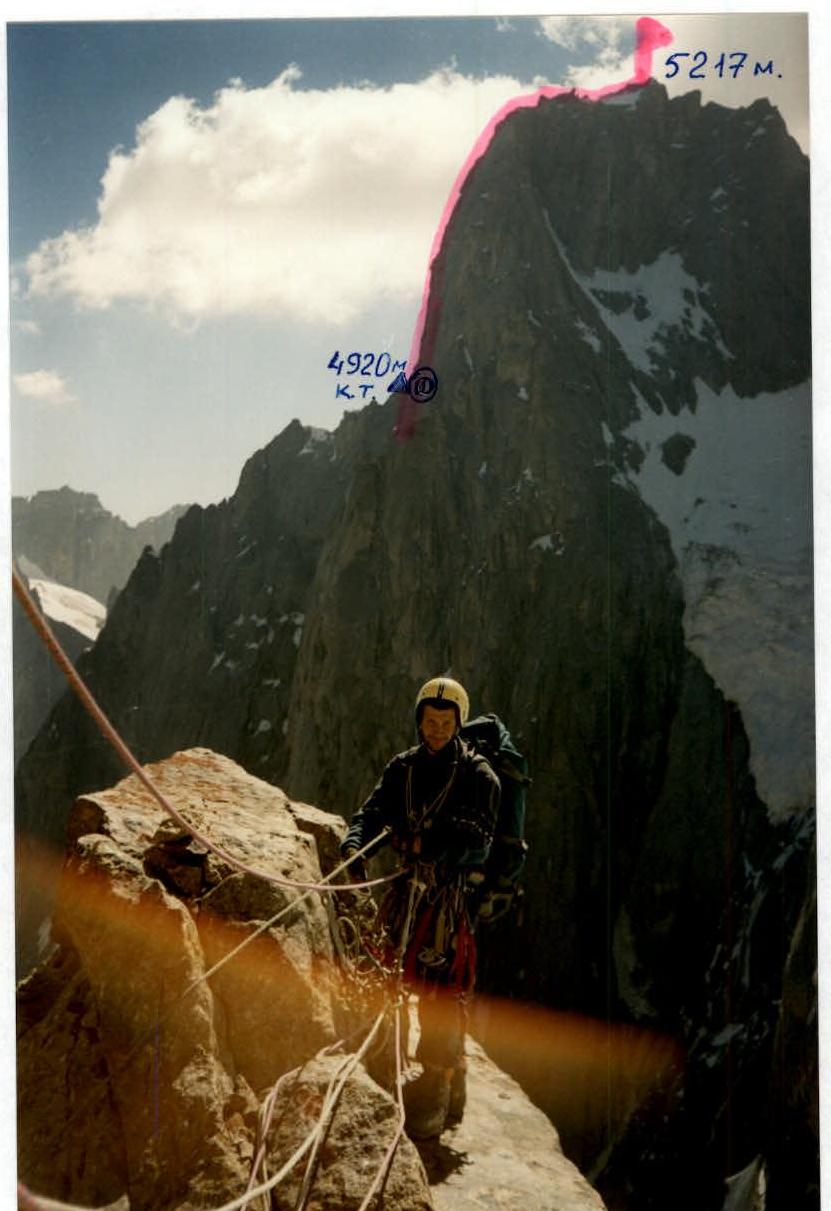
Panorama of the area
p. A. Bloka 5239 m
p. 4600" 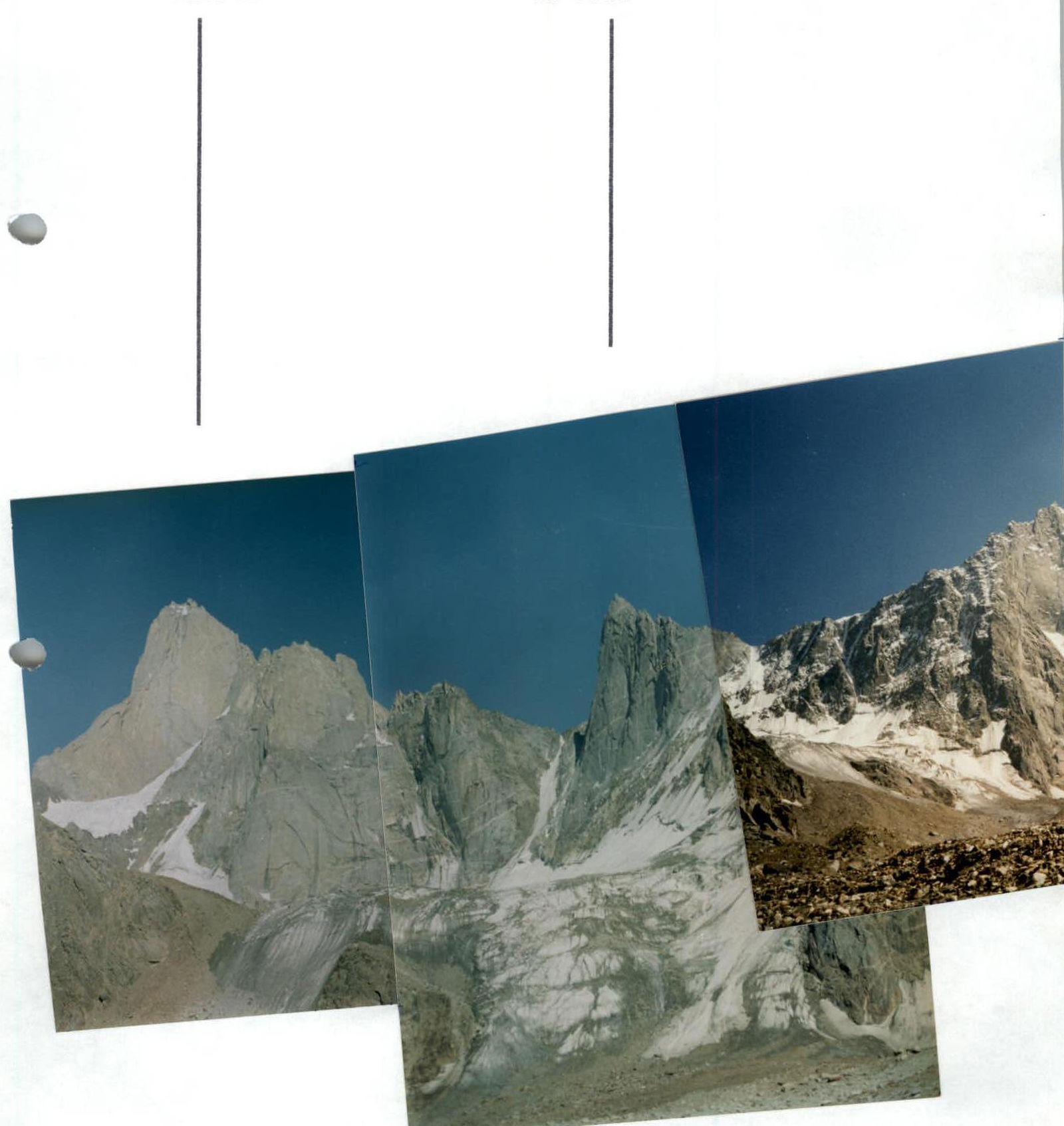
Panorama of the area (continued)
Tactical actions of the team
The tactical plan for the ascent was made based on the study of the first ascent report and consultations with P. Shabalin, A. Antonov, N. Medvedev. During the preparation for the ascent, constant observation of the route was carried out from July 20.
When drawing up the plan, objective and subjective factors influencing the safe passage of the route were taken into account. The ascent was planned for 10 days, with a supply of gas and products for 12 days. For 3 hours after bad weather (August 4–6), we waited for the snow to settle and the danger of rockfall to decrease. By August 7, the team from Kirov had descended to the saddle between AkSu and 4600 m, the Kievans had started on the Troshchinenko route, and the Yekaterinburg team had begun the ascent on August 5 via the Odintsov route – consequently, our route was away from the work areas of the other climbers.
August 7, 1997
- Departed at 6:00 from the bivouac under the big rock on the glacier.
- Shavrovich worked at the front.
- By 12:00, we reached the base of the crevice from which the Popov, Chaplinsky, and Shabalin routes begin.
- Mochalov went first.
- By 17:00, we reached under the cornice R6; working conditions were complicated by a waterfall with ice and snow.
- Set up a platform and settled in for the night.
- Total for the day: 11 travel hours, 260 m covered.
August 8, 1997
- At 8:30, the Rylov-Puchnin pair went up, with Rylov working first.
- By 10:30, a large cornice was passed, and the 1st rope was processed.
- Further, complex ITO.
- By 18:30, we reached the site of the next overnight stay under the R11 cornice.
- From 15:00, work continued in conditions of an increasing waterfall with ice and snow.
- Total for the day: 10 travel hours, 170 m.
August 9, 1997
- At 8:30, the pair went to process the next section, with Mochalov working first.
- At 12:00, on the 2nd rope from the overnight stay, we found a dry and safe place for the night, and re-hung the platform.
- By 16:00, two more ropes were processed.
- A waterfall begins and continuously intensifies.
- By 16:30, the pair descended to the platform to rest and dry off.
- Further, a ice couloir is visible.
- Total for the day: 8 h 30 min, 155 m covered.
August 10, 1997
- At 9:00, we started work.
- Shavrovich worked first.
- We approached a snow field, passed it.
- By 19:00, we settled in for the night under a cornice on a rope above the snow field.
- Total for the day: 10 h, 245 m covered.
August 11, 1997
- At 8:30, the Rylov-Puchnin pair went up, with Rylov working first.
- At 9:30, having made a 20-meter pendulum, the Yekaterinburg team jumped onto the ice above us in a crevice.
- For safety reasons, we were forced to leave the crevice and move left onto the wall.
- By 14:00, we reached the overnight site under the "cross".
- Further work was stopped due to constant rock and ice falling from the Yekaterinburg team working above us.
- At 18:30, the Zhizhin-Puchnin pair went to process the ice couloir.
- By 20:00, two ropes were hung.
- Total for the day: 7 h of travel time, 200 m covered.
August 12, 1997
- At 9:00, the Shavrovich-Mochalov pair went up, with Shavrovich working first.
- By 11:00, we processed another ice rope, changed the lead, and moved left under the base of the "nose".
- The pendulum indicated in the first ascenders' description is dangerous due to many loose rocks, so we moved left-up through a hidden narrow crevice.
- By 16:00, the pair reached the overnight site at the base of the "nose".
- By 19:00, we processed another 1.5 ropes: a rope on ice ledges on "fifis" and 20 m on skyhooks.
- Total for the day: 10 h of travel time, 150 m covered.
August 13, 1997
- At 9:00, the Shavrovich-Puchnin pair went up, with Shavrovich first.
- Until 17:30, we moved on skyhooks and bolted pitons, then extreme ITO.
- At 20:00, we reached the control tour left by Shabalin's group.
- Total for the day: 11 h of travel time, 220 m.
August 14, 1997
- At 8:30, the Mochalov-Puchnin pair went first, with Mochalov working.
- It was very cold, the first climber's hands and feet were freezing.
- The next three ropes (section R33–R36): extreme ITO, overhanging, slate rocks crumbling under minimal load.
- By 19:30, the pair descended to the platform.
- Total for the day: 11 h of travel time, 120 m hung.
August 15, 1997
- At 9:00, Shavrovich and Puchnin went up via the fixed ropes, with Shavrovich working first.
- It was cold, hands and feet were freezing.
- Continued on crumbling "slate", extreme ITO.
- By 16:00, we reached a relatively flat ice section (section R38–R39), convenient for setting up an overnight stay.
- By 19:00, we processed ice and rocks for one rope.
- Total: 10 h of travel time, 135 m covered.
August 16, 1997
- At 9:00, we started moving, with Mochalov working first.
- It was cold.
- In the ice couloir, Shavrovich went first.
- At 13:00, we reached the descent loop, at 14:00 – the summit.
- We began the descent and by 19:00 were at the overnight stay under the base of the summit tower.
- Total: 5 h of ascent, 335 m covered.
All overnight stays on the route were organized under cornices or overhanging walls on a platform suspended on 2 bolted pitons 10×30 mm or 4 8×20 mm. The belay loop passed inside the tent. Helmets were not removed, even at night. The work schedule was based on daylight hours (sunrise – 7:00, sunset – 21:00) and the condition of the route.
All team members worked on a double rope only. The first climber went on one "Edelweiss" rope and one rope made in Asbestos, with a "bukashka" belay device by Kashechnik. The second climber always had ice gear with him due to frequent changes in terrain. All stations were set up from 3–5 points (or 2 10 mm bolted pitons). Physical and technical preparation of the participants allowed them to work throughout the daylight hours.
Complexes of "Strehor" friends, ice fifi, hookclaws, skyhooks, ladders with rings, and a set of bolted gear for 8 and 10 mm were constantly used. All this was repeatedly tested on previous ascents and home training. The quality and range of gear corresponded to the complexity of the route.
An observation group was constantly stationed under the route. Radio communication was carried out using the "ALAN 38" radio station, with emergency communication planned using lanterns and signal flares. There were no missed radio communication sessions.
Twice a day – morning and evening – the team received hot meals (vermicelli, mashed potatoes, soups, porridge); during the day – individual nutrition (chocolate bars, nuts, dried apricots, raisins). Total products – 22 kg, at a rate of 0.3 kg per person per day.
The group had a first-aid kit with a full set of medications for providing first aid and maintaining vital functions for 5 days.
For emergency evacuation, a transportation chain "clearing–Oshgorosh–Tashkent" was worked out. A drop was made under the saddle between 4600 m and AkSu: products, gas, rescue gear.
Route scheme in UIAA symbols
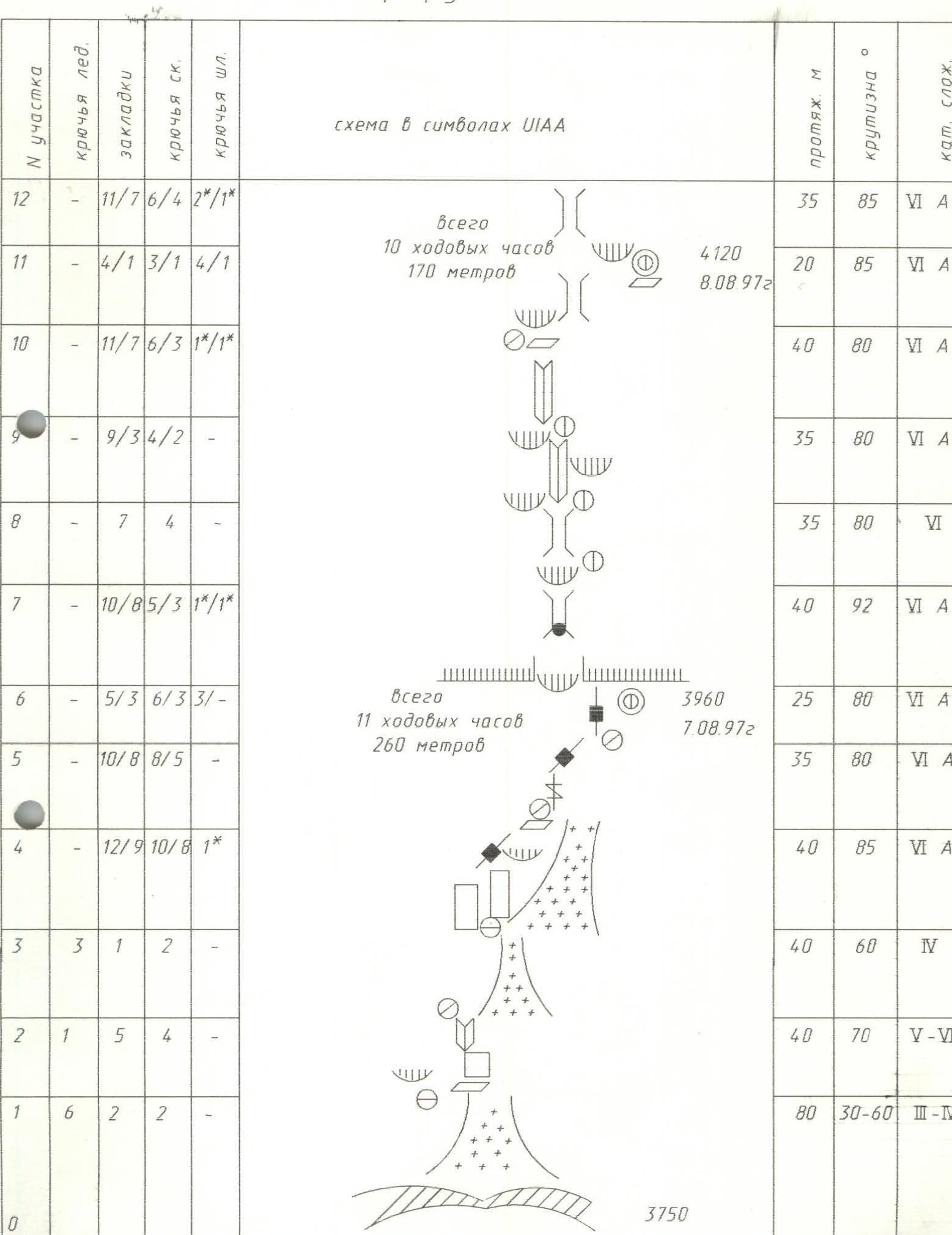
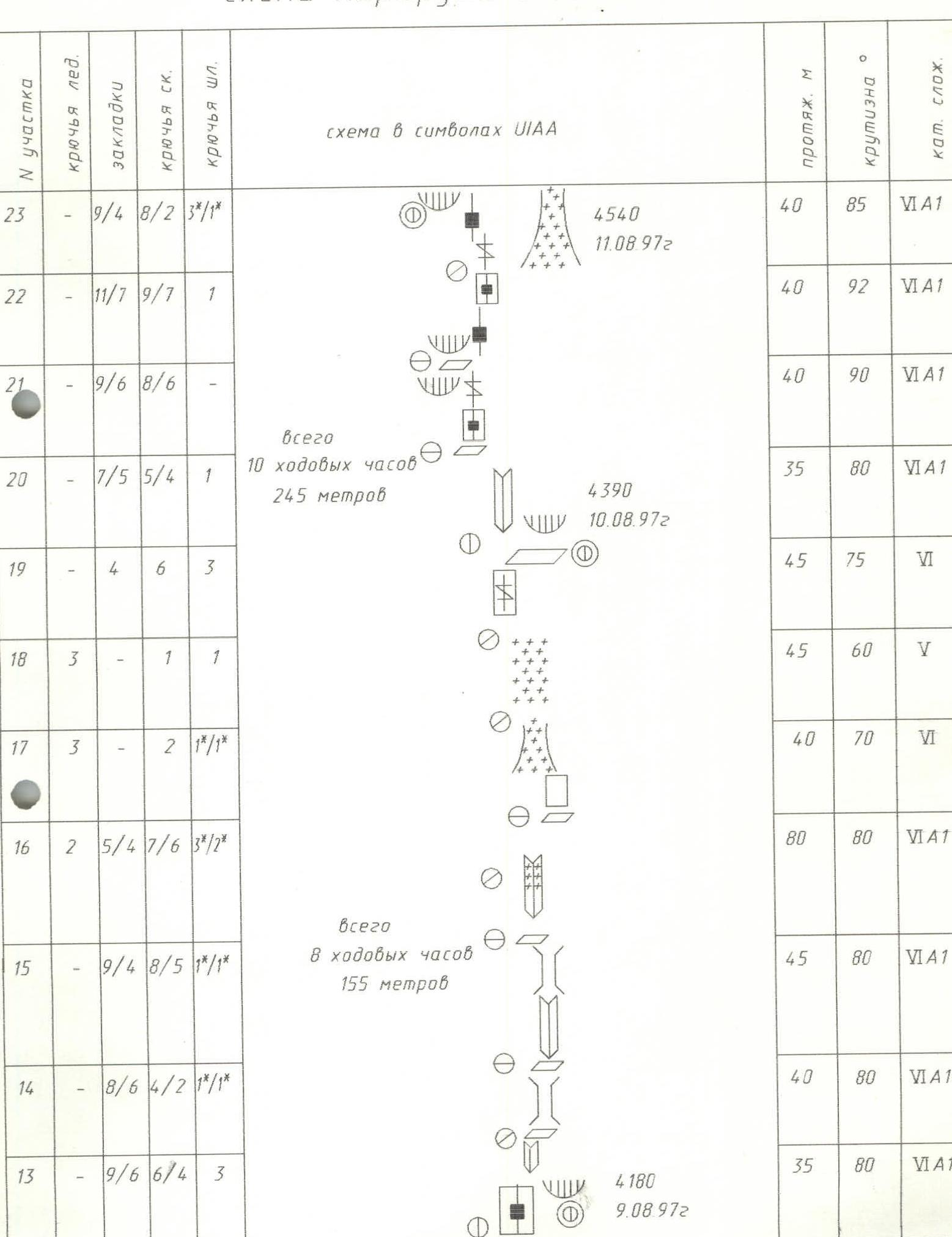
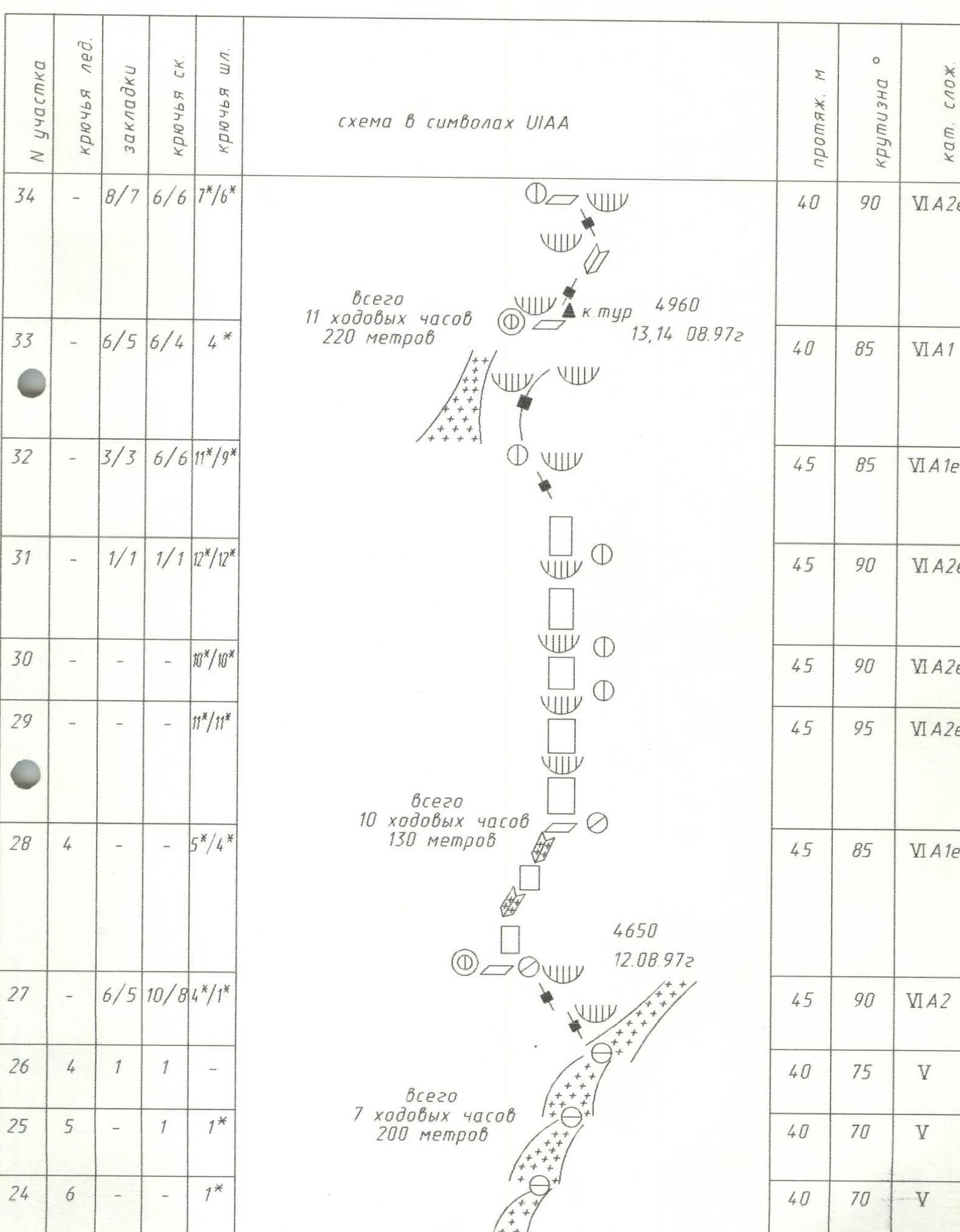
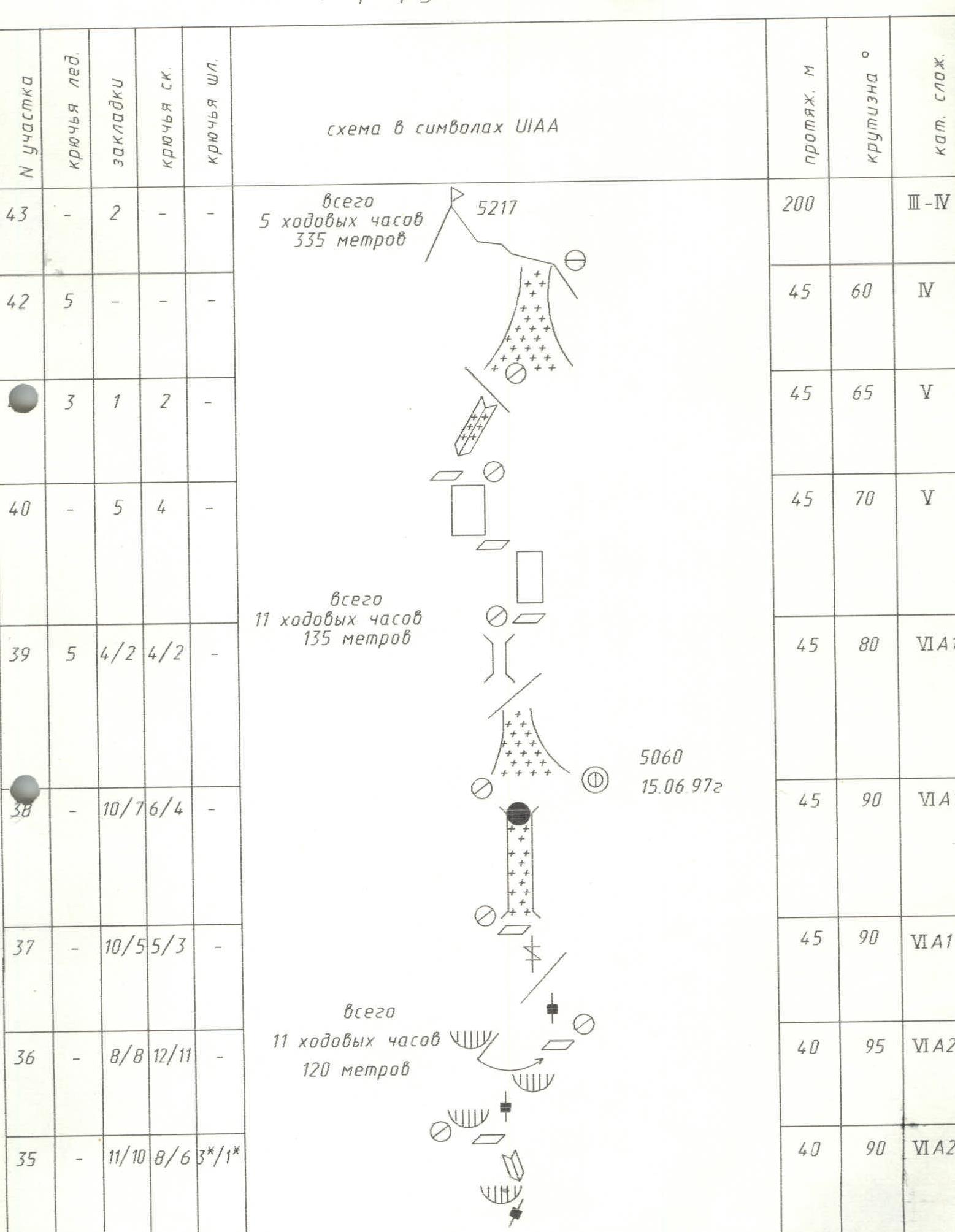
| Section # | ice pitons | chocks | rock pitons | bolted pitons | length m | steepness ° | complexity cat. |
|---|---|---|---|---|---|---|---|
| 12 | - | 11/7 | 6/4 | 2*/1* | 35 | 85 | VI A1 |
| 11 | - | 4/1 | 3/1 | 4/1 | 20 | 85 | VI A1 |
| 10 | - | 11/7 | 6/3 | 1*/1* | 40 | 80 | VI A1 |
| 9 | - | 9/3 | 4/2 | - | 35 | 80 | VI A1 |
| 8 | - | 7 | 4 | - | 35 | 80 | VI |
| 7 | - | 10/8 | 5/3 | 1*/1* | 40 | 92 | VI A1 |
| 6 | - | 5/3 | 6/3 | 3/- | 25 | 80 | VI A1 |
| 5 | - | 10/8 | 8/5 | - | 35 | 80 | VI A1 |
| 4 | - | 12/9 | 10/8 | 1* | 40 | 85 | VI A1 |
| 3 | 3 | 1 | 2 | - | 40 | 60 | IV |
| 2 | 1 | 5 | 4 | - | 40 | 70 | V–VI |
| 1 | 6 | 2 | 2 | - | 80 | 30–60 | III–V |
| 23 | - | 9/4 | 8/2 | 3*/1* | 40 | 85 | VI A1 |
| 22 | - | 11/7 | 9/7 | 1 | 40 | 92 | VI A1 |
| 21 | - | 9/6 | 8/6 | - | 40 | 90 | VI A1 |
| 20 | - | 7/5 | 5/4 | 1 | 35 | 80 | VI A1 |
| 19 | - | 4 | 6 | 3 | 45 | 75 | VI |
| 18 | 3 | - | 1 | 1 | 45 | 60 | V |
| 17 | 3 | - | 2 | 1*/1* | 40 | 70 | VI |
| 16 | 2 | 5/4 | 7/6 | 3*/2* | 80 | 80 | VI A1 |
| 15 | - | 9/4 | 8/5 | 1*/1* | 45 | 80 | VI A1 |
| 14 | - | 8/6 | 4/2 | 1*/1* | 40 | 80 | VI A1 |
| 13 | - | 9/6 | 6/4 | 3 | 35 | 80 | VI A1 |
| 34 | - | 8/7 | 6/6 | 7*/6* | 40 | 90 | VI A2e |
| 33 | - | 6/5 | 6/4 | 4* | 40 | 85 | VI A1 |
| 32 | - | 3/3 | 6/6 | 11*/9* | 45 | 85 | VI A1e |
| 31 | - | 1/1 | 1/1 | 12*/12* | 45 | 90 | VI A2e |
| 30 | - | - | - | 10*/10* | 45 | 90 | VI A2e |
| 29 | - | - | - | 11*/11* | 45 | 95 | VI A2e |
| 28 | 4 | - | - | 5*/4* | 45 | 85 | VI A1e |
| 27 | - | 6/5 | 10/8 | 4*/1* | 45 | 90 | VI A2 |
| 26 | 4 | 1 | 1 | - | 40 | 75 | V |
| 25 | 5 | - | 1 | 1* | 40 | 70 | V |
| 24 | 6 | - | - | 1* | 40 | 70 | V |
| 43 | - | 2 | - | - | 200 | - | III–IV |
| 42 | 5 | - | - | - | 45 | 60 | IV |
| 40 | - | 5 | 4 | - | 45 | 70 | V |
| 39 | 5 | 4/2 | 4/2 | - | 45 | 80 | VI A1 |
| 38 | - | 10/7 | 6/4 | - | 45 | 90 | VI A1 |
| 37 | - | 10/5 | 5/3 | - | 45 | 90 | VI A1 |
| 36 | - | 8/8 | 12/11 | - | 40 | 95 | VI A2e |
| 35 | - | 11/10 | 8/6 | 3*/1* | 40 | 90 | VI A2e |
Total 10 travel hours, 170 m. (August 8, 1997) Total 11 travel hours, 260 m. (August 7, 1997) Total 10 travel hours, 245 m. (August 10, 1997) Total 8 travel hours, 155 m. (August 9, 1997) Total 11 travel hours, 220 m. (August 13, 14, 1997) Total 10 travel hours, 130 m. (August 12, 1997) Total 7 travel hours, 200 m. Total 5 travel hours, 335 m. Total 11 travel hours, 135 m. (August 15, 1997) Total 11 travel hours, 120 m.
Description of the route by sections
Section R0–R1: A snow-ice slope with a bergschrund at the top leads to the start of the route.
Section R1–R2: Highly destroyed rocks, covered with ice, with snow-filled cracks. Exit to an ice "river".
Section R2–R3: Along the ice, alongside rocks, exit under a wall with an oblique crevice. Insurance via ice screws.
Section R3–R6: Vertical slabs covered with rime ice, after 15:00 – a strong waterfall. Climbing on ITO after clearing the wall of snow and ice. Overnight stay on the right under a cornice. Water flows onto the tent.
Section R6–R7: The cornice is passed through the center, via a chimney with a plug. Complex ITO. In the morning, everything is covered with ice.
Section R7–R11: A chain of internal corners is passed, sometimes on the left, sometimes on the right wall (photo #1). Alternation of sections with free climbing and sections passed on ITO. Lots of snow and ice. On the right under a cornice – bolted pitons for an overnight stay. Dry overnight stay.
Section R11–R13: Rime ice. The cornice is bypassed on the left via a crevice with an exit to a chimney filled with snow. Complex climbing on ITO. On the right under a cornice – bolted pitons for a "dry" overnight stay.
Section R13–R15: A series of snow-filled cracks and internal corners (photo #2). Passed on ITO.
Section R15–R16: An internal corner with an ice icicle is passed on "fifis" with insurance via rock pitons and ice screws. In some places, the ice disappears, and here – tense ITO.
Section R16–R19: Destroyed rocks to the right of the crevice are passed with free climbing. On the right wall – bolted pitons for an overnight stay.
Section R19–R23: Complex ITO. The cornice is passed on the right (photo #3). Rime ice, many loose rocks. Under the ice tongue – a complex 5-meter transition to an overnight stay.
Section R23–R26: Ice "river", with complex transitions on ITO in two places. Exit to a hidden oblique crevice.
Section R26–R27: Complex traverse left-up, extreme ITO. Exit to a small oblique ledge under the base of the "nose". Bolted pitons for an overnight stay. 20 m to the left – a control tour on the Popov route.
Section R27–R28: Along a steep ice ledge right-up 20 m, transition on "skyhooks" up to the second ice ledge (photo #4). Along it to a station on 2 bolted pitons.
Section R28–R31: Extreme ITO on "skyhooks" via the holes of the first ascenders. Stations – on 2 bolted pitons.
Section R31–R32: Half a rope via holes, then complex ITO using pitons and chocks. The cornice is bypassed on the left (photo #5).
Section R32–R33: After the cornice, right-up, exit to an inclined ledge under an overhanging wall (photo #6), along it to a fragment in the form of a "shield", under it – a control tour.
Section R33–R36: Unpronounced internal corners with overhanging walls, cornices, hidden crevices. Frequent transitions left-right. Extreme ITO, steep. The upper layer of rocks crumbles (photos #7, 8).
Section R36–R37: A vertical crevice leads up under a chimney filled with ice.
Section R37–R38: An overhanging, ice- and snow-filled chimney, ITO on large friends.
Section R38–R40: An ice wall is passed on crampons, then – a chimney leading right-up. Loose boulders – danger! Further – free climbing.
Section R40–R43:
- Along an ice internal corner, exit to a couloir (photo #9).
- From it, left via a crevice, exit to a ridge 10 m to the right and below the descent loop.
- To the summit – about 200 m of 3–4 cat. diff.
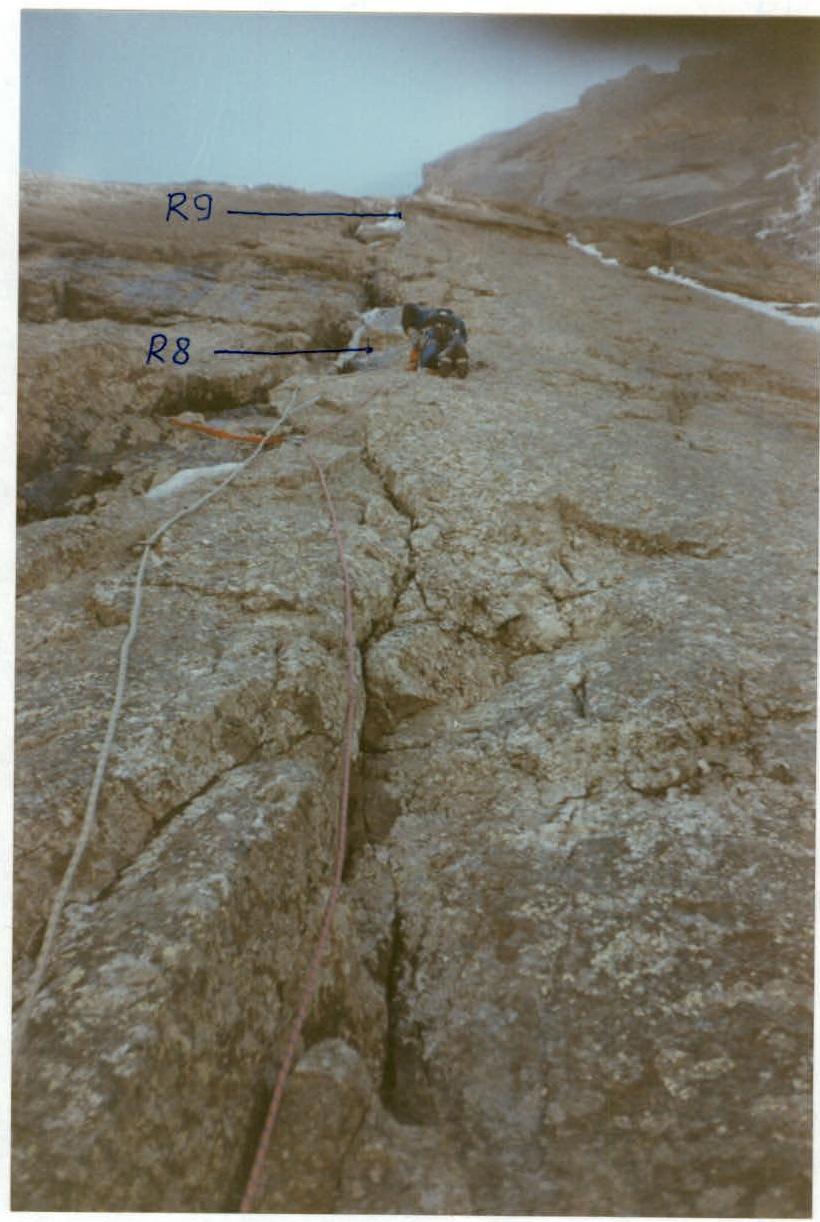
Photo # 1. Sections R8–R9. Rime ice on rocks complicates passage.
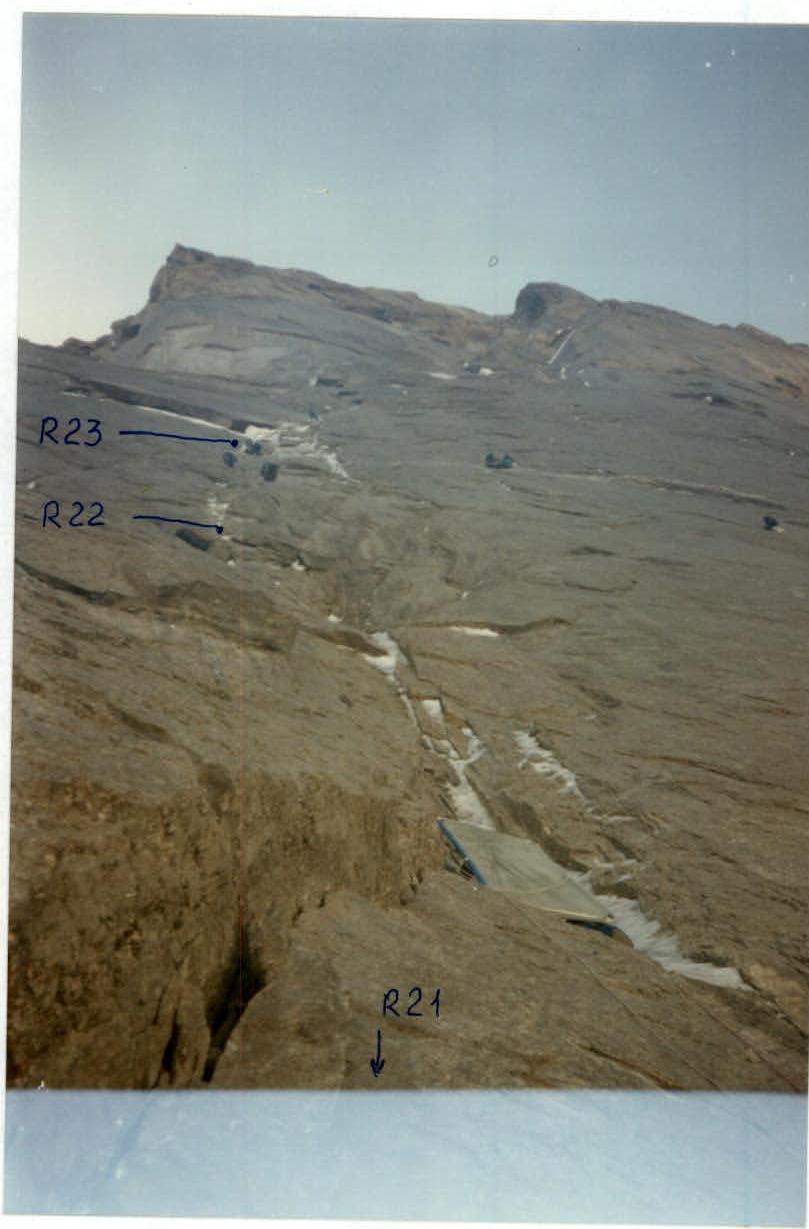
Photo # 3. Sections R22–R23. Approach under the "cross". The Yekaterinburg team is above us.
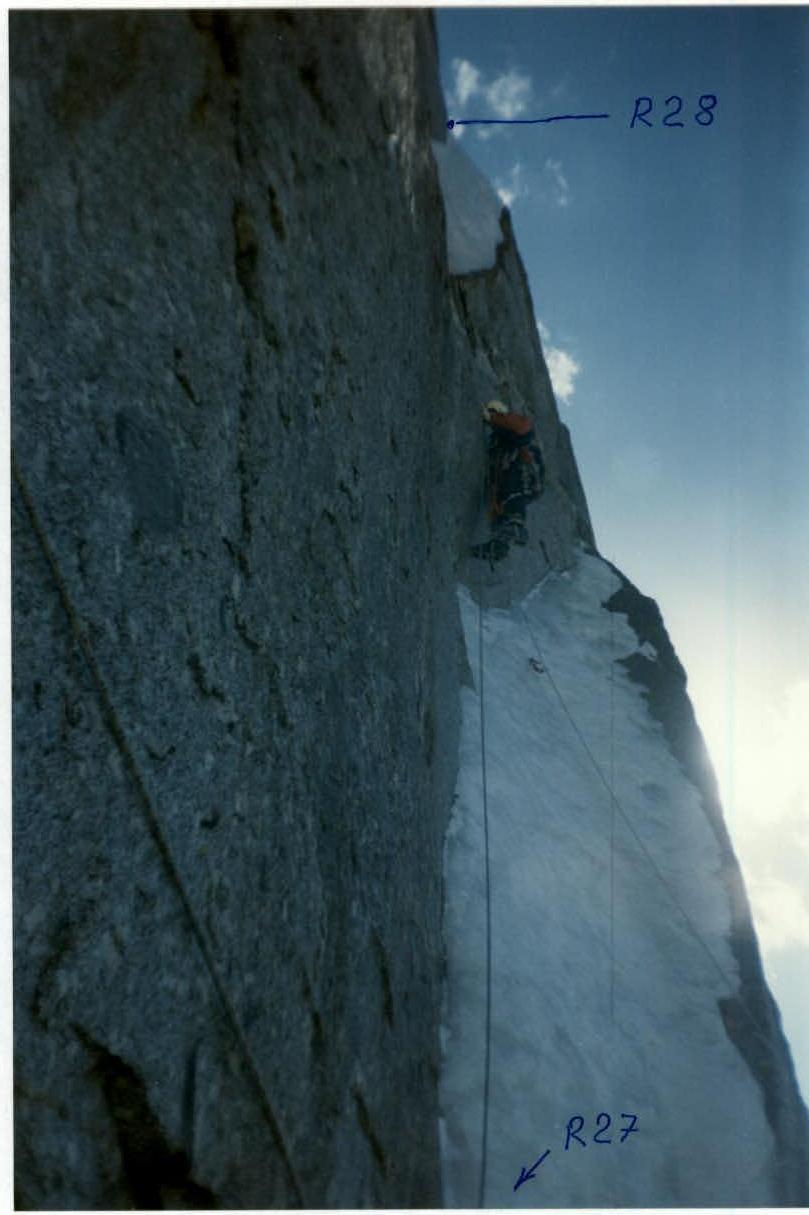
Photo # 4. Section R28. The wall between ice ledges is overcome on ITO.
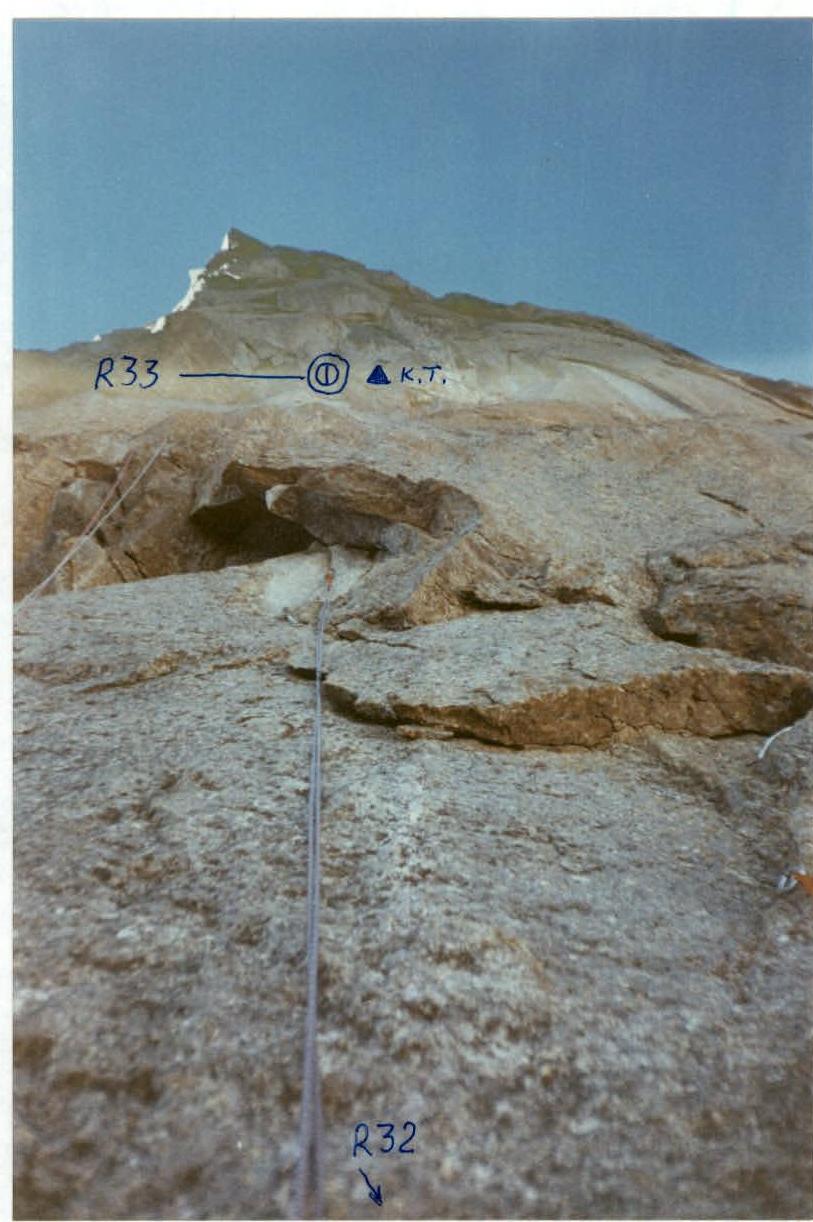
Photo # 6. Section R33. Behind the cornice – a control tour.
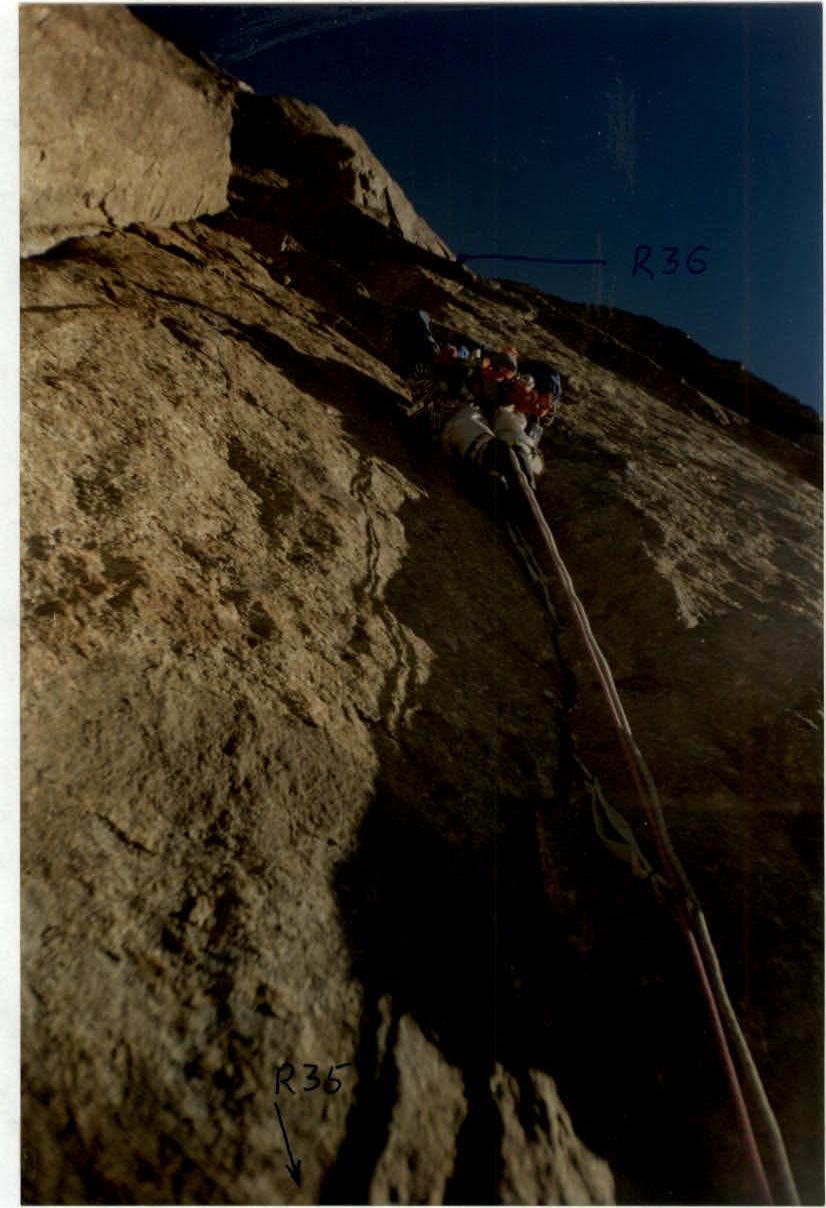
Photo # 8. Section R36. Extreme ITO, rocks crumble under load.

Comments
Sign in to leave a comment