
To the head coach of mountaineering of the USSR Sports Committee, Comrade SHAATAEV V.N.
To the chairman of the classification commission of the FAM USSR, Comrade PETRASHKO G.A.
We are submitting a report on the ascent of v. Borzov za mir via the center of the southern wall, made on July 13, 1980, by a group of climbers from al "Artuch" led by Bezverkhy A.I.
Conclusion on the route: The ascent of v. Borzov za mir, 4100 m, via the center of the S wall is a first ascent. The route is of a rocky nature and corresponds to the 4A category of complexity by its technical difficulty.
We request that this report be reviewed and the route of ascent to v. Borzov za mir via the center of the southern wall be classified.
Head of KSP in the Fann Mountains T. MUMDJI November 13, 1980. Leader A. Bezverkhy + 4 people.
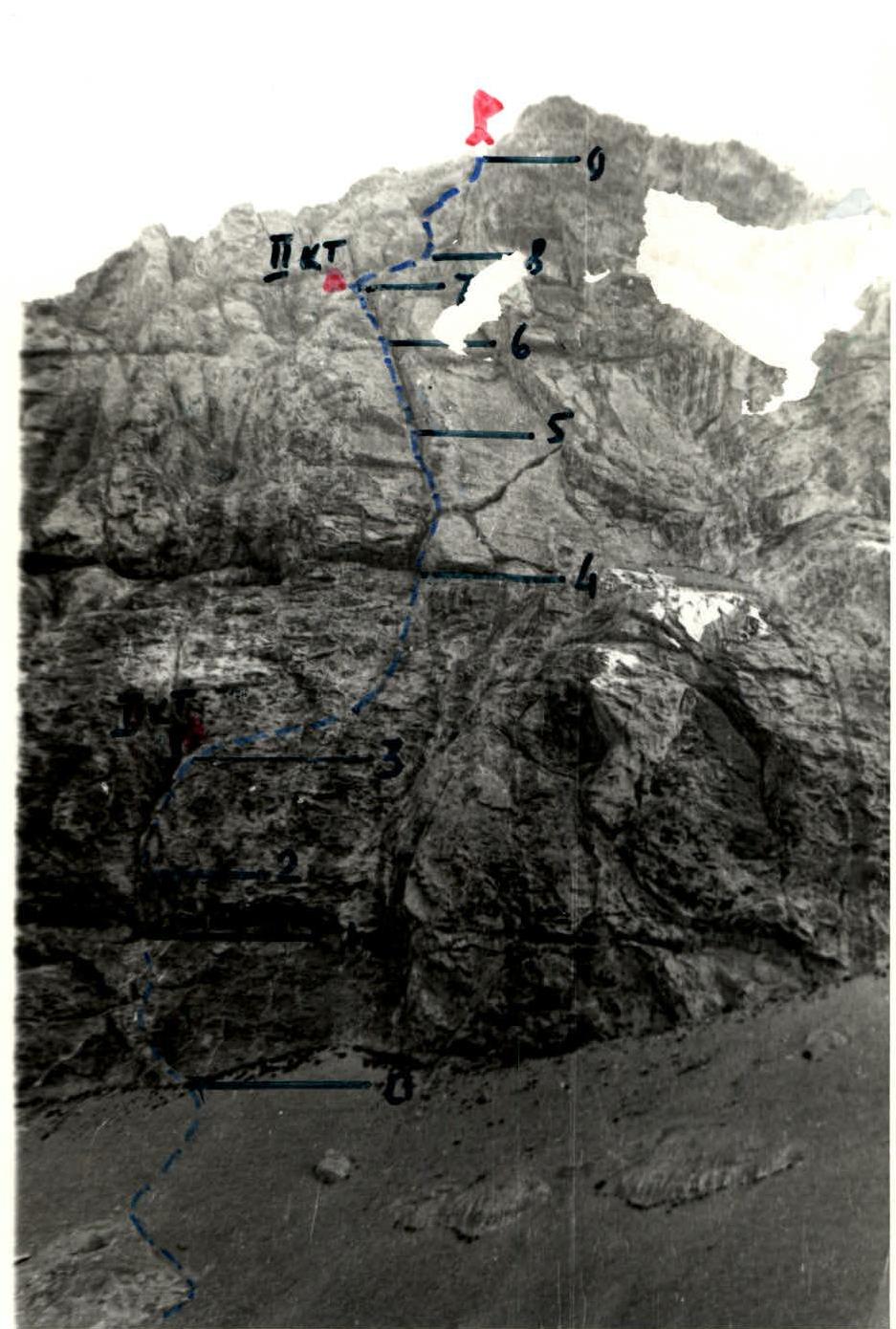

Route Description
| Date | Designation | Average steepness in degrees | Length/m | Terrain character | Difficulty | Condition | Weather condition | Rock hooks | Bolt hooks | Stoppers |
|---|---|---|---|---|---|---|---|---|---|---|
| 13.07. 1980 | R0–R1 | 60 | 30 | slab | III | monolithic | excellent | 4 | ||
| R1–R2 | 100 | 10 | cornice | VI | monolithic | " | I, IV | I, II | I, II | |
| R2–R3 | 80 | 30 | slab | Y | monolithic | 4, I | I | |||
| R3–R4 | 60 | 40+30 | slab | III–IV | monolithic | 7 | 2 | |||
| R4–R5 | 70 | 40 | inner corner | IV | monolithic | 4 | ||||
| R5–R6 | 75 | 30 | chimney | Iy | monolithic | 3 | 2 | |||
| R6–R7 | 80 | 25 | slab | y | monolithic | 5 | ||||
| R7–R8 | 30 | 15 | ledge | II | destroyed | 2 | ||||
| R8–R9 | 45 | 100 | large-block rocks | II–III | destroyed | 4 |
From Lake Bebi-Djanat, follow the trail leading to the Alaudin pass, to a large solitary stone near the trail - 1.5 hours. From the large stone (the entire route is clearly visible), head towards the summit, through a stream flowing from the pass, then across the scree and through rocky outcrops - approach to the start of the route.
At the beginning of the route:
- Guiding cairn.
- From the cairn, straight up the slabs towards the notch in the cornice (bolt) - section R0–R1.
- Up the notch, overcoming the cornice (undercut, ladders).
- Further up the inner corner (difficult climbing) 30 m (section R2–R3) upwards (bolt).
- In the crack of the bolt R1 - control cairn.
From R1 control cairn:
- 70 m up towards the protruding large stone (section R4–R5).
- Bypass the stone on the left via the inner corner, which then turns into rocks.
- Immediately up the chimney (section R5–R6).
- Then up the left slab of the chimney (section R6–R7) (arduous climbing) - exit onto an inclined ledge (R2 control cairn).
From R2 control cairn:
- Up and to the right via the inner corners of large-block rocks (section R8–R9) - exit to the summit.
Descent via the 1B category route.
Protocol
Analysis of the ascent of v. Borzov za mir via the center of the southern wall (first ascent, estimated 4A category).
Group composition:
- Bezverkhy A.I. - leader
- Belan N.I.
- Grebennikov A.A.
- Sedov V.I.
- Khoroshilov A.A.
Those present at the debriefing:
- Team commander Stadnik V.F. - Master of Sports of the USSR
- Instructor Chegel V.I. - Master of Sports of the USSR
- Instructor of KSP Shestipalov I.Ya. - Master of Sports of the USSR
Bezverkhy: The route is purely rocky, about 350 m. The average steepness of the route is 60°. The character of the rocks is monolithic slabs with shallow cracks. We started the route at 5:00. By 7:00, we were under the route. We reviewed the route again, took photos, and chose a variant to pass the cornice. We began work at 8:30. We passed the second rope (key point of the route) by 13:00 (overcoming the cornice kirchhof, hammering in 4 bolt hooks). At the end of the R2 rope, in the crack opposite the bolt hook - a control cairn. We reached the large scree ledge by 18:00. We were on the summit by 19:30. The descent was normal. We were back at the camp by 21:00.
The group worked on the route well, confidently. We hammered in 38 rock hooks, 4 bolt hooks, and placed 7 "stoppers". Of these, for creating artificial points of support:
- 2 bolt hooks
- 5 rock hooks
- 2 stoppers
The cornice was passed with ladders.
I believe the route is approximately 4A category. The route is dry, with no suitable places for overnight stays.
Khoroshilov: I want to note that the group worked very well on the belays. I consider the lack of hook holders a drawback. I consider the chimney to be an objectively hazardous place on the route, as any rocks falling from the scree ledges above will hit the chimney when other groups are on the summit. I believe the route is 4A category.
Sedov: In some sections of the route, there is a limited number of cracks for hammering in hooks, and it is necessary to have short and petal-shaped hooks and stoppers. The route is very similar to the 4B category route on v. Alaudin.
Grebennikov: I liked the route very much. I have no further comments. I believe the route corresponds to 4A category.
Belan: I enjoyed the group's working atmosphere. I believe the route is 4A category.
Stadnik: It is clear that most of the time on the route was spent on passing the cornice. This is due to the lack of experience in passing such sections. The group did not accurately assess the complexity of the route during reconnaissance. It is apparent that the assortment of hooks was insufficient for this route. The route can be recommended as 4A category, but groups attempting a long route should have experience with 4A and 4B category ascents. I recommend that the group register this route as a first ascent for approval by a qualified commission.
Chegel: I believe the group started the route late, at 8:30. With additional reconnaissance, the route could have been started at 7:00. The route is interesting. I believe it can be recommended as 4A category.
Shestipalov: The route is short but technically demanding, requiring skills for working on cornices; judging by the group's accounts, it is safe. A drawback is the passage of the cornice using bolt hooks. The route exceeds the 3B category in complexity and corresponds to 4A category. It can be recommended for technically prepared groups as training before wall ascents.
The ascent and leadership are to be credited. July 15, 1980.