
Ascent Passport
-
Ascent class — rock climbing.
-
Ascent area — Alay, northern spurs of the Alay ridge, 5.1.
-
Peak, its height, ascent route — peak "4300", northern peak of XXII Olympiad, team route a/l "Shkhelda" through the center of the eastern wall.
-
Proposed difficulty category — 5B (3rd sports category).
-
Route characteristics:
height difference — 900 m, wall section height difference — 450 m, average steepness — 85° (wall section), length of 5th–6th difficulty category sections: wall section — 520 m, total — 610 m.
-
Pitons hammered:
| rock | bolted | "heavenly" | chocks | |
|---|---|---|---|---|
| for belay | 108 | 4 | - | 23 |
| for a.t.o. | 15 | 5 | 12 | 9 |
-
Number of travel hours:
wall section route — 34 h, total — 42 h.
-
Number of overnight stays and their characteristics:
3 overnight stays. Two hanging in the "triangular niche" and one lying on a wide ledge.
-
Surname, name, and patronymic of the leader, participants, and their qualifications:
Nikolaychuk Oleg Leonidovich, Candidate Master of Sports, leader Senchina Svyatoslav Vladimirovich, Candidate Master of Sports Ufimtsev Vladimir Dmitrievich, Candidate Master of Sports Fast Alexander Alexandrovich, Candidate Master of Sports
-
Senior team coach —
Shalaev Gennadiy Ivanovich, Master of Sports of the USSR. Team coach —
Bolitenkova Valeria Konstantinovna, Master of Sports of the USSR.
-
Date of departure and return: from August 16 to 19, 1980.
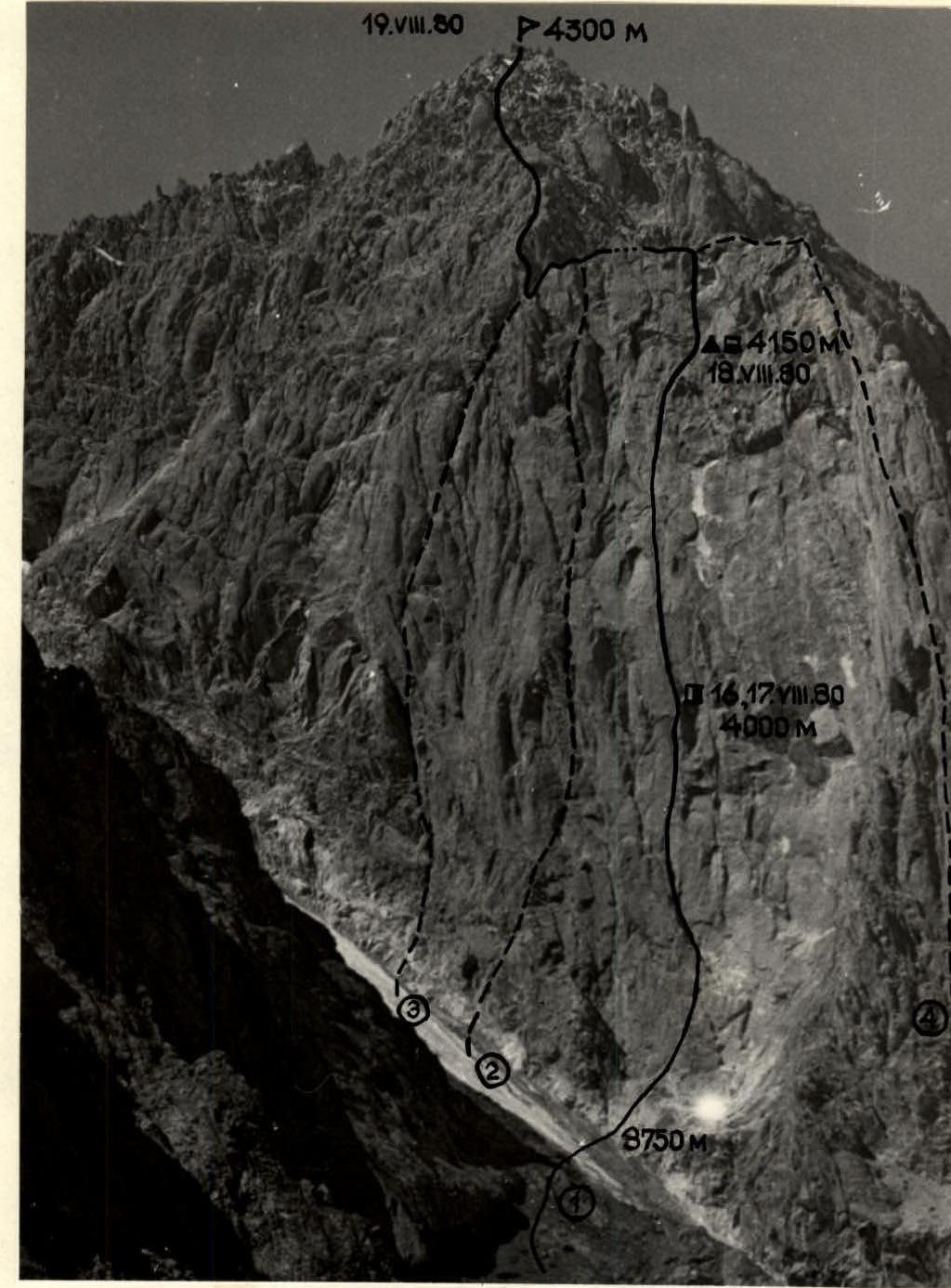
Photo 1. Eastern wall of peak "4300"
(1) route of the team a/l "Shkhelda". (2) route of the team a/l "Elbrus". (3) route of the team a/l "Uzunkol". (4) route of the team CS DSO "Spartak". — bivouac sites (hanging and lying). ▲ — control cairn.
Route sketch through the center of the eastern wall of peak "4300"
(Route of a/l "Shkhelda")
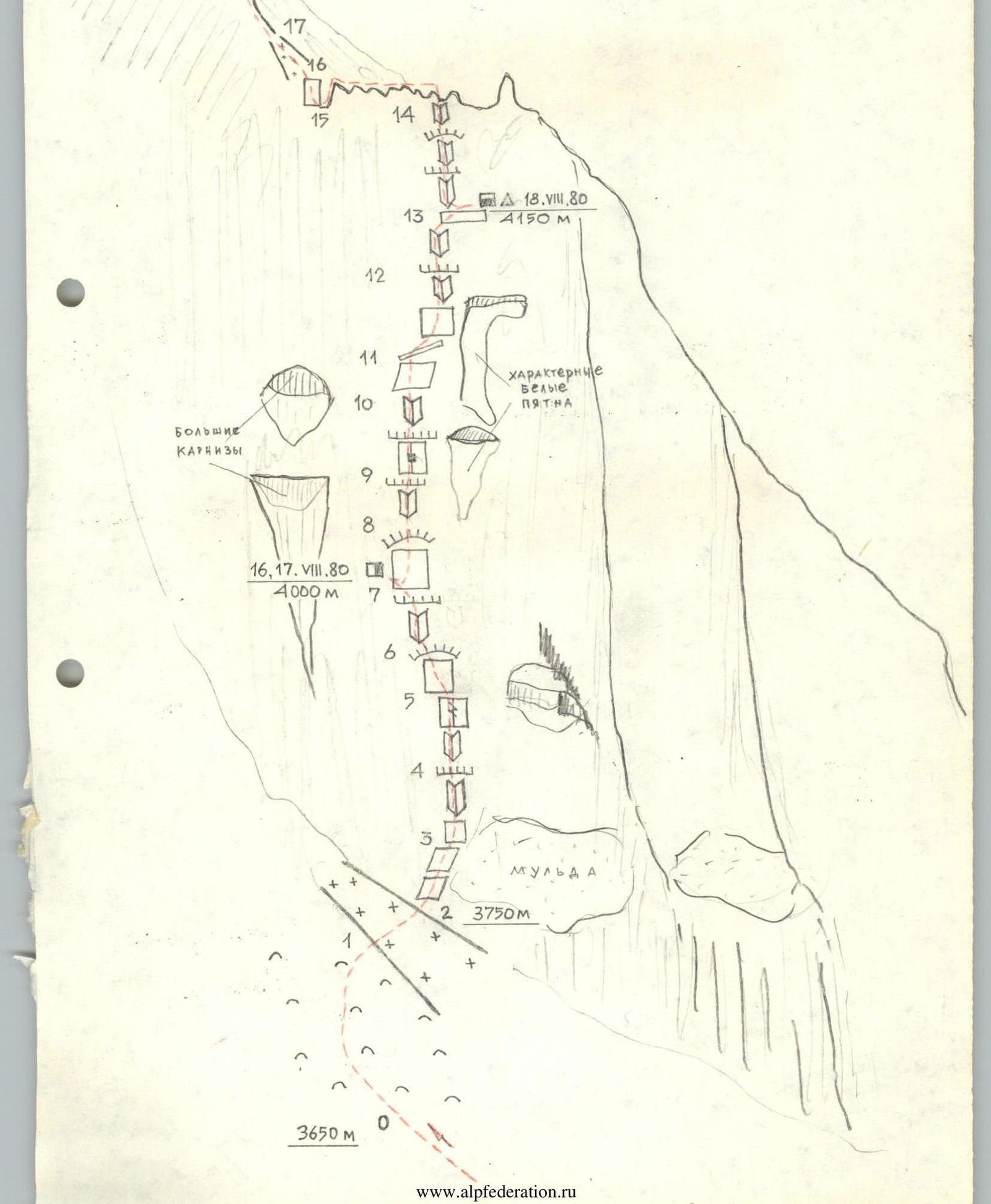
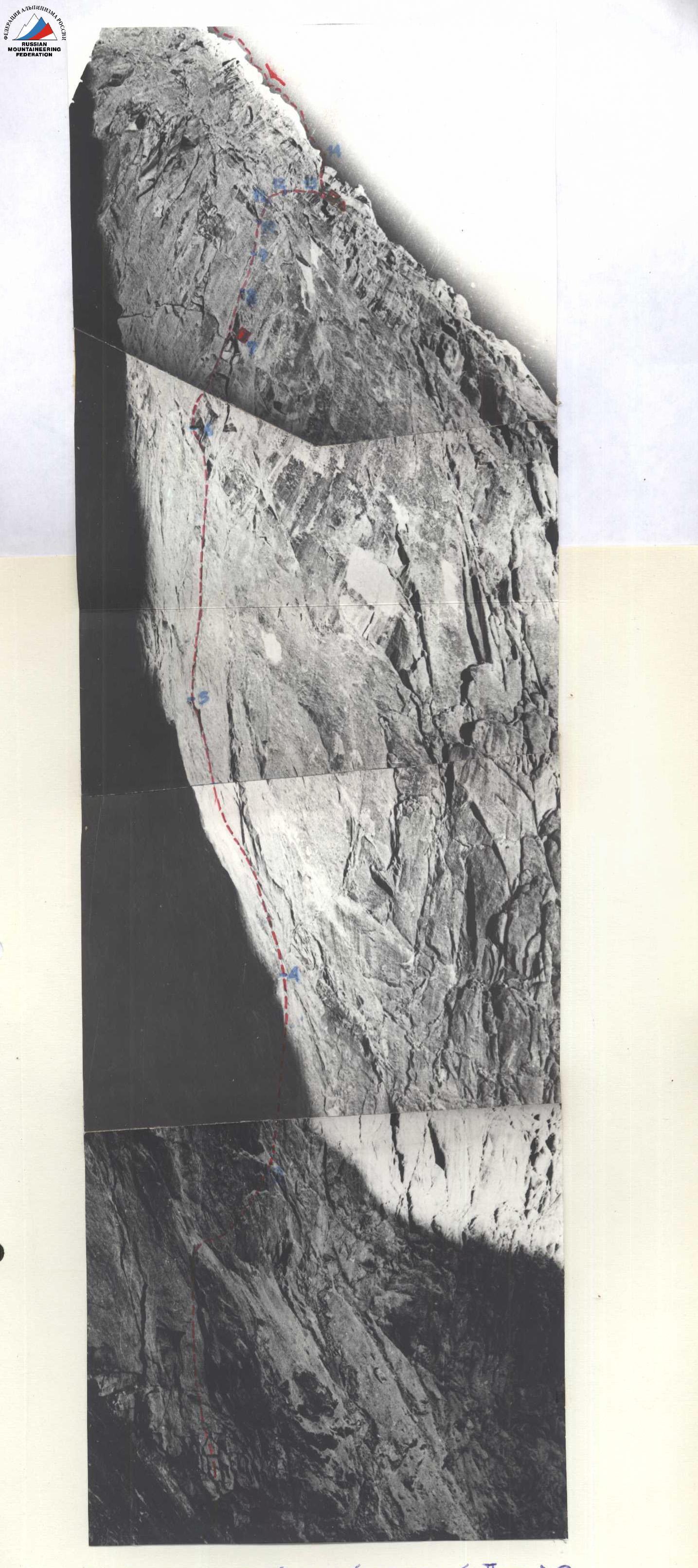
Photo 2. Route passed by the PriKVVO team on the eastern wall of peak "4300"
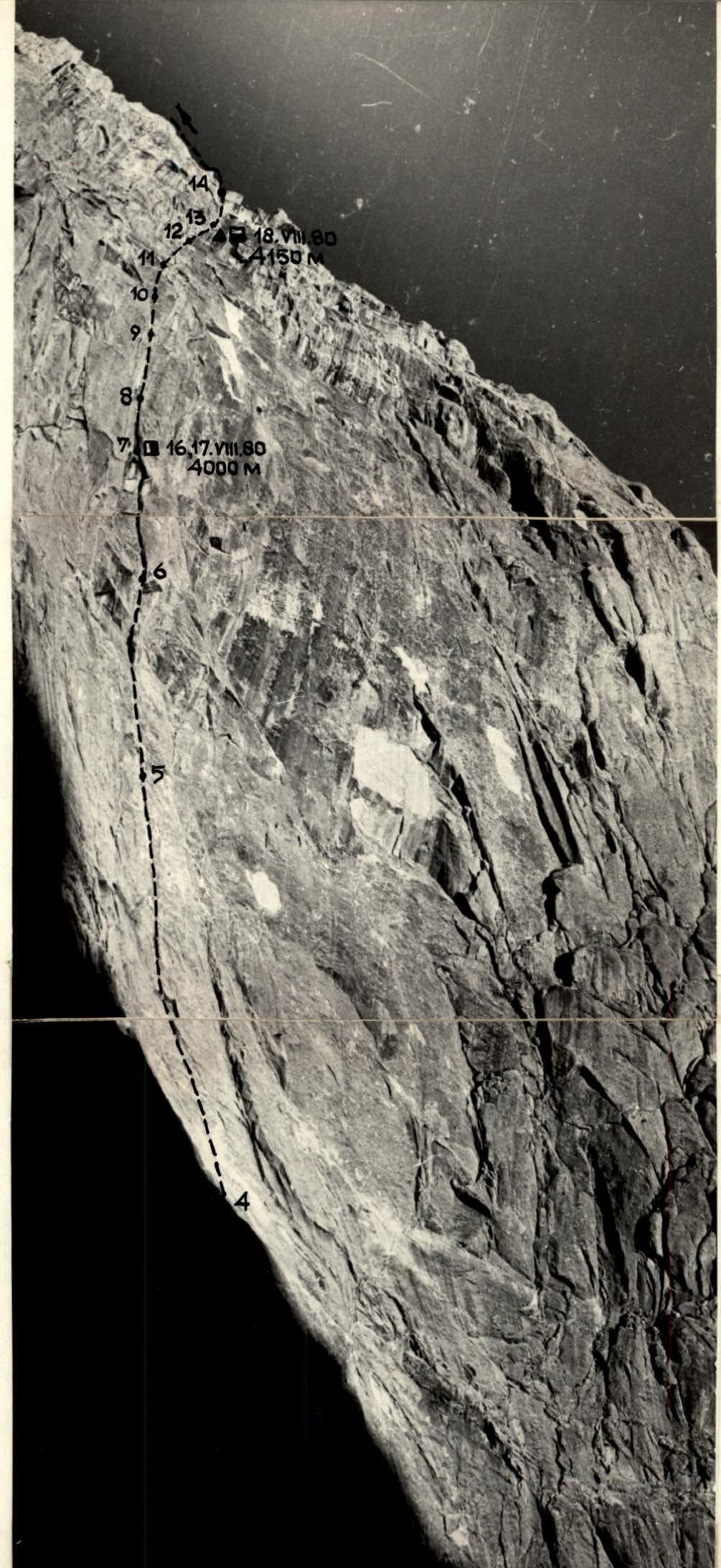
Photo 2. Route through the center of the eastern wall of peak "4300" (route of the team a/l "Shkhelda").
Table of main characteristics of the ascent route to peak "4300" through the center of the eastern wall / a/l "Shkhelda" /
| Date | Sect. # | avg. slope | length in m | Terrain characteristics | difficulty | condition | weather conditions | Rock pitons, wedges | Bolt | "heavenly" | chocks |
|---|---|---|---|---|---|---|---|---|---|---|---|
| 1 | 2 | 3 | 4 | 5 | 6 | 7 | 8 | 9 | 10 | 11 | 12 |
| 16.08 | 1 | 30° | 210 | Ram's foreheads | II | good | - | - | - | - | |
| 2 | 50° | 80 | Ram's foreheads, snowy couloir | III | covered with rubble, rockfall | good | - | - | - | - | |
| 3 | 70° | 60 | Slabs | 5 | covered with rubble | - | - | - | - | - | |
| 4 | 75° | 60 | Slab, internal angle with cornice | 6, A1 | monolith | - | - | - | - | - | |
| 5 | 90° | 70 | Internal angle, crevice, slab | 5 | monolith, blind cracks | - | - | - | - | - | |
| 6 | 100° | 40 | Rock wall with cornice | 6, A1 | crumbling rocks | overcast | - | - | - | - | |
| 7 | 100° | 40 | Internal angle, cornice | 6, A2 | - | - | - | - | - | ||
| 8 | 80° | 15 | Slab with overhang | 5 | monolith | snowfall, cold wind | - | - | - | - | |
| Hanging overnight stay in the "triangular niche" on a steep slab. Pitons hammered for belay | 1 | 3 | - | - | |||||||
| 575 | Total for the day: | 46/6 | 3/0 | 0/5 | 5/2 | ||||||
| 17.08 | 9 | 80° | 25 | Internal angle with overhang | 6, A1 | crumbling rocks, blind cracks | good | - | - | - | - |
| 10 | 90° | 40 | Wall with crevice, cornice, wall with internal angle | 6, A1 | snowfall | - | - | - | - | ||
| 11 | 80° | 20 | Slab, ledge | 6, A2 | monolith | waterfall | - | - | - | - | |
| Hanging overnight stay in the "triangular niche", where the group descended by rappelling | - | - | - | - | |||||||
| 85 | Total for the day: | 23/2 | 0/5 | 0/6 | 8/6 | ||||||
| 18.08 | 12 | 90° | 65 | Smoothed slabs, internal angle, cornice | 6, A1 | monolith with flaking surface | good | - | - | - | - |
| 13 | 75° | 25 | Internal angle, large ledge | 5 | blind cracks | - | - | - | - | - | |
| 14 | 90° | 60 | Internal angle, two overhangs | 6, A1 | - | - | - | - | - | ||
| Lying overnight stay on a large ledge | - | - | - | - | |||||||
| 150 | Total for the day: | 31/7 | 1/0 | 1/0 | 8/1 | ||||||
| 19.08 | 15 | - | 120 | Ridge, descent with 20 m rappel | 5 | monolith | good | - | - | - | - |
| 16 | 70° | 10 | Rock wall | 4 | rubble on ledges | - | - | - | - | - | |
| 17 | 35° | 30 | Snowy couloir | 3 | - | - | - | - | - | ||
| 18 | 45° | 300 | Summit dome (rocks, scree) | 3 | - | - | - | - | - | ||
| 460 | Total for the day: | - | - | - | - | ||||||
| 1270 | Total for the route: | 108/15 | 4/5 | 0/12 | 23/9 |
Captain of the PriKVVO team O. Nikolaychuk
Explanations for the table of main characteristics
August 16. Departure at 4:00. We quickly prepare tea, have breakfast. We approach the wall in the light of headlamps. We rope up before traversing the couloir and start climbing the wall at 7:20. A. Fast goes first. About one and a half ropes of difficult climbing are passed by independent roped teams. The weather is excellent. The eastern wall of peak "4300" is already lit by the sun, warm, dry. We need to move carefully as the slabs are covered with small rubble and sand. Already at the end of the second rope, the difficulty of the route starts to approach the limit. Further, the internal angle ending in a cornice turns into a narrow crevice with smooth edges. There are very few places to hammer in pitons, and they have to be searched for a long time. The cracks in the rocks are mostly shallow and blind. We are pleased to note that our set of pitons and wedges corresponds to the character of the route. Especially good on this wall are the titanium "bong-bong" wedges, which we used for the first time on the walls of Arga and Bodkhona. The structure of the wall reminds us very much of our Carpathian rocks. Characteristic features:
- Smoothed overhanging walls with crevices, the edges of which are smoothed out.
- Lack of microrelief.
- Blind cracks.
- Huge, somehow held "patches".
The first ones go mainly on spacers and counter-pressure. There are practically no belay platforms on the wall. We belay and tie in, standing in étriers. By lunchtime, the weather starts to deteriorate, and when we start to pass the internal angle with a cornice at the beginning of the key section of the wall (6B, A1 according to the classification of the first ascenders), snowfall begins. It significantly slows down the pace of movement along the route. Only by 18:00 we approach the site of the first overnight stay of the first ascenders — the "triangular niche". The comfort of the overnight stay is very relative here. There is no ledge, there is a slab with a steepness of up to 45°. We hang ourselves in backpacks and harnesses on three bolted pitons hammered by us for belay. We prepare tea, have dinner, and spend the night, which we will be able to talk about for a long time.
August 17. First Venus, and then the Sun, successively appearing from the east, inform us of the start of a new day. There's no point in lingering at the overnight stay; we gather quickly, as quickly as possible on a hanging bivouac, and start working.
The difficulty of the route today does not drop below 6, A1. The most complex sections of free climbing alternate with extremely tense sections of a.t.o., i.e., with the use of artificial points of support. Our first ones — Fast and Senchina — work very reliably. Pitons for belay are hammered according to the principle: "for a crevice — a piton", and so far this principle has been maintained. Every 4–5 m of ascent, a good piton for belay is hammered thanks to a good assortment of rock climbing equipment.
When we approach the "bolted wall" (section 11), the weather starts to deteriorate again. Here, on a slab under the wall, we notice a rappel loop made of reepschnur, fixed on an ice and channel piton. The character of the loop's placement on the wall allowed us to conclude that it was used for rappelling or oblique traverse to the left along the way, towards the route passed by the team a/l "Elbrus" at the USSR Championship. Thirty meters above and below along the route, under the overhang, we see a second loop made of reepschnur, also fixed on two wedges. This circumstance makes us wary. Later, we came to the conclusion that the group that tried to repeat the route of a/l "Shkhelda" before us left it in this way from under the key section to the technically simpler route of "Elbrus", and maybe further along the wall.
There are no pitons on the wall, but white spots mark a chain of holes from bolted pitons. We have a bolt and pitons, but it starts to snow. After 15 minutes, the snowfall turns into a real snowstorm, during which we continue to hang on the wall, dressed in down jackets and with anoraks pulled over them. The snowstorm lasted about 1.5–2 hours. After it, water flows abundantly down the wall, which we immediately collect in our five-liter canister. We start working. It is not possible to hammer our pitons into the old holes from bolting as they are broken when the pitons are pulled out. However, they can be used for "heavenly" pitons, of course, only as artificial points of support. New holes are made with great difficulty as the wall is wet and the rock (marbleized limestone) clogs the hole in the bolt. Having hammered three bolted pitons and several regular ones between the wall and a small "patch" to the left along the route, A. Fast approaches almost the end of the bolted wall. It's already past 7 pm, and we decide to descend almost three ropes to the previous overnight stay. Here, everything is familiar, and we hang on the pitons in a more comfortable way for the night.
August 18. We get up (if one can put it that way) early and quickly pass the processed ropes. It takes no more than 15 minutes to lift one participant on 40 m (good jumar ascenders plus a "chest-leg" system). The bolted wall is dry, and having hammered two additional bolted pitons (five in total instead of eight by the first ascenders), Fast reaches a narrow, steep ledge.
The character of the route does not change. Difficult climbing alternates with a.t.o. Many pitons and chocks are required for belay. The surface of the rocks is very easy to flake off and crumble, the cracks are still blind, not allowing normal piton placement. The use of chocks is very effective here. A double rope and étriers on almost every piton greatly facilitate the work of the first climber; the rope goes quite freely. Here, Fast is replaced by Nikolaychuk, who prefers technical climbing. At a good pace, he passes the steep internal angle ending in a cornice, then another angle with an overhang. It starts to snow, at first very hesitantly, then thicker and thicker, but Nikolaychuk has already reached a simpler section (just "five"). By 18:00, we are all on a large ledge where the first ascenders spent the second night. In the corner of the ledge is a control cairn, in which we find a "company" note from the team a/l "Shkhelda" led by G.S. Shchedrin. So, we are making the second ascent of this route!
Nikolaychuk continues to work. There are still 60 m to the ridge — an internal angle with two (at least) overhangs. Again, all our pitons and chocks are in use. By dark, we manage to finish processing the internal angle and calmly settle in for the night (lying down!) on the ledge.
August 19. We depart only at 8:00. We were too comfortable lying on the ledge, warming up in the rays of the morning sun. Having passed the processed internal angle, we reach an almost horizontal ridge composed of smooth hills. It's just like in the Carpathians.
Having passed the ridge (about 100 m), we rappel with a rope from a small "gendarme" into a hollow under the dome of peak "4300". There's a lot of ice here, and we relax a bit — we brew as many as two pots of tea (our water ran out yesterday). We traverse the dome of the peak — category 3 difficulty — simultaneously. We change the note in the cairn (today, the UralVO team was here, having climbed the "Elbrus" route) and head along the ridge to the Main peak of XXII Olympiad, "4550". We make our last radio contact with observers already on the descent, in a scree couloir. And on the trail in the Archa-Kanysh gorge, we were met by Valery Brezin, who escorted us to the bivy site in the Archa-Kanysh gorge by 23:00.
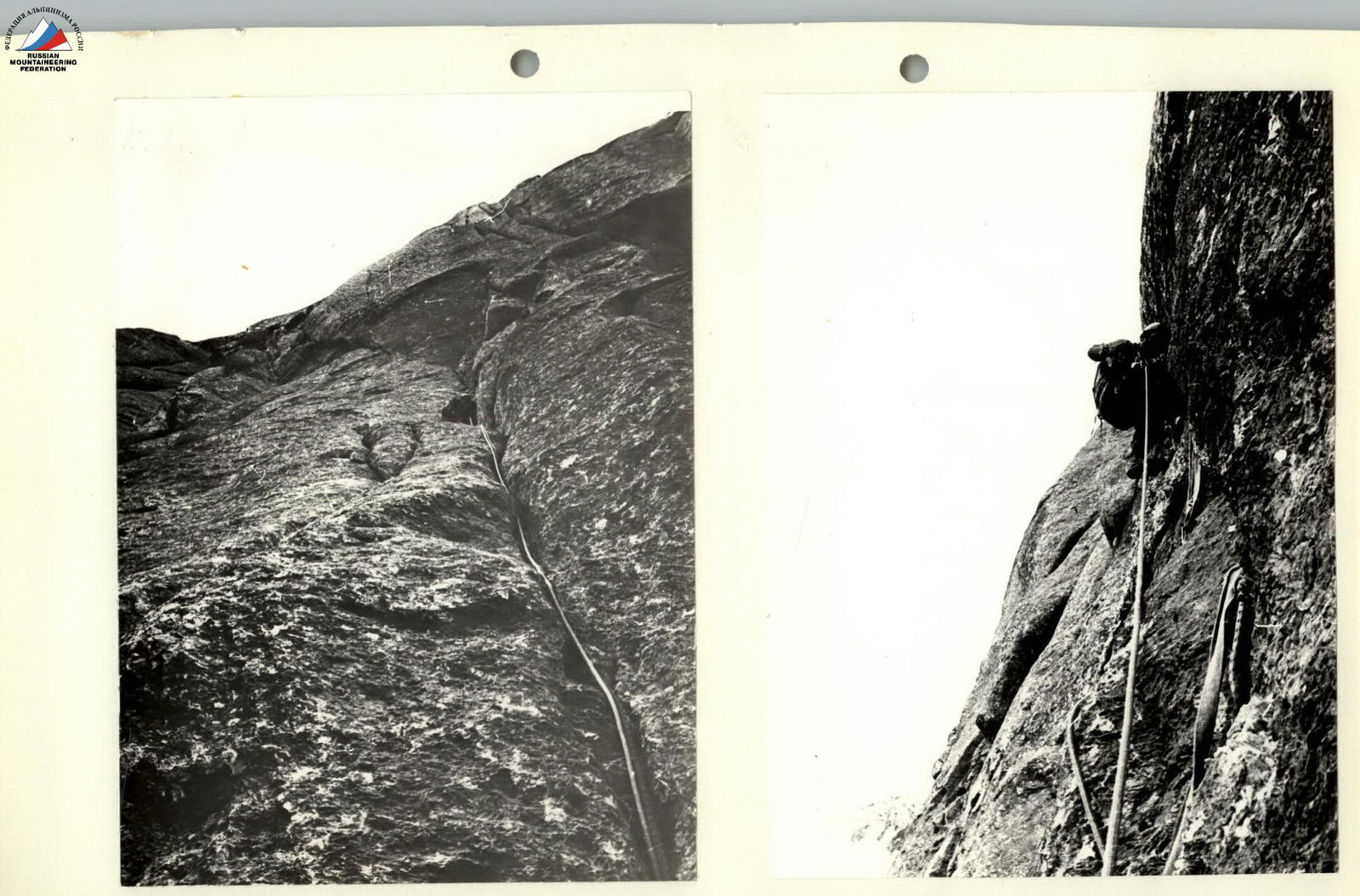
Photo 3. Internal angle with cornice (section R3–R4) Photo 4. Wall with overhang (section R5–R6)


