Ascent Passport
I. Ascent class — technical 2. Ascent area — Pamir-Alay, Dugoba alpine camp 3. Peak, its height and ascent route: Peak Evening Sverdlovsk, 4600 m, via the left edge of the western wall 4. Proposed difficulty category — 5A category of difficulty 5. Route characteristics: height difference — 600 m average steepness — 53° length of sections: 1 — 200 m 3 — 80 m 4 — 220 m 5 — 300 m 6. Number of pitons hammered for belay: rock pitons — 36 pieces 7. Number of travel hours — 13 hours 8. Number of overnight stays and their characteristics: The route was completed without overnight stays due to preliminary route preparation and its logical sequence. Overnight stays can be organized on scree ledges before the "saddle". After the "saddle", an overnight stay is possible at the summit. 9. Surname, name, patronymic of the leader and participants, their sports qualification: Sereda Vladimir Alexandrovich — 1st sports category, Chepalov Valery Alexandrovich — 1st sports category, Bayakin Sergey Gennadievich — 1st sports category, Prokopiev Valery Pavlovich — 1st sports category. 10. Team coach — Master of Sports, senior instructor Yakovlev Vitaly Dmitrievich 11. Date of departure and return — July 6, 1977
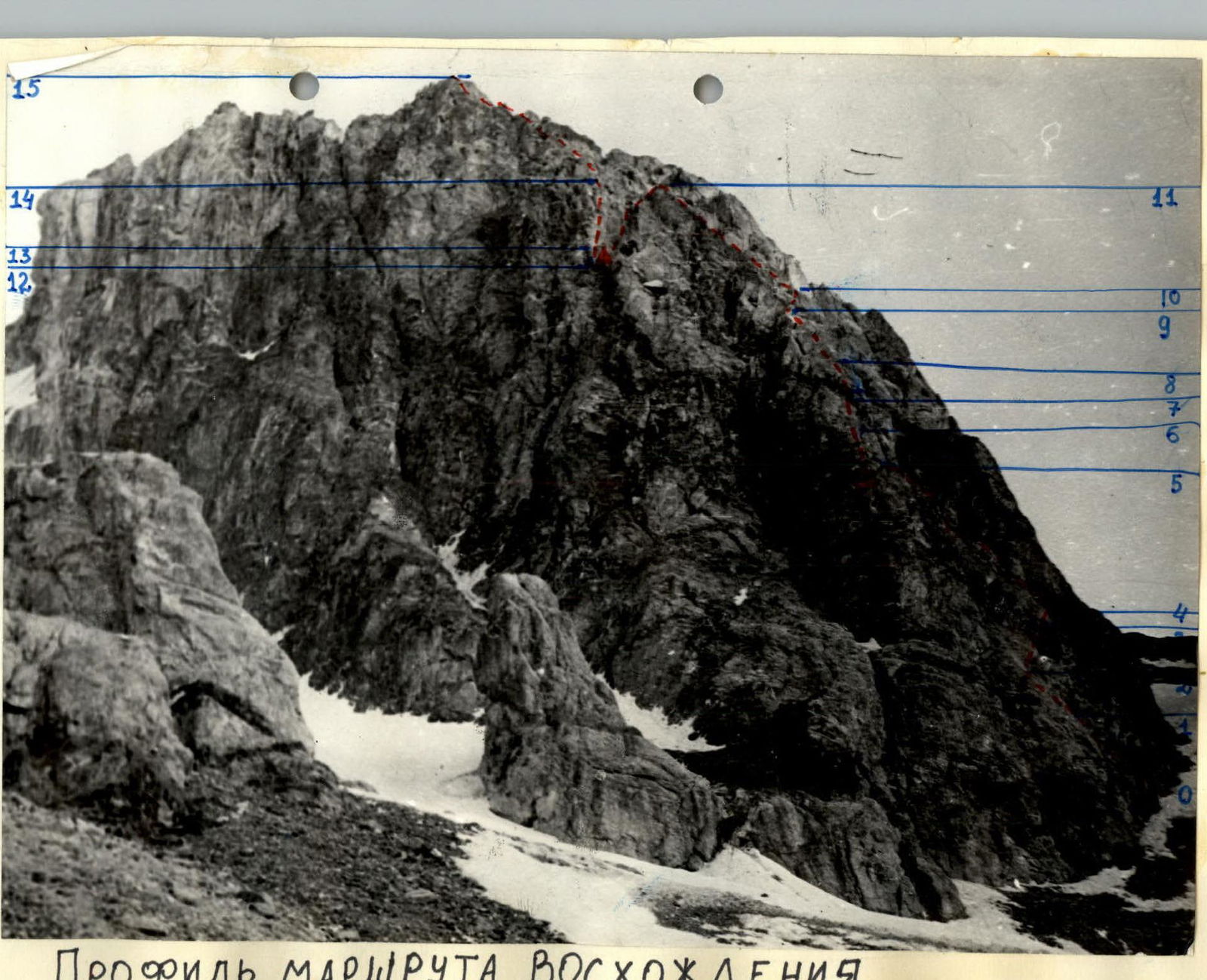
General view of Peak Evening Sverdlovsk and the ascent route.
Approach to the start of the route
From Dugoba alpine camp, ascend up the Dugoba gorge to the confluence of the Ak-Tash and Surmetash rivers (overnight stays at the second confluence). Approach time 2.5–3 hours.
From the overnight stays:
- ascend along the left (orographically) bank of the Ak-Tash river to the canyon;
- then ascend along the right bank of the Ak-Tash river to the terminal moraine of the Ak-Tash glacier;
- then along the right side of the moraine, we approach the scree slopes of Peak Evening Sverdlovsk;
- along the scree slopes, we approach the start of the route;
- the start of the route is on the right side of the angle.
Ascent Route
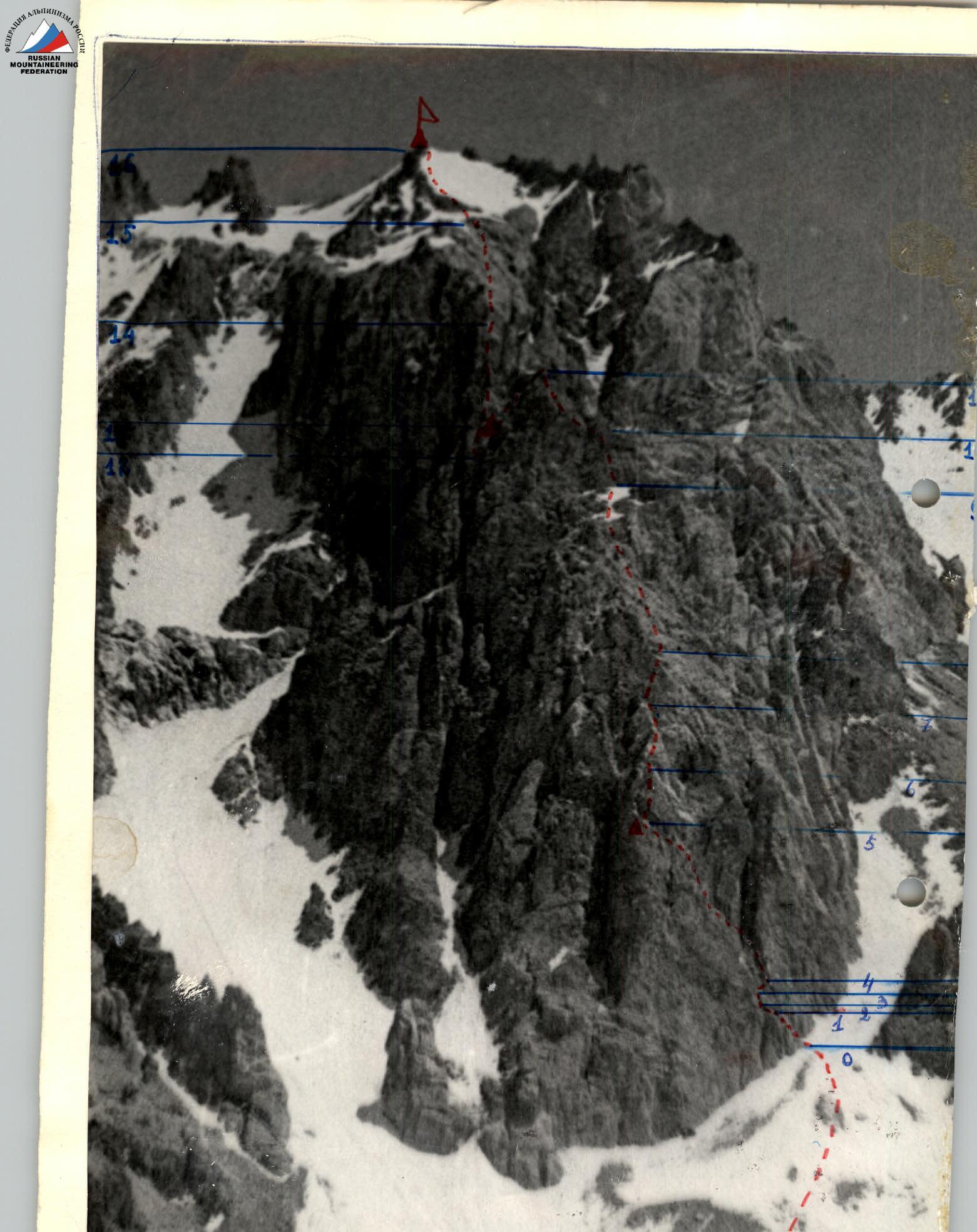
Section 0–1. Ascend 40 m up the severely broken rocks, moving left-up to a scree ledge. Steepness 70°. Piton belay. Climbing is of medium difficulty. 3 pitons hammered. Section 1–2. From the ledge, ascend 35 m left-up through an internal angle to the edge ("Watch out for loose rocks!"). Piton belay. Steepness 60°. 3 pitons hammered (Photo #1). Section 2–3. Then ascend 10 m up the wall to a ledge. Severely broken rocks. Steepness 85–90°. Piton belay (2 pitons). Climbing is difficult. Section 3–4. Then traverse 10 m right-up along an inclined slab (60°) with cracks into a rock couloir. Climbing is medium. Piton belay (2 pitons). Section 4–5. Ascend 40 m up the rock couloir with a steepness of 70° to a 7-meter rock wall (90°). Climbing is medium. Ascend the rock wall to a ledge. Climbing is difficult. Pitons are hard to hammer. 5 pitons hammered. Traverse left along the ledge to the edge. Control tour. Section 5–6. Ascend a 10-meter rock wall (90°). Rocks are monolithic. Move left-up along the wall. Piton belay. Climbing is above medium. 2 pitons hammered. Section 6–7. Then move 40 m along a steep ridge. Steepness 70°. Rocks are monolithic. Belay through rock outcrops. Section 7–8. The ridge is interrupted by a 20-meter rock wall. Steepness 85–90°. Move 17 m right-up through a crack. Then ascend 3 m up a 90° wall to a scree ledge. Rocks are monolithic. Piton belay (4 pitons). Climbing is difficult. Section 8–9. After the ledge, ascend 60 m straight up monolithic rocks resembling "sheep's foreheads" (60 m). Steepness 60°. Piton belay (6 pitons). Climbing is medium. ("Watch out for rocks!"). Reach a scree field. Traverse right-up 40 m along the scree field to the shoulder of the edge (Photo #3). Section 9–10. Ascend a 20-meter rock wall. Steepness 85–90°. Rocks are monolithic. Climbing is difficult. 4 pitons hammered. Reach the ridge. Section 10–11. Continue 30 m along the ridge to the "saddle". Steepness 10°. Rocks are broken. Belay through rock outcrops. Possible overnight stay location. Section 11–12. Descend 20 m into the "saddle" using a rappel. Then traverse 10 m right and descend 10 m to a col. Piton belay (2 pitons). Section 12–13. From the col, ascend 20 m up the left side of the edge to a scree ledge. Steepness 70°. Rocks are severely broken and covered with rimaye ice. Pitons are hard to hammer. Climbing is difficult. ("Watch out for rocks!"). 2 pitons hammered. Control tour on the ledge (Photo #4). Section 13–14. This section is a 60-meter rock wall and is the key section of the route. Steepness 80–85°. Rocks are of shale type. Pitons are hard to hammer. Move 40 m left-up along the left side of the edge, then 20 m up to the edge. 3 pitons hammered. Climbing is difficult (Photo #5, 6). Section 14–15. Continue 120 m along the ridge. Steepness 50°. Rocks are severely broken. Belay through rock outcrops. Climbing is medium. Section 15–16. This section is a scree ridge leading to the summit. Steepness 20–25°. Simultaneous movement (160 m).
Descend from the summit towards Peak Zachyotnaya. Then descend along a scree couloir to the start of the route. The route took 9 hours.
| Date | Section | Steepness | Length | Terrain | Difficulty | Condition | Weather | Rock Pitons | Ice Pitons | Bolt Pitons |
|---|---|---|---|---|---|---|---|---|---|---|
| 1 | 2 | 3 | 4 | 5 | 6 | 7 | 8 | 9 | 10 | 11 |
| 05.07.1977 | 0–1 | 80° | 40 m | wall | 3 | broken | good | 3 | - | - |
| 05.07.1977 | 1–2 | 60° | 40 m | angle | 3 | broken | good | 3 | - | - |
| 05.07.1977 | 2–3 | 85–90° | 10 m | wall | 5 | severely broken | good | 2 | - | - |
| 05.07.1977 | 3–4 | 60° | 10 m | slab | 3 | monolithic | good | 2 | - | - |
| 06.07.1977 | 4–5 | 70–80° | 50 m | couloir, wall | 3, 5 | monolithic | good | 5 | - | - |
| 5–6 | 90° | 10 m | wall | 4 | monolithic | good | 2 | - | - | |
| 6–7 | 70° | 40 m | ridge | 4 | monolithic | good | 6 and outcrops | - | - | |
| 7–8 | 85° | 20 m | wall | 5 | monolithic | good | 4 | - | - | |
| 8–9 | 60° | 60 m | "sheep's foreheads" | 3–4 | monolithic | good | 6 | - | - | |
| 9–10 | 85° | 20 m | wall | 5 | monolithic | good | 4 | - | - | |
| 10–11 | 10° | 30 m | ridge | 3 | broken | good | simultaneous | |||
| 11–12 | 85° | 30 m | descent into "saddle" | - | severely broken | good | 2 | - | - | |
| 12–13 | 70° | 20 m | edge | 5 | severely broken, rimaye ice | good | 2 | - | - | |
| 13–14 | 85° | 60 m | wall | 5 | conglomerate | good | 3 | - | - | |
| 14–15 | 50° | 120 m | ridge | 3 | severely broken | good | 8 and outcrops | - | - | |
| 15–16 | 20° | 160 m | ridge | 1 | scree | good | simultaneous |
Gaiters were used by the first climber on sections (2–3), (3–4)–(10–11), (13–14). Ascenders were used on all sections, except (10–11), (14–15), and (15–16).
| # | Equipment, clothing, and footwear | Quantity | Total weight |
|---|---|---|---|
| 1 | Main rope 12 mm – 40 m | 4 | 47 kg |
| 2 | Rock pitons | 25 | |
| 3 | Hammers | 3 | |
| 4 | Ice pitons | 3 | |
| 5 | Carabiners | 15 | |
| 6 | 2-step ladders | 2 | |
| 7 | Ascenders | 4 | |
| 8 | Down jackets | 4 | |
| 9 | "Golf" pants | 4 | |
| 10 | "Vibram" boots | 4 | |
| 11 | Gaiters | 2 | |
| 12 | Tents | 1 | |
| 13 | Primus stove | 1 | |
| 14 | Down sleeping bags | 2 | |
| 15 | 2-liter canister | 1 | |
| 16 | 2-liter pot | 1 | |
| 17 | 5 mm cordelette | 30 m | |
| 18 | Belay harnesses | 4 |
General view of Peak Evening Sverdlovsk and the ascent route.
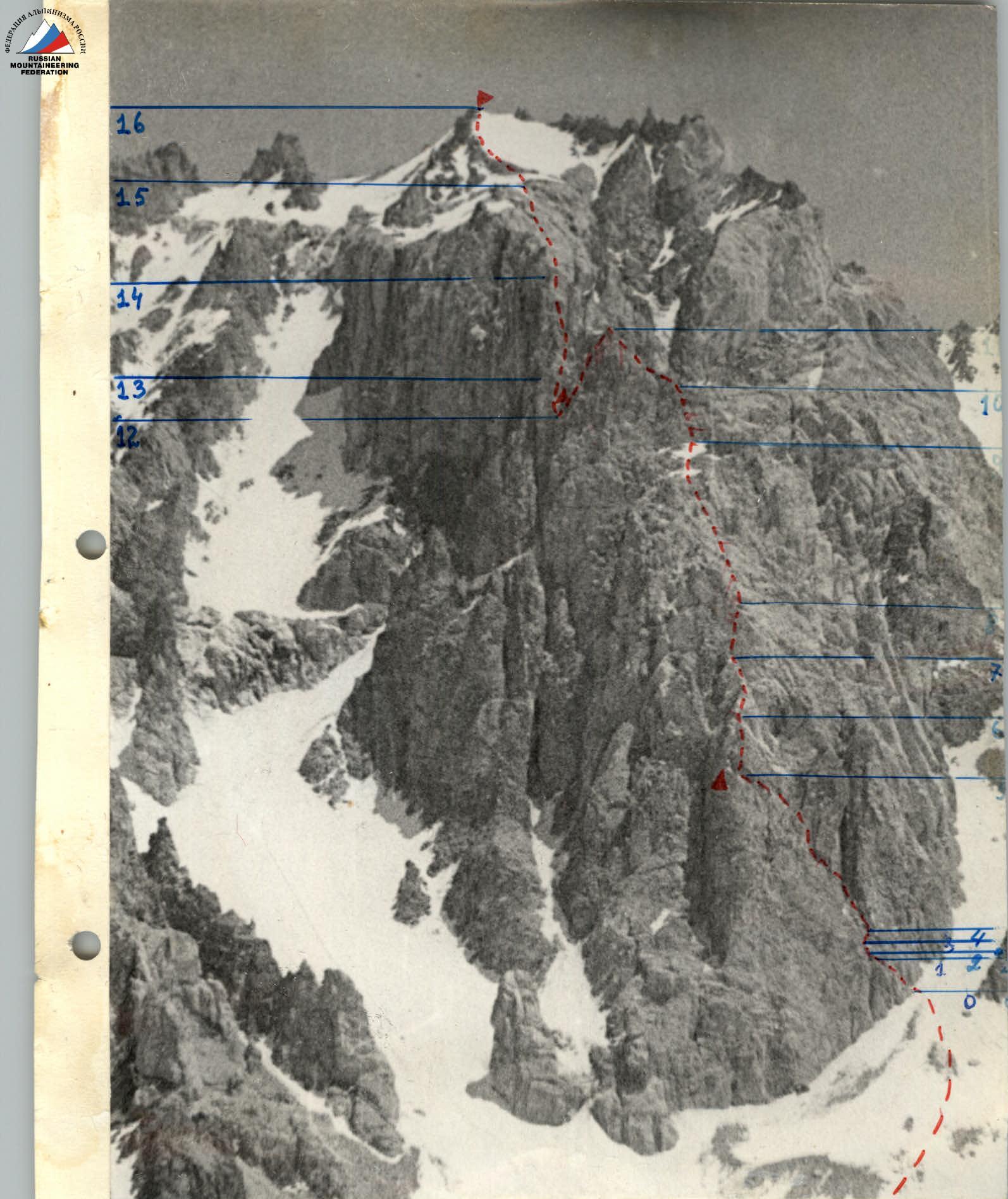
Ascent Route Profile