
PASSPORT
- Class — rock climbing
- Western Tian Shan, Ugam Ridge.
- Ascent of peak "4200" via the North Edge, first ascent.
- Proposed category of difficulty: 5B.
- Height difference: 720 m, route length: 960 m, of which 5–6 category of difficulty: 420 m, average steepness of the main part of the route — 60°.
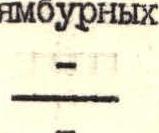
- Pitons used:
| Rock | Bolt | Nuts | Ice screws |
|---|---|---|---|
| 60 | — | 25 | — |
| 5 | 3 |
- Climbing hours — 25, including 12 hours of preparation.
- Overnight stays — none.
- Team leader: Dediy Viktor Ulyanovich — Candidate Master of Sports Team members: Bobrov Alexander Mikhailovich — Candidate Master of Sports, Gorn Viktor Fedorovich — 1st sports category, Baimolin Galimjan Temirzhanovich — Candidate Master of Sports, Son Vladimir Enovich — Candidate Master of Sports, Fisher Ivan Ivanovich — Candidate Master of Sports.
- Coach — Aigistov Gleb Andreevich — 2nd sports category.
- Approach to the route — June 29, 1986. Summit — June 29, 1986. Descent — June 29, 1986.
- Organisation — Kazakh Alpine Club.
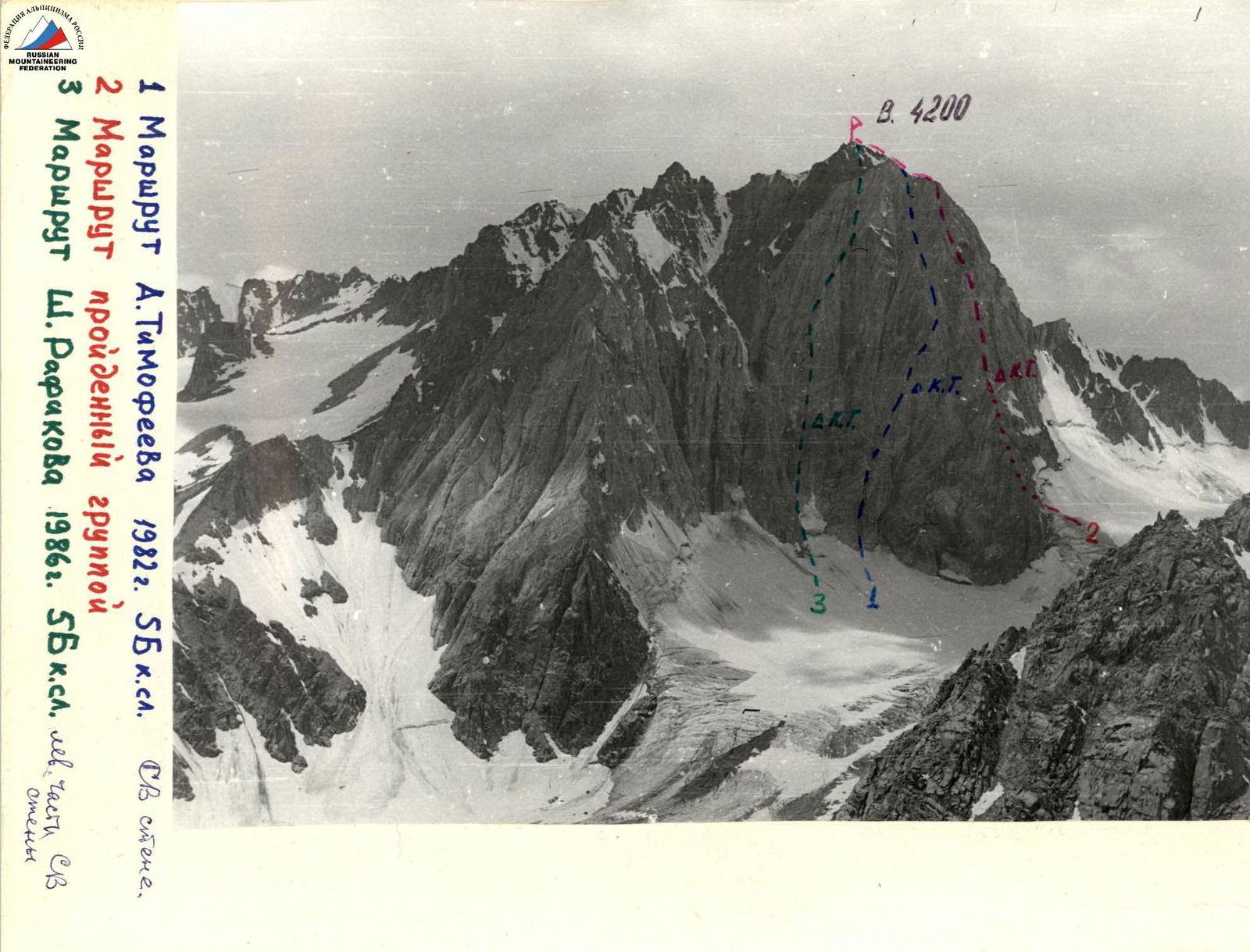
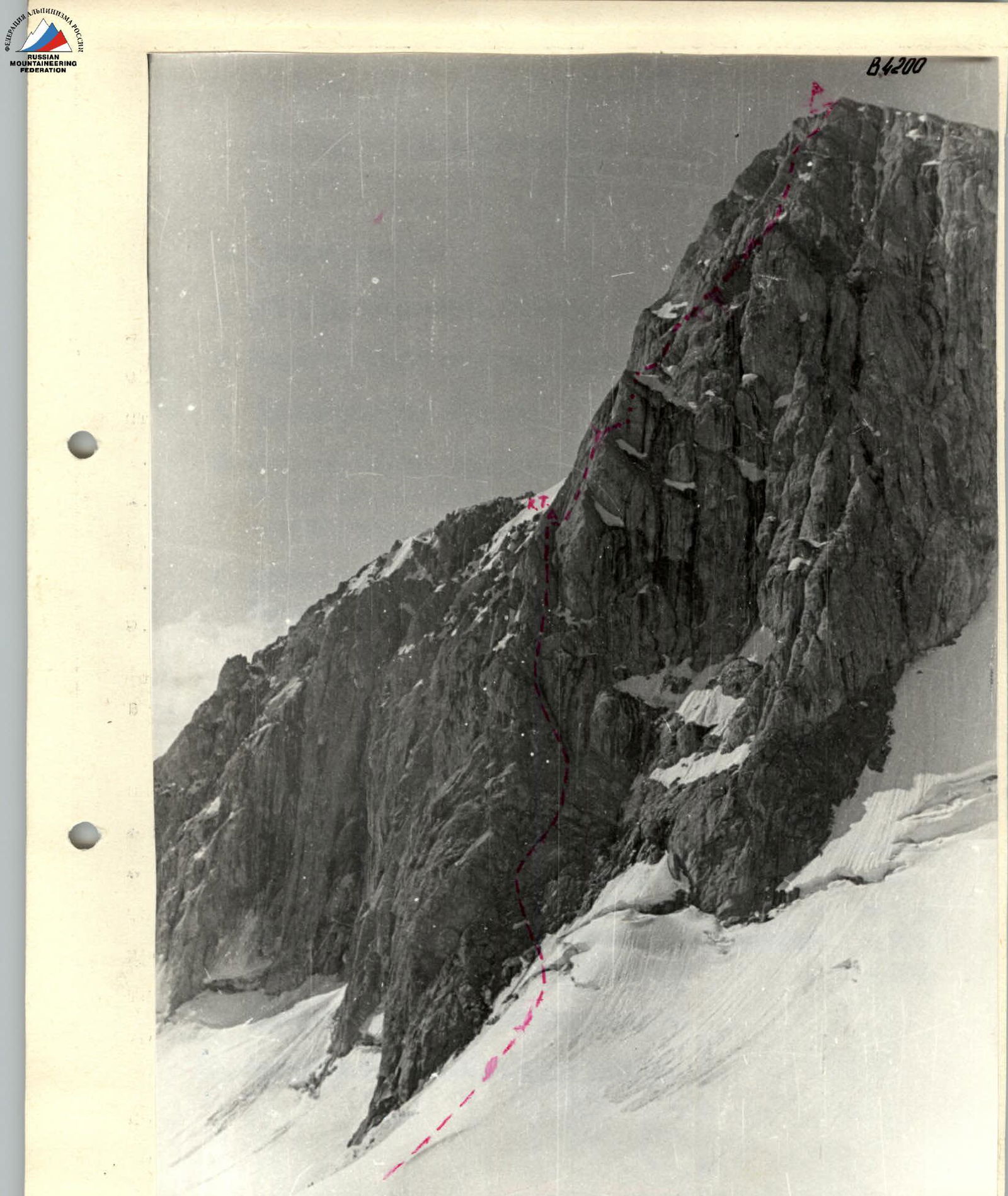
Route profile photo on the right
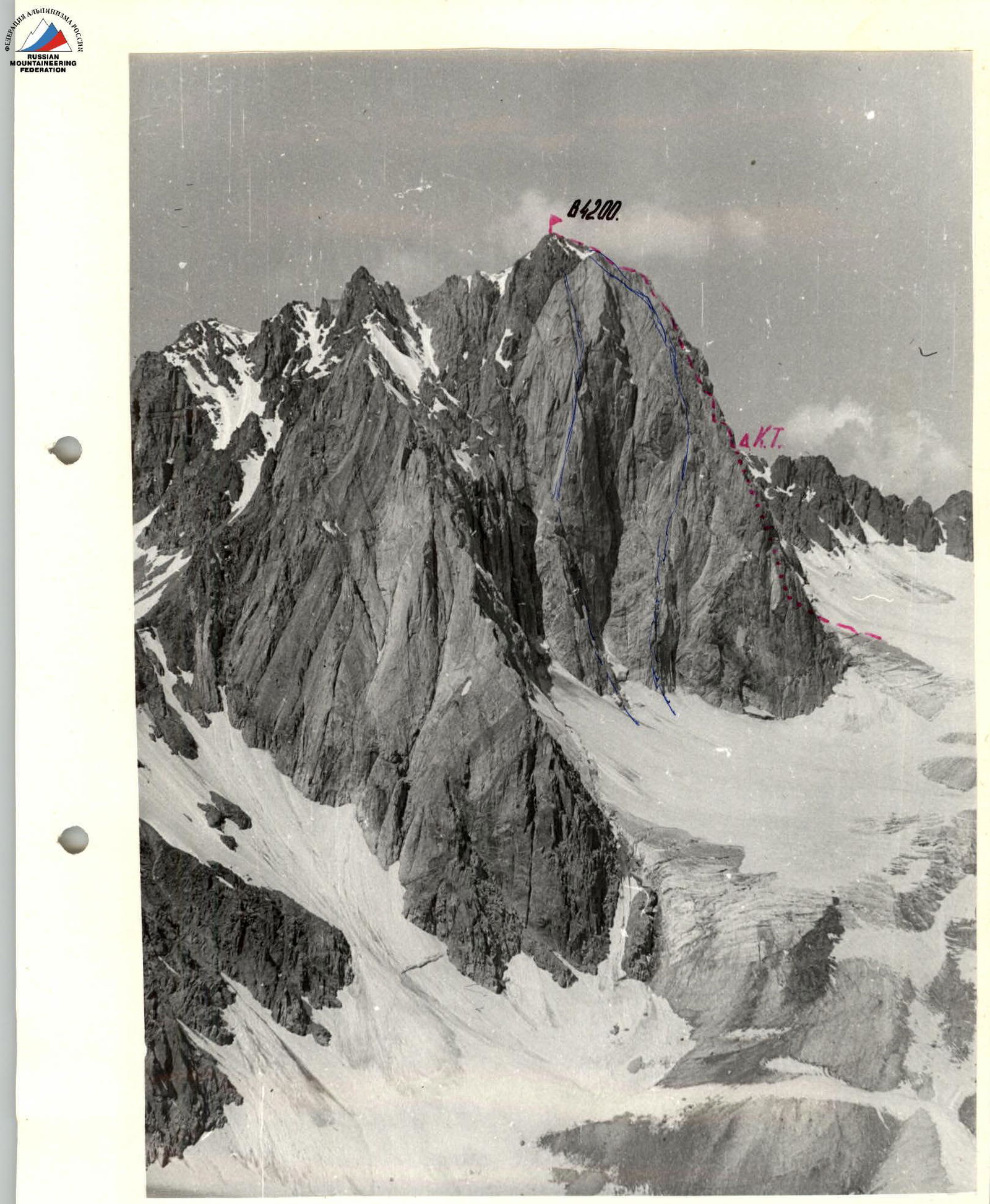
Route photo on the left
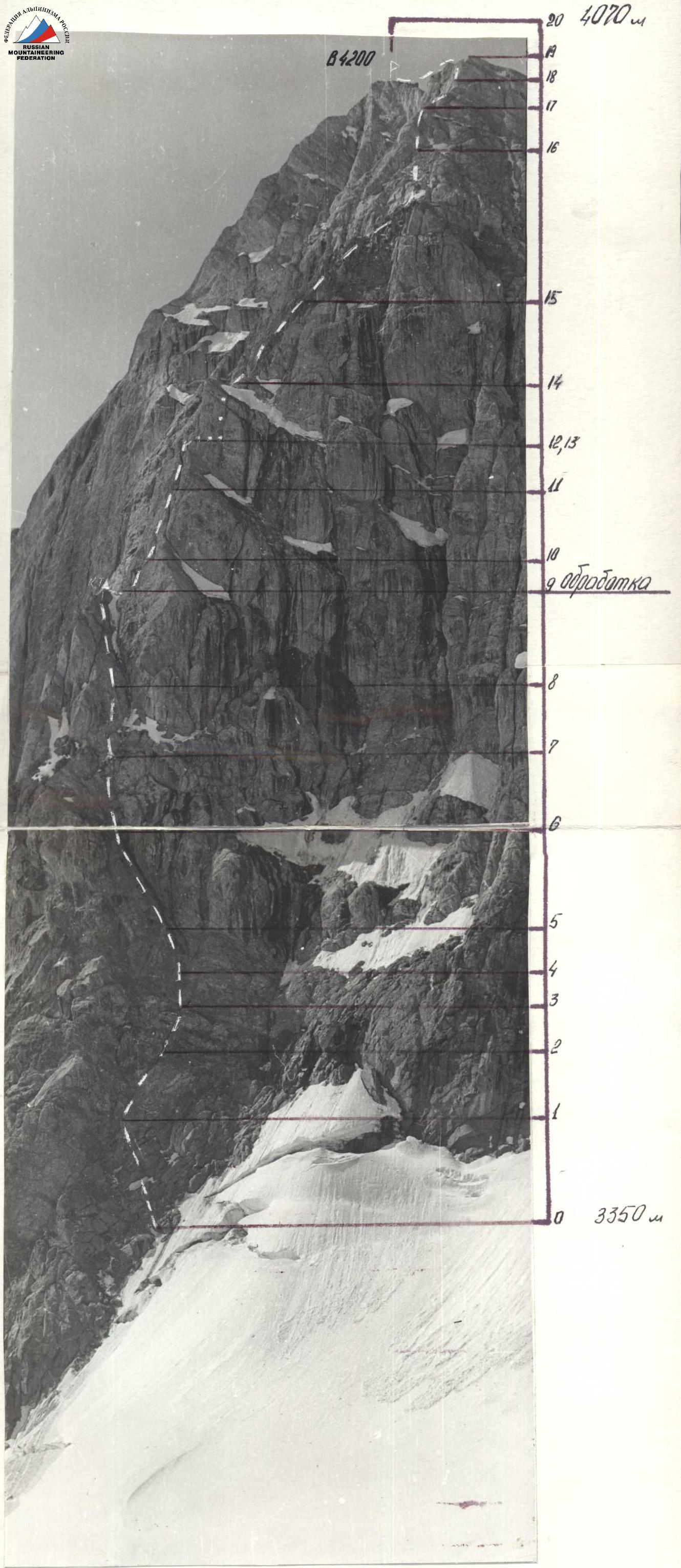
Technical photo of the route
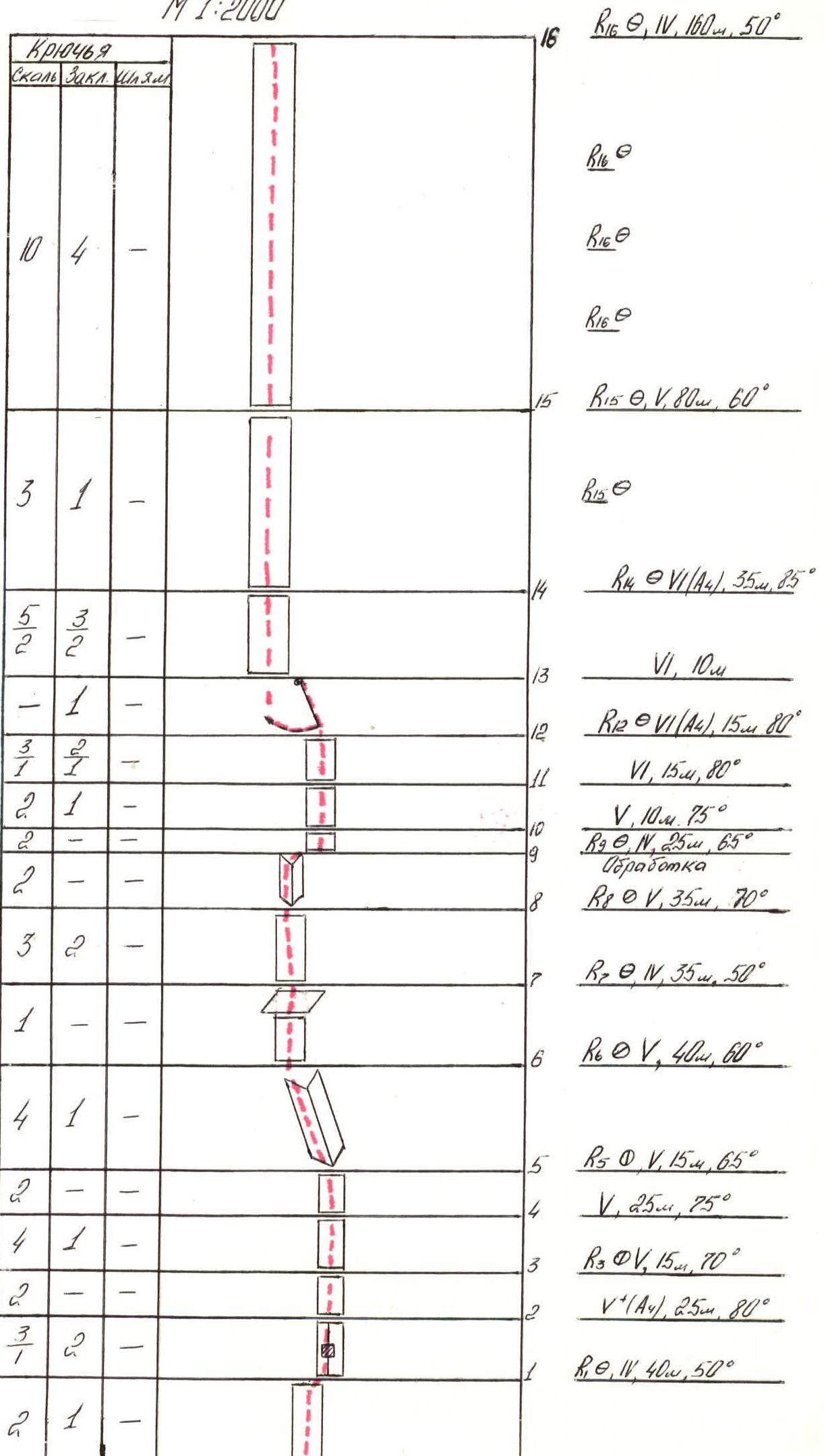
Route diagram in UIAA symbols, scale 1:2000
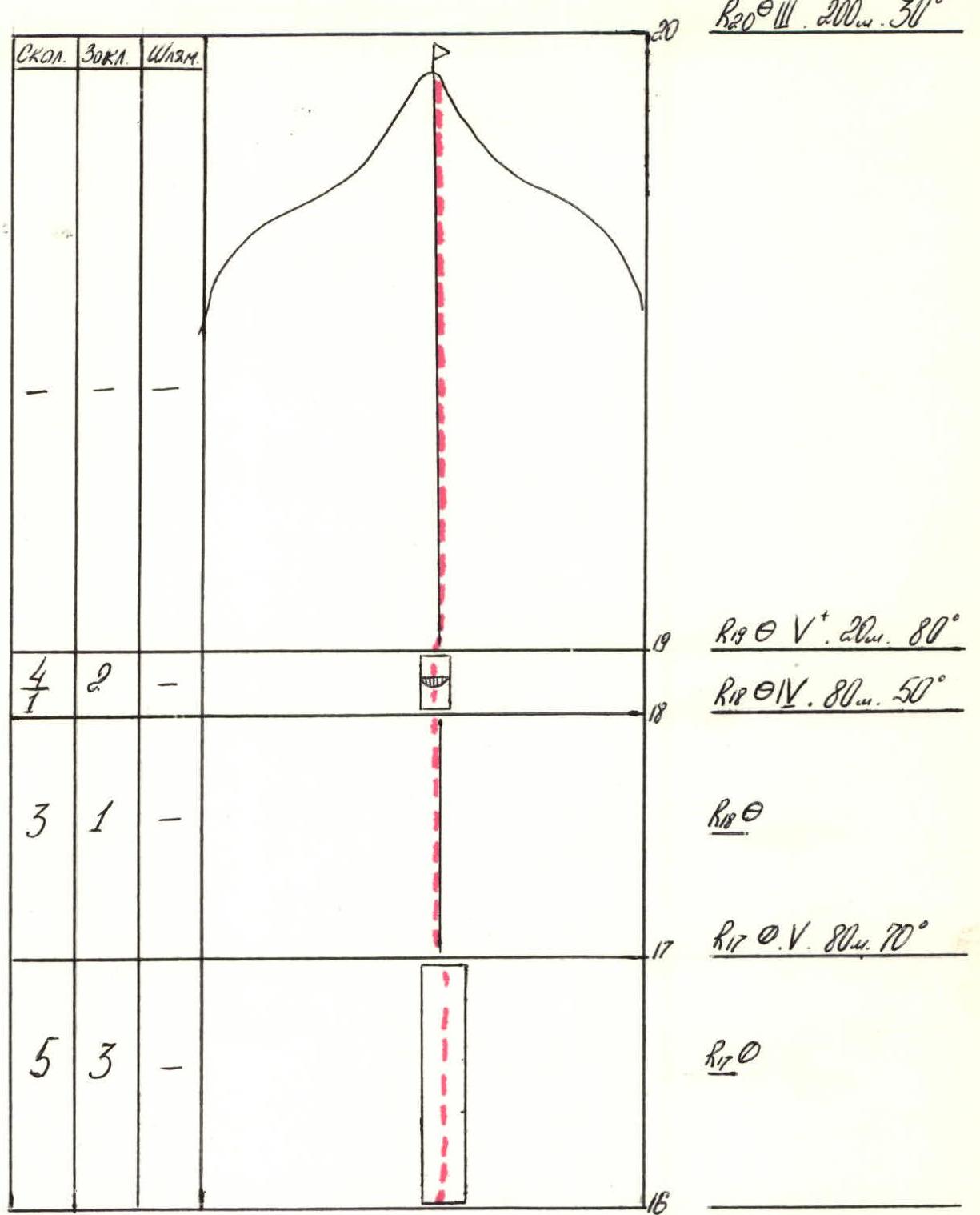
ROUTE DESCRIPTION BY SECTIONS
Section R0–R1. Heavily fragmented rocks, move with caution, "live rocks".
Section R1–R2. Monolithic wall intersected by a cleft from left to right. Few handholds, edges of the cleft are smooth. Boxes and placements like "friends" work well.
Section R2–R3. Wall ending with a narrow sloping shelf. Belay spot is inconvenient, no more than 3 people can stand.
Section R3–R4. Wall with a small number of handholds, rock is loose, flakes off under load.
Section R4–R5. Rocks are smooth, few cracks for pitons, cracks are blind. Thin small pitons like "petals" can be used.
Section R5–R6. Inclined inner corner, move along its left edge, rocks are smooth, movement is mainly on friction. Very difficult to belay, no place to hammer pitons, cracks are blind.
Section R6–R7. Not steep wall, heavily dissected by cracks, ends with a small shelf.
Section R7–R8. Inclined slab with limited number of cracks. Rocks are smooth.
Section R8–R9. Along the left edge of the inner corner, dissected by a wide crack. Ends with a sharp rock edge at the top. On the edge, a control cairn: a tin can hanging on a piton.
Section R9–R10. From the control cairn, cross a snowy saddle to a rock wall.
Section R10–R11. Steep wall, smooth relief. Climbing on "mizers".
Section R11–R12. Wall with a cleft is passed using artificial aids. At the top, it leads to a small shelf.
Section R12–R13. From the shelf:
- climb up the wall to the left for 10 m, where to place a "segment" nut in a crack;
- return to the shelf;
- from the shelf, swing left to a small ledge.
Section R13–R14. Move up the cleft using artificial aids. Boxes and placements like "friends" can be used. At the top of the cleft, it leads to a snowy ridge.
Section R14–R16. Move straight up the fragmented rocks. Be careful, many "live rocks".
Section R16–R17. Wall is passed straight up. Rock is loose, handholds crumble into sand under load, few cracks.
Section R17–R18. Rock edge of medium steepness leads to the foot of a small wall.
Section R18–R19. Rock wall with a small overhang in the middle. After the overhang, traverse 2 m to the left and then straight up — exit to the pre-summit ridge. Rock is loose.
Section R19–R20. The summit is accessed by an easy ridge, simultaneous movement, belay through outcrops.
The summit is composed of large red granite blocks.

Comments
Sign in to leave a comment