
- High-altitude class.
- Central Tien Shan, North Inylchek Glacier.
- Khan-Tengri Peak, 6995 m, via the center of the North Face.
- Proposed category: 6B, variation.
- Elevation gain — 2700 m, distance — 3550 m
Distance of sections with 5–6 category difficulty — 1430 m, including 185 m of 6th category. Average steepness — 55–58°.
- Pitons driven:
| Rock | Bolt | Nuts | Ice |
|---|---|---|---|
| 151/3 | - | 211/3 | 12 |
-
Climbing hours: 51.5 hours and 5 days.
-
Overnights: 1 — lying down, on a rocky-ice ridge. 2 — semi-reclining, on a rocky ledge. 3 — semi-reclining, on a rocky platform. 4 — semi-reclining, on an inclined rocky ledge.
-
Team Leader: Viktor Ulyanovich Dediy — Master of Sports of International Class
Team Members: Alexander Borisovich Savin — Master of Sports, Anatoly Alekseyevich Uruzgaliyev — Master of Sports, Sergey Vasilyevich Ovcharenko — Master of Sports, Artur Rodionovich Shegay — Candidate for Master of Sports, Valery Eduardovich Kutenkov — Candidate for Master of Sports
- Coach: Yuri Mikhailovich Moiseev
- Departure to the route: August 6, 1990.
Summit: August 10, 1990. Return: August 11, 1990.
- Organization: State Sports Committee of the Kazakh SSR.

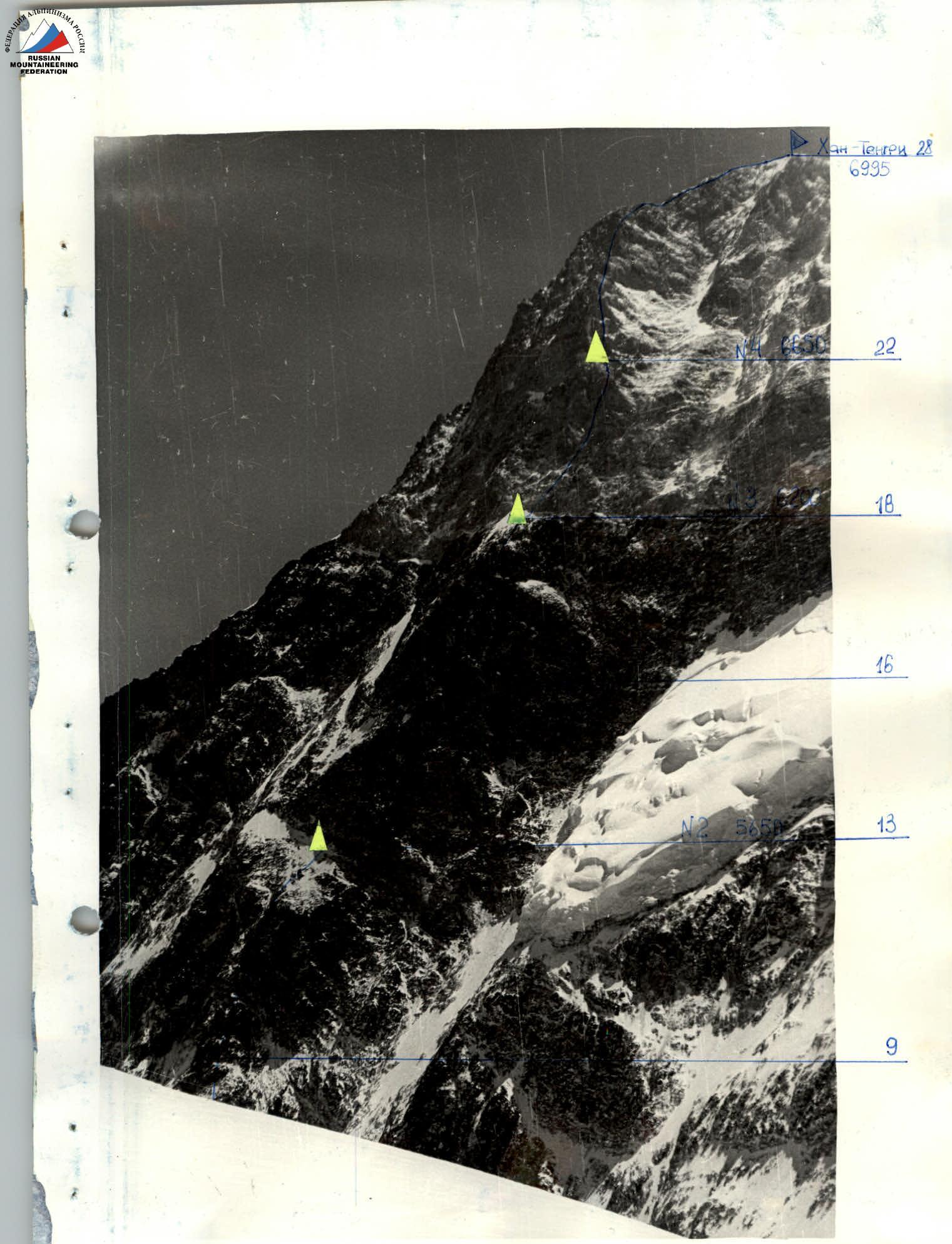
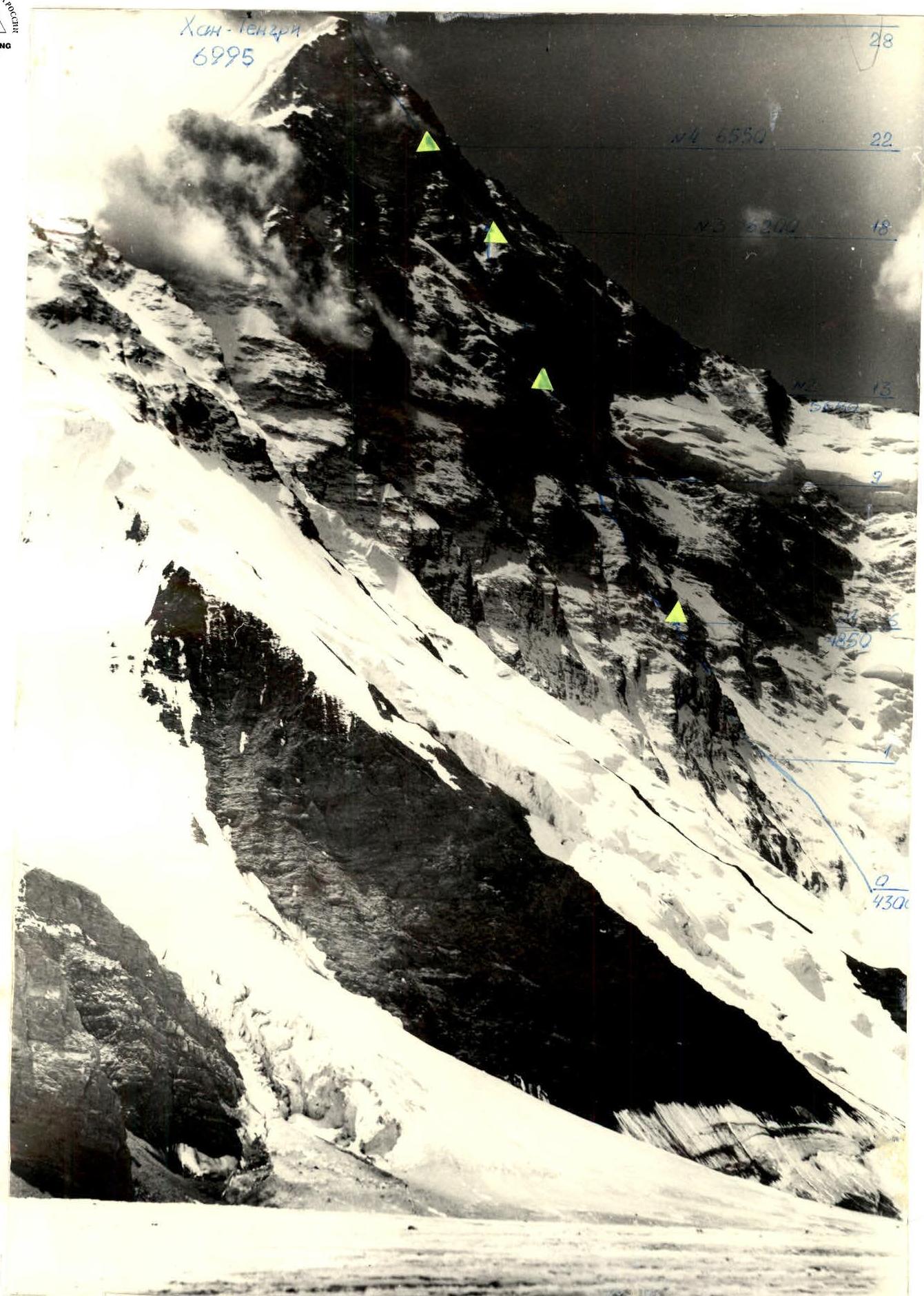
Photo #3. Profile of the wall from the left. August 9, 1990. Lens "Industar-26", f=105 mm, distance 7.5 km. Point #3, altitude 4400 m.
Tactical Actions of the Team
The tactical plan for the ascent was largely executed. The deviation from the planned second overnight stay location (planned at 5200 m, actual at 5650 m) is explained by the preliminary processing of a rather long (5 ropes) section of complex rocks and the high pace of the participants' movement.
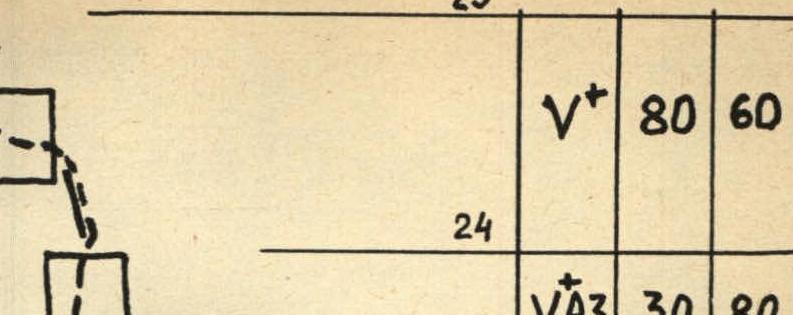
The route was completed by the team without preliminary processing of its beginning. The passage was predominantly free climbing, excluding sections (R7–R8), (R16–R17), (R23–R24), where sheer walls without pronounced microrelief were encountered.
The movement was organized as follows: the first in the leading rope team passed a section (usually a rope length), fixed the rope, and then the second climber ascended on the fixed rope, carrying a rope for the first climber's further movement and necessary equipment. The third climber removed unnecessary intermediate anchors, making the route more rational. The remaining participants carried ropes and equipment. The leader worked without a backpack.
On the most complex and rockfall-prone sections, insurance was organized using a double rope. The reliability of insurance points (2–3 rock pitons + a nut or a protrusion) was very high.
When moving along the route with complex terrain, the team tried to adhere to the following regimen: the lead climber was replaced approximately every 4 hours of work — this allowed maintaining a fairly high tempo and significantly increased safety. During the change of the lead climber, a short rest with consumption of snacks was taken. Hot meals were prepared in the morning and evening at the overnight stops. Sublimated products were very convenient to prepare. The use of an autoclave significantly increased the speed of cooking.
The organization of the last three overnight stays required significant physical effort: for several hours, platforms were laid out, ice was chipped away, and obstructing stones were removed. Nevertheless, it was possible to create decent conditions for rest.
All overnight stays were safe:
- 1 — on a rocky-ice ridge, far from the wall,
- 2–4 — on snow-covered rocky ledges under the cover of rocky walls, eliminating the risk of rockfall.
The system of fixed ropes passed through and around the tent provided insurance. There were no "working" falls or injuries.
The problematic sections were: R4–R5, R7–R8, R14–R15, R16–R17, R21–R22, R23–R24, R24–R25.
The combination of technically complex climbing on loose rocks, the presence of ice, and bad weather (starting from the second half of the day on August 8, 1990) created significant difficulties. They were overcome:
- using modern and special equipment ("Friends", elongated titanium pitons);
- constantly using crampons for climbing;
- selecting the most technically prepared participant to lead.
The physical reserve of the team can be judged by the following fact: after participating in the championship, the team, almost in full composition, after a short rest (5 days), made an ascent to Peak Pobeda. Moreover, the path to the summit from 5900 m and the descent to the Zvezdochka Glacier were completed in extreme weather conditions in 2 days instead of the usual 4.
The technical reserve can be judged by the following:
- high speed of movement, despite bad weather;
- absence of any falls;
- predominant use of nuts for intermediate insurance points, which significantly saves time and is much more reliable than piton insurance on loose rocks.
The team's movement in extreme weather conditions (August 9–10) did not affect safety, as ascents in similar and harsh conditions were repeatedly made by team members during year-round training in the Trans-Ili Alatau, and during the winter ascent to Peak Pobeda.
High-quality down equipment, plastic boots, and masks allowed working in strong winds with snow and low temperatures. There were no cases of frostbite.
Communication with the observation group was carried out regularly via the "Pəlmeit" radio station, according to the schedule. The observation camp, having a KВ R-143 radio station, was stably connected with:
- the KSP of the area,
- the base camp on the North Inylchek Glacier,
- other teams in the Khan-Tengri area.
Observers constantly monitored using a 60x spyglass.
The rescue team of 5 people was located in the observation camp on the lateral moraine of the North Inylchek Glacier opposite the north face of Khan-Tengri.
4–16
V 80 60
IV+ 60 60
55
45
55
55
 IV 300 45
55
Category complexity
Distance, m
Steepness, °
IV 300 45
55
Category complexity
Distance, m
Steepness, °
 10–21
4/1–8
VIA 50 85
2–10
V 215 80
1
92
11.5 ч
720 м
IV+ 85 60
14–15
V+ 105 65
7–2
IV+ 90 65
10–21
4/1–8
VIA 50 85
2–10
V 215 80
1
92
11.5 ч
720 м
IV+ 85 60
14–15
V+ 105 65
7–2
IV+ 90 65
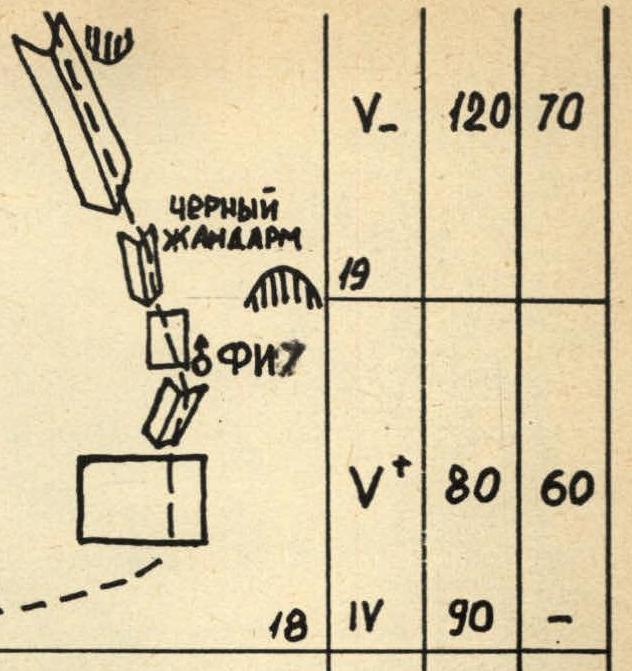 2–7
V+ 80 60
6/3–4
VA3 30 80
1–7
VI 70 85
5–7
V 120 55
75
9х4
3–9
V+ 130 65
6–8
V 90 60
2–7
V+ 80 60
6/3–4
VA3 30 80
1–7
VI 70 85
5–7
V 120 55
75
9х4
3–9
V+ 130 65
6–8
V 90 60
 151 12 211 374 6995 28
55/3
10х4
IV+ 210 45
2–3
2–2
IV 30 60
2–4
V 60 55
151 12 211 374 6995 28
55/3
10х4
IV+ 210 45
2–3
2–2
IV 30 60
2–4
V 60 55
Description of the Route by Sections
Section R0–R1. Snow-ice slope with outcrops of ice-covered rocks.
Section R1–R2. Rocky ridge covered in ice leads to the base of the wall.
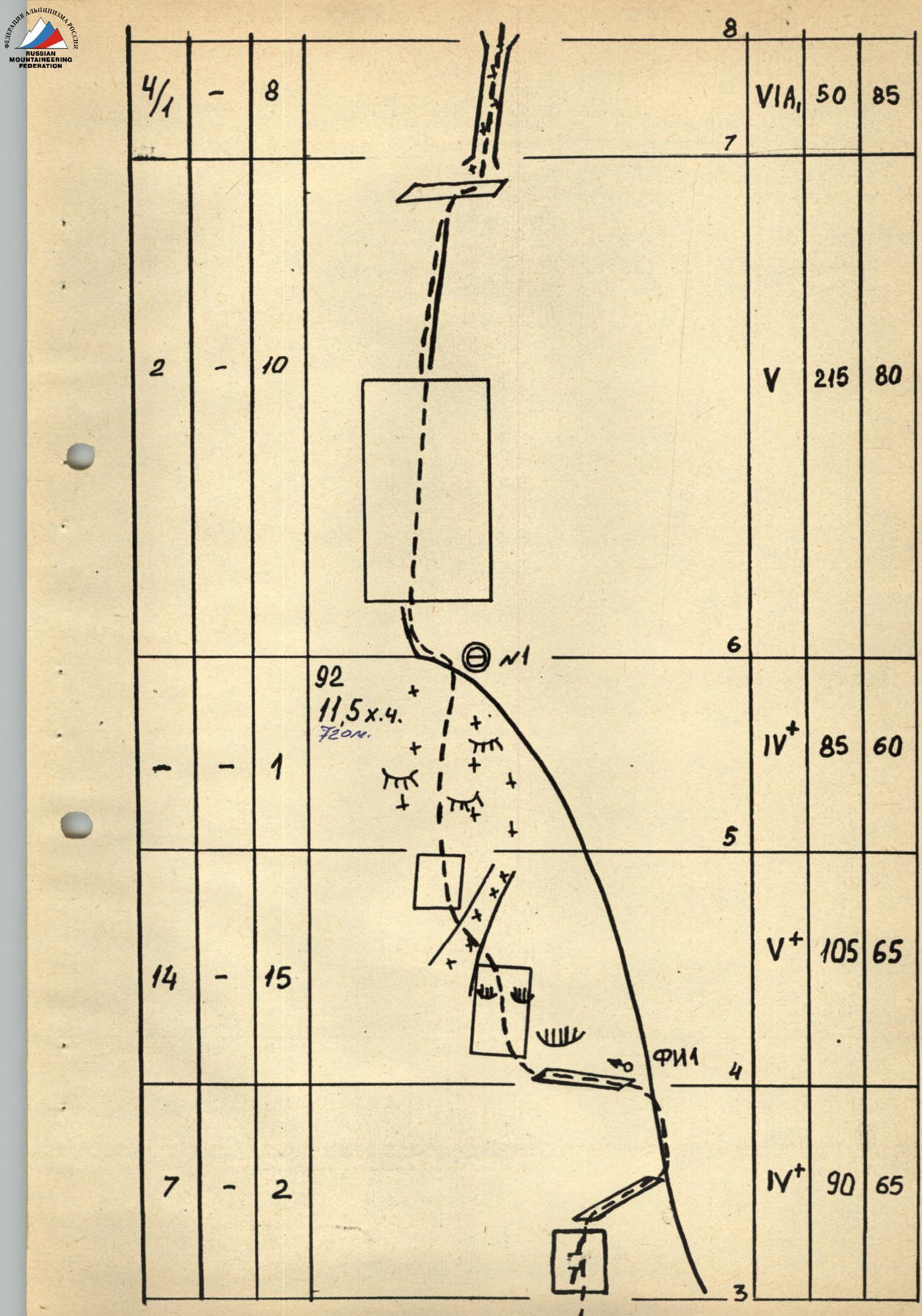
Section R2–R3. The wall transitions into a chimney. Movement is done in opposition. Insurance is provided by nuts.
Section R3–R4. From the wall with a cleft, exit onto a ledge, then right-up (10 m) onto a rocky ridge and up (45 m) to a ledge under a cornice.
Section R4–R5. From the ledge, traverse left to bypass an overhang. Further up the wall covered in ice. Passage between two cornices. Then left-up, crossing a couloir, exit onto a wall with a blocky structure (live rocks!), and through it onto a snow slope.
Section R5–R6. Snow slope leads to a snow shoulder. A good spot for an overnight stay.
Section R6–R7. Along the snow ridge and slope, approach a steep rocky wall. Holds are small. Exit onto a small rib and then onto an inclined snow ledge.
Sections R7–R9. From the ledge, exit into an ice-covered internal corner (45 m). Rocks are unstable. Movement is done in opposition. The internal corner leads to a broad ridge. Rocks are like "sheep's foreheads". Ice accretion. Along the ridge and further along the snow slope, approach a large rocky wall.
Section R9–R10. The wall is a rocky ridge cut by vertical clefts filled with ice.
- First, along a small wall right-up behind a corner into a cleft.
- The cleft is passed in a hanging position left, exit onto a narrow ledge.
- Along the ledge, traverse left under the wall.
- Further along the wall (85°) and cleft with snow (nuts).
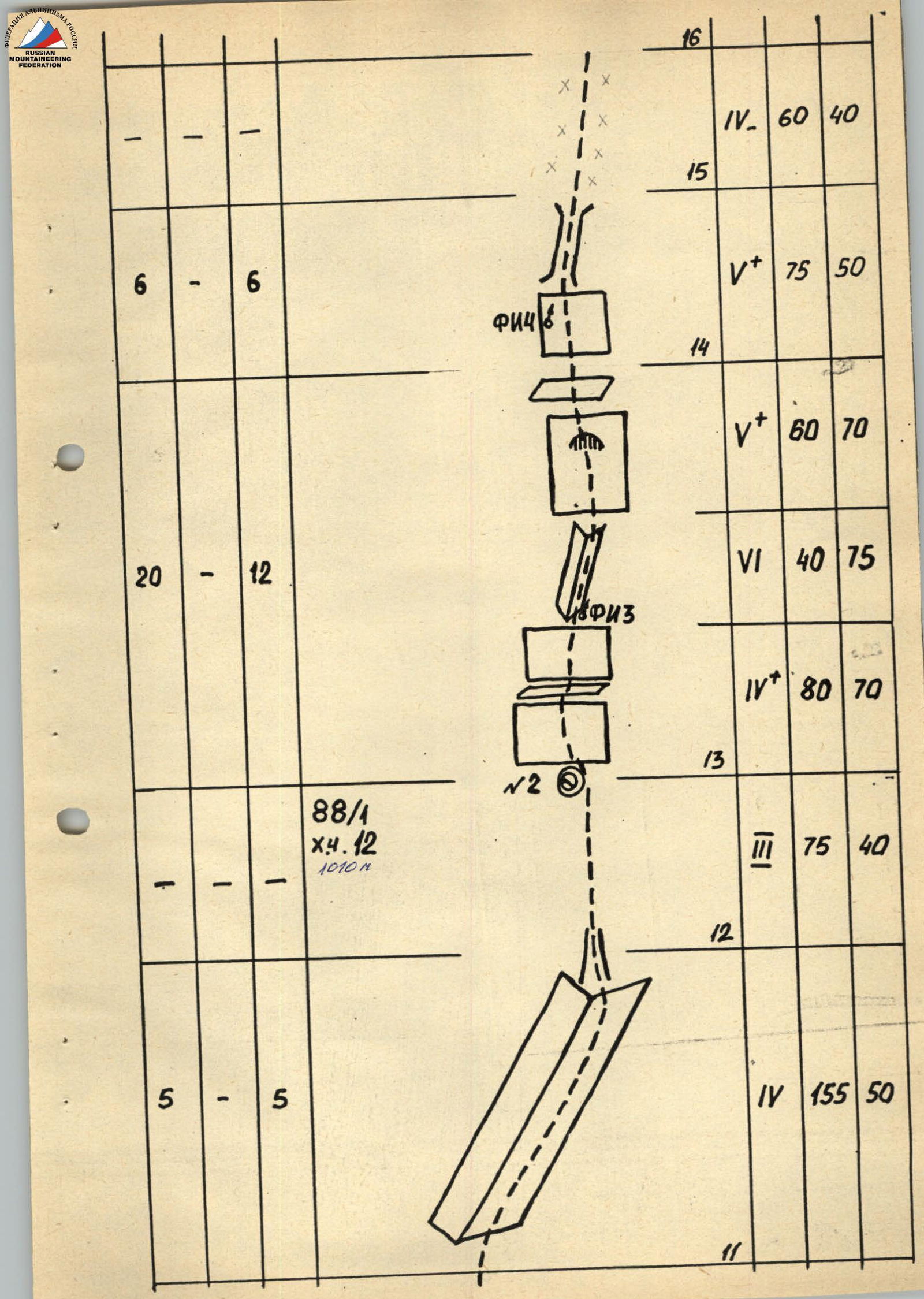
Section R10–R11. The ridge becomes more gentle and is an ice-covered wall of smoothed rocks.
Section R11–R12. Approach an inclined internal corner and along it into a narrow couloir leading onto a snow slope.
Section R12–R13. Snow slope. Overnight stay under a rocky wall.
Section R13–R14. From snow, exit onto a rocky wall cut by an inclined ledge into two parts:
- The upper part is steep (75°) with outcrops of marble; "Friends" are used in narrow cracks.
- Further, an inclined internal corner leads under a wall (80°) with a niche.
- From the niche, exit (3 m) with a pull-up onto a snow ledge.
Section R14–R15. A rocky wall leads to the base of a chimney. From the chimney, exit onto smoothed rocks, then onto a snow slope.
Section R15–R17. Along a snow slope with rocky outcrops in the upper part, approach a wall. Start movement along a broad cleft (large nuts), then along a wall, exit onto a narrow ridge, and along it, approach an 80° wall. The wall is passed via a cleft (Aided Technical Climbing). Further, along an internal corner, crossing it in the upper part, exit onto a snow slope.
Section R17–R18. Along a snow slope, exit under a marble wall. Overnight stay on a narrow ledge.
Section R18–R19. Traverse right along the boundary of black and red rocks. Along a steep rocky wall with a chimney in the lower part, exit onto a red wall. Complex climbing. Movement continues along internal corners in a direction left of a black gendarme.
Section R19–R20. Along an inclined internal corner left-up. Rocks are like "tiles", heavily destroyed. Further up the wall left of a cornice.
Section R20–R21. Chimney with a plug ("Friends"). Exit onto a narrow ridge.
Section R21–R22. Series of small walls separated by inclined ledges. Rocks are heavily eroded. Insurance is provided by wide and long rock pitons. Overnight stay on an inclined ledge.
Section R22–R23. Along a snow ridge, exit into a giant internal corner. Along its right side, ascend, then left-up, exit under a rocky wall.
Section R23–R24. Along an 80° wall (difficult climbing) — exit into a chimney filled with ice. In the upper part, an overhanging plug (passed head-on). Climbing is complex, in opposition. Further:
- move right,
- exit along a wall (small, inconvenient holds),
- exit onto a ridge.
Section R24–R25. Rocky ridge (movement along the right side for 30 m). Then transfer to the left side and traverse along a rocky shelf left towards a couloir.
Transfer to the left side of the couloir — pendulum.
Section R25–R26. Rocky shelf on the left part of the couloir leads to an inclined groove. Crossing the groove, exit onto a wall.
Section R26–R27. The wall is heavily destroyed. Further along a broad cleft — exit onto a snow slope.
Section R27–R28. Snow slope leads to the summit. Snow is deep, over 0.5 m. Loose. Insurance is provided by rocky outcrops to the right. Before the summit, sections of hard firn are encountered.

Comments
Sign in to leave a comment