
PASSPORT
-
Winter category.
-
Kyrgyzsky Ridge, Aла-Арча gorge.
-
Peak "Svobodnaya Koreya" 4740 m.
-
Route variations:
- Myshlyaev L. (right rib of N. side) via the right part of N. side.
- Bagaev B. (triangle of "N. side")
-
6A category proposed for a winter group ascent.
-
Elevation gain — 640 m. Distance — 770 m. Average steepness of the main part of the route (from bergschrund to ridge 61°). Distance of sections:
- 5–6 difficulty category — 560 m.
- 3–4 difficulty category — 210 m.
-
Pitons driven:
Ice Rock Nuts 75 41 16 -
Total hours of ascent: 60 h.
-
Number of overnight stays: 3 sitting.
-
Team leader: Grigoryev O.E., Master of Sports / Candidate for Master of Sports Team members:
- Fyodorov A.V., Candidate for Master of Sports
- Usaev M.B., Candidate for Master of Sports
- Dokukin A.V., Candidate for Master of Sports
- Mats R.L., Candidate for Master of Sports
-
Team coach: Grigoryev O.E.
-
Departure for the route: February 16 (including preparation). Summit ascent: February 21. Return to base camp: February 22.
-
Team of the State Sports Committee of the Republic of Uzbekistan.
| 2 | 3 | 4 | 5 | 6 | 7 | 8 | 9 | 10 | 11 | 12 | 13 | 14 | 15 | |
|---|---|---|---|---|---|---|---|---|---|---|---|---|---|---|
| 18 | 60° | 20 m | Ice slope | Difficult | Cutting steps, climbing | good | 18:00 | 1.0 | 2 | 4 | overnight stay on a lying жандарме | 600 g | ||
| 80° | 20 m | Rocky жандарм | Alternating, with fixed ropes | |||||||||||
| day | 200 m, average speed 20 m/h | 37 | 19 | |||||||||||
| TOTAL for the day | ||||||||||||||
| 0.71 | 19 | 65° | 40 m | Ice slope | Difficult | Cutting steps, front points, alternating | good | 8:00 | 1.30 | - | 4 | - | - | |
| 20 | 65° | 40 m | Ice slope | Difficult | Cutting steps, fixed ropes | good | - | 1.30 | - | 4 | - | - | ||
| 21 | 65° | 80 m | Ice slope | Very difficult | Cutting steps, fixed ropes, pulling up backpacks | good | - | 4.0 | - | 6 | - | - | ||
| 22 | 70° | 60 m | Ice slope, жандарм | Very difficult | Alternating, fixed ropes, pulling up backpacks | good | 17:00 | 2.0 | 4 | 4 | lying overnight stay on жандарме | 600 g | ||
| TOTAL for the day 220 m, Average speed 20 m/h | 9.0 | 4 | 18 | |||||||||||
| 0.71 | 23 | 65° | 40 m | Ice slope with embedded rocks | Difficult | Cutting steps, fixed ropes | good | 8:00 | 1.0 | 4 | 4 | - | - | |
| 24 | 70° | 40 m | Ice-rock slope, traverse upwards | Difficult | Cutting steps, fixed ropes | good | - | 1.0 | 5 | 4 | ||||
| 25 | 60° | 40 m | " " " " " " | 1.0 | 6 | 4 | ||||||||
| 26 | 60° | 40 m | Snow-ice slope | Moderate difficulty | Alternating | good | - | 1.0 | 2 | 2 | ||||
| 27 | 90° | 30 m | Rocks, inner corner | Very technically difficult | Ladder, fixed ropes | good | - | 2.0 | 25 | |||||
| Further, a ridge route of 5A category difficulty | Overnight stay on the moraine of the "Top-Karagay" glacier | 600 g | ||||||||||||
| TOTAL for the day 220 m, Average speed 28 m/h | 37 | 14 |
PREPARATION FOR THE ASCENT
Preparation for the 1997 CIS Alpine Championship was ongoing and served as preliminary training for the team members' ascent on Everest.
In November 1996, all participants in the ascent were at a gathering under Peak Lenin, where the selection for the national team took place, and techniques and tactics for winter ascents were practiced, with special equipment tested.
In the winter, constant training was conducted on rocks and especially on ice. The tactical plan included safety measures. The team had good material support, a wide range of technical means, especially for ice climbing.
For the gathering in the "Ala-Archa" alpine camp, preparations were made accordingly for winter:
- a first-aid kit,
- the team was accompanied by an experienced doctor-alpinist.
Good physical condition and constant acclimatization contributed to adhering to the pre-planned ascent schedule.
TACTICAL ACTIONS OF THE TEAM
The team's tactical actions were conducted in accordance with the tactical plan. Due to constant bad weather and strong frosts of –30 °C, the tactical plan was thought out in great detail.
The organization of rope team movement, their interaction, and the change of lead climbers were carried out according to the tactical plan.
For quick passage of the route and greater maneuverability related to safety, 45 m ropes were used. To ensure the safety of the lead climber throughout the route, a double rope was used, both (1) UIAA certified.
Modern Western-style mountaineering equipment:
- impact ice axes
- jumar ascenders
- stoppers
- crampons
- ice screws (domestic)
- ice tools
This provided increased reliability and safety for the route passage.
The belay of the first climber on a stance was done through a block-and-tackle. All participants, from the first to the last, climbed on a double rope. The team's movement regime throughout the day was continuous; nutrition was provided by individual packets with high-calorie products. The entire wall of "Svobodnaya Koreya" is problematic for overnight stays (if there's no platform). Therefore, the team's tactical actions were aimed at finding an overnight stay above the midpoint of the route. For this reason, a new route (variation) was taken.
The overnight stay was safe, located under a cornice, but uncomfortable: 5 people could fit sitting.
We had to spend three nights here - it was exhausting.
In the summer, the route is very dangerous due to:
- the upper chute;
- a "hanging icicle" 80 m high, which sometimes breaks off and creates danger for almost half of the route.
The route is interesting due to the combination of ice and granite rocks.
We have climbed many routes with ice and rocks, but this one is the most unpredictable. On the rocks lies more than 1 m of snow, and under the snow, there's no ice; we had to dig a tunnel through the wall, which was very challenging. The ice in the lower part of the route (before the overnight stay) is unreliable, accumulated, and thin, constantly cracking from drillings and ice screws. We had to reinforce the fixed ropes with rock pitons.
The route was climbed with a sufficient margin of safety. Being on it for 7 days at a temperature of –30 °C with constant bad weather indicates a stable moral climate within the group.
All sections of the route were climbed reliably, with increased safety measures for all team members.
The rescue team, along with a doctor, was in constant "combat" readiness at the "Koronskie" overnight stays. During the ascent, uninterrupted radio communication was maintained.
General photo of the route.
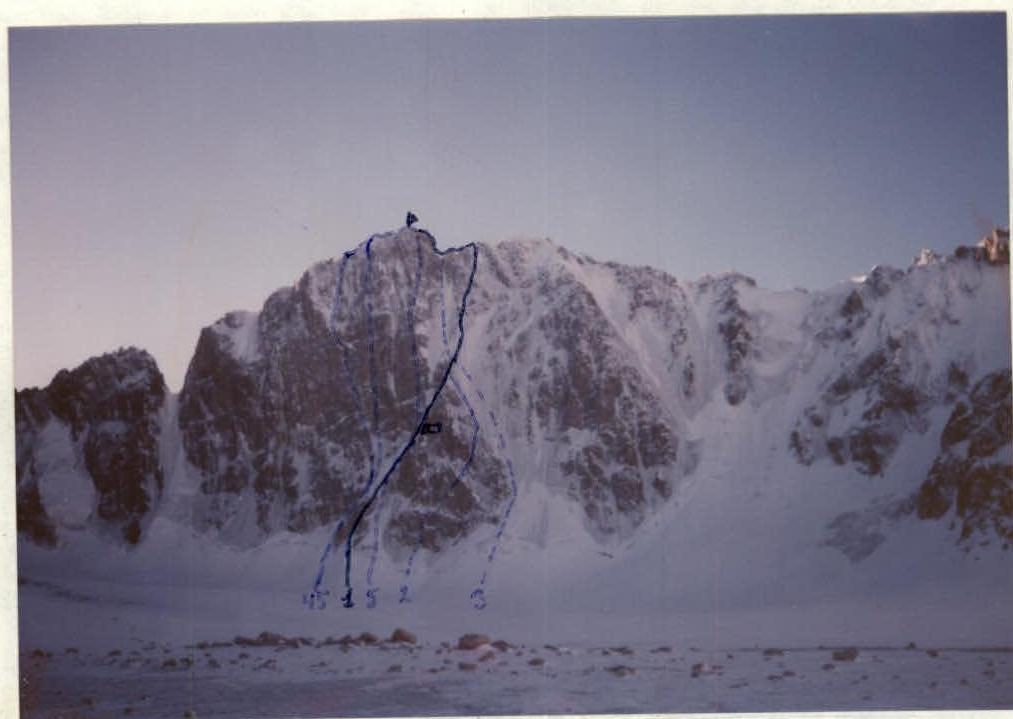
- Team's route 6A(winter)
- Bagaev's route 5B.
- Barber's route 5B.
- Bezzubkin's route 6A.
- Popenko's route 6A.
| Ice | Rock | Nuts |
|---|---|---|
| 2 | 10/5 | 5/3 |
| 1 | 9 | 6 |
| 2 | 2 | 3 |
| 5 | 3 | |
| 4 | 2 | |
| 8 | ||
| 5 | ||
| 6 | ||
| 4 | 2 | |
| 8 | ||
| 5 | ||
| 4 | 2 | |
| 3 | 4 |
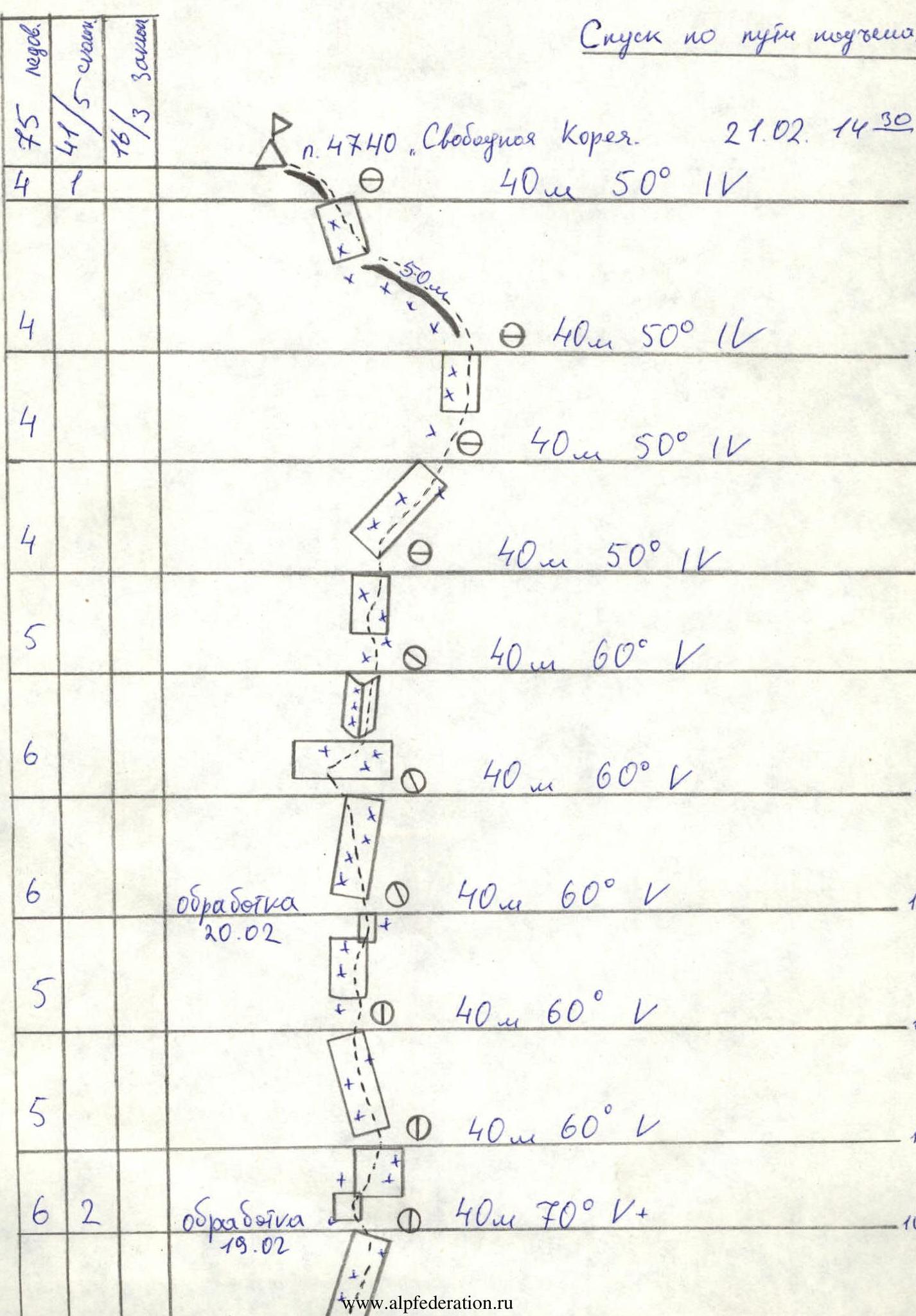
Description of the route by sections
Arrived at the "Ala-Archa" alpine camp. Climbed up to Ratsek's campsite. Spent four days practicing ice climbing techniques on the Ak-Sai glacier, which later yielded positive results - confidence and competence. The entire route was climbed in crampons.
February 16, 1997
Took all necessary gear for the "Koronskie" overnight stays and set out to prepare the route. At 9:00, approached the bergschrund and immediately faced the problem of crossing it. Due to a large amount of snow, crossing it took 2 hours. Then, the rope team Grigoryev - Fyodorov began work on the ice wall up to the inner corner (section R1). Ice with snow had to be traversed using impact tools (ice axes). Section R2 - inner corner, filled with snow. After clearing it, we reached a sloping ledge up to the ice blade (section R3). It is climbed using ice screws between rock outcrops, using drillings and rock pitons. At 16:00, preparation was stopped due to bad weather.
February 17, 1997
At 9:00, started preparation, ascending via fixed ropes took 1 hour. Further continuation of the ice blade, climbing was difficult, tense, with the use of ice and rock climbing techniques up to section R6. Threw ropes and equipment. At 18:00, stopped preparation.
February 18, 1997
At 9:00, began ascending via fixed ropes up to section R6. Further, a problem arose regarding where to set up a tent for the overnight stay. Carefully examined the terrain, analyzed the situation. Under a cornice, saw a depression; after working towards it, concluded that a sitting, but safe, overnight stay could be set up.
Prepared the section:
- R7 - pendulum into the ice couloir;
- passage of the wall covered in ice (section R8);
- exit under the cornice where the overnight stay was planned.
With great effort, made a platform and threw equipment onto it. Stopped preparation at 19:00. Descended already at night.
February 19, 1997
Ascended via fixed ropes to the overnight stay and prepared sections R9–R10. This is the inner side of the triangle of N. side.
At the beginning:
- a cornice, during the passage of which I.T.O. was used with the application of the entire arsenal of equipment.
Movement:
- by digging through dense snow and clearing it from granite,
- moved upwards along the edge of the triangle.
Character of the passage:
- difficult, tense climbing.
At 18:00, stopped preparation and descended to the overnight stay.
February 20, 1997
At 9:00, started preparation with the goal of finding a new overnight stay, but without success. Hung more ropes along the ice edge up to section R13, reaching the upper part of the triangle. Coordinated our position via radio. Counted the number of ropes (we had a total of 12 × 45 m), decided to start the assault tomorrow and, if the ropes were insufficient, to remove them from the fixed ropes. The weather began to deteriorate sharply. At 18:00, stopped preparation.
February 21, 1997
At 9:00 - movement along fixed ropes. Sections R14–R18 - this is a rocky jumble covered in ice, where it's necessary to orient correctly and pass as quickly as possible, as a huge snow cornice hangs above us. All belay stances were located in relatively safe places. Having reached the ridge, moved towards the summit. Reached the summit at 14:30. Began descent to the tent. At 20:00, already in complete darkness, descended to the overnight stay.
Carefully examined ourselves (for any signs of frostbite), went to sleep. Throughout the entire time at the gathering, there were no cases of frostbite, which testifies to a competent approach to winter extreme ascents.
February 22, 1997
At 9:00, began organizing the descent to the base camp in complete bad weather, navigating via radio. At 14:00, descended to "earth".
Recommendation: The route to the summit "Svobodnaya Koreya" should be correctly named as: the right part of the "triangle" of N. side with variations of Myshlyaev's and Bagaev's routes. The route is logical in its orientation during winter - rockfall and avalanche danger are low. In the summer, it's more prone to rockfall and avalanches. Having climbed many routes in winter, we believe that the route fully corresponds to the 6A category for a winter group.
Photo of section R7
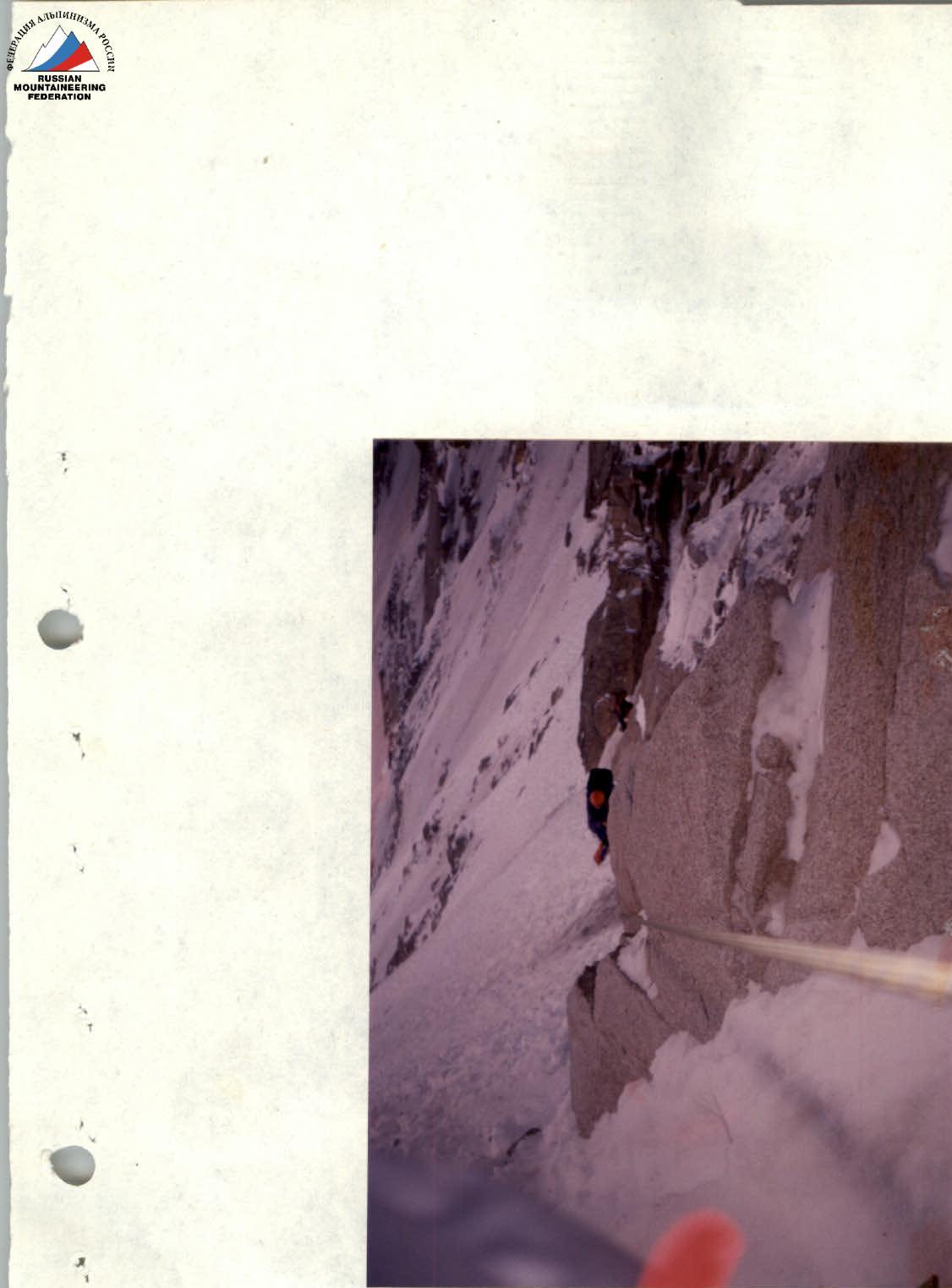
Photo of sections R7–R9
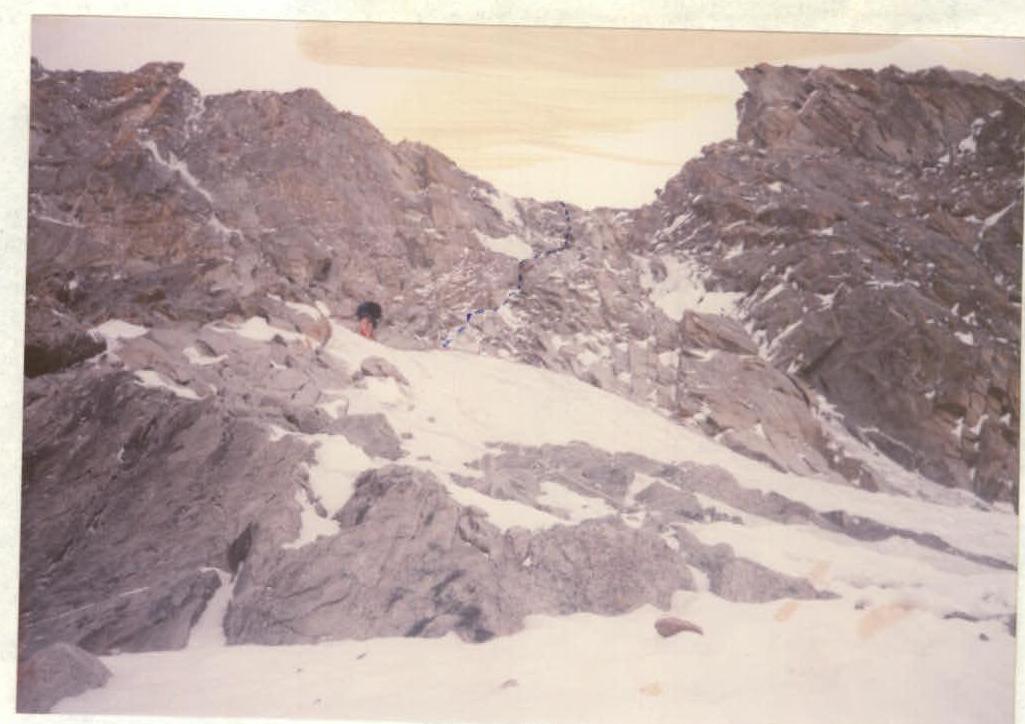
Photo of sections R6–R11


Comments
Sign in to leave a comment