
Гора Сокол марушт подарочный набор (большая прогулка) 2А
Автор: Иванов Геннадий
В июне 2012 года мы с моей женой Аней побывали в Судаке и совершили восхождение на гору Сокол по марушу с названием «Подарочный набор» 2А–2Б.
Маруш попроще Вилки или ПК в Форосе. Так что, скорее всего, его категория 2А.
Мои коментарии к описанию (курсивом)
R0–R1 35 м: 5с+
- страховка организуется по деревьям и по необходимости — своя.
- Станция на шлямбуре и дереве, на маленькой полке.
Длина участка 45 м, на 35 м встречается первый шлямбур, но станция на 10 м выше.
R1–R2: 25 м, 5Б — простое лазанье с легкой организацией страховки по деревьям и при необходимости своими точками.
Станция на полке на дереве.
R2–R3: 50 м, 5C — от дерева влево вверх через небольшое нависание, потом по удобным для страховки щелям забирать направо.
Станция на огромной полке на дереве.
R3–R4: 50 м, легкий траверс вправо по полке мимо деревьев. Станция на дереве.
На участке есть спуск вниз. Шли со страховкой.
R4–R5: 50 м, 4C, траверс полки с постепенным подъемом на седло. Станция на дереве с левой стороны седла.
R5–R6: 50 м, 5C+
- Пройти через небольшой кусочек зеркала
- Перейти на щель над разрушенным участком породы
- Выйти на дерево
Страховка организуется легко. Станция на дереве. Эта верёвка совпадает с верёвкой «Единички».
При прохождении разрушенного участка старались его не нагружать. В целом участок проще, чем 5с, пологие скалы, скальники стоят на них как влитые.
R6–R7: 25 м, 5а:
- По полке направо
- Потом по щели на плато
Совпадает с «Единичкой». Станция на плато на маленьком
можжевельнике.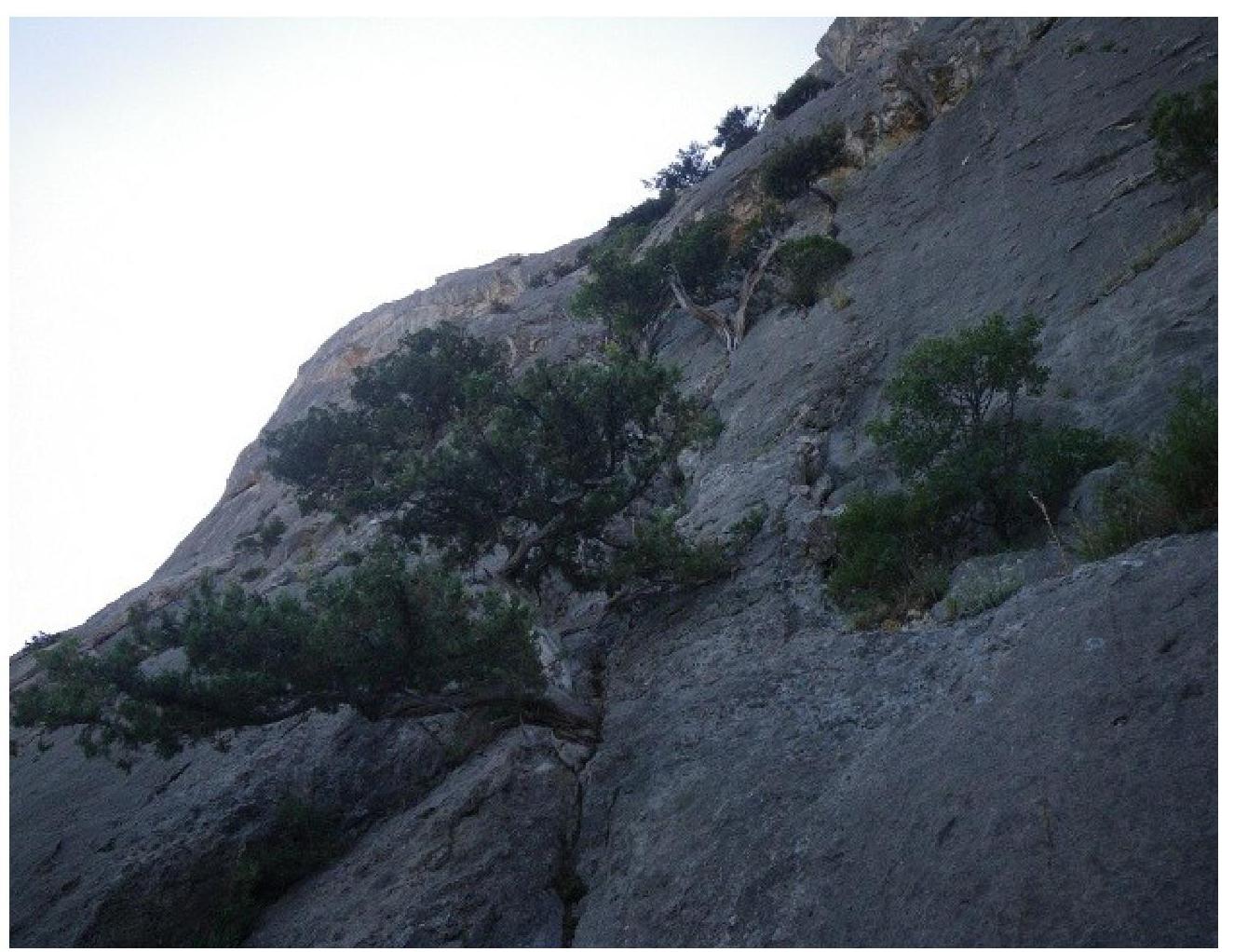
Первая верёвка
маршрута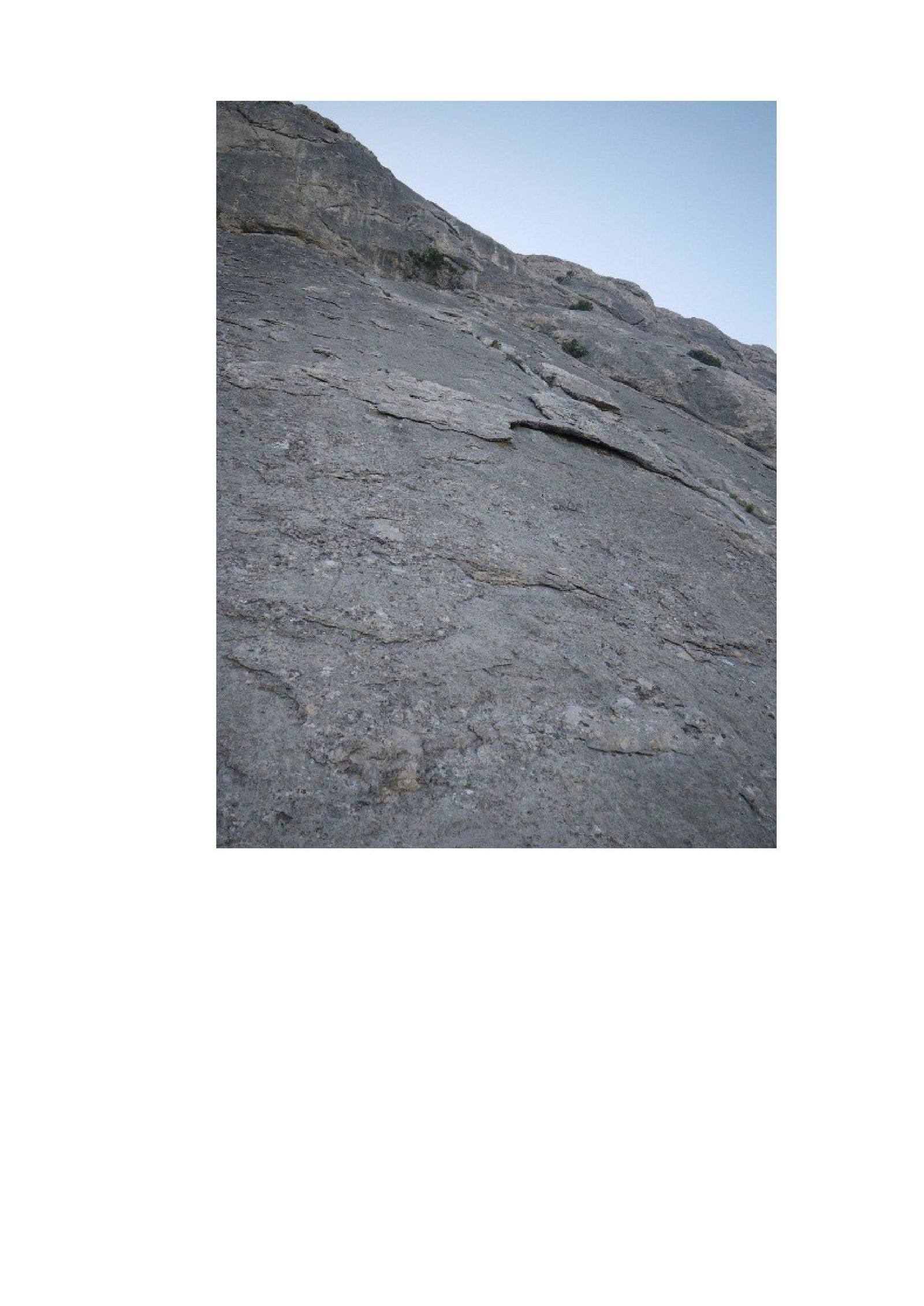
1. Introduction
This document provides an overview of the key concepts and methodologies used in the study of quantum mechanics. It covers:
- Fundamental principles
- Mathematical formulations
- Practical applications
2. Fundamental Principles
2.1 Wave — Particle Duality
Quantum mechanics introduces the concept of wave — particle duality, where particles, such as electrons and photons, exhibit both wave-like and particle-like properties. This duality is central to understanding quantum behavior.
2.2 Superposition
The principle of superposition states that a quantum system can exist in multiple states simultaneously until it is measured. This is mathematically represented by a wave function, denoted as |ψ⟩.
2.3 Uncertainty Principle
The Heisenberg Uncertainty Principle states that it is impossible to simultaneously know the exact position and momentum of a particle. This is expressed as: Δx ⋅ Δp ≥ ℏ/2 where Δx is the uncertainty in position, Δp is the uncertainty in momentum, and ℏ is the reduced Planck constant.
3. Mathematical Formulations
3.1 Schrödinger Equation
The Schrödinger equation is a fundamental equation in quantum mechanics that describes how the quantum state of a physical system changes over time. It is given by: iℏ ∂/∂t Ψ(r, t) = Ĥ Ψ(r, t) where Ψ(r, t) is the wave function, Ĥ is the Hamiltonian operator, and Ĥ is the Hamiltonian operator.
3.2 Dirac Notation
Dirac notation is a convenient and convenient way to represent quantum states and operators. It uses bra-ket notation, where a quantum state is described by a quantum state, and bra-ket notation is used to represent quantum states and operators.
4. Practical Applications
4.1 Quantum Computing
Quantum computing leverages the principles of superposition and entanglement to perform computations that are infeasible for classical computers. Quantum bits, or qubits, are the fundamental units of quantum information.
4.2 Quantum Cryptography
Quantum cryptography uses the principles of quantum mechanics to secure communication. Quantum key distribution (QKD) is a cornerstone of quantum computing, where key distribution (KDD) is a subset of classical computers.
5. Conclusion
Quantum mechanics is a cornerstone of modern physics, providing a framework for understanding the behavior of particles at the smallest scales. Its principles have led to groundbreaking technologies and continue to inspire new research and development.
6. References
- Griffiths, D. J. (2005). Introduction to Quantum Mechanics. Pearson.
- Shankar, R. (2012). Principles of Quantum Mechanics. Plenum Press.

Комментарии
Войдите, чтобы оставить комментарий